
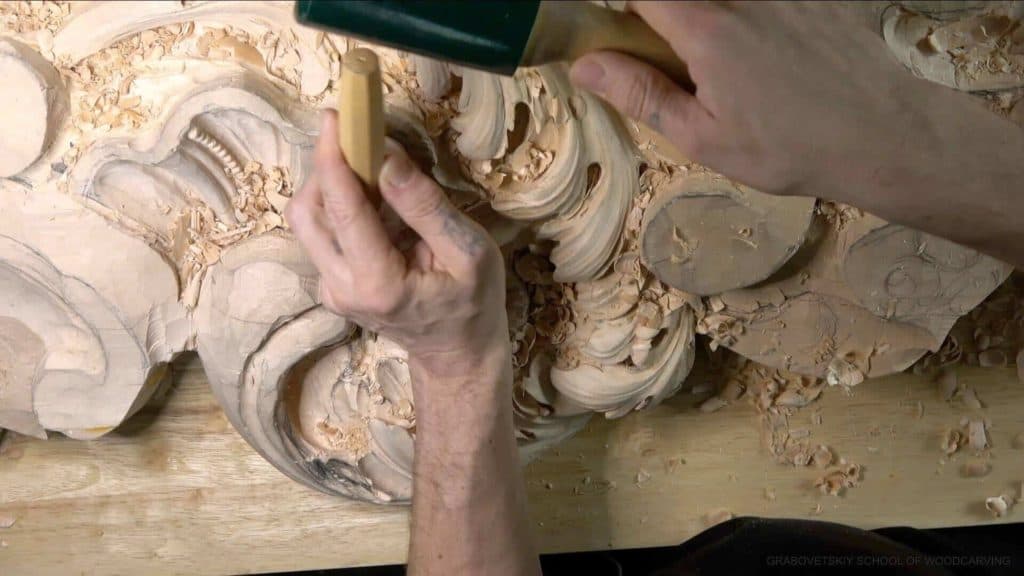
Alexander Grabovetskiy, woodcarver, School of Woodcarving · Published 2020
How do you know when a deep hollow is deep enough for the shadow you want?
Quick answer: Deep enough is a call I make at the wood, and in Venice Room workshop 16, part 4, I made it (07:40). I kept checking, floated an 11 for deeper shadow, and then thought the hollow was enough.
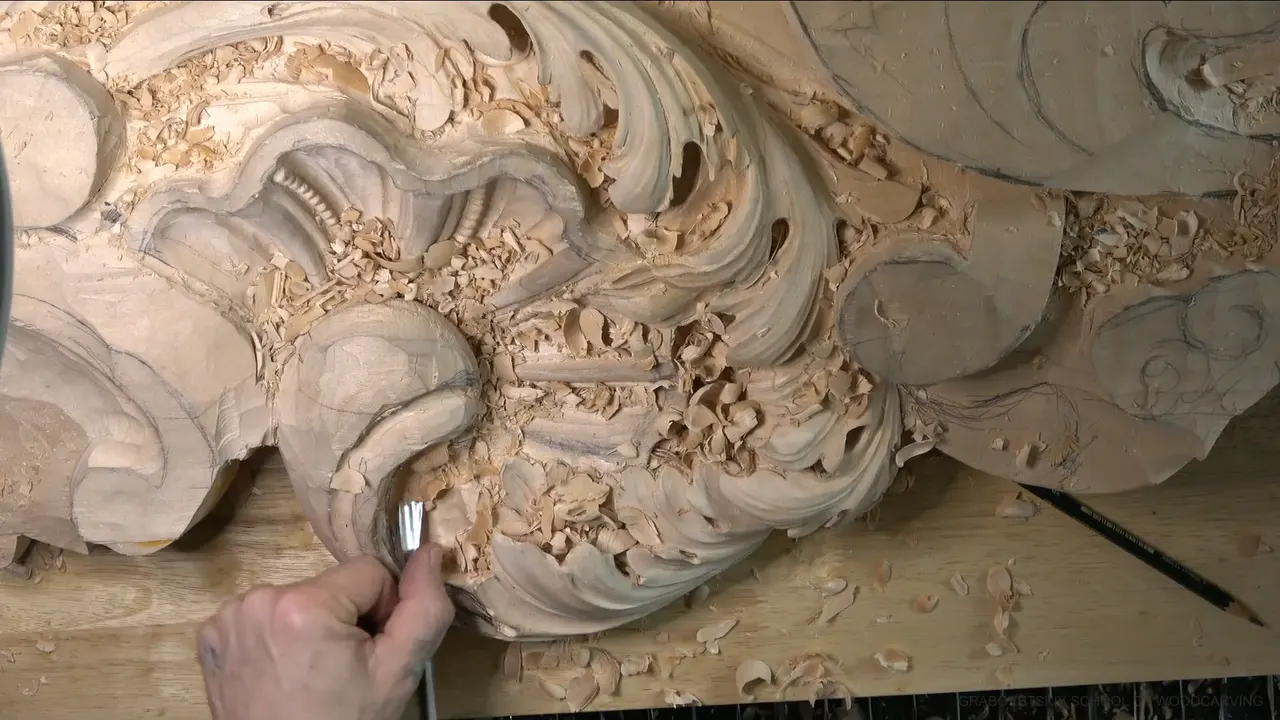
A hollow is deep enough when I say so, and in part 4 of Venice Room workshop 16 I said it at 07:40. My words were "I think it is enough" (07:40). They came after a long string of checks and three gouge sizes I named out loud.
Do you ever dig a hollow, stop, and wonder whether one more pass is needed? Would it help to watch a carver who checks again and again and admits he could overdo it? Ten minutes of that are in part 4. Around it, I'll set out how I said "deep enough" in other lessons.

What part 4 shows about digging a deep hollow
- A number eight was not enough, so I moved to a number nine (00:14, 00:25).
- Three sizes of nine came up in a row, and I named each one as I went (00:58, 01:11, 02:05).
- I kept checking (01:57).
- Next came a deep excavation, for a deep shadow (06:38).
- Number 11 took over at 06:58.
- Enough came at 07:40, and a ground base followed (07:51).
Which gouge did I start the deep hollow with?
The video opens on a verdict. "Number eight is not enough" (00:14). One way out was to continue with the number eight but a smaller one (00:16), and I said that first. I changed my mind next: "But I think I should switch to number nine" (00:25). A straight nine went in first (00:31).
Three sizes follow. My first figure was 16 millimeters, about 5/8 inch (00:58), and I was constantly checking what was going on inside (01:01). Next I needed the spoon number nine, half an inch, about 13 millimeters (01:06, 01:11). By 02:05 it was three-quarter of an inch, 20 millimeters, number nine.

The sizes did not climb in a straight line: 16, then 13, then 20. Back in part 2 of this workshop I had said I couldn't go more than three quarters of an inch (07:02 in that part). That figure returns in part 4, next to a number nine.
How often did I stop and look?
Over and over. I said it plainly at 01:57: "I'm just checking and checking and checking, okay?" The reason came right after it. There is always a possibility to overdo it (02:02).
These words came back at 03:59, said in a row: "But got to check. Cannot overdo it" (03:59, 04:01). Then came a warning about the tool itself. At some point it would not be sufficient for me (04:14).

Between 05:32 and 06:38 the captions go quiet, so I won't describe those minutes. Just before, at 05:24, I had said I was still able to work the nine and make it a little more round. When the captions pick up at 06:38, the hollow already has a name.
Why did I trade a number nine for an 11?
My answer is on camera. If you asked me what the difference between nine and 11 is, I said at 03:29, I would say that number nine is a half round, and I am digging with the corners (03:36). The 11 is more like a U shape, and I use one of its sides to clean the upper part (03:41). So the 11 gives me a cleaner cut (03:49).
Yet at that moment I was still using the nine (03:52). Earlier, at 02:24, I had hedged: probably time for number 11, or for a smaller number nine first and then the 11. The real change came at 06:58. I really wanted to see an even deeper shadow in that area, and that was the reason I gave.

A similar preference turns up in workshop 44, part 12. There I said I needed the bigger number 11, because with it I'll be able to create a cleaner and faster cut (05:10). I probably should use a mallet too, I said, since with the mallet I'm always gaining a lot more control (05:37, 05:44).
What did I say at the deepest point?
"Really deep excavation for just a deep shadow" (06:38). Then, "So that is what I am trying to do" (06:46), and once more, "Really deep excavation" (06:55). Three seconds later I said I probably had to go to number 11, because I wanted a deeper shadow still (06:58).

I called a stop (07:40), and in the same breath planned something else right there (07:44, 07:47). No figure comes with it, only my word that it was enough, said once in the captions.

What came after I called it enough?
A ground base came first. "I want to create a ground base right in this point" (07:51). I did not explain the phrase, so I won't. Then, at 08:15, I could probably work on details on the inside.
One of the separations would go all the way from underneath (08:26). I wanted a main movement right there (08:38), because it has to be the big chunk together (08:48). That point had to land underneath (09:01), following the main movement (09:05).

I took a smaller number nine and excavated a little of that mass (09:15, 09:21). Carefully, I outlined it and set it in, approximately (09:32, 09:36). "Just approximately" (09:53). Last came "Let me relieve that triangle right at separation point" (10:06), and then "Remove that plug" (10:16). The final caption line sits at 10:42.

Why was the shadow worth so much digging?
Time after time, I gave one reason: the inside would be visible from the bottom. You hear it in part 2 (02:30 in that part), in part 3 (04:01) and in part 6 (03:22).
In part 7 I thought about the light at night. If it comes from the ceiling, I said, I really want to see that exaggeration, that shadow (01:32 in that part). In part 8 I said a deep excavation was needed because it would be visible when you look from another part of a room (01:00 in that part). There I considered a bigger excavation than 3 millimeters (about 1/8 in), maybe a quarter inch, 6 millimeters, for a lot better shadow (01:42, 01:45 and 01:57 in that part).

How did I judge depth when a hollow felt too shallow?
Open workshop 62, part 7, and you hear me call a pipe visible, but not deep enough to suit my taste (00:27). A little deeper was needed, because it was really important for me to cast some shadows, and right then it still didn't (00:43). Maybe I would just establish my depth with the back bend (00:49, 00:54). That way I would know where the depth should sit (00:59, 01:01), and a moment later I had the preliminary depth (01:10).
That back bend was a number eight, I said, three-eighths of an inch, 10 millimeters (01:14). Next I needed a number 11 and seven, the same as I used before, to continue my cut around (01:27). Destroying previous cuts was okay (01:54). I was still establishing what was good (02:00).
Hashemi lesson 41, part 1, has a leaf that still had to go even deeper under another one (03:08, 03:12). I took the V-tool again to make it deeper (03:14, 03:19). "But still have to check how deep I can go" (03:28), I said, and then I could use the number 11 again, to create even deeper shadow (03:35, 03:40).

Go to workshop 128, part 1, and I am looking back at a number 11 at 7 millimeters (a little over 1/4 in) (00:06, 00:10). I could actually go deeper in this case, I said (00:12). I think I could go with 10 millimeters (about 3/8 in), which would give me even more shadow (00:16, 00:22). I really needed deep shadow right there (00:24). Seven millimeters came up next, then a correction: probably jump right on the 5 millimeters (about 3/16 in) (00:40, 00:45).
When did I stop digging and call it enough?
In my Furniture Panel course, lesson 20, part 5, I took a number 11 veiner and outlined a semi-deep spot (14:57, 15:08). I went deeper (15:31). The words came at 15:47: "I think it is deep enough." Losing the detail was no worry, since I would reestablish it and knew exactly how it should look (15:58, 16:04).
Floral and Molding lesson 13, part 2, has me excavating a little deeper and getting a little closer to the line (07:46, 07:51). "I'm not going to go deeper than that" (08:01). Deep enough, with a really beautiful shadow cast: that was my verdict (08:04, 08:08). I kind of liked it (08:11).

Hashemi lesson 45, part 7, has a smaller version of the same call. I used the 11 at one millimeter (about 0.04 in) (00:58, 01:03). I liked how deep it was right then and said, "Let me keep it" (01:21, 01:27). "It does create enough shadow" (01:29).
Back in workshop 44, part 12, I went around with the bigger 11 and said, "That's probably deep enough. I don't want to go too deep" (05:59). I repeated it at 06:03 and added that too deep would not be good (06:06). I also liked how high the upper part was, and I would most likely keep it that way (06:17, 06:20).

What did I say when I held back on purpose?
Look at workshop 38, part 5, for a smaller number 11, maybe about 3 millimeters (about 1/8 in) or even 2, and I tried the 3 first (06:49, 06:56). Depth had a limit there, because I did not want to create too weak a detail (07:12). I wanted it deep enough for the shadow to cast (07:19).
In workshop 74, part 1, I held back. A spot stayed shallow, because I did not want a too deep shadow there (04:53, 04:58). That would be a little too distracting, so I didn't really need to (05:01, 05:06).

Workshop 69, part 11, shows a rotation movement and a dig (00:08, 00:12), and it ends with a pretty deep hole inside (00:55, 01:00). I was leaving about 10 millimeters of space, nearly 3/8 in, between the upper point and the lower, like a ceiling of my future dome (00:16, 00:25). Not much depth was needed, only deep enough (01:01), and I asked how deep I had got (01:05). The answer was maybe about 20 millimeters, like 3/4 inch (01:08, 01:12). "That's going to give me a shadow that I'm after" (01:29).
| Where I said it | What I was digging at the time | The figure |
|---|---|---|
| Part 4 of 16 | Digging with a nine, then an 11 | Twenty millimeters |
| Lesson 62, part 7 | A pipe that was not deep enough yet | Three-eighths inch |
| Venice 69.11 | A hole left open under a future dome | Maybe 20 millimeters |
| Venice 128.1 | A hollow that could still go deeper | Ten, then five |
| Hashemi 45.7 | A tiny number 11 line I decided to keep | One millimeter |
The table gathers the figures I said in these moments, and each row has shadow close by.
How do I dig deep with small tools?
In Floral and Molding lesson 13, part 3, I had a one-millimeter (about 0.04 in) number nine, a really small, tiny spoon (04:28, 04:31, 04:35). Half a millimeter (about 0.02 in) was the next size, I said, which would be the number 11 veiner (05:11, 05:16). I also wanted to excavate a little deeper inside (05:24). "Really, really deep shadow. Can you see how deep shadow that is?" (05:34).

Roman Acanthus lesson 12, part 3, has a number seven back bend, about 3/32 of an inch at the end (about 2.4 mm), and with it I could dig really deep (01:33, 01:41, 01:45). Nothing was in my way, and I could create a deep shadow (01:54, 01:58).
In workshop 54, part 11, I said a couple of spots had to be very deep (04:00). The nine is always a half round, I said, a true one, and if you rotate it, it makes a perfect round (04:51, 05:00). Without pressing too much, I removed small plugs (05:04, 05:13), and I could drill it as deep as I wanted (05:20). Once I said "I'm after deep shadow" (05:37), and again at 05:40.

One plug was about six millimeters, about a quarter inch, and it took a couple of seconds (06:31, 06:34). Workshop 16, part 6, also shows plug cutting, with a nine at a quarter inch, and I got about 5/8 of an inch (about 16 mm) in (00:41, 01:47 in that part).
What could you try on your own piece?
Here is the order I followed in part 4: a number eight that was not enough, a number nine in three sizes, check after check, a number 11 to deepen the shadow, and then "enough." Which of those steps does your hollow still need?
This video is one of twelve in workshop 16, and the course page is Advanced Carving: Venice Room, Part 2. The craft is wood carving, a branch of woodworking. A gouge belongs to the chisel family, and a mallet drives it. A relief is carved on a flat background, and an acanthus leaf holds shadow in its hollows. The fibers I talk about are the wood grain. The room is in the style of Venice, and my sizes are in millimeters and inches.
Which hollow on your piece is waiting for one more pass?
How it's done
- Name the gouge that is not enough. Part 4 opens with a number eight that is not enough, so I went to a nine (00:14, 00:25).
- Pick the next size and check. I used a straight nine, then a spoon nine, then a bigger nine, looking inside each time (00:31, 01:06, 02:05).
- Keep looking inside. I checked and checked, because there is always a possibility to overdo it, I said (01:57).
- Reach for the 11. I changed to the 11, since I wanted more shadow there (06:58).
- Say when it is enough. It was enough, I said, and I moved on to the ground base and the separations (07:40, 07:51, 08:26).
Frequently asked questions
Which sizes did I name in part 4?
I named 16 millimeters at 00:58, half an inch (about 13 millimeters) at 01:11, and three-quarter of an inch (20 millimeters) at 02:05. A number nine went with the last two. Between them I kept checking what was going on inside.
What is the difference between a nine and an 11 for a deep hollow?
A nine has a half-round shape. I dig with its corners. An 11 is more like a U shape, and I use one of its sides to clean the upper part. The 11 gives me a cleaner cut, I said, though I was still on the nine right then.
How did I know part 4's hollow was finished?
The switch to number 11 for more shadow was only a maybe on camera, and then I called the hollow enough. Before that I had called the work a deep excavation. The captions give no figure for it, only my word that it was enough.
What to carve next