
Alexander Grabovetskiy, woodcarver, School of Woodcarving · Published 2020
Should you clean pencil marks off a carving before the final look?
Quick answer: Cleaning a pencil mark is a light pass of a small tool that takes the line off the wood. In this Venice Room video, I cleaned one off, and in other lessons I said where I clean pencil, where I leave it, and what I use instead.
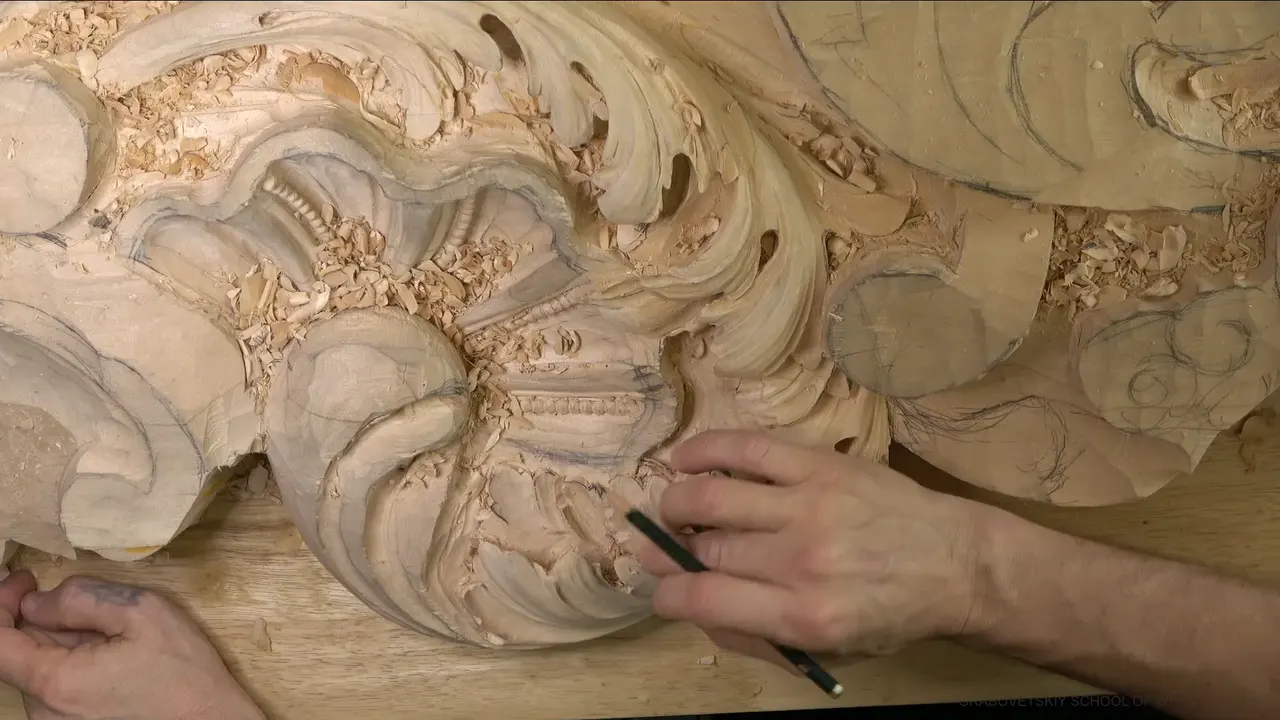
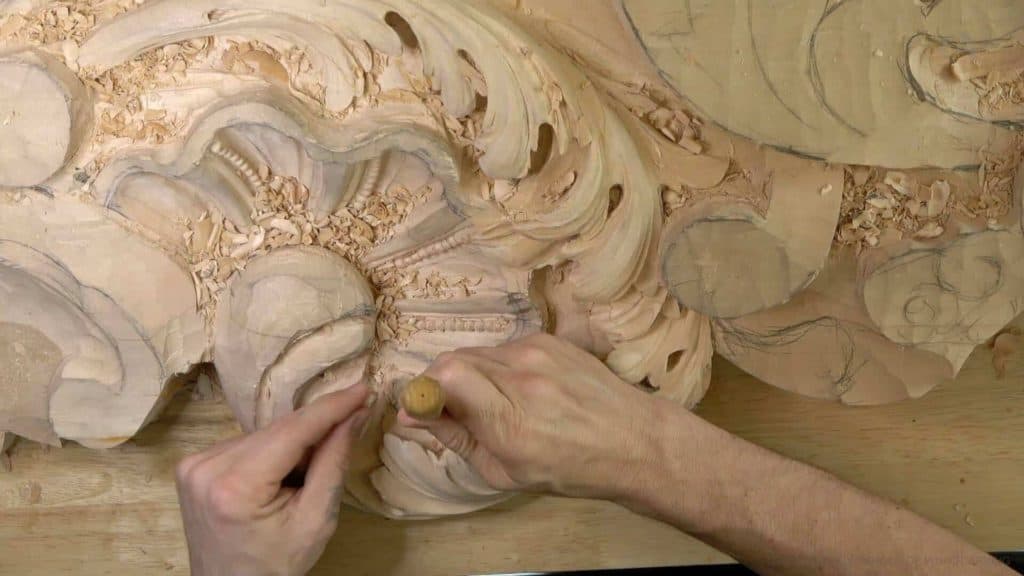
Cleaning a pencil mark is a light pass of a small tool that takes the line off the wood before the final look. Workshop 16, part 1, shows me doing it, because the mark was distracting a little bit from the final look.
This part is short. Its captions stop near six minutes, so I added what I said about pencil in other lessons. Each piece says where it comes from, and the lesson is linked.
Do you draw your design on the wood in pencil, and then carve up to the line? Is it still there at the end, grey across an edge you wanted crisp? I have done that on camera, and I will tell you what I did about it.

What did I do about the pencil mark in this video?
A cleaner cut under a detail came first. I made it with number 11 again, and at 02:23 I said it was actually really good. Next came the mark. "Let me clean little back right here," I said, since the line was distracting.
At 02:40 I said sorry for covering something with my head. "But sometimes I have to, I think," I added. These few lines do not say which tool took the mark off, so I went looking in other lessons.

Why do I try to keep a pencil away from the wood?
Hashemi Flowers lesson 49, part 2, says it most plainly. My pencil was out "just because I'm filming it," I said, and then came the rule: "I try to avoid as much as possible pencil use." The reason followed. The marks and the pencil itself make your carving dirty, so it will not be a clean-looking one.

Lesson 9 of that course carries the same worry. At 05:47 of part 4 I said, "I wish I did not put that pencil mark," and a few seconds on, "I really don't like to use a pencil." At that stage it sat on the wood so you could see what I was doing. Better to leave it off, I said, because it leaves dirty marks.
In lesson 2, part 5, I caught myself in a habit. I outlined with the V tool and a pencil more than once, and I told you that you would probably ask why. To be honest, I don't have to, I said, and I still don't have an answer. Just a habit, I guess. A moment later: it is much better with no pencil at all.
That was not the end of it. Most of the time, I said, I don't use a pencil right on the wood after I started to carve, and then I took it back a little. "I shouldn't say most of the time. Sometimes I still do, but I try not to."
Which lessons say a pencil line is hard to clean up afterward?
Roman Acanthus lesson 14 has the reason, and it is short. Number three was in my hand again, cleaning pencil marks, and from 00:39 I said I was trying to leave the pencil out when I do just the production work, because it's hard to clean and your piece becomes more dirty. At that stage it is better to leave it out, I said. I was using it just to show what I was doing.
Hashemi lesson 7 adds a second angle: in part 7 I wanted to make sure I was not leaving any pencil marks on the piece, because otherwise you have to clean it, and it is just not going to look nice. Two parts back, at 00:38 of part 5, the line was different: if you have an idea, I will not place any pencil marks. I will use my chisels or gouges.
Why did I pick up a pencil anyway, with all that dirt?
The camera was my reason in the lessons above. In Hashemi lesson 43, part 4, I used a marker just because I was filming. Right away I told you not to use a marker, to go with a pencil instead, and at 01:15 came, "Well, I'm not sure if it's better or not." Two seconds on came a third thought: pencil is also not the best idea, because your piece becomes really dirty after too much use.

A plainer admission sits in Furniture Panel lesson 21, part 8. Next I cleaned a mark I created, and I said I usually try to skip the pencil, but I really need to show you what I'm doing. Then: since I started the school, I'm using a pencil a lot, and I think it's already one of my habits I did not have before.
Venetian Flowers Rosette lesson 3 gives it twice. Part 4 has me with too many pencil marks just because I was showing you, and I said those marks don't help. The other half sits in part 1: I drew it in pencil to show it to you, so the mark had to go afterward.

What do I use instead of a pencil?
Back in Hashemi 43 the answer came right after my second thoughts. What you could use, I said, is just a V tool. Use it as a marking tool, make some cuts, and those determine all the divisions. After that came, "But I'll use a marker."
The Roman Acanthus lesson asked for something even shorter. Please try to use a knife for marking, even if you have to mark something, I said, and it will look much cleaner.

The courses do not agree, and I will not fake that they do. On Byzantine Acanthus lesson 9 I put a line back between two eyes in pencil and said: "You're going to clean it, but with the pencil. It's a lot easier than a marker, like I do." Over on Furniture Panel lesson 14 I said I kind of like the charcoal, and then that I should not touch one area with it yet, because it's really hard to get rid of the charcoal.
Which pencil, then? That same design lesson, part 4, has an 8B that I called really soft, and I said any pencil will do, even the hard ones. In workshop 67 I drew with an HB and said, twice, "It's not about the pencil I use." And in workshop 64, part 11, my pencil broke. After a few tries at sharpening it I had my 8B, short, beautiful and not cheap, and I was glad I have a lot of them.
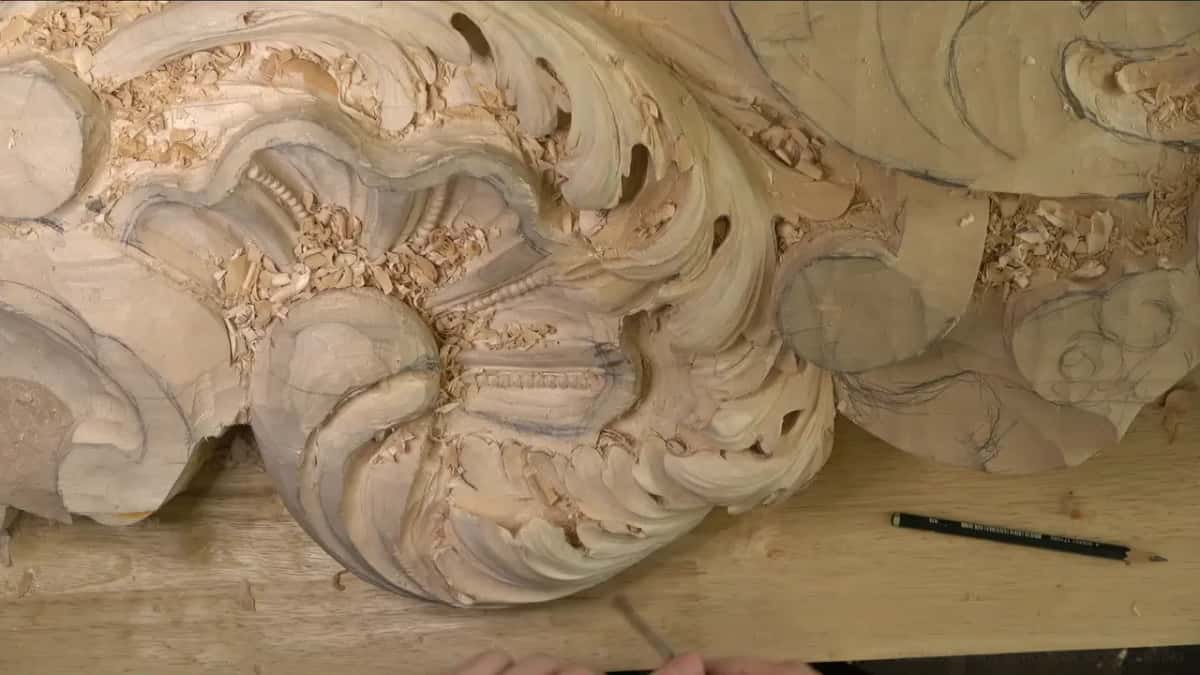
How do I take a pencil mark away from a carving?
I use a small tool and I take very little. The table below lists five of them, and the text after it tells what I said around each one.
| Where | What I took the mark off with | How little |
|---|---|---|
| Roman lesson 14 | I used number three again and cleaned the pencil marks | One gouge |
| Furniture Panel 20 | I went around the pencil mark with a very thin pass | Very little |
| Venetian Flowers Rosette 3 | A spoon gouge took out the mess my pencil made | One millimeter |
| Venice Room 24 | I chose probably just a skew, carefully | Barely shaving |
| Furniture Panel 21 | I talked about sanding it off, or scraping | A cheaper gouge |

Number three did the job in the Roman lesson. A thinner pass sits in lesson 20 of the Furniture Panel, part 3. There the plan was to carefully grab half a millimeter (0.02 in) and go around the mark. That is not a fixed number, I said, since one millimeter (0.04 in) works too.
The rosette lesson shows the clean-up. The pencil had left a mess, so I took a one millimeter (1/25 in) number 11 spoon gouge and took the mess out. "Here you go," I said. "You can see that movement."

Hashemi lesson 15 had a spoon gouge again, for the pencil mark I left for you. Venice Room workshop 24 has me using probably just a skew, carefully. Even when I am cleaning, I said there, I am still taking some material out, but I am barely shaving it.
Sanding came up twice, and the two do not match. Furniture 21 has me ready to sand the pencil away, or scrape it and use a cheaper gouge. In Greek Acanthus lesson 15 I called it "actually just a sanding, but slightly" that takes out the unnecessary marks and dirty spots and does not destroy your carving. Then, at 05:40: "I would not recommend to use a sandpaper." The two lines sit in different videos, and in what I read I found no place where I reconcile them.

What does a pencil mark hide?
A mark can hide the edge, and sometimes you cannot see the true one. Venice 24 puts it bluntly: where the marks sit, sometimes it's impossible to see the true edge, and in my case I did not see it. On Furniture 21, part 6, I wanted to clean whatever mark I have and attack the edge, because then I can see exactly if it needs to be fixed, if it's ragged, or if it's good. A little later I said, "Okay, just the pencil marks. They got to be gone."

It can send your eye the wrong way. Workshop 84 is about the eye: I wanted the mark for the eye gone, otherwise it was going to confuse me. If it confuses me, I'm going to make a mistake, and I really don't want any more.
Workshop 15, part 5, was the same: because of the mark, my eye was distracted and I did not see the crispness. In Floral and Molding lesson 11 I said, in part 3, maybe the mark was a little distracting, and that everything would come to the line.
Clean-up can also show what a shape is doing. Two workshops had the same fix. In 73 I had too many marks, pencil marks, and I needed to take them out so you would understand much better what I mean. In part 12 of 84, I said maybe I have to just clean it, and then it's going to make more sense.
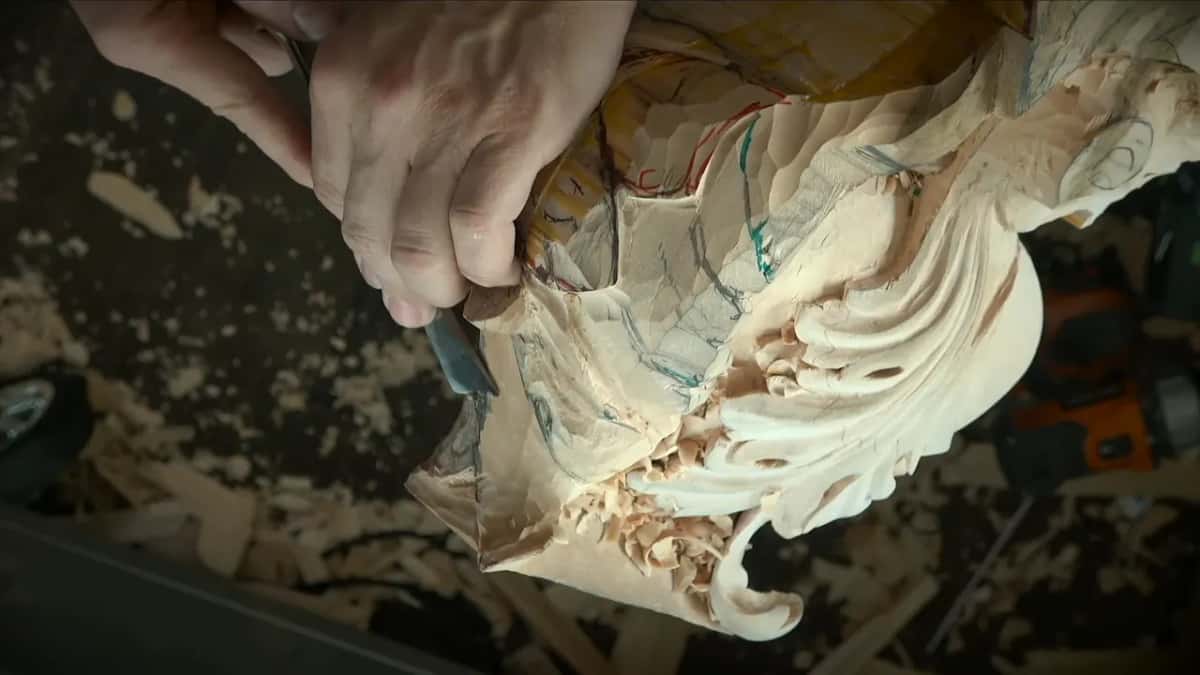
A cleaned mark can move a line. Lesson 19 of the Furniture Panel, part 12, has it: I said the mark had to go, and then: since I cut that pencil mark, I need to make sure my middle line is going to be in the right position. Later I could double-check if I messed up or not. For now it looked okay.
When do I leave the pencil alone?
Once, I picked it up because nothing had to be cleaned afterward. In Furniture 19, part 14, I drew my final look in pencil, because I don't have to worry about cleaning later on. The width was about one millimeter (0.04 in), and all of it was waste.

I also pushed cleaning off camera. Back in workshop 67, part 3, I wished I had not put pencil marks, but it's okay, and cleaning and refining, I said, could be done off camera, so you would not watch hours of it. Cleaning sometimes takes the longest, I said.
Workshop 72 had this: "Don't pay attention to those pencil marks. I'll get rid of them, okay?" For me it is a lot more important how it looks overall, and the cleaning I would take care of off camera.
And in workshop 76, part 7, I said something looked really dirty and that it did not look too good. "That's why I hate pencils sometimes," I said. Then: "Let me clean that little bit."
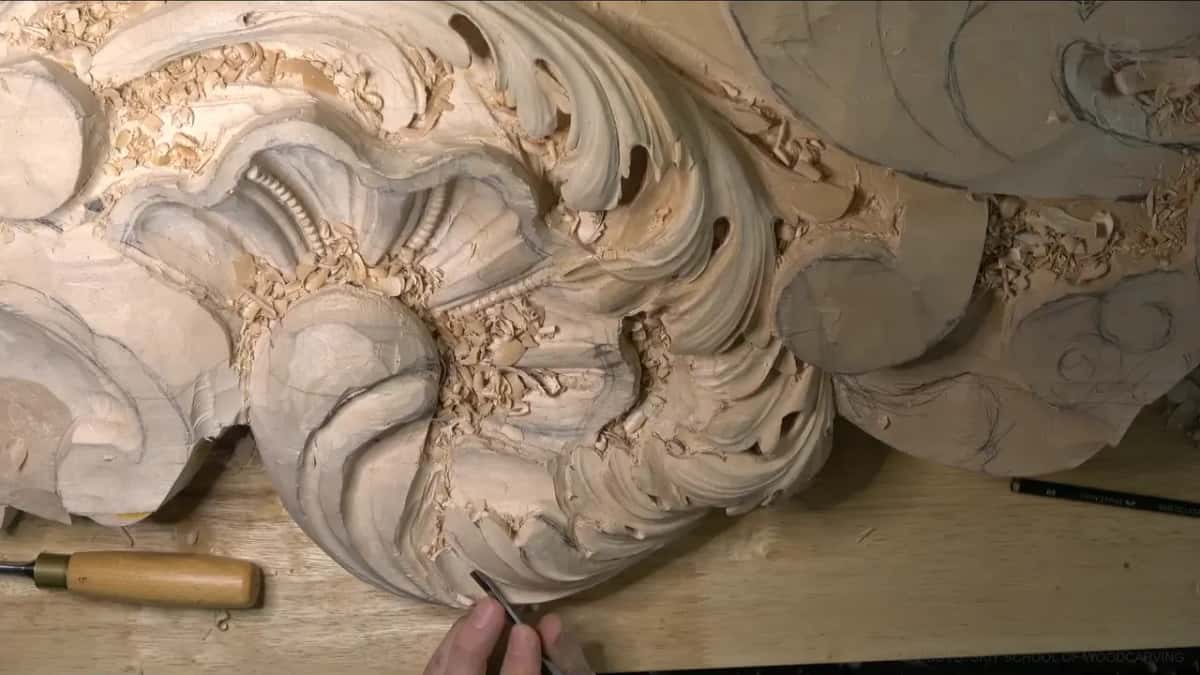
What do all these lessons add up to in the end?
In this video the pencil gets only a few lines, and no tool is named for it. The lessons around it fill in the rest. I try to skip the pencil because its marks and the pencil itself make a carving dirty. I use it because I am filming and need to show you what I am doing, and because of a habit I picked up when I started the school. The clean-up is small, with a small gouge, a skew, a light sanding, or a scrape.
The lines I mean are graphite from a pencil, the charcoal I said is tough to remove, and the marker I use on camera. A marking knife line, a V tool line, and no line at all are the three ways I named to mark. Sizes here are in millimeters and inches, my figure first.
This is wood carving for the Venice Room course, and in part 3 of this workshop I call one piece on the panel the main acanthus head. The whole course sits on the Venice Room, Part 2 page, and all twelve parts of workshop 16 are in the tuition.
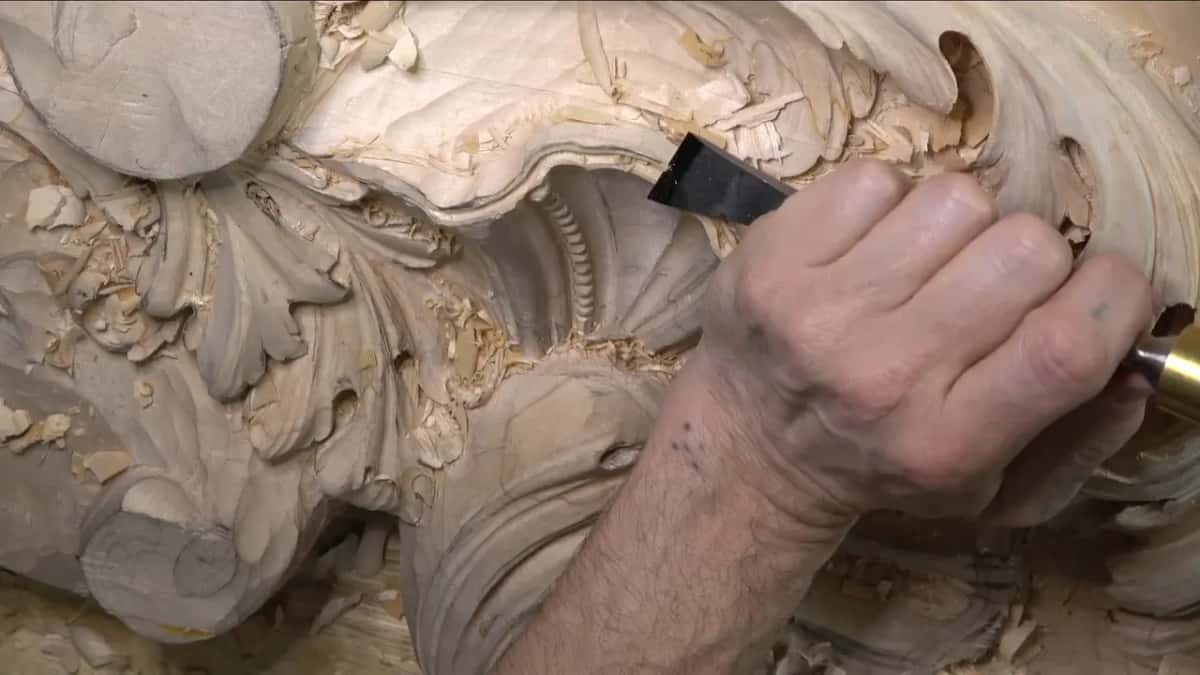
Which pencil line on your piece is still there? Take it off a little at a time, then look at the edge.
How it's done
- Mark with a knife or a V tool. A knife can be the marking tool in Roman Acanthus 14, and a V tool can mark the divisions in Hashemi 43.
- See what the line hides. Venice 24 says pencil can make the true edge impossible to see.
- Reach for a small tool. A spoon gouge, a skew, or number three did the work in my lessons, and even cleaning takes a little material.
- Take almost nothing. Half a millimeter (1/50 in) around the line worked on Furniture 20, and one millimeter (about 1/25 inch) was fine too. On Venice 24 I was barely shaving.
- Check the edge afterward. On Furniture 21 I attacked the edge to see whether it was ragged, needed a fix, or was good.
Frequently asked questions
Do I clean every pencil mark off a carving?
Sometimes the marks stay for later. Furniture 21 wanted them gone so I could see the edge. Venice 72 pushed the cleaning off camera, since the overall look mattered more. And on Furniture 19 I drew a thin line of waste in pencil, about a millimeter wide (1/25 in), because no cleaning was waiting for that line.
Why does a pencil make a carving look dirty?
I gave the result and no cause. Hashemi 49 says the pencil and its marks make your carving dirty, so it will not look clean. Hashemi 9 says the marks are dirty, and Roman 14 adds that they are a chore to clean and the piece gets dirtier.
Which tool took the pencil off in Venice Room 16.1?
I did not say. At 02:23 I only said I would clean a spot because the mark distracted, and I named no tool. Other lessons show number three, a spoon gouge, the skew, a thin sliver, or a light sanding.
What to carve next