
Alexander Grabovetskiy, woodcarver, School of Woodcarving · Published 2020
Should you sand a carving when the customer wants it smooth, or does a good carving have to stay off sandpaper?
Quick answer: Sanding a carving is a choice that changes with the customer, the finish and the wood. An Italian customer wants it like marble, I said, while one from England wants tool marks. On a painted job I used a little paper. In the video for part 8 the question stayed open.
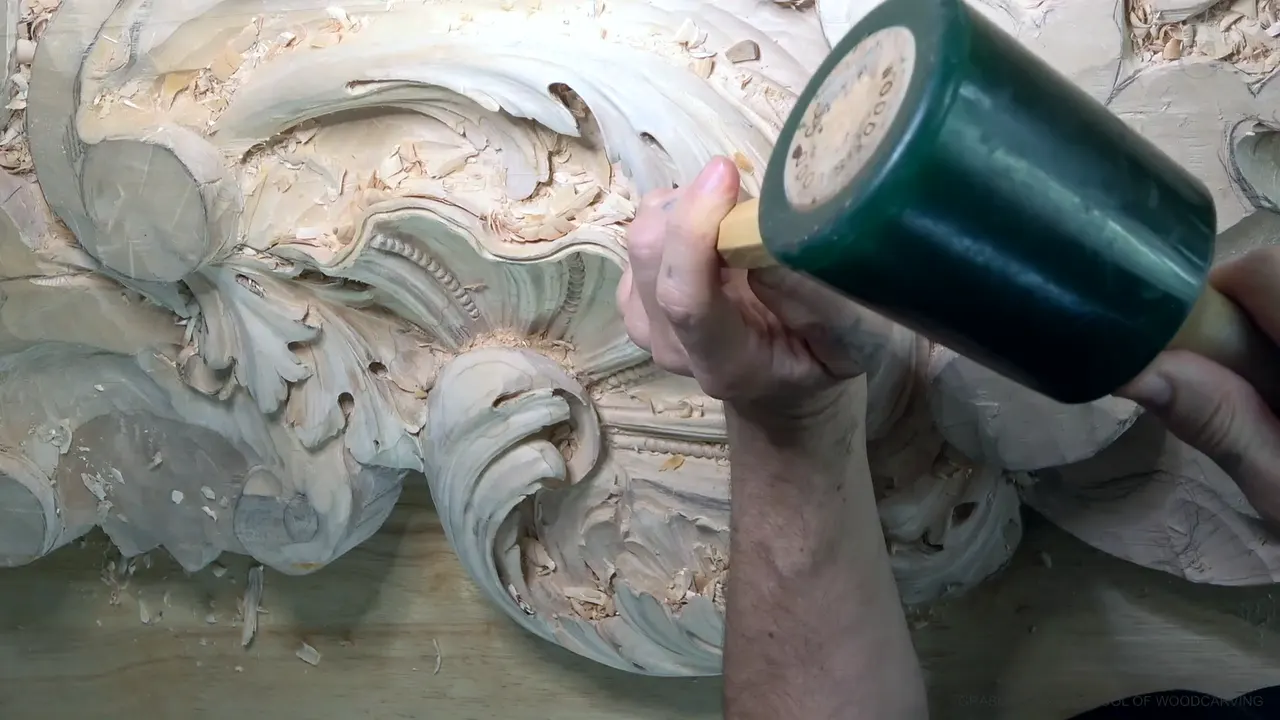
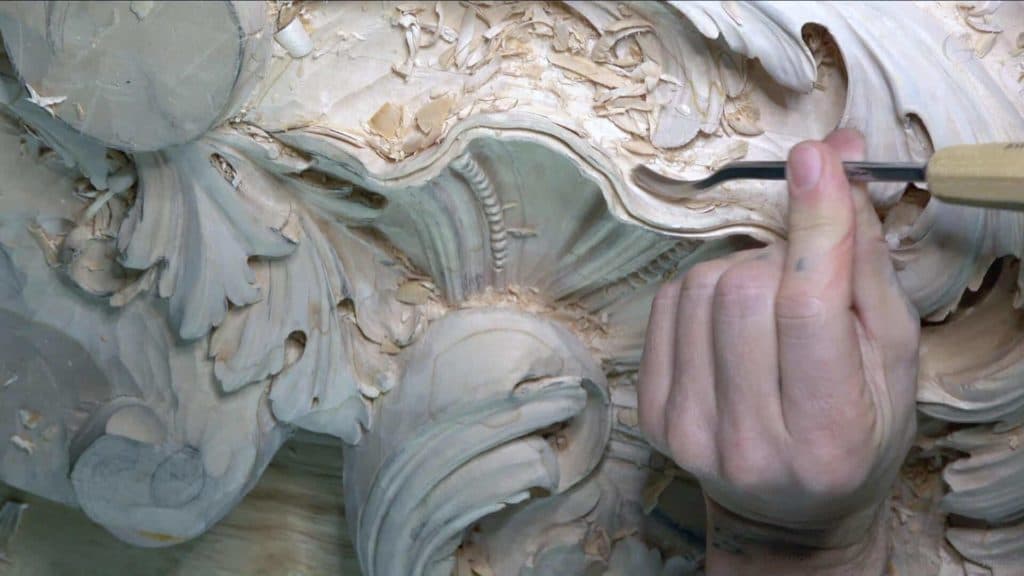
Whether to sand a wood carving is a choice I make for each piece, and it depends on who the piece is for, what finish goes on it, and how much wood is left to push against. I talk it over while I carve in Venice Room workshop 24, and I tell you I had not made up my mind (05:57).
I looked through my other courses for the times I told you what I do about sandpaper, and I put those lines beside this one. Every lesson I quote has its own page, linked where it comes up, so you can hear the words yourself.
Has a customer ever asked you for a carving with no tool marks at all? Have you stood over a finished leaf with a sheet of paper in your hand and wondered if you were about to wreck it? Read on, because I changed my own mind on this, and I tell you where.

Where do my lessons land on sandpaper?
- A customer from Italy wants it smooth, I said, and customers in England want to see marks.
- A painted job got a little paper from me, and in workshop 24 I was still deciding.
- Good grain made me sand a little on a lily flower.
- A knife for scraping or a flatter gouge can smooth a surface with no sandpaper at all.
- Thin wood that moves under the tool is a reason to slow down, whatever the surface will be.
What does the video for part 8 say?
The sanding talk starts at 02:05, in the middle of a careful pass. There are different cultures, I said, and different ideas about how a carving should look (02:12). In Europe, I began, and then I stopped myself. Not in all European countries, I shouldn't say that, because some of them use sanding a lot (02:25, 02:31).
England came next. Most of the carvers there leave more or less rough cuts, I said. I took back the word lots, because not too many carvers are left (02:40, 03:07).

Asia was next. I should mention it, I said, but not Asia in general, just Chinese culture (03:16, 03:25). When you Google Chinese wood carving, I told you, the pictures look gorgeous. You see the famous work. Please note that all of it is sanded completely smooth, and it looks absolutely nice and beautiful (03:31, 03:59, 04:09). That proves the point, I said. If it looks really nice, you could actually sand that, no problem (04:15, 04:21).
Back at the wood, I said I would use a number 11 again, at 5 millimeters (about 0.2 in), and take my time not to force it (04:44, 04:58). Then a line I had not planned came out. I just wonder sometimes why I didn't sand before, I said, and in the same breath I took it back. On some of the works I did a little bit, and it depends on the customer. Some customers really require everything smooth and absolutely polished, almost (05:07, 05:13, 05:20).

This piece got no verdict. Maybe on this one, I said, I should use a little more sanding. On the other hand, it's going to be paint grade (05:35, 05:45). Maybe I still kind of have to decide, I said, and I said it a second time at 05:57 (05:48). Nothing later in the part settles it.
A second voice ran under that talk, and it was about thin wood. At 00:10 I thought out loud that I could probably go a little deeper right there, but I had to be careful, because I still wanted to keep it strong (00:13, 00:17). Seven millimeters (about 0.28 in) was my start, and maybe a mallet would do for that. When I'm pushing in it, I said, it's moving the whole thing, so I have to be careful how I do it (00:45, 00:53, 01:00, 01:04).

I was pretty close to the extreme, and I said I did not want to do that (01:09). At 01:34 I said I could probably use even a straight tool. I said let me use a number 12 at a quarter inch (6.35 mm), and let me see if we're going to be able to get in. Yes, I said at 01:53 (01:39, 01:41, 01:46, 01:53).

At 02:54 the wood moved again. That's too weak, I said, and I wanted no extra stress on it (02:54, 02:58). Near the end the thickness made me worry. No, I didn't want that mistake, a part too weak. I guess I've done it too many times, I said, and from my experience that's not good (06:25, 06:36, 06:43, 06:53, 06:58).

The back of the carving is the last thing in the video. That side won't be visible at all, I said, so all I have to do is make it semi-clean (07:10, 07:17). I told you to look at pictures of the back side of the work of Grinling Gibbons, where sometimes it is actually not too clean at all (07:21, 07:32). Next I said I would try to get to the other side and clean it from the opposite side, probably more accessible for me (07:37, 07:43).
Should you sand a wood carving when the customer asks for smooth?
I follow what the customer likes, I said in my modern acanthus class, and I have customers from different countries (02:53, 03:27). Let's say the customer is Italian. Oh man, they love to sand to death. It has got to look like marble, everything smooth, not even one tool mark (02:56, 02:59, 03:05).
If my customers are from Europe, let's say England or Germany, those guys don't want to touch anything with sandpaper. They want to see all the marks, and it shows authentic. I think both show authentic (03:08, 03:14, 03:21).

In my case I have to just follow what customers like. But usually I try to tell those people, before I sign the contract, that in my opinion it looks better without sandpaper (03:27, 03:39, 03:45).
The same question came up in workshop 12 of the lily box. Should I hit that with the sandpaper or I shouldn't? What would you do? I knew the answer. In Europe somewhere you would say absolutely not, and in the USA you would say oh, yes, sand that and make it smooth. Two different cultures (10:59, 11:08, 11:15, 11:20, 11:29, 11:36).
I fixed it right away. I shouldn't say Europe, because Europe is huge. Go south to Italy, and those people really love to sand everything. England is nope, no sanding allowed (11:50, 11:55, 11:58, 12:28, 12:30). I gave you my hedge too. I'm basing that just on my experience, I said, and I'm not an expert on the cultures. I had seen some sculptures and carving done by Italians, and they looked beautiful (12:02, 12:05, 12:12, 12:19).

Does a painted carving need sandpaper?
Paint changed my answer in a few lessons. For the Venice Room panel, in workshop 10, I told you a sandpaper would do, because the job is paint grade, and anyway I have to sand my first coat, the base coat (02:55, 02:59, 03:03).
In acanthus over moldings I said it is absolutely okay to use sandpaper if you feel like you have to, and I have no problem with that (04:16, 04:19, 04:26). That was a paint grade project. Some sandpaper went on, just to buff the previous ones, not much, because paint would cover it and I didn't want to spend long cleaning my facets (04:29, 04:40, 04:53, 05:00).

Don't get the idea that I use paper all the time, I told you there (05:06, 05:09). For a long time I felt sandpaper was just not really authentic, but I changed my mind a little. It all depends what you're working on, I said (05:24, 05:30, 05:36, 05:39).
At the end of the floral and molding course I said some of what you saw I left somewhat rough. I don't need to take it to extreme, because paint covers it (09:01, 09:05, 09:09, 09:12).

Furniture that will not be painted is different. I would spend a little longer and just clean it, I said, and even if you want to use sandpaper, why not (09:20, 09:26, 09:29). I'm not the biggest fan of the sanding process itself, and I like to leave my work with the facets. But a lot of furniture makers like to make it really smooth, which is absolutely fine (11:07, 11:11, 11:15, 11:19, 11:23).
When does the wood itself ask for a little paper?
Over a lily flower in workshop 11 of the lily box I said there is nothing wrong sometimes with the sanding of your work, because the grain of this wood is so gorgeous (07:07, 07:12, 07:17, 07:20). I wanted to pop a little more grain out. There were too many tool marks, and I didn't want to draw your eye to the tool marks. I wanted to draw it to the grain of the wood and the overall movements (07:31, 07:47, 07:51, 07:55).

Please don't hate me for that, I said. Some of you really don't like the idea of sanding, and I really don't like to sand also. But sometimes it just makes sense, especially on a beautiful wood like that (10:11, 10:15, 10:19, 10:21, 10:24). Later I said I hoped I would not put stain on it, because that all depends on the client, and I don't want to destroy the beautiful movements of the grain and the play of the colors of that olive wood (10:58, 11:04, 11:12, 11:19).
I used a 220 Festool paper from one of my sanders there, and later a 320 automotive paper. A flat piece gets sanded with the grain, I said, but here that was almost impossible, because the grain goes in all directions (13:12, 13:15, 17:14, 17:22, 14:13, 14:17, 14:24).

A small flower in workshop 12 of the same box gave me a second reason. The flower looked really good without any sanding, I said. But if I hit those ridges a little bit with 320, I'm not really destroying them, just giving a smoother light travel (12:35, 12:39, 12:44, 12:48, 12:51). I'm not talking about speed. I'm talking about how light hits the surface, travels on it and creates the shadows. Leave all those hard ridges, and it has a bumpy ride, a ridgey light travel (13:02, 13:07, 13:12, 13:16, 13:27, 13:32, 13:52). The form is still there, I said (14:16, 14:22).

The Italian question has a history side too, in Venice Room workshop 9. Probably I could use sanding, because it's Italian style. Greek and Roman cultures really like smooth surfaces, I said, and they worked with marble and stone, so you never would see any rough marks (02:33, 02:40, 02:51, 02:55, 03:03, 03:06). With a little bit of sanding it would be even more authentic to the original, I think. I don't have to, but I think I can create an even better look that way (03:40, 03:42, 03:46, 03:52, 03:57, 04:00).

How do I smooth a carving when I would rather stay off paper?
In workshop 20 of the furniture panel you could just scrape it with the same knife, I said. That's not the best idea, but it's still possible to do it (08:23, 08:27, 08:31). I scraped a little bit. Ask whether it destroys the tool, and I said it absolutely does not (08:34, 08:42, 08:46).
Whatever mark I left, I could scrape away. And we're still authentic, by the way, because we did not use any sandpaper on it. You have to scrape and see which direction is best, and the result is still crisp, much better than sandpaper (09:39, 09:45, 09:47, 09:53, 10:09, 10:12).

The Byzantine acanthus lesson answers a question a lot of people ask, which is how to leave the surface smoother, but not smooth like a sandpaper, which I don't really like (04:02, 04:07, 04:12). If you like to use a sandpaper, I said, I'm absolutely okay with that. But I still love the finish that comes out of the chisel (04:14, 05:13).
The technique is easy, I said. You take a flatter gouge, a number 3 or a number 2, and ride on top of the fibers, attacking from different sides (05:30, 05:34, 05:38, 05:40, 09:03, 09:04, 09:08). Spend another month, I said, and it can look like sanded (09:16).

How did each lesson come out on sanding?
| Lesson | What I said about the sanding there | Piece | What came next |
|---|---|---|---|
| Venice Room 24.8 | Maybe I should use little more sanding | Paint grade | Still have to decide, I said |
| Venice Room 9.3 | Maybe even better with a little sanding | Italian style | Not required, but I think better |
| Lily Box 12.7 | Italian work I saw looked beautiful, sanded | Small flowers | Used 320 grit near the edges |
| Modern Acanthus 7.2 | Everything smooth, not even one tool mark | Customer work | I follow whatever makes them happy |
| Lily Box 11.3 | Sanding sometimes makes sense on beautiful wood | Olive wood | A 220 Festool paper came first |
| Over Moldings 9.2 | I used some sandpaper on paint grade | Painted job | Not much, but I used some |
| Furniture Panel 20.3 | Scraping a little with the knife followed | Upper flowers | Still authentic, no sandpaper on it |
What is left for you to decide?
I can't tell you what is right for your carving. The questions I asked on mine are plain ones. Who is it for? What finish goes on it? How thin is the wood where I want to push?
Part 8 leaves the question open, and I took you through the doubts out loud (05:57). The Advanced Carving: Venice Room, Part 2 course has every workshop. Some of my works got a little bit of sanding, I told you in part 8 (05:13).
How it's done
- Ask who the carving is for. In my modern acanthus class I said customers from different countries like different things, so I go with what they like (03:27).
- Tell them what you think. I usually try to give my own opinion about the sandpaper before the contract is signed (03:39, 03:45).
- Check the finish. Near the end of the floral and molding course I told you I did not need to take it to extreme, because paint covers it (09:09, 09:12).
- Look at the wood. A lily flower had grain I loved, and I wanted to pop a little more of it out, so some sanding went on (07:31).
- Keep the paper light. In another lily box lesson I said I wouldn't do too much, and I used a 320 near the edges (09:59, 19:03).
Frequently asked questions
Does a good wood carving have to stay off sandpaper?
My lessons say it does not. Part 8 of workshop 24 has me saying that if work looks really nice, you could actually sand it, no problem. And in the moldings course I called sandpaper absolutely okay when you feel you have to. My own love is the chisel finish.
What should you tell a customer who wants a carving sanded smooth?
I usually try to give my opinion before I sign the contract, which is that it looks better without the paper. An Italian customer may ask for marble-like work, I said, while one from Germany or England wants to see all the marks. After that I follow whatever makes them happy.
Does paint grade change whether you sand a carving?
Paint grade work in the moldings course got some sandpaper from me, not much, because I did not want to spend long cleaning facets. In this video I weighed extra sanding against paint grade. I said I was still deciding.
What to carve next
- Advanced Carving: Venice Room, Part 2, the course page
- Venice Room workshop 24
- Venice Room workshop 9
- Venice Room workshop 10
- Lily Box workshop 11
- Lily Box workshop 12
- Carving Modern Acanthus, workshop 7
- Acanthus over Moldings, workshop 9
- Floral and Molding for the Panel, workshop 14
- Carving Furniture Panel, workshop 20
- Carving Byzantine Acanthus, lesson 10