

Alexander Grabovetskiy, woodcarver, School of Woodcarving · Published 2020
How do you carve a piece too big to rotate when you can only attack it from one spot?
Quick answer: Carving a piece too big to rotate starts with picking the one spot where you can stand. Part 9 of Venice Room 24 has me saying I could not turn it, so I had to find a side, and my other lessons show what I do next about grain, reach and hands.
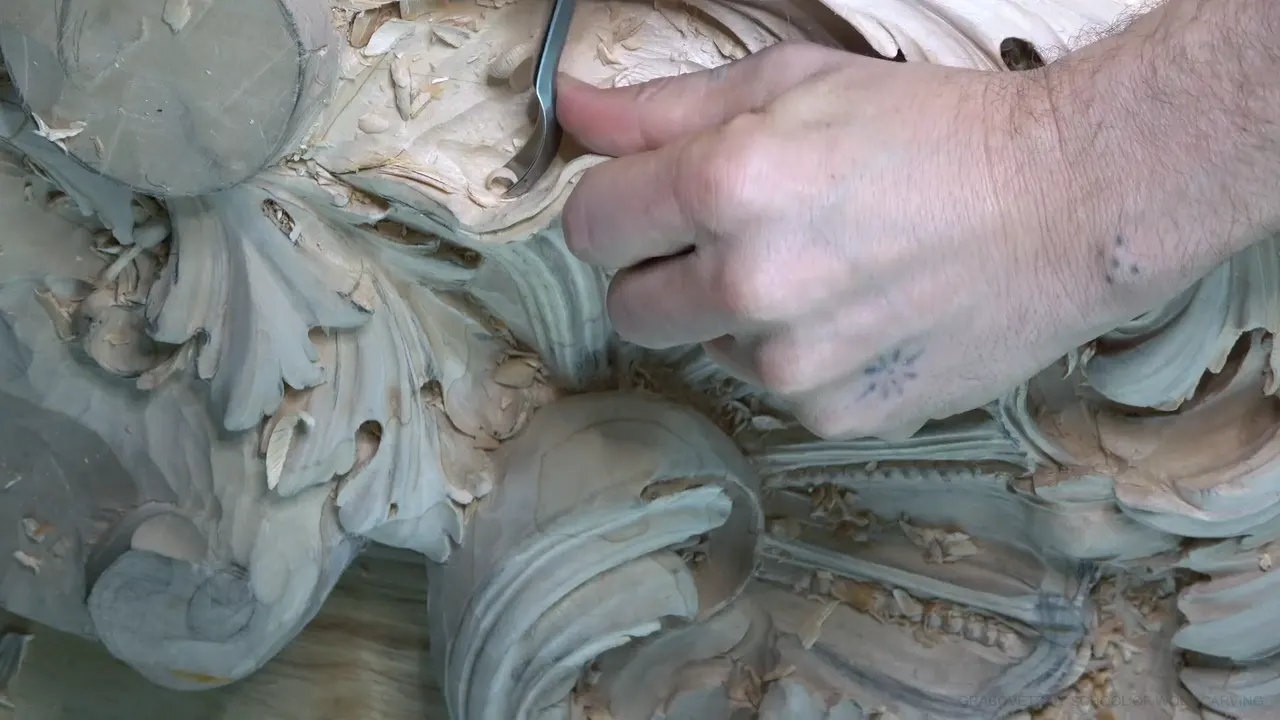
Carving a large piece is carving from the one spot where you can stand, so pick that spot with care. In part 9 of Venice Room workshop 24 I put it this way: "this is a huge piece and there's no way I can rotate" (00:42-00:46). Then I went looking for a location, spot, I should say, position, what side I should work from (00:50-00:59). My other lessons say what that costs and what I do about it.
Part 9 runs about seven minutes, and much of it is quiet work. So I went through my other courses for the times a piece would not turn, and for how I got in anyway. Every lesson I quote has its own page, linked where it comes up, and the numbers in brackets are the times where you hear the words.
Ever stood over a big piece and wished you could spin it on the bench? Did the grain run the wrong way from the only side you could reach? Pull up a stool, then. This is wood carving with a gouge, and what follows is spot by spot, in my own words, for the days when walking around is off the table.

What did I do in part 9 when I could not rotate the work?
The video opens on the problem. "It would be really nice to rotate my workpiece," I said (00:38-00:42). Nothing could be done about that, so I had to choose a side, and I told myself I got to be careful again (00:50-01:05).
At 02:06 I said "let me try to get this side." Next I spoke at 02:45: I'm not going to go deeper, probably, than that, and I really don't need to (02:49).

A cleanup came after. I planned to blend everything from the backside and make it look a little cleaner than it was (02:59-03:07). I stopped myself mid-thought. "I shouldn't say that. I could, but I don't really need it." The reason came right after. Maybe it's even wiser not to do it, because it has to be strong (03:15-03:33).

Which tool for the cleaning? I stopped to think, then said maybe I can try the skew (03:50-03:59). "I can't push it," I said. "I can see that moves" (04:16-04:18). Even the skew was not too convenient for this spot (04:47-04:52).

Next my tool hit a point and knocked it down. A mistake, I said (05:15-05:18). An extra notch, I said, and now it would look done on purpose (05:23-05:44). Fixing that took a different tool, and I planned number seven (05:44-05:50). At 06:01 I said there you go, I've got the extra notch, and called it just extra detail.
It was an indication, I said, that I have to be really careful what I'm doing, which means I was probably rushing too much when I was grabbing my tools (06:13-06:26). Slow down a little bit, I said, though not in work, but just to be kind of careful (06:30-06:43).

Why can't I just walk around a huge piece?
Time is the cost, and workshop 57 is where I said it. A smaller carving would let me rotate the work or circle it and attack from the opposite direction, which would be smarter, and safer (05:42-05:54). Huge pieces are another matter. Circling them? I would spend too much time (05:59-06:10).
A deadline sits in my head, too. Not a real one, I said, but a point where I want the stuff finished, and if I can shave off a minute, I'd rather do that than walk around (06:22-06:33). Only while it's still safe. When safety is a concern, I said no, and I won't save the minute (06:37-06:41).

Hashemi Flowers 47 makes the same split. I could rotate my piece and approach from another side, I said, and that works with a piece like that (09:08-09:17). Then the other case: sometimes I have to work on huge pieces, the big ones, and I really can't walk around or rotate. I attack from just the one point, from where I'm standing (09:21-09:39). That is why I keep developing different techniques, I said: how you attack your piece, and what hand you're using (09:42-09:49). Before that, at 08:29, I had a skew gouge in hand, probably a sweep number five, and I called it really handy in spots like that (08:29-08:46).

How big is huge? Take the corbel in Venice Room 79. Measured out to the edge, I gave about 42 inches (about 1,067 mm), at about nine inches thick (about 229 mm). I called it super heavy and a full 3D movement, and I had two to make (00:08-00:43). On the corbel I said I need to be really accurate with my measurements, and I would probably use just the calipers a lot of times (01:29-01:45). A few templates were glued on plywood about 3/16 inch thick, five millimeters, so I could measure against them (01:45-01:57).

When do I rotate a carving, and when is it out of the question?
Small work gets rotated. Byzantine Acanthus, lesson 2 says to feel what the grain does. If it's working against you, change the position, rotate the piece, and work the opposite direction (00:11-00:15). Should the grain bite, just rotate (01:28-01:31).

A warning followed: don't be lazy to rotate the piece, it's really important (03:19). Sometimes we really don't want to do it. Still, it is a good idea to attack from different directions, especially on the small pieces (03:23-03:33).
The Greek acroterion lesson shows the move in two lines. The grain was working against my cut there, which I called not the best idea, so I said I had to just rotate my piece and carve from this side (08:16-08:20).

A piece that spins gets spun. What is left on this page is for the ones that do not.
What do I do when the grain is wrong and I cannot turn the piece?
Workshop 66 is blunt, and you can hear it in Venice Room 66: "I am carving against the grain." The reason I gave was that I had absolutely no access from the opposite side (01:21-01:33). I tried to see whether I could get in to some degree. Really not convenient, I said, but that doesn't mean it's impossible, and it was still going to look beautiful (01:36-02:06).

Over in workshop 74 I said I am carving against the grain, which is okay, I guess, and that I needed to excavate a really deep hole right here (00:46-00:59). The tool was just the 2 mm number 11 (about 5/64 inch) (01:02-01:06). "Not your convenient spot," I said, yet I wanted to excavate somewhat deep and create that shadow (01:10-01:29). Getting in was almost impossible. Next I noticed a bump left over from previous cuts, and I said I would take advantage of it (01:33-01:58).

Workshop 67 covers the whole job. I can't attack from this side, I said, because the grain runs in that direction. But it's okay. Every project has some areas that are inconvenient, really inconvenient (01:20-01:39). I'll survive. I actually like those challenges, because finding the right angle makes the work really interesting (01:53-02:13).

One more, from Venice Room 81. For a nicer transition downhill I would need, again, probably a 3 mm veiner, number 11 (about 1/8 inch) (03:29-03:37). Then came my verdict on the spot: a really not convenient area, almost scratching, not carving (03:45-04:03).

Which tool reaches a spot I cannot get at from where I stand?
A bent tool, sometimes. Lesson 73 has a number 5, half an inch (about 13 mm), back bend (06:35-06:41). It was going to be a skew, I said, but it doesn't have to be, so don't panic: any back bend will work (06:43-06:52). In my case, I said, the back bend was the only solution, because I do have a bench already. Otherwise a normal tool was impossible to use, and with one I could hit only a single section (06:52-07:18).

Back bends turn up in Venice Room 67.6 too. I had just created a really sharp middle line that I didn't need, and I said I would hit it with the back bend, which I thought was a good idea (04:50-05:06). Straight tools let me down in Venice Room 71 as well. That area was not too convenient for them, I said, so I said let me try just the skew (04:23-04:30).
Is it safe to carve toward yourself when you cannot turn the piece?
I carve toward myself when I must, and my lessons say how I keep it safer. In Venice Room 53 I said, carefully, I need to change the position, and added I'm not suggesting that you do that, because it's breaking the rule: you're usually not supposed to cut toward yourself, because you can cut yourself (04:14-04:28). Lock your hands, put one right on the piece and hold it strongly, and I believe it's safe enough, I said, but I'm not advising anybody to do that (04:28-04:41). I couldn't rotate this piece, and it was probably my only line of attack (04:47-04:54). My tool was a 12 mm number 11, a little less than half an inch (about 0.47 inch) (05:31-05:39). By then one pipe was already visible, and I said I needed to jump and create the second pipe, starting on this side again, carefully (05:14-05:31).

Workshop 57 adds the grip. I'm using my finger to control, I said. I worked as a cranker, or leverager, with my hand placed really solidly (05:09-05:23). I was working toward myself, a little bit dangerous, because that was the only route for excavating (05:25-05:36). I also said I had already developed the skill of controlling the tool without cutting myself, and I almost never cut myself anymore. It used to happen a lot of times, even multiple times in one day (06:45-07:11).
The plainest rule is in Venice Room 67.6. When you can't avoid it, lock your elbows and your hands right on the piece (05:20-05:24). Even if you slip, I said, the hand will not let you cut yourself, and then it's kind of safe, or safer, I should say (05:28-05:42). But if you don't have to cut toward yourself, don't do it (05:47). To be honest, I added, every carver does it (05:54-06:00).

Venice Room 85 brought it up again, with a 7 mm gouge (about 0.28 inch). I would try the seven first, I said, and it was so inconvenient for me because I have to carve toward myself (07:05-07:14). In Venice Room 62 I put the feeling plainly: I really don't like carving toward myself. Although it's okay, I said, I'm able to do that, but it's not really convenient (06:47-06:55). Safety has general pages too, like occupational safety and health, and ergonomics covers how a body and a tool fit together.
How much wood do I take from a spot like that?
Short of deeper was my line in part 9, and strength was the reason (03:31-03:33). Back in workshop 57 I said I can't overdo it at that point, because I'm still going to need some material to create the beads a little later (04:46-04:57).

One line from Venice Room 70 fits as well. No deeper right here, I said, because it's supposed to just wrap, and the deep spot would come in this section, much deeper, but not right here (04:44-04:57).
What did I say about each hard-to-reach spot?
The table puts the lessons side by side, reworded.
| Lesson | Said | Tool | Next |
|---|---|---|---|
| Workshop 24.9 video | Going deeper looked unneeded, strength came first | A skew | Pushing it was not an option |
| Lesson 57.5 video | Circling huge work would eat my time | My finger | Hand set solidly, working toward myself |
| Part 53.8 video | Turning this piece was not possible here | Locked hands | I advise nobody to copy it |
| Video 66.11 clip | The opposite side gave me no access | Against grain | I expected it to look beautiful |
| Clip 73.10 video | Normal tools were impossible for that spot | Back bend | Skew or another bend, both fine |
| Class 67.6 video | Some areas on every project are inconvenient | Right angle | Challenges keep the work really interesting |
| Hashemi 47.9 video | Huge pieces allow no rotating or walking | One point | Techniques develop from that, I said |
What does a huge piece teach you about where to stand?
I do not have one trick for it. The same few habits come back in lesson after lesson. Turn a piece that turns. Read the grain from the one side you have, then reach with a bent tool where a straight one fails. Keep wood where you will want it later, and stay careful. If you want to read around the subject, the chisel and hand tool pages cover the tools. A workbench page covers where the work sits. Woodworking and wood sit behind all of it. The whole course is at Advanced Carving: Venice Room, Part 2.
How it's done
- Try rotating first. On small work I rotate and go the opposite direction when the grain bites (Byzantine Acanthus 2, 01:28-01:31).
- Pick the spot. On the huge piece in part 9 I had to find a location, spot, I should say, position, what side I should work from (00:50-00:59).
- Read the grain from there. From my one side in workshop 66 I carved on, expecting it to look good anyway (01:21-02:06).
- Reach with a bent tool. A number 5 back bend was my only solution in workshop 73 (06:52-07:10).
- Lock your hands. When I must cut toward myself, I lock my elbows and hands onto the work (workshop 67.6, 05:20-05:24).
- Keep wood for later. Strength was my reason in part 9 to say I probably would not go deeper. In workshop 57 I kept material for the beads (03:31-03:33, 04:46-04:57).
Frequently asked questions
Do I rotate a carving when I can?
Small work gets rotated. In Byzantine Acanthus 2 I said that if the grain bites, you rotate and go the opposite direction, and don't be lazy about it (01:31, 03:19). On a huge piece in Hashemi 47 I said rotating was out, so I attack from one point (09:30-09:39).
Why not just walk around a huge carving?
Time, I said in lesson 57.5, because circling pieces like that eats it, and I would spend too much of it on a huge one (06:03-06:10). I'd take a saved minute only while the work stays safe, and a safety concern ends that (06:29-06:41).
Can you carve when no other side is open and the grain runs wrong?
In lesson 66.11 the far side gave me absolutely no access. Not convenient, I said, but impossible it is not, and I still expected a beautiful result (01:21-02:06).
What to carve next