

Alexander Grabovetskiy, woodcarver, School of Woodcarving · Published 2020
How much cleaning does a side of a carving need if nobody will see it?
Quick answer: Cleaning a hidden side is a matter of what that spot does for the carving. In my lessons a hidden side got a light clean, or one small gouge for a shadow, and I held back where more wood off would leave the spot too weak.
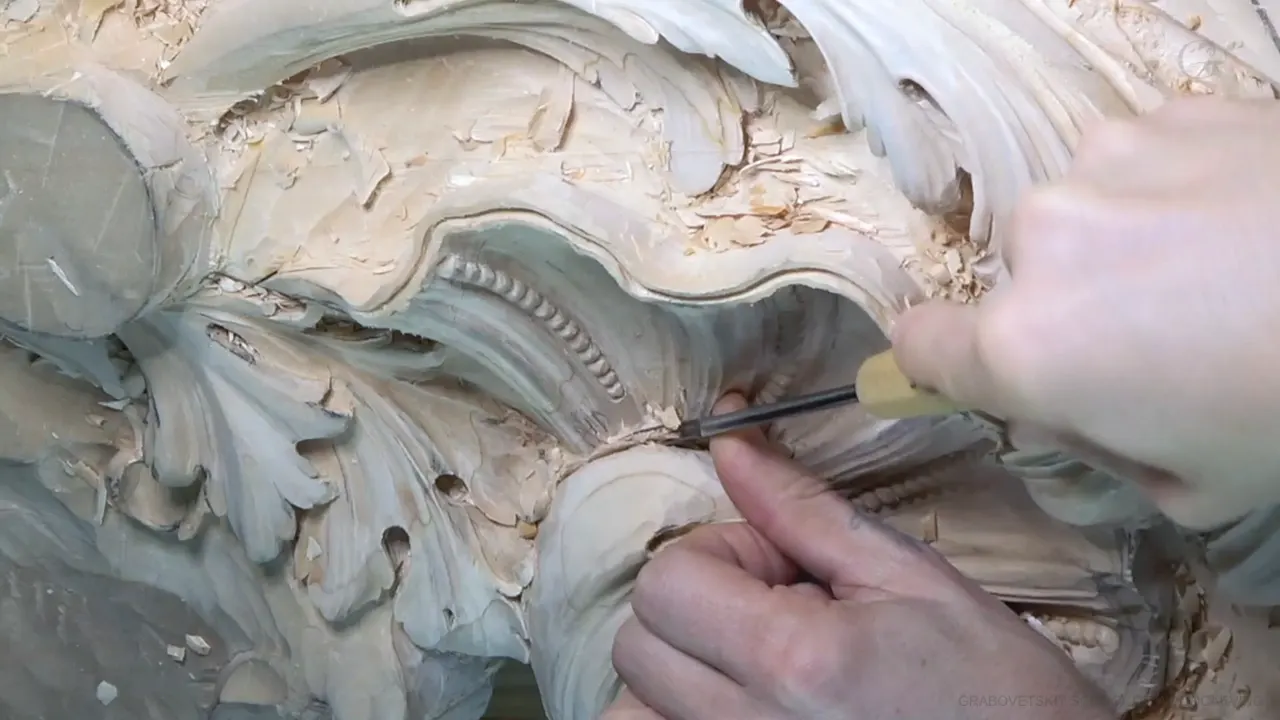
How much to clean a side nobody will see depends on what that spot does for the carving. In part 7 of Venice Room workshop 24 I called it the side which is also never going to be seen, so I had no need to go really deep. Just some cleaning and refining (00:57).
That part of the video is short. So I went through my other Venice Room courses and the rest of the school for the times I called a spot hidden, and for what I did next. Each lesson I quote is linked where it comes up, so you can watch the moment yourself.
Ever wonder how much time a hidden side on a wood carving deserves? Does your back tell you to move on while your hands want to keep going? Then pull up a stool, and I will show you where I stopped and where I kept going.

What did I do in part 7 of workshop 24?
- A number 11 at 4 millimeters (about 5/32 inch) was my first tool to attack from the side, though I said maybe it was a little too big (00:06, 00:17).
- A hidden side only needed a little work, I told you (00:57).
- Maybe a smaller one, like 2 millimeters, could follow a little deeper (02:09).
- For another side I picked a 7 millimeter number 11 and a shallow angle inward (03:38, 03:54).
- Taking my time mattered, I added (04:45).
- Maybe number three came next, and then number seven to get inside (05:30, 06:44).
How far did I carve on the side nobody sees?
Part of the way. My plan was the 4 millimeter number 11, coming in on the side to clean all that stuff out. At the start I admitted that I would not be able to excavate all the way, and that it would still give me a really good start (00:06, 00:21, 00:26). A little wiggle was coming, too (00:41).
At 01:29 I said, see right here, and then that I could probably attack from that side. It was not too convenient, I added (01:29, 01:34, 02:00).

A smaller tool came next. Maybe I needed 2 millimeters (about 0.08 inch) and a little more depth, I said, and I added that this is a number 11, a spoon gouge (02:09, 02:20). Okay, that's good, I told you around 02:57. The small bits could wait, even off-camera, because in the previous segments I had shown how to do them (03:00, 03:10, 03:17).

The next wall got 7 millimeters on a number 11 as my starting plan (about 0.28 inch, which I called a little bigger than a quarter inch, or 6.35 millimeters). I planned to go a little inward, not much, and I said I really did not need to undercut there (03:38, 03:48, 03:54, 03:58).
Does the camera show what a viewer standing below will see?
That depends on where the camera sits. I asked you to understand my camera position, a little farther away and looking from that side, which is why you see this wall on the video. From where I stood I did not see it at all, I told you, and from underneath it stayed out of sight too (04:01, 04:16, 04:20).

Workshop 14 has the same habit. I worked on the side of my pipe and said it needed a cleaner pass, then explained that this camera or any other one will not show it, but from below it will be visible. I called it a really nice sweep (03:42, 04:10, 04:18).
My goal in workshop 17 was to see from one position below the piece, and to picture what would be seen, what would be missed, and what would throw a shadow (00:21, 00:31).

A short one comes from workshop 12. We have to look from down, I said, so the viewer misses that overlap anyway, and then I said, take this one down (08:01, 08:09).

The viewer shows up again in Venice Room 56.2. An eye on that side, which you don't see, would still show from underneath, I said. Showing it matters a lot to me, I added, not for you, but for the people who meet the piece in real life (00:09, 00:14, 00:24, 00:30).
Is carving the part nobody sees worth the time?
At times it is, and the reason is the shadow. One area in Venice Room 99.12 I called somewhat forgiving, because nobody sees it. But still, I said, I'll try to get that clean (05:30, 05:37, 05:43). A bigger tool went in next, and I pointed out that it already casts a shadow and gives a more beautiful look (05:49, 05:55).

My reason was plain. In the daytime it matters, I said. At night the light shoots from above, so you lose it, but in the day, or especially in the morning, it gives a beautiful effect. At least I hope so (05:59, 06:04, 06:18). That hedge stays.
I checked depth in the same pass. About an inch deep (about 25 millimeters), so it's plenty, I said, since otherwise it would be a problem for me to carve (05:14, 05:19). Earlier I said maybe I was able to go much deeper for the shadow's sake. On the other hand, overcomplicating it was a risk, because a bead molding was coming (03:20, 03:25, 03:29).
Venice Room 112.3 has a hidden spot of its own. All the way through right there, I told you, and then I needed a flatter gouge, something like number three, to clean all that mess underneath. After that came the plan for the 1 millimeter (about 0.04 inch) to get a little nicer, just a shadow right here, though no human eye would reach it (05:20, 05:33, 06:07, 06:16).

You won't see that, I said, and it makes me happier. I know that I did it, and that's going to look good (06:30, 06:34, 06:41).
The Hashemi Flowers lesson has the same idea under a petal. My words were, let me take a number nine at 4 millimeters (about 5/32 inch) and excavate even deeper underneath of this petal. "The reason why I'm doing those really extreme excavations from underneath, I know you're not going to see that," I told you, "but it does create a shadow when the light hits. And every little shadow helps" (04:44, 04:50, 05:25, 05:45).

One more in the same family is in Byzantine Acanthus 5. For a triangle area I said you could use a smaller tool if you have, and get to that point. Nobody sees it, I added, but it gives a beautiful shadow casting (05:43, 05:53, 05:58, 06:04).

Another hidden spot sits under a flower in Hashemi Flowers 6. The marks looked rough, I said, and I really did not like how it looked (03:33, 03:36). Let me get the number seven, 10 millimeters (about 0.39 inch), the spoon gouge, and attack from the right position with the grain. Even if I would not see too much of the ridges, I still thought it would look better, and the surface would look cleaner (03:36, 03:44, 03:54, 04:02). That part would be completely hidden under the flower, I added, but still (04:27, 04:31). On the same side I planned some movements, and those would be hidden completely because of the flower position, but still (05:16, 05:39, 05:48). Look at it from the side and you can see it (05:48, 05:53).
When did I stop cleaning a hidden side?
I stopped when one more pass could hurt the carving. In part 7 I held back on doing too much, because a spot could get weak (05:50). A little later I told you I thought it was enough with the number three (06:34).

The longest version of that thought is in Lily Box workshop 11. The backside was the opposite side, I said, and the worry was that it would get weak. "I don't really want to make it look perfect on the backside. Well, I really want to, but I have to just make sure it's going to be practical" (12:10, 12:23).

The next reason had nothing to do with being seen. If I take off a little too much, I said, especially with a wood like this one, it's crunchy, and I can create a big mistake. I can make it almost too fragile and unpractical (12:31, 12:51). I would be happy just to give the main form (12:59, 13:05).
Time was the other limit. Deep carving was not needed in Venice Room 65.8. I could, I said, but I did not need it. The job was to darken two spots a little and give them that pop (05:20, 05:33). Two millimeters first, I said, and of course it would be number 11 (about 0.08 inch). A 1 millimeter gouge (0.04 inch) was an option, too, and would give me an even better shadow (05:42, 05:59).

An undercut was a maybe, and flowers would cover that spot anyway (06:14, 06:18). Then came this line. "I have to be wise. I could spend too much time in an area I don't need to" (06:14, 06:25).
What about the carver who finished his backsides for God?
The question in workshop 65 is, if you would say, how about Riemenschneider? I mentioned multiple times that he was working even on the backside and made it to the perfection (06:40, 06:49).
Let me tell you a story.
In the Hashemi Flowers course I said, like I told in another workshop, that Tilman Riemenschneider, a German carver, would always make it look nice from the backside, and I named him among the carvers of the 15th and 16th century. When people asked him why he worked in a spot nobody sees, he answered, "Yes, human not going to see that, but God will see it" (00:07, 00:24, 00:43).
Back in workshop 65 I called that true. Then I added that we live in a different century now, and people expect everything done pretty quick. I don't have that luxury of what they had in the 15th century, I said, when they could spend years in one location (06:58, 07:08, 07:21, 07:28). I leave both lines standing.
What did I say about a spot that shows from one side only?
A small one comes from Hashemi Flowers 44. My plan there was that number 11 again, deeper right here, and I added that you can see it only because it is laying on the side. Later it will stand like this, and then it will be gone from view (07:15, 07:26, 07:34). I also said I would take a little from the backside, or maybe a deeper concave, curling downward inside, and then I said I would not risk it (07:43, 07:50, 08:03, 08:19).

The table sets my lines on hidden spots side by side, with the spot and what I said next.
| Lesson | What I said about the unseen spot | Where | Then came |
|---|---|---|---|
| Venice Room 24.7 | So I don't really have to go | Light cleaning | Just cleaning and refining, not deep |
| Workshop 99.12, Venice | Somewhat forgiving area because it's never visible | Daytime shadow | I'll try to get that clean |
| Room 112.3, Venice | I need the 1 millimeter to get | Shadow underneath | I know that I did it |
| Hashemi Flowers 36.1 | Doing those really extreme excavations from underneath | Underneath petal | But it does create a shadow |
| Lily Box 11.10 | Don't want to make it too weak | Opposite side | Just to give the main form |
| Lesson 65.8, Venice | Spend too much time in an area | Under flowers | I really have to be wise |
| Byzantine Acanthus 5.3 | Triangle area, you could use a smaller | Smaller tool | But it creates beautiful shadow casting |
Is the gouge number a big deal on a side nobody sees?
Little, going by part 7. Number one was an option in part 7, very much, but let me see, I said (05:36). Before that I thought number three would be easier to clean with if I chopped a little inward (05:18). Last came number seven, to get inside of that area (06:44, 06:49).

And then the line you may remember. "Number seven will work, number eight will work, number nine will work. Essentially, it's the same idea" (07:21, 07:27). For this inside spot, three gouge numbers got the same verdict.
I also said something about hurry in part 7. It's important for me not to rush, because sometimes I feel like I have to rush it. But it's not the best practice, I said, because a mistake would be hard to fix (04:45, 05:08, 05:10).
What do the lessons agree on?
Three questions run through the lessons above. What will the viewer see from the bottom (part 7, 04:01)? Does a small cleaned spot throw a shadow when the light hits (Hashemi 36.1, 05:38)? Will more wood off leave a spot too weak (part 7, 05:50) or spend time I don't need to (Venice 65.8, 06:31)?
All of it is woodworking by hand tool, with a gouge and a chisel on the workbench. The full course is on the Venice Room, Part 2 course page, and workshop 53 has another spot where I said you will not see the shadow right away, because of my light source (06:21, 06:31).
How it's done
- Check the view from below. That wall was out of sight from underneath in part 7 (04:01).
- Clean, then stop. A hidden side only needed a little work, and deep work was not required (00:57).
- Add a shadow if light will find it. A cleaner spot in Venice 99.12 already threw a shadow, and I hoped for a good effect in the morning (05:55, 06:18).
- Stop before the wall is weak. I held back to avoid a weak spot (05:50).
- Pick a gouge that works. Seven, eight and nine all worked inside that area, I said (07:21).
Frequently asked questions
Do you carve the hidden side of a piece at all?
Part 7 gave it a little work, and I did not go deep (00:57). In other lessons I added one small gouge pass for a shadow, as in Venice 112.3, where I said I needed the 1 millimeter (about 1/25 inch) for a spot no eye would reach (06:07, 06:20).
Why clean a spot that nobody can see?
I gave two reasons. A cleaner area casts a shadow that matters in daylight (Venice 99.12, 05:55 and 06:08), and it makes me happier (Venice 112.3, 06:34). In Hashemi 36.1, every little shadow helps (05:45).
How do you know when to stop on a hidden side?
I watch the wood and the clock. Part 7 held back to avoid a weak spot (05:50). The Lily Box lesson says that too much removed leaves the wood fragile and unpractical (12:51), and Venice 65.8 says to be wise about time (06:25).
What to carve next