

Alexander Grabovetskiy, woodcarver, School of Woodcarving · Published 2022
Should you push a carving gouge with your arms or with your whole body?
Quick answer: Pushing a gouge from your body is letting your torso do the moving while your hands stay almost in one place against it. On my floral panel I made my long passes like this, then looked at what was left. Slicing, a left hand set solid and a palm on the mallet go with it.
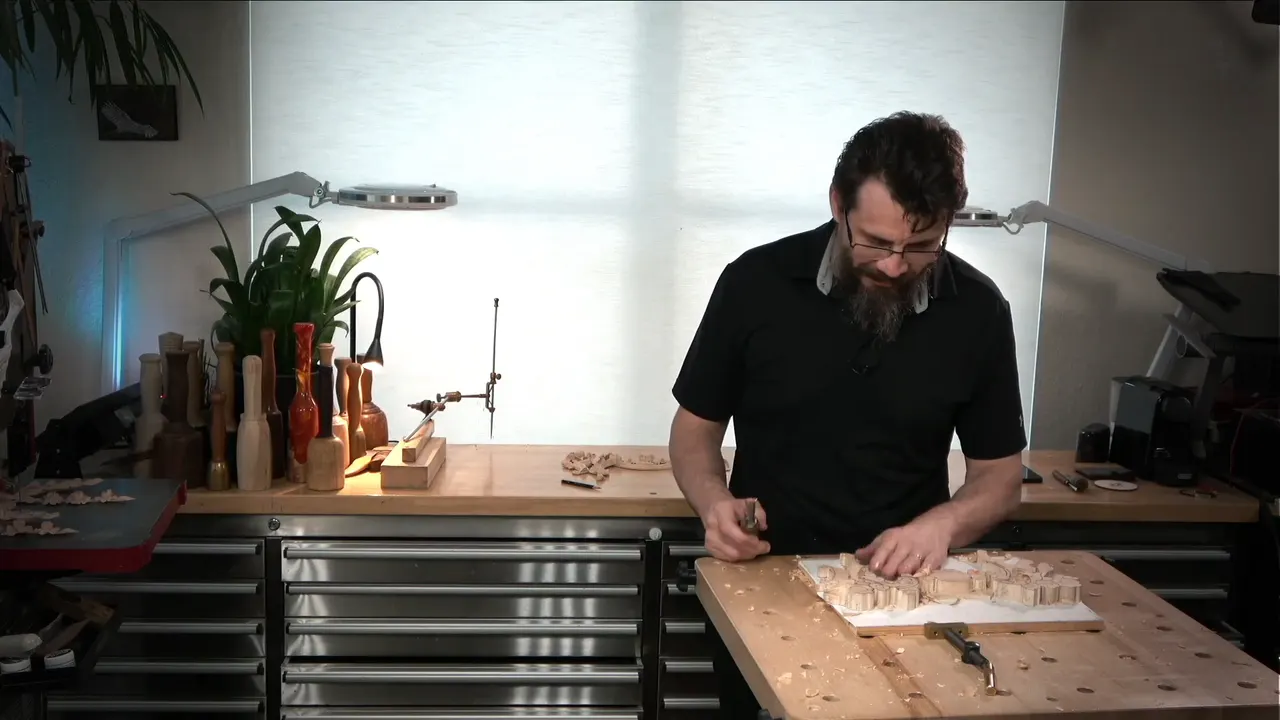
Pushing a carving gouge with your whole body is moving your body and keeping your hands almost still against it, instead of shoving the tool along using only your arms. I made the long passes in this video that way, and I said so out loud.

Do your shoulders ache after one long pass? Does the tool ever run on into the next detail? Then watch my hands in this part of the floral and molding course, because they hardly travel at all. My body does the traveling.
The long pass takes a small slice of a busy video. I leave room for an undercut, measure with the pointing machine, strop a number 9 and swap gouges again and again. Next to it I set my lines on the same idea from other courses, and I name each place as we go.
Six lines on pushing with the body
- While I make a long pass my hands stay nearly in place and my body does the pushing.
- I compared the motion to using a plane.
- My left hand sits solid.
- A long pass left me a thin layer of wood to work with next.
- In other courses I say to slice instead.
- A mallet gets struck with the palm.
How do you push a long pass from your body?
You let your body travel and your hands ride along. Right after I leave space for the undercut I say, "And in this case, I can do long cuts." Then I go quiet for a good while, and the camera just watches the wood.
When I talk again, I explain what you could not see. "With the long cuts, I am trying to use my body very much, and I'm pushing not with the hands, but with my whole body." My hands stay almost in the same position toward the body. The motion is "just the same idea if you would use a plane," a hand plane being a tool you push along a board.

The pass itself was off camera, so I pointed at what you can see. "You don't see the cut, but you can see that I'm holding my hands really tight to my body." The motion, I said, is "almost like dancing." Then came a short line. "All right. Here you go."
Afterward I looked at what was left. "I don't know, maybe about one-eighth of an inch, three millimeters. Something like that. Maybe a little less, maybe two and a half millimeters." That second figure is about 0.1 in. "But it looks good," I added. Then I turned to the next section, because it has to go the same direction, and picked up the same tool.

The idea turns up in other rooms. In a Furniture Panel workshop on acanthus movements, I told you, "I'm not moving the tool, I'm actually moving the whole body with the tool." One workshop earlier, carving flowers in the upper right corner, I put it a second way. "I'm not pushing on the tool. I am controlling with the whole body."
Over in the Lily Box course I rotated the tool, started with almost nothing, and said, "Move with your body, not with the tool, but move the whole body just like that." The Tray of Blessing gave me a slow version, and I called it "almost dancing," and the body is what moves. That makes three courses beyond this one, with one idea in all of them.
Why does the left hand stay planted?
A solid left hand gives you control, so I plant mine before I push. Partway through this part I tell you to look. "Pay attention how I'm holding my tool. Left hand always solid." Solid means "solidly placed on a block of wood, either on a background or right on design." Then you have a lot more control, and you can work in tiny steps that stay precise.

The Modern Acanthus course adds the other half. "Do not do air carving," I said, meaning both hands floating. Keep the left hand as close to the blade as you can. I pointed at the muscles working in it and said I wasn't getting tired, unlike what happens when the right hand does all the work. Find that in the first Modern Acanthus lesson. Tight areas got the opposite advice about length in that same lesson. Do short ones there, and attack from different points.
The Byzantine acanthus course gives a rule for the second hand. Two hands on the handle is not right, I said, and it is like painting with a brush. Put the second hand as close as possible to the edge. Your hand and palm muscles carry it, so you won't tire, and the tool feels like an extension of your hand.

What happens when you push with your arms?
You get more resistance and a rougher finish, and you tire sooner. I teach that in lesson 1 of this course, where I said that in person I see it as the biggest mistake lots of people make. They push the tool straight through. A sharp tool can do it, I said, but the finish will not look as nice and "you're going to get a lot quicker tired." Slicing is my answer, and it starts at the edge.
In my Grinling Gibbons class in Maine I called pushing the mistake people make. "You just using too much a force of your body," and you tire. The fix came next. You start on one side of the tool, end on the other and rotate it while you carve. That takes a lot less force, and you remove a lot more material.
The first Tray of Blessing lesson gives a picture of it. "You are a general," I said, and a general gives the order and lets the tool do the job. A little later I said, "I don't push it at all. I don't want to get tired." I feel what the tool does. In lesson 6 I scooped a spot out with a rotating, slicing motion and said, "That's why I am not getting tired and I don't have any blisters on my hand."

Hazelnuts put a size on it. I took no more than one-eighth of an inch (3 mm) deep, and I told you not to place the whole tool and try to remove the whole thing. "You're going to get tired. There's no reason. Let the tool do the work and not you." My own way there is to start on the left-hand side of the tool and finish on the right-hand side. I have a lot less fight that way, and I can probably work one side at a time, then flip the piece and attack from the other side.
A mallet changed my mind on one point. For a long time I skipped mine, because I figured I would just push and that would do. In the April 2020 livestream I said I found, personally, that the mallet gives me a lot more control. When you push, "you're forcing the whole body, and there's still momentum," and the pass can run on into the next detail.
Not every pass gets the body, either. On a Furniture Panel pass that starts with the corner of the tool at about 45 degrees, I said, "I'm not pushing with the whole body." You can hear it yourself in workshop 31.
Should your body swing the mallet along with the gouge?
You strike with your palm. During the livestream I told people they're not supposed to use the whole body "or even the whole hand" when they bang on the tool. "You're really just using your palm." That put no stress on my arm, hand or shoulder, and I said it can get really painful if you hit all day long.

Venice Room workshop 55 shows the same thing. "A lot of people, they bang like this," I said, "and they get the pain in the shoulder also." The mallet should hang free inside your palm, so your hand is not becoming really tired. I said that banging on a mallet using the whole body would get me tired really quickly.
Put together, the body carries a long pass while the hands stay put, and it stays out of the mallet swing.

Does the bevel decide how tired your shoulder gets?
A bevel that is too short makes you lift the tool, and your elbow and shoulder rise with it. I explained that in a lesson on bevels for hardwood. Carve every day and keep raising the tool, I said, and you have to raise your elbow and your shoulder. After many hours you get some pain. A person can get used to it, but you get tired.
The in-person sharpening class in Maine says it twice. A brand-new tool has a pre-established bevel, and you have to raise your hand really high to carve with it. In a softer wood like basswood, I told the class, keep the bevel low enough that your knuckles almost touch the wood. I call it a low bevel, and some people call it a long bevel. Then you solve two problems. The pain stops, and your shoulder and elbow don't tire. "You can carve all day long," I said, if the tools have the low bevel.
How do you carve toward your body without getting hurt?
You lock your arm and hands onto the piece. I'm careful with this one, because I carve toward myself on camera and I tell you not to copy me. The eighth Byzantine acanthus lesson has a joke in it. Only a dentist should work that way, I said, and I told people to lock their forearm. I also said I do it for the camera.

Venice Room workshop 67 gives the rule. If you do have to carve toward yourself, lock your elbows and your hands right on the piece. Even if you slip, the hand will stop the tool from reaching you, and it is then "safer." If you don't have to, I said, don't do it. "To be honest with you, every carver does it."
I admitted the same thing in workshop 25 while I carved toward myself with the camera running. "The whole body is at the front," I said, and that is why I locked my hands really strongly on the piece. "I'm not doing it from the air."

How far from the line do I stop a long pass?
My numbers change with the next job, and these are four of them. The sizes stay small. Three of the four sit near 3 mm (1/8 inch), and the Tray sits near 5 mm (3/16 inch).
| Where this happened | What I did with the wood, with the sizes | Words I used about it then |
|---|---|---|
| This floral panel | Left 1/8 in (3 mm) after the long pass | A little less, maybe 2.5 mm |
| The Tray course | Stayed 3/16 in (5 mm) from the design line | I want to avoid getting tired |
| Lily Box workshop | Kept the deepest spot about 1/8 in (3 mm) | We still have to undercut here |
| Hazelnuts lesson one | Took no more than one-eighth inch (3 mm) deep | There was no reason, I said |

On the Lily Box I gave the reason for that eighth. I think it is the rule I followed on the first layer, so the deepest spot stays consistent with the overall design, and I said it blends better.
What else happens in this part of the course?
The first thing you hear is about shadow. "I always do undercutting even on those volutes, even on the panels. It's going to cast some shadow, and it's going to look much better." So I leave space for the undercut.

Once the pass ends I measure the height of the volute, and later I catch a mistake of mine. "I forgot to make it tight." A skew carves a slope that goes down about 5 mm (3/16 inch), which I called a really big slope. I strop a 6 mm (1/4 in) number 9 on leather with mirror paste, one of my favorite compounds lately, and said I can get really close to my final line. Later a number 7 of about 28.5 to 30 mm (roughly 1.1 to 1.2 in) takes a long slope down.

The lowest spot read no deeper than about three millimeters, about 1/8 inch. A number 9 at 10 mm (3/8 in) was "a little too big," so I went down to a quarter inch (6 mm), and then a number 7 of 14 mm (about 1/2 in) went in. Before that, on the next volute, I looked back at the first piece I did and saw some sloping there, not much.


This is lesson 4 of Carving Floral and Molding for the Panel, and the lesson page holds the other two videos. With Access you get the full videos of all fourteen lessons. Do you want to see where my hands sit while I push? You will see it in the video.
How it's done
- Plant your left hand. I set my left hand solid on the background or on the design, close to the blade. Hands in the air are no good.
- Keep your hands close. During a long pass I hold both hands tight against my body and let the body push, the same idea as using a plane.
- Run the edge across. My pass runs from one end of the edge to the other while I turn the tool. That takes a lot less force and removes more wood.
- Skip the big bite. Taking the whole thing at once is not worth it. On Hazelnuts I said there is no reason, since you tire for nothing.
- Leave a little wood. After this pass I left about 3 mm, maybe a little less, and said it looks good before I turned to the next section.
- Use your palm on the mallet. I strike with my palm and keep the rest of my body out of it, so my arm, hand and shoulder stay free of stress.
Frequently asked questions
Is it okay to push a long pass if the tool is sharp?
Sharpness makes it possible, I said, but the finish will not look as nice and you get a lot quicker tired. I slice instead. The edge travels from one corner to the other while I rotate the tool through the pass.
Should a mallet swing come from the body?
Mallet work is palm work. When you bang on the tool, I said, you're not supposed to use the whole body or even the whole hand. At workshop 55 of the Venice Room I added that the mallet should hang free inside your palm.
Where does the left hand go on a long pass?
Mine sits solid on the background or on the design itself. Control gets much better for tiny, precise passes, I said, and I warned against carving with both hands up in the air.
What to carve next