
September 2, 2024 · Updated August 23, 2026
By Alexander Grabovetskiy — Master Woodcarver · Founder, School of Wood Carving · 19 min read
Can walnut wood be used for carving?
Walnut wood is a dark brown hardwood, Juglans nigra, and it carves clean and holds fine detail under a sharp gouge. I love walnut and I once worked a whole house built from it. The cost people do not expect is color, because dark wood hides the depth of your own carving while you work.
You bought a walnut board. You carved a leaf, stepped back, and the whole thing read as one flat gray smudge under the shop light. Your hand is fine. The board is fine.
What happened is that a dark wood eats its own shadows while you are still working on it, and no amount of extra carving will fix that. Light fixes it. Below you get what walnut does under the tool, the published numbers on it, the share of it that goes in the bin, and the stain I boil out of walnut shells.
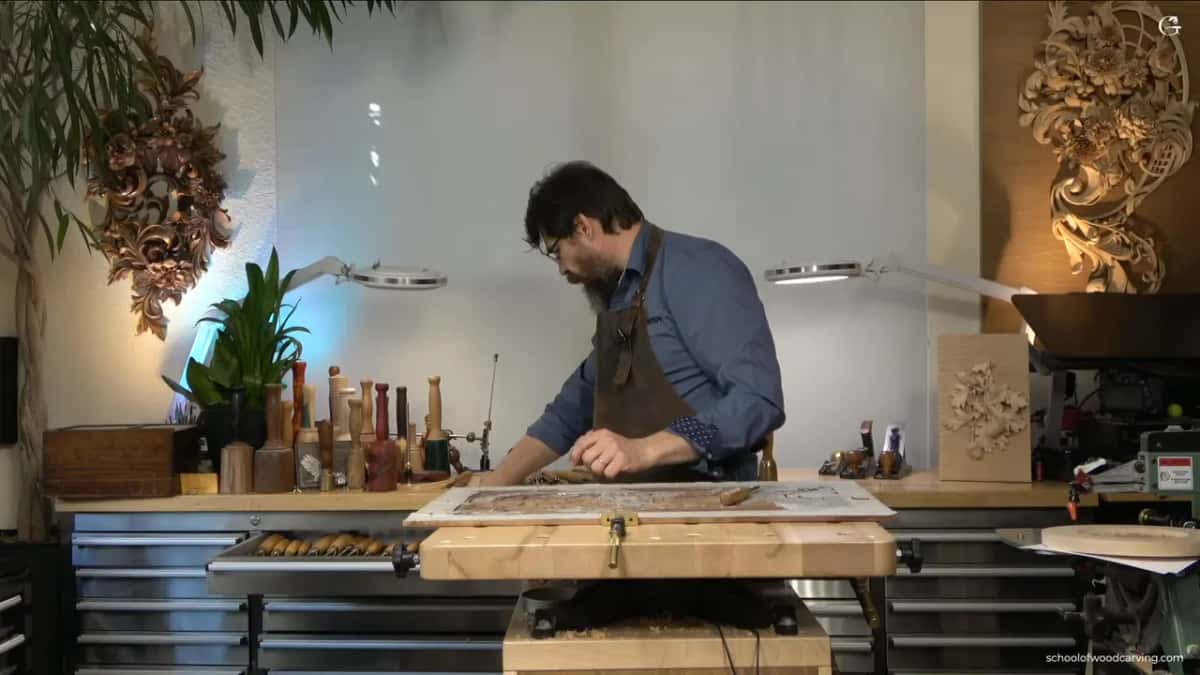
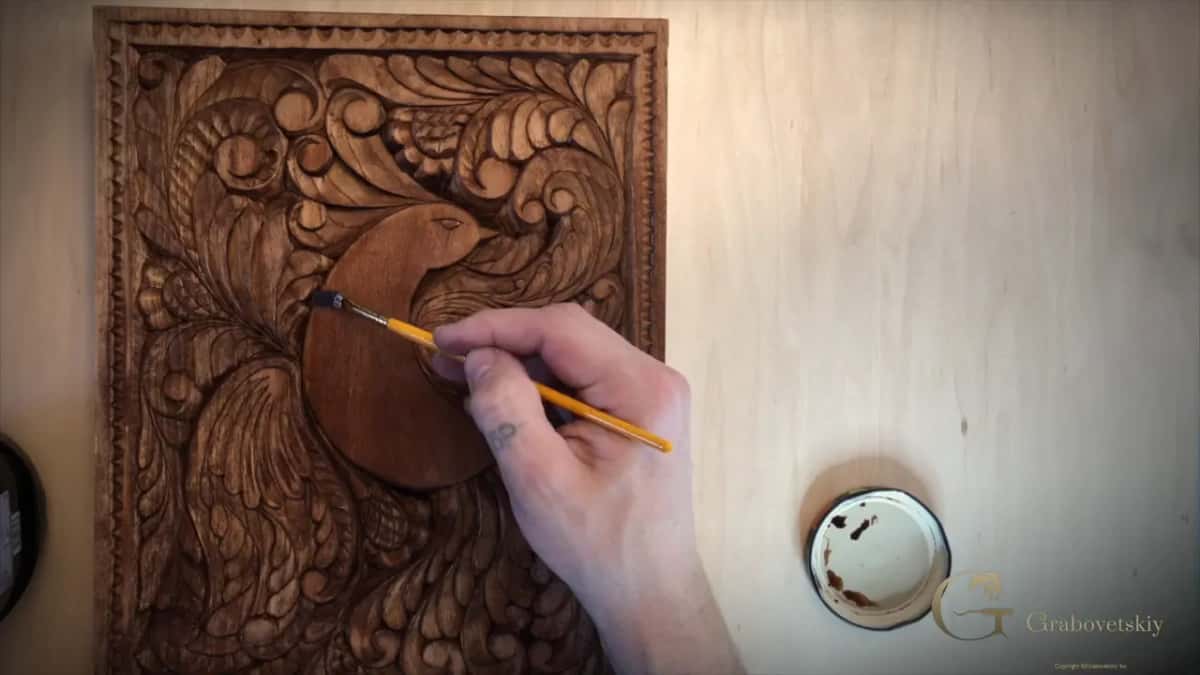
A long panel on the bench, with finished work hanging behind it.
Short version, before the long one.
- Harder than basswood, and gentler with a mistake than most hardwoods.
- Color is the price, not hardness.
- Detail breaks when you take too much at one bite, so take less.
- Up to forty percent is waste.
- Quiet grain in the black American kind, many shades in the European one.
- Cherry is the first hardwood I rate beside it for detail.
Is walnut hard to carve?
Walnut is harder than basswood, and it is still one of the friendliest hardwoods you will ever put a gouge into.
Hard and difficult are two different measurements, and many pages treat them as one thing. They are not. Walnut, though, is somewhat forgiving. Sometimes you can go against the grain and nothing bad is going to happen.
You still have to keep an eye on what the grain of the wood does. But it is not the same as other species. Really forgiving.
Compare that with the woods I chose for a lily box once, acacia and olive, ancient woods and crunchier than this one. Had I gone with walnut instead, it would have been a little bit easier to carve. It would not have been as crunchy.
The Wood Database puts black walnut at 1,010 lbf on the Janka scale, and the same site puts basswood at about 410 lbf. So the board under your hand takes roughly two and a half times the force to dent. Your arm feels that. Your edge barely notices, which is the part a number can never tell you, and it is worth reading what the Janka number actually means before you let it pick your wood for you.
I once had a project where the whole house was walnut. Not black walnut, and not European walnut either. Special walnut, more of a purple. Some of you never saw purple walnut, and there is such a thing. The doors ran about two inches and seven eighths, almost three inches thick, and no soft touch gets a door like that carved. There is more about that kind of work on my page for carving for furniture makers.
None of it makes walnut a wood that fights you. The ones that really do fight are on my list of the woods that fight back, and walnut is not on it.
Why does dark wood hide the depth you carve?
Dark wood swallows its own shadow, so the depth is really there in the board and your eye simply cannot read it yet.
Walnut itself is just dark. Sometimes you can see the real depth, and sometimes you cannot see it at all. You have to take my word for it while the chips are still coming off, because at the end it is going to look and blend really nicely.
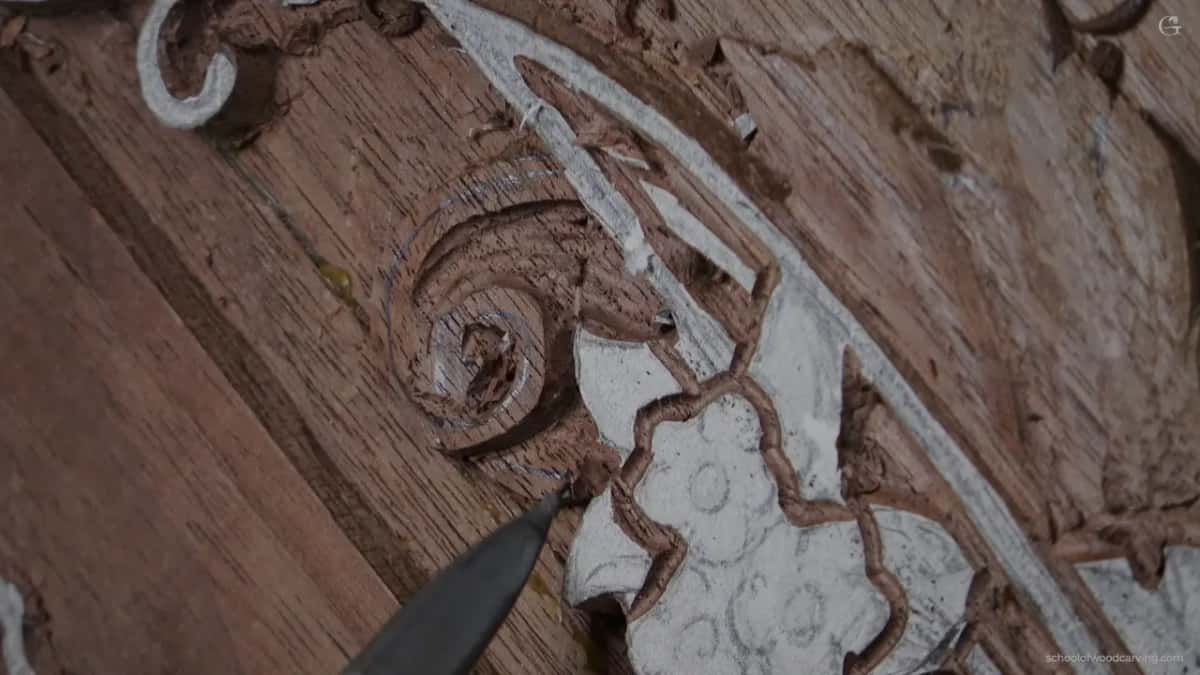
Turn the board instead, and let the light come across the face. The shadow off each carved edge is what tells you the shape you actually made.
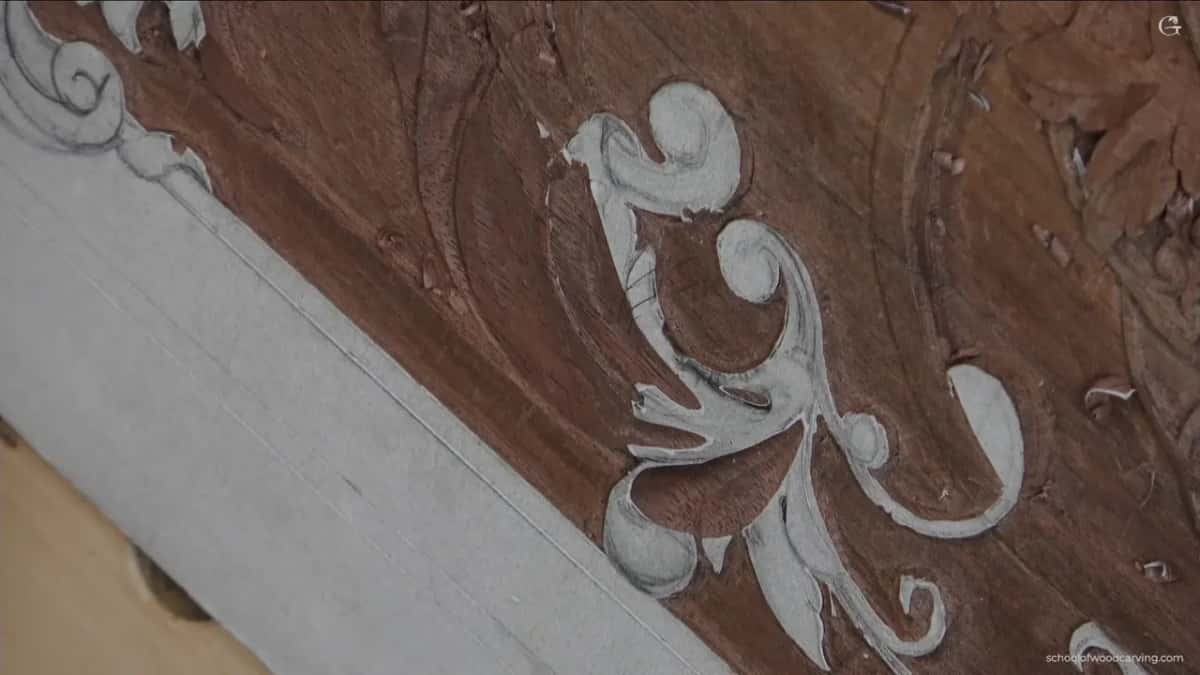
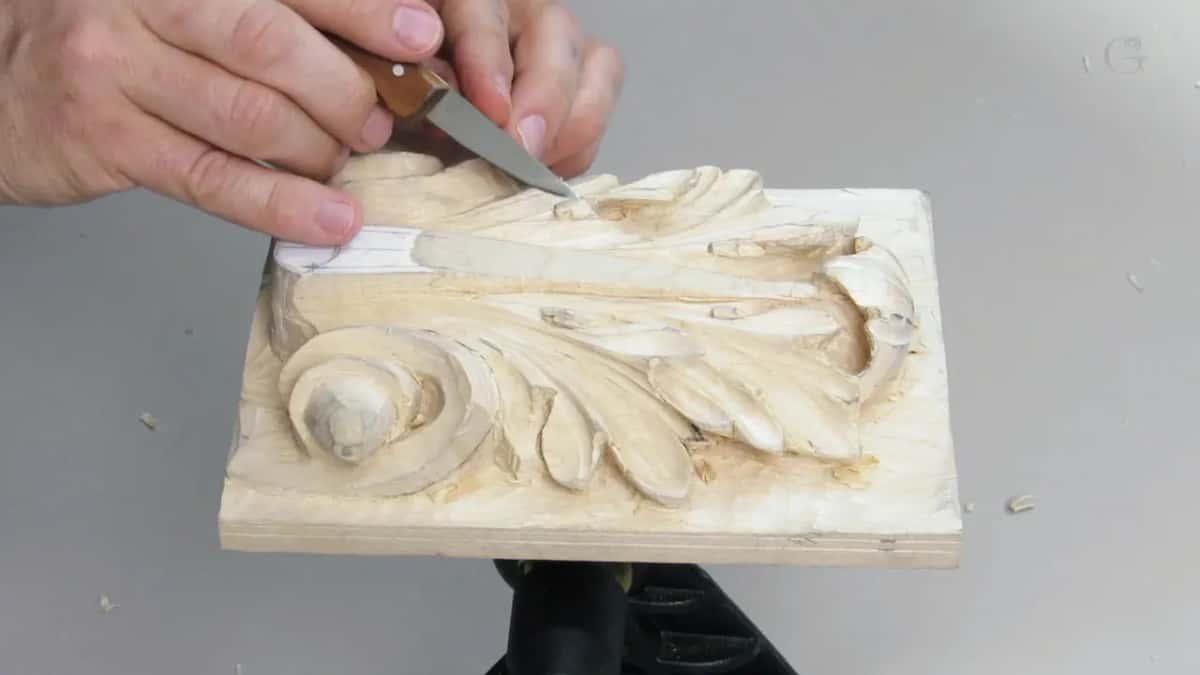
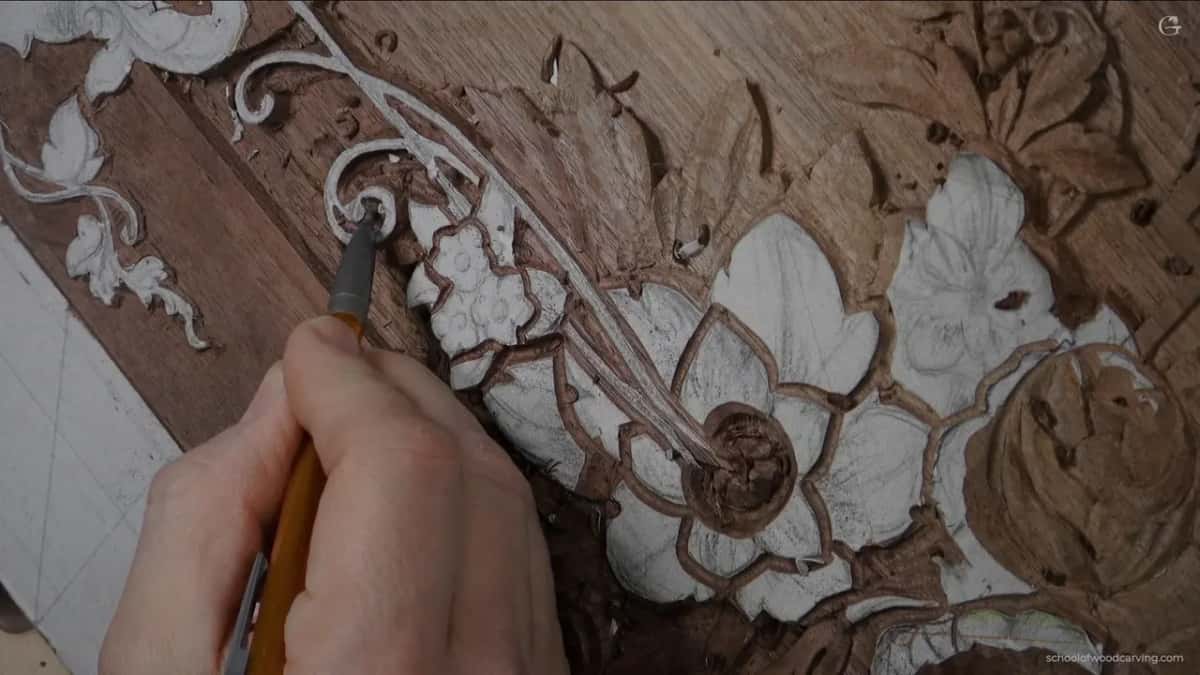
A scroll, read by the light falling across its carved edges.
When a whole area still reads wrong after all of that, I take a number 11 and lower the entire thing rather than fussing at one leaf. Light colored stock does that job for you free of charge, and basswood shows every level while the chips are still falling. Walnut makes you earn the reading. It pays you back at the finish, when the same darkness that hid your shapes turns around and gives them their weight.
This can sound like a warning. It is a working method. Move the light, believe the shadow, and carve to the shadow rather than to what the wood looks like flat.
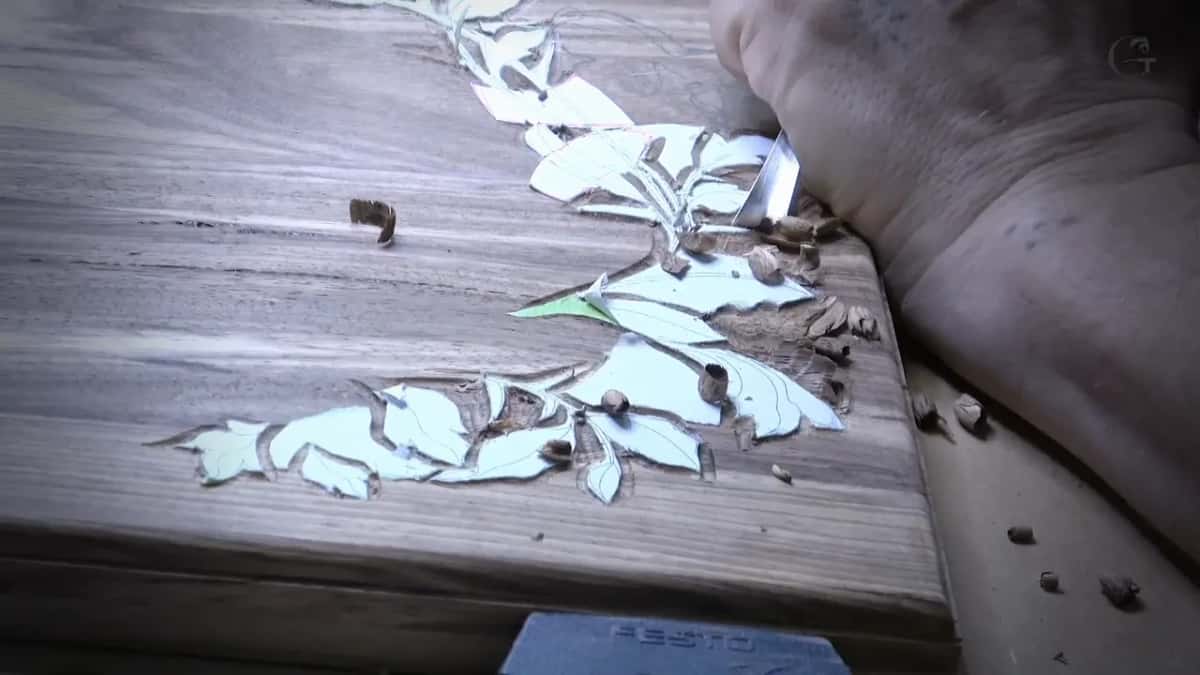
How does walnut compare with basswood for carving?
Walnut asks more of your arm than basswood does and hands you back an edge that stays crisp.
Here are four woods set out side by side.
| Species on the bench | How the wood feels under a gouge | Fine detail | What the grain does to you | What it costs |
|---|---|---|---|---|
| Walnut, the wood in this question. | Slices firmly. | Holds a crisp carved edge well. | Mostly quiet grain. | Sapwood waste and dust you must respect. |
| Common basswood. | Soft and very quick to remove. | Detail holds fine. | Almost no grain figure to fight against. | Bruises easily. |
| Red oak, the ring porous one. | Hard, coarse work. | Detail survives with real care. | Loud figure. | Design must follow the way the grain actually moves. |
| Cherry, close grained. | Smooth and even, a pleasure to slice. | Excellent detail. | Quiet figure to read. | Harder work than basswood. |
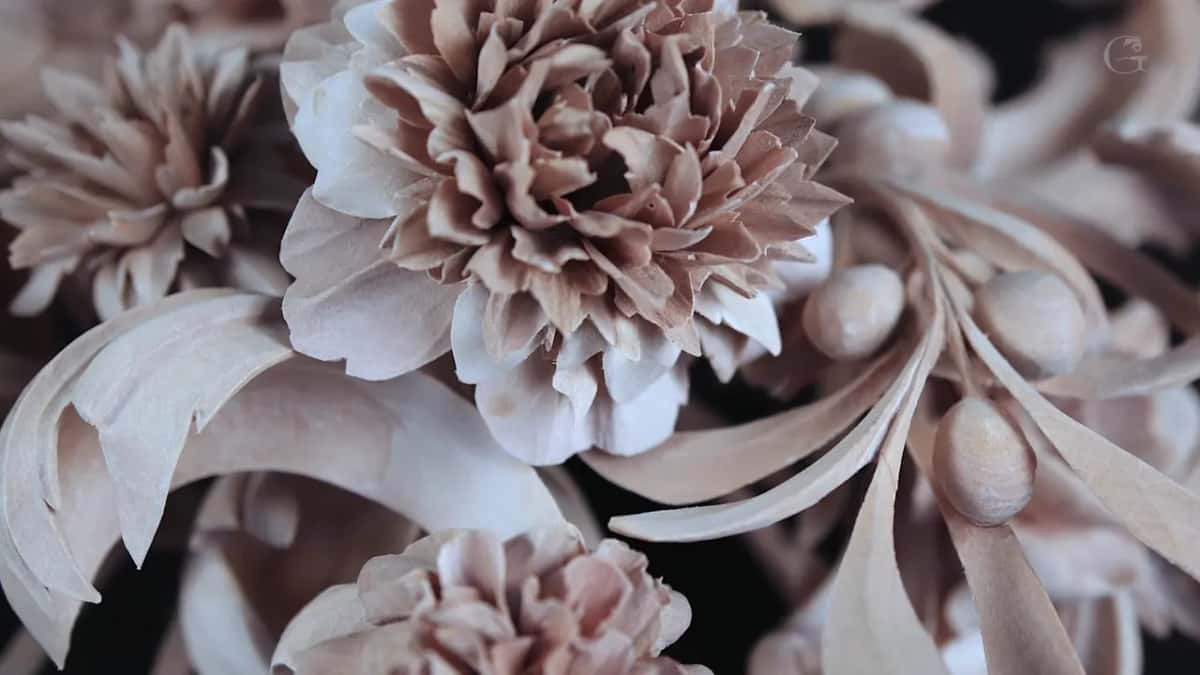
Pale wood, and the petals layered deep.
On a walnut panel I still do not worry much about design movement. With red oak I have to be mindful of it. And pine, which I do not like to carve at all, has grain so visible that it distracts from everything you put on top. Every other species I use sits in the wood species guide, including basswood on its own page.
One more thing about that table. Every number in a published wood table comes out of the small clear specimen standard, which tests a flawless little stick of wood. You are holding a board with a knot in it. Read the tables, then read the board in your hands, and let the board win the argument.
There is one more difference that nobody writes down. Basswood keeps its detail too, right up until the moment you press on it. Press it and you have bruised it. Walnut stands up better under the same lazy hand. Call that the trade, because softer paler boards show you everything and forgive nothing about pressure.
Quiet grain also buys you freedom in the layout. On oak your design has to agree with the rays and the pores, or the two of them will argue on the finished panel forever. Walnut mostly lets the drawing win.
What do the numbers say about black walnut?
Black walnut sits in the middle of the hardwood range, and one of its published numbers is strange enough to change how you plan a panel.
Juglans nigra carries a specific gravity of 0.61 at 12 percent moisture, plus a modulus of rupture of 14,600 psi, in the Wood Database entry. Fine. Ordinary numbers, both of them.
Now look at how it shrinks. That entry lists 5.5 percent radial, 7.8 percent tangential, and 12.8 percent volumetric, which works out to a tangential to radial ratio of 1.4. Across most species that ratio sits near 2, and the Forest Products Laboratory reports tangential shrinkage running about twice radial as the normal case. Walnut moves unusually evenly. A flatsawn face and a quartersawn face pull against each other far less here than they would in most woods on your rack.
Even movement is a gift, and I would not have thought to go looking for it. At the bench it means the two faces of one board argue less with each other as the seasons turn. Which is why how wood shrinks matters more to carved work than most people believe, and why the question of how thick a blank needs to be gets one answer in walnut and another in oak.
Weight is a rough guide to all of this while you are standing at the rack. Published weights get standardised at 12 percent moisture content, which is where a board sits at about 65 percent humidity. Green wood can weigh more than double its ovendry weight, so a walnut plank that feels heavy for its size is far more likely wet than special.
A word of warning about hardness numbers in general. The USDA Wood Handbook fits hardwood side hardness to roughly the square of specific gravity, while bending strength climbs close to linearly, so hardness rises far faster than strength does. That handbook also says plainly that gravity is a good index, not a guarantee, and only for clear, straight grained, defect free wood. The whole argument lives on the page asking whether denser wood is stronger. At least, says the Wood Database, five different ways to express it, so two sites can quote one wood and still disagree.
Does walnut wood hold fine detail?
Walnut holds fine detail as well as any wood on my bench, and among the hardwoods cherry is the first one I set beside it.
If it would be a harder wood, like maybe walnut or cherry, you are in good shape. Cherry and walnut, they hold the detail really nicely. Basswood also holds detail with no problem, as long as you do not press it too much and you do not make unnecessary cuts.
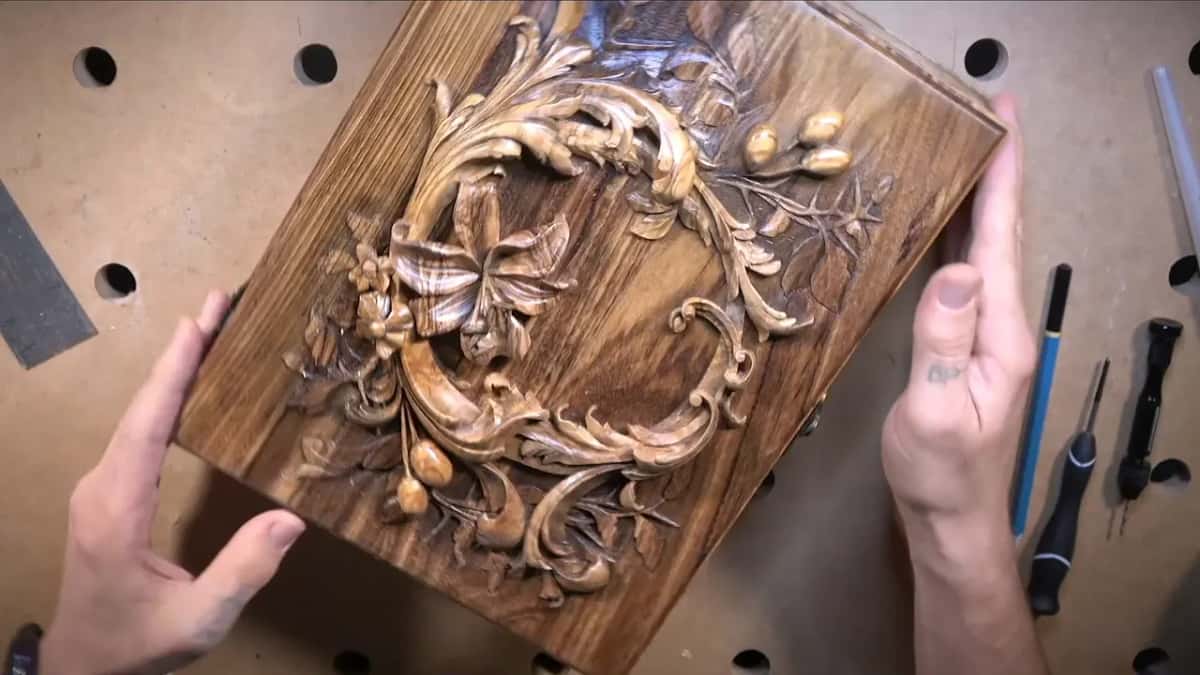
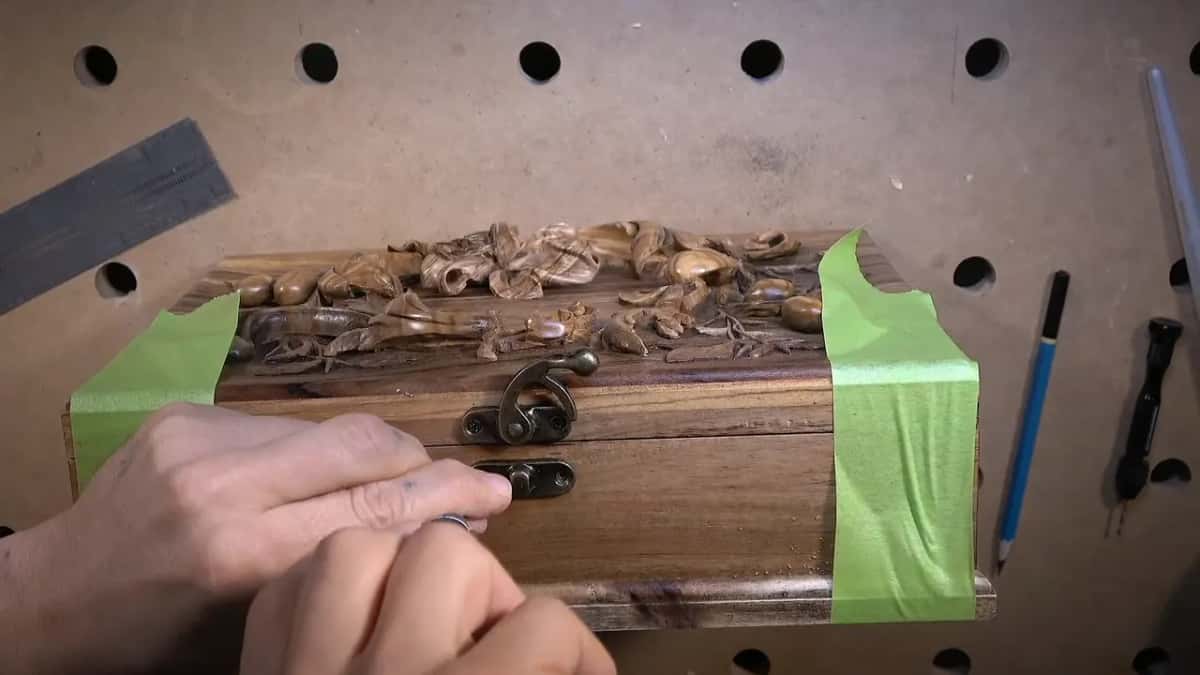
Flowers standing well above the lid, held up in two hands.
Pressing is the whole failure. A pressed fiber is not a carved fiber, and the wood remembers what you did to it. This matters more in relief than anywhere else, because an undercut leaf in walnut has to carry its own thin edge for as long as the panel hangs on a wall.
One of the school panels is an authentic 18th century design in very low relief. Some spots on it run less than one thirty-second of an inch, less than a millimetre, and the wood still carries them.
That headboard is walnut and it is mine.
A headboard lives at eye level, which is about the hardest test a dark carving ever gets. Walnut survives that inspection when the depth is honestly in there.
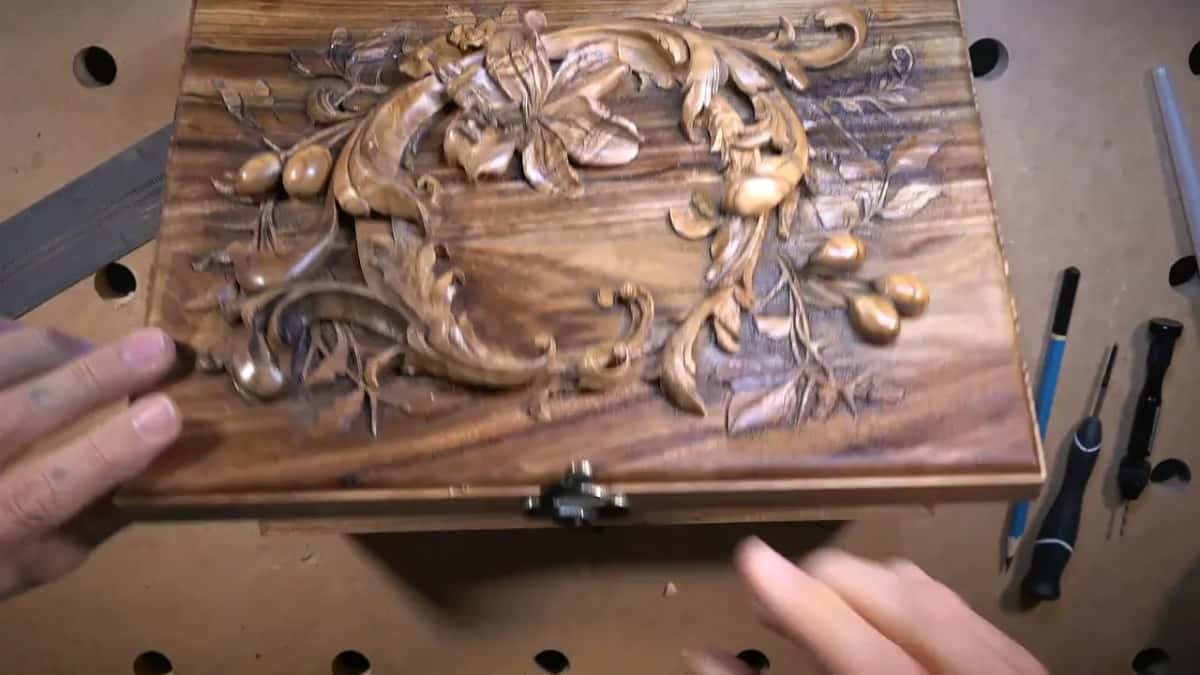
For the smallest work, tiny beads and lettering and the parts that make people lean in, a tighter grain than walnut helps, and boxwood is where the wood guide sends you. At the size of a door, walnut wins on every other count. A companion piece on what walnut costs you walks a whole first project through, board to finish, so I am not going to repeat that here.
Why is so much walnut thrown away?
Sapwood is the reason, and up to forty percent of the walnut coming off the saw goes in the bin because of it.
The pale outer wood is not what people paid for. They wanted the dark heart, so the light part gets cut off and thrown away, and across a mill that adds up fast.
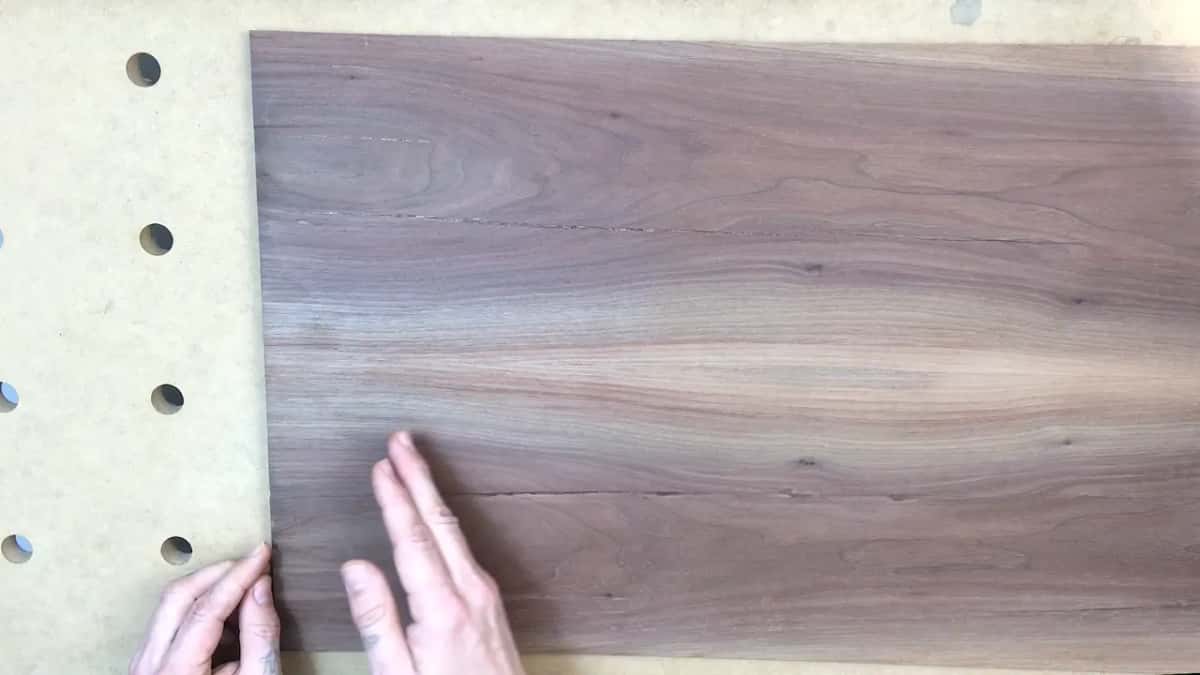
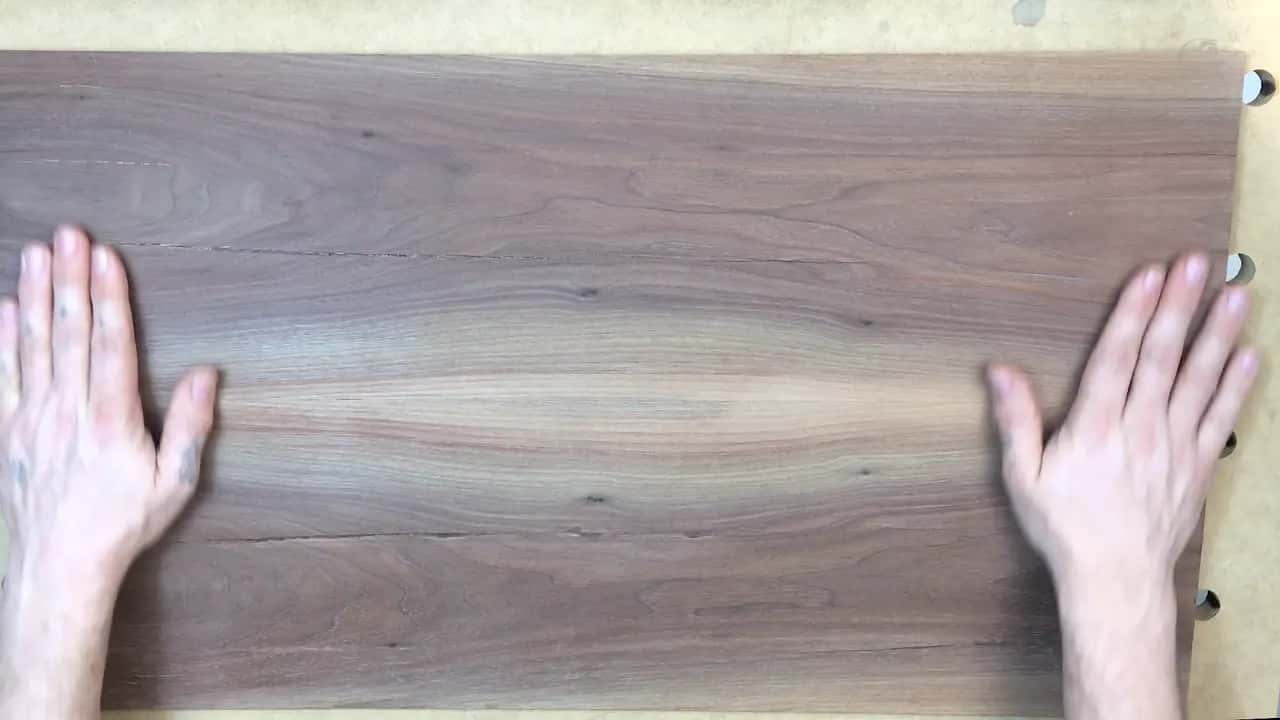
One board, and a paler tan band running low across it.
Older shops did something smarter with the problem. They would blend that sap wood in with the main body of the walnut, and it would all read as one unified color. They did not throw that sap wood away. They used it.
Nothing stops you doing the same. A stain that darkens the pale part until it matches the heart turns that waste back into usable stock, and I give you my own recipe for that further down this page.
Sometimes it is fine to leave the pale part exactly as it is. The panel in my furniture course is a leftover from that purple walnut house, splits and all, and I did not want to throw it away just because of a few cracks in the wood.
Look at the edge of a board and you can see the line for yourself. Heart wood is the dark part running through the middle. Sap wood is the pale outer ring, and the pale ring is usually the part that gets cut away before anybody sells you a board. Less sap on a log means more usable plank out of it. That is the reason a broad clear walnut board costs what it costs at the lumber yard.
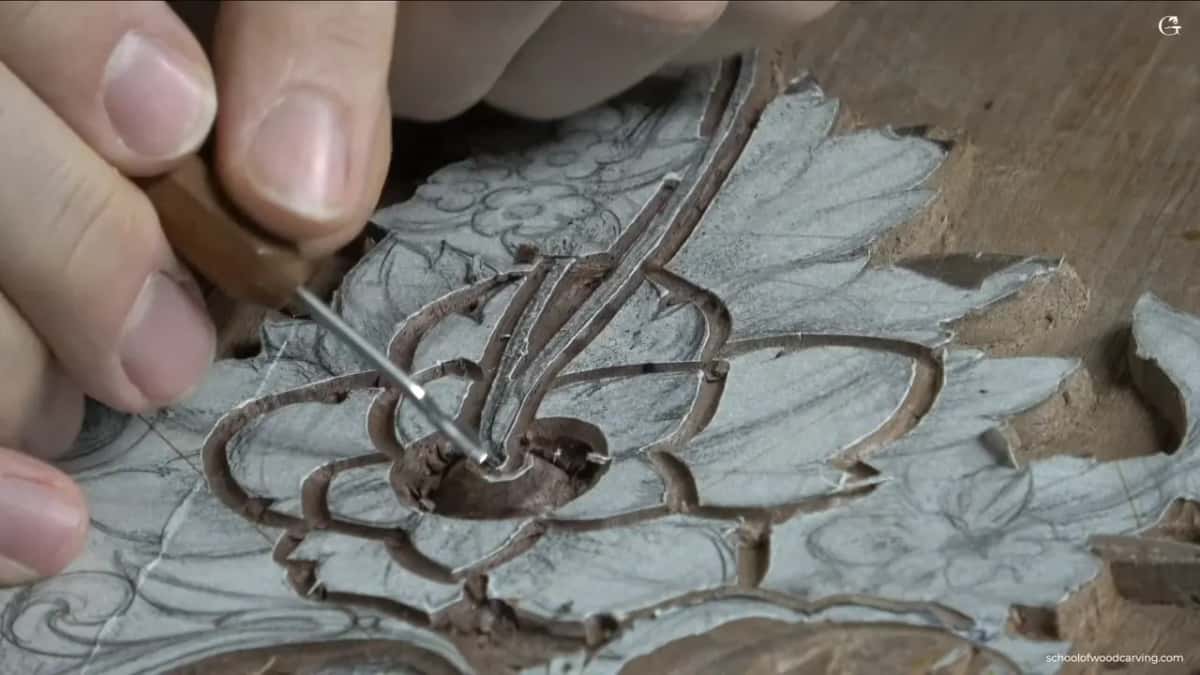
That trouble is worth taking, because the tree takes so long to make. The USDA puts mature black walnut at 100 to 120 feet tall with 30 to 40 inches across the trunk, and even under careful management a 20 inch veneer log wants 40 to 50 years of growing. Every scrap you burn is decades of somebody waiting. I keep the walnut writing together at the black walnut posts.
Two smaller habits will protect the boards you have already paid good money for. Quartersawn stock, says the Forest Products Laboratory, cups, surface checks and splits less in seasoning and in use. And should you ever saw your own, the Wood Database is blunt, seal the end grain immediately, within minutes of the cut rather than hours.
How do I carve walnut without losing the detail?
Work in two passes, straight down first and then in from the side, and never take a big bite.
Some species are really crunchy. If you are not careful about how you make your cuts, if you are just taking too much at one cut, you can snap off the whole detail. That is why I do it in this order.
Step 1, draw the design before the wood
Design comes first, then sharpening, then carving, and carving is the biggest of the three. I do not move that order for anybody. Work your drawing out on paper until it is right, the way I set it out in planning the design first, and the whole of the design course is built on that one habit. A weak drawing carved beautifully is still a weak thing on the wall.
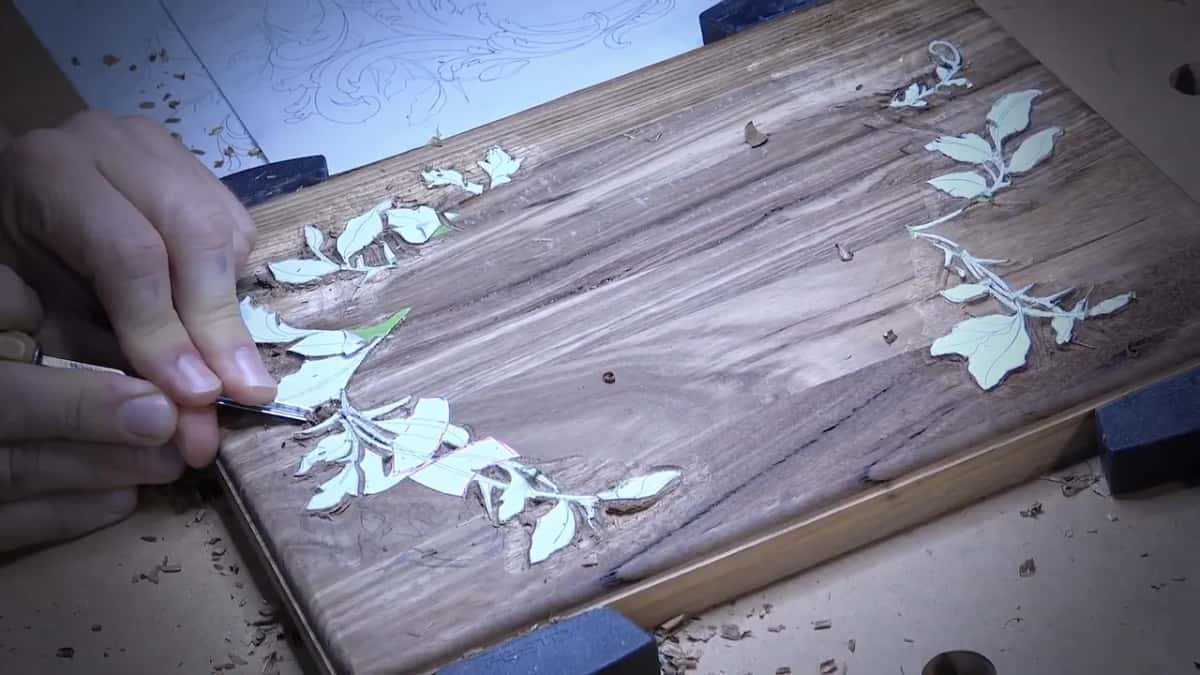
Step 2, sharpen before you touch a hard board
Much of this depends on what tools you have, and whether they are sharp or not. With sharp tools it really does not matter. You can go against the grain or along the grain, and you are not going to split it, and you will not make a big mistake.
So it is a good idea to keep your tools really sharp, and then you do not have to worry. Somebody who cannot sharpen all the time, and who still wants to do beautiful work, has to be mindful of the grain instead. Start with a free sharpening lesson, and take the sharpening course when you want the full method.
Step 3, set the outline straight down
Go straight down first, all the way around your shape. This is the wall your detail will stand on for the rest of its life. Do not lean the tool.
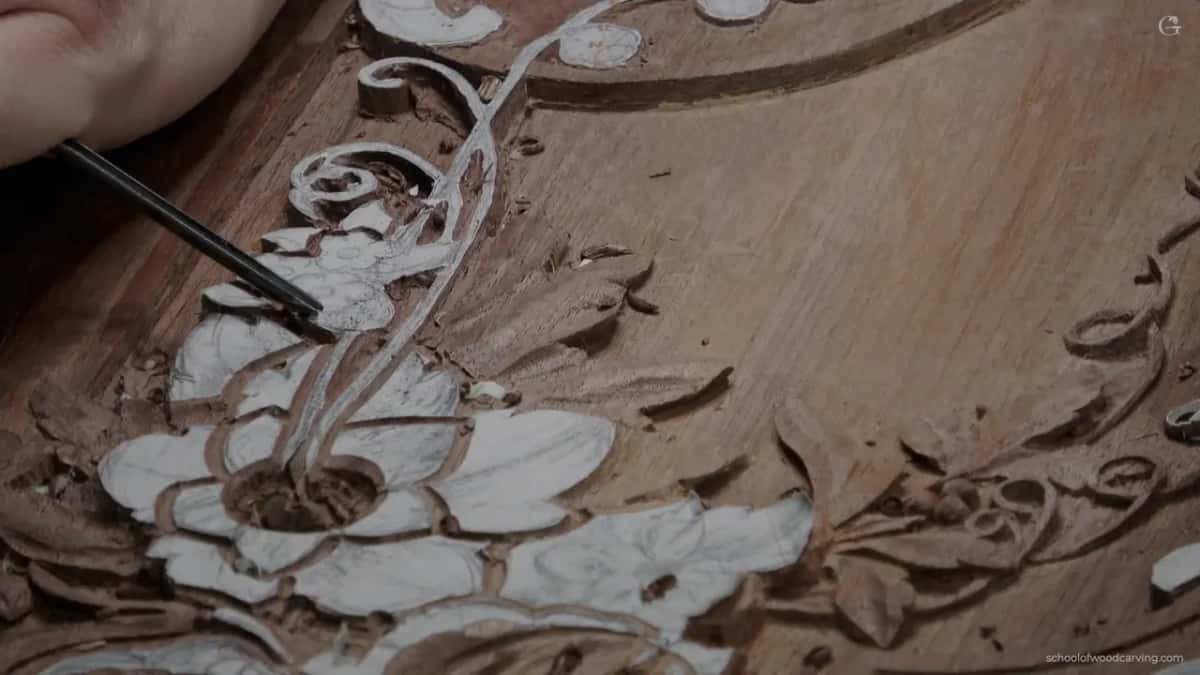
Step 4, clean in from the side
Then clean with the side of the tool, little by little. Do not try to take as much material at once. On that furniture panel my step number one was a sphere, and I got it really nicely rounded before anything else came near it.
Step 5, stop and read the depth
Turn the board so the light crosses the carved face, and read the shadow before you carve any deeper.
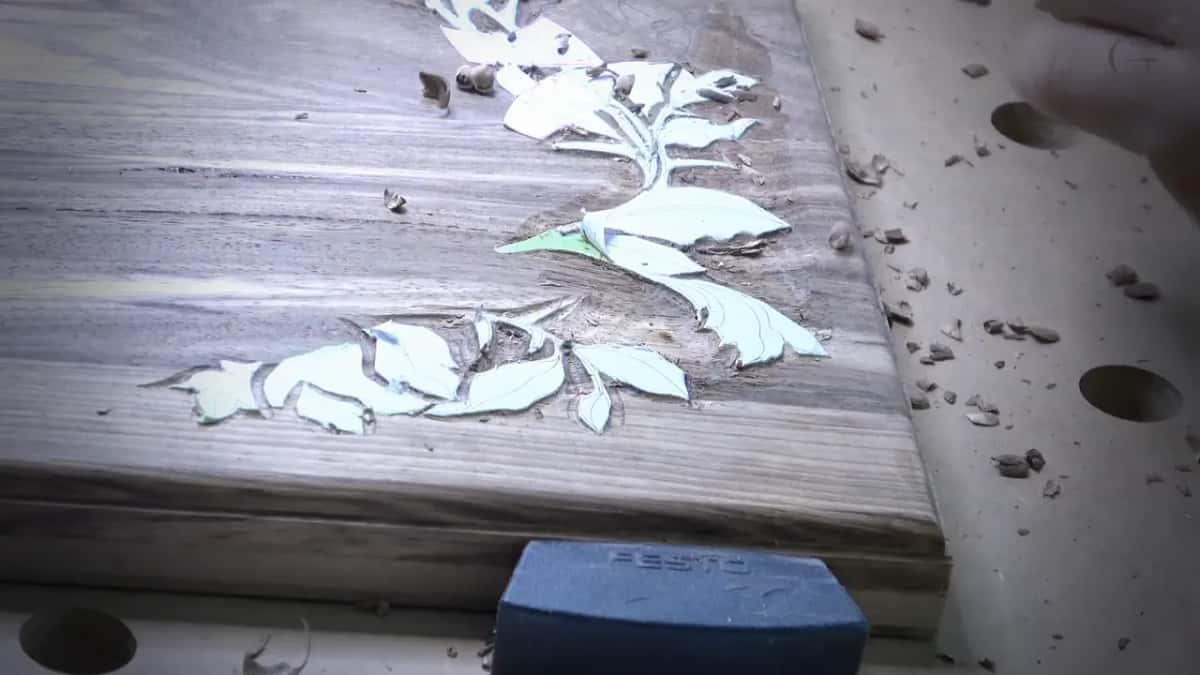
Step 6, wipe it down and look at the color
A damp rag over the surface shows you roughly what a finish is going to do. Should the shapes go muddy the moment the color deepens, they were too shallow all along, and that is a far easier thing to fix now than after the lacquer.
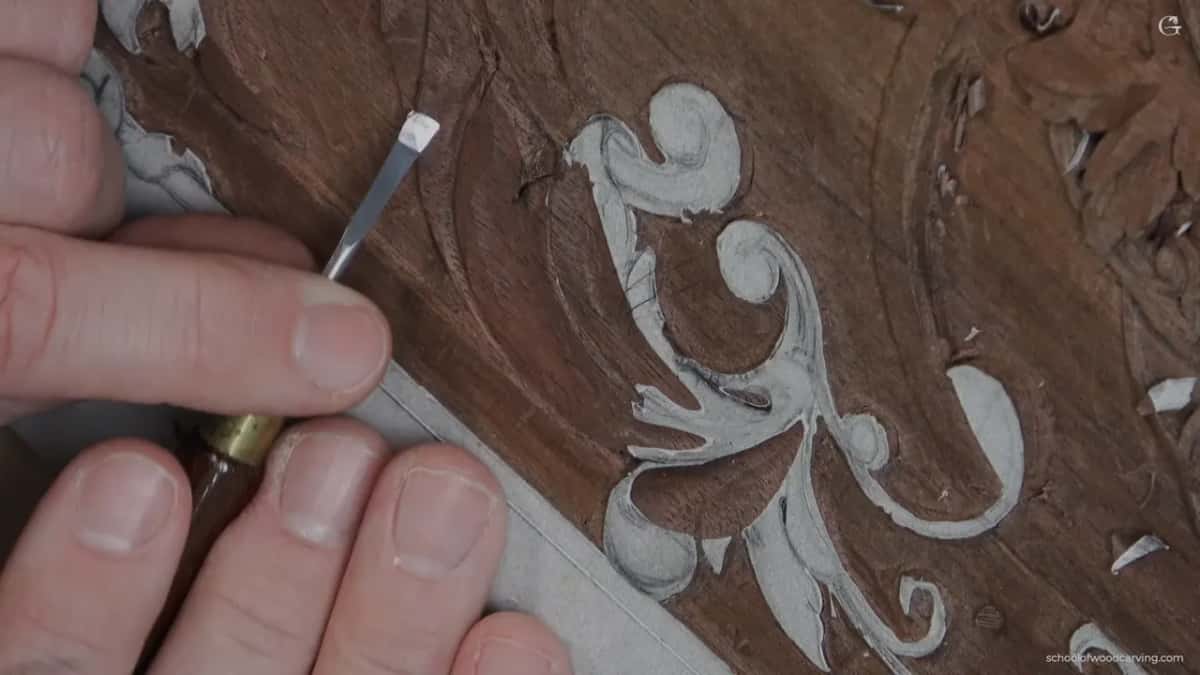
One caution on timing. The same handbook says to install interior wood at 8 percent moisture on average, so a blank that arrived wet last week is not ready this week. Stack it, sticker it, and carve something else while it settles.
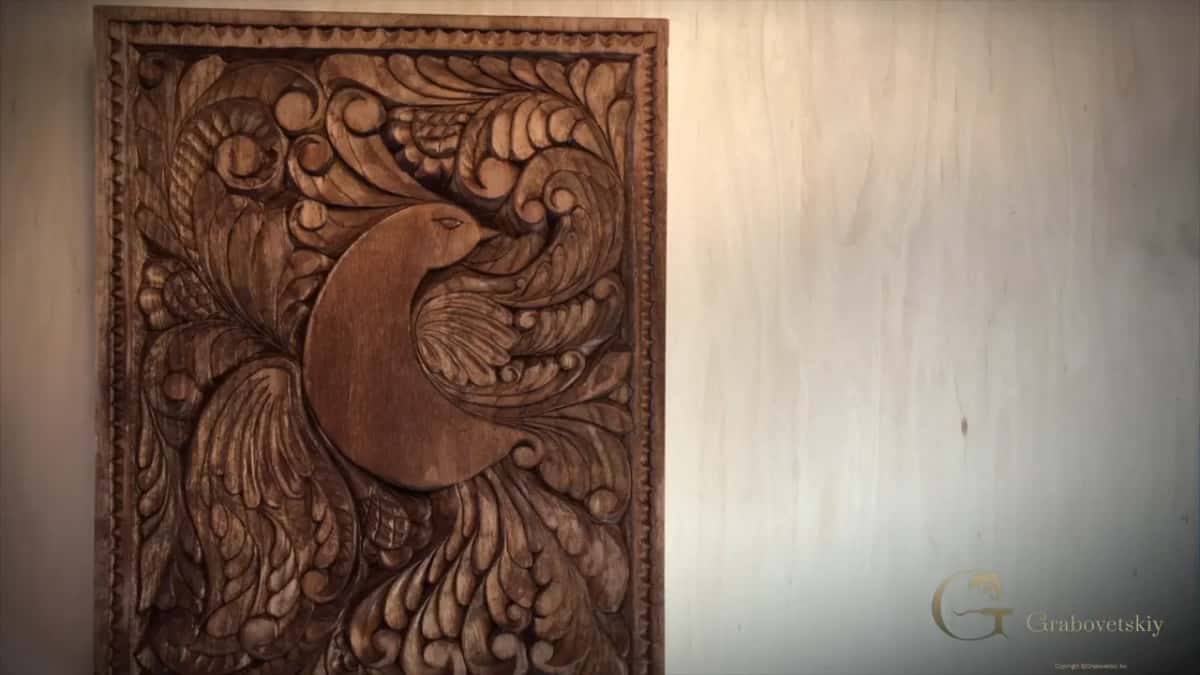
Can you stain walnut wood?
I do not stain walnut heartwood. The shell stain is for the pale sapwood, and for a board you will eat off.
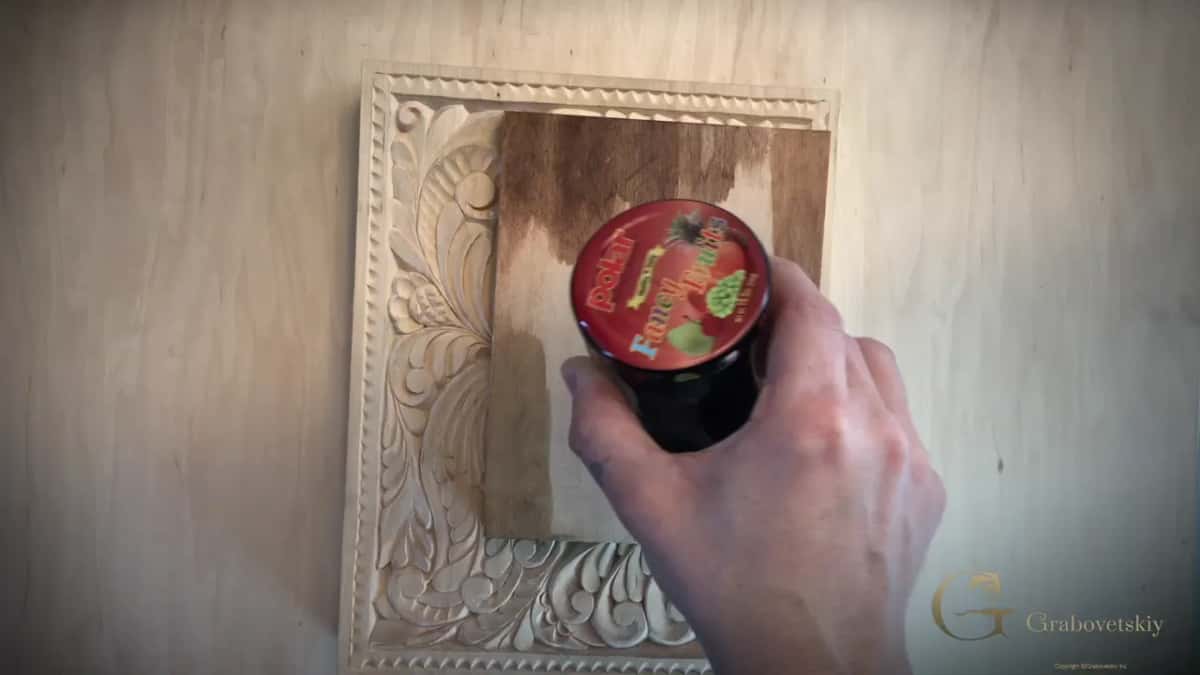
What I have got is just walnut shells, and not too many of them either. I add some water and just a little bit of baking soda, and I boil that for about four hours. What comes out is a really, really thick stain.
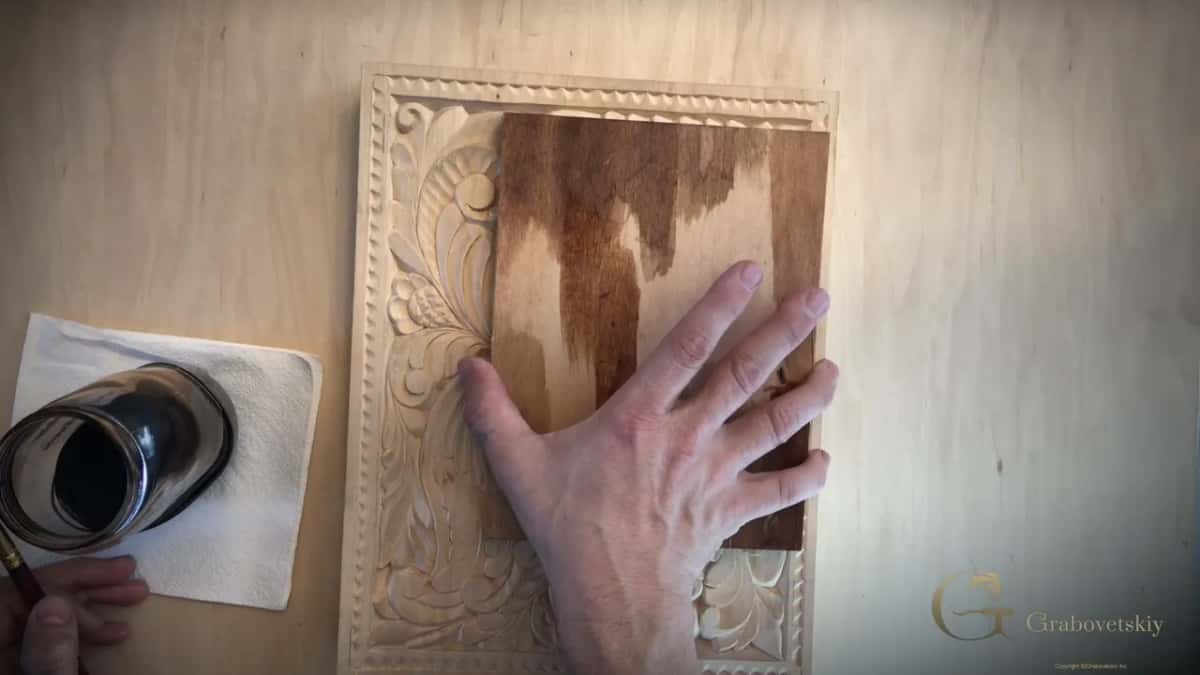
Once it dries, it will be the color of true walnut, and not a color mixed up in a factory to look roughly like walnut from across a room. The actual thing, out of the shells of the same tree.
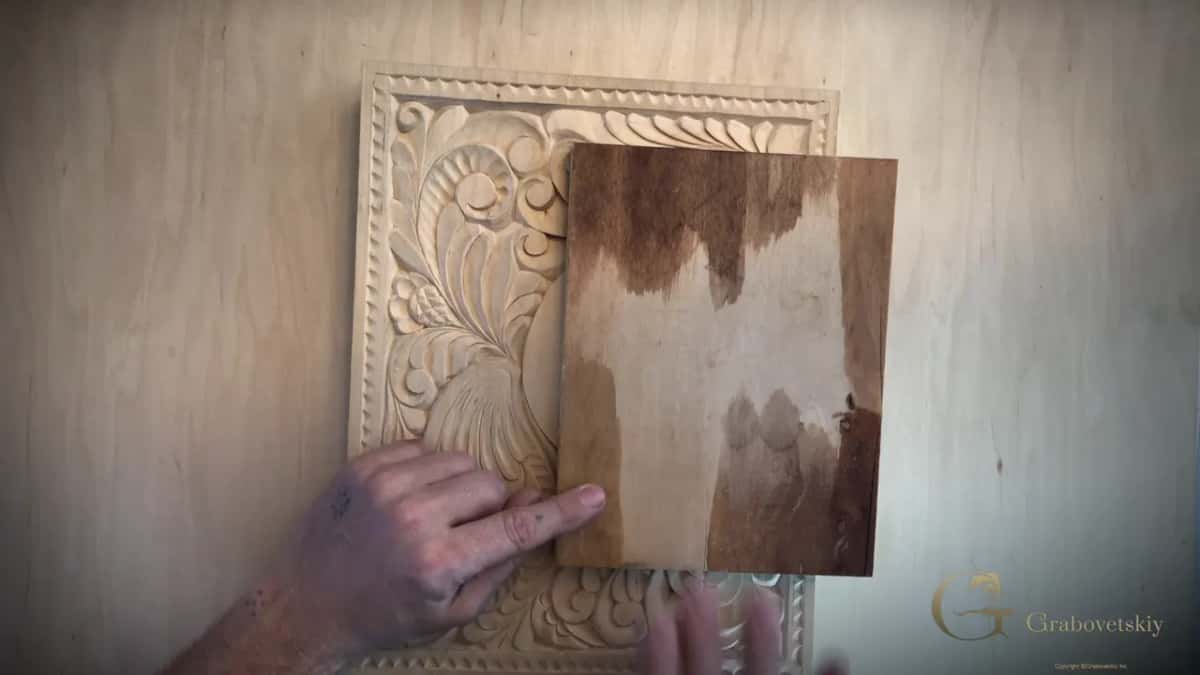
Half of this little board is stained, half of it bare.
Before it dries I take just a napkin. You can use a rag.
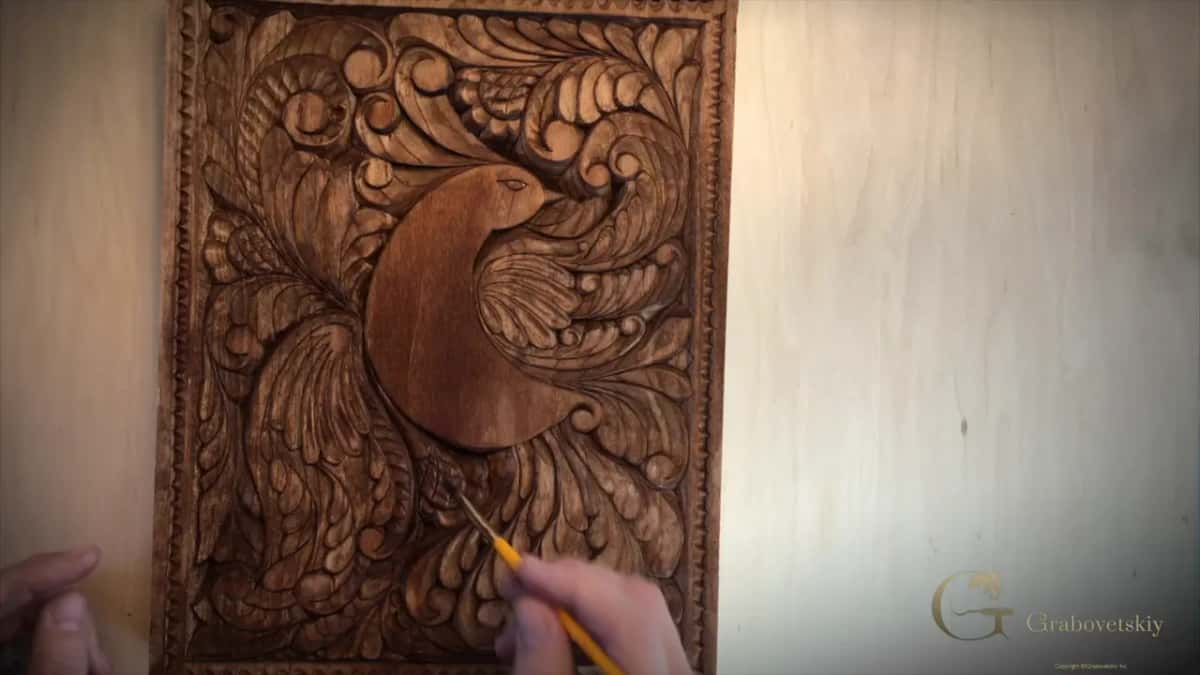
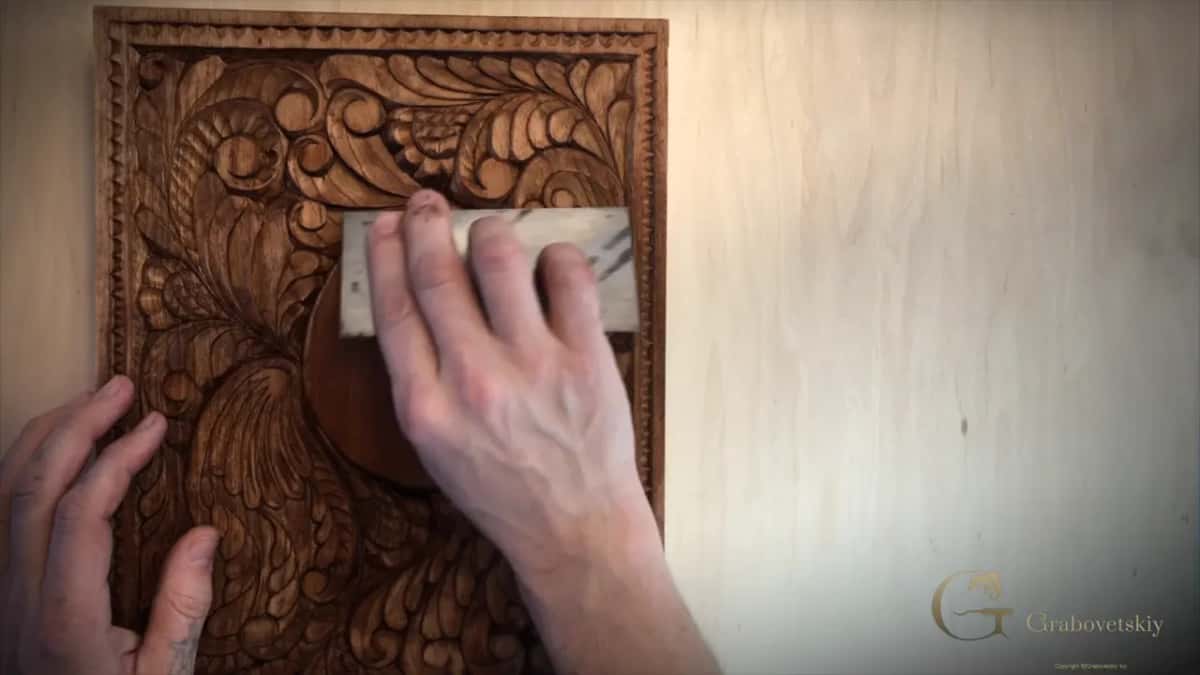
That stain is one hundred percent safe for food, so a cutting board can be stained all over and then given a coat of linseed oil or plain mineral oil from the pharmacy. Treat it like a dye, not a paint. The more of it you put on, the more color develops.
Test on an offcut of the same board every single time. You get one shot at the real panel. Afterwards, the film you lay on top is a separate decision, and I go through mine on the page about sealing wood after carving. What you choose there has more to do with how long a carving lasts than the species underneath ever will.
How do I keep walnut dust out of my lungs?
Wood dust is the one part of walnut that can genuinely hurt you, and the published limits are lower than they look.
Take it seriously once, set the shop up properly, and then stop worrying. OSHA sets a permissible limit of 15 mg per cubic metre of total dust across an eight hour day, with 5 for the respirable fraction, while NIOSH recommends 1. The Canadian Centre for Occupational Health and Safety notes that walnut dust is rated A2, a suspected human carcinogen, inside a class that IARC already puts in Group 1.
Reference tables list black walnut as an irritant and a sensitizer, and the fraction that gets people is the one nobody sees, those particles from two to ten microns that hang in the air after the tools go quiet. Purdue Extension adds that juglone sits in all parts of the black walnut tree.
That same Canadian listing names skin irritation, rhinitis and possible asthma against black walnut in particular. A sensitizer is exactly that, a wood you can handle for years before your body decides it has had enough. Purdue also notes juglone is poorly soluble in water, and that its effect on the ground can persist for years after the tree itself is taken out.
None of that is a reason to avoid the wood. Sanding and machining are where the trouble lives, and both of them are easy enough to control once you decide to.
Hand carving makes chips, not clouds, which is one argument for a gouge over a grinder. Wear a mask when you sand. Open a window. Sweep the bench with a damp cloth rather than a brush, because a brush lifts the fine part straight back into the air where your face already is.
Is walnut wood good for a first carving?
Walnut makes a fine second wood and a hard first one, and the reason is color as much as hardness.
A beginner needs to see what the tool just did. That feedback loop is the whole of early learning, and a dark board breaks it at exactly the wrong moment. Carve two or three panels in basswood, learn what a clean wall and a clean floor look like, then move across.
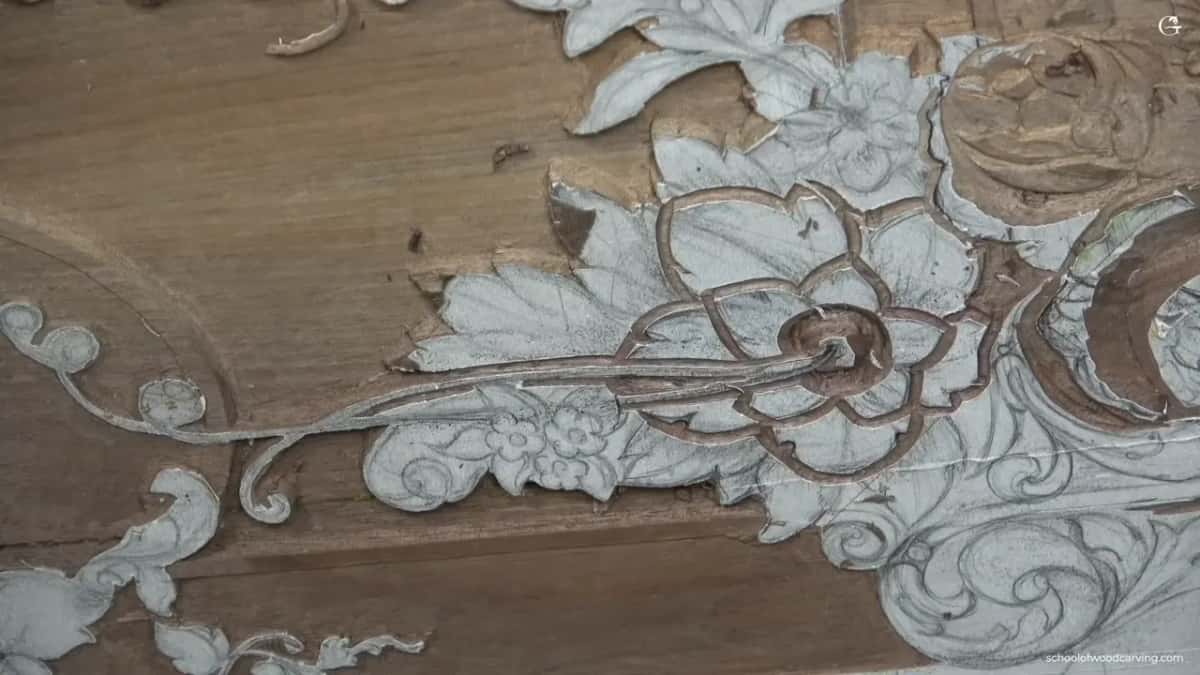
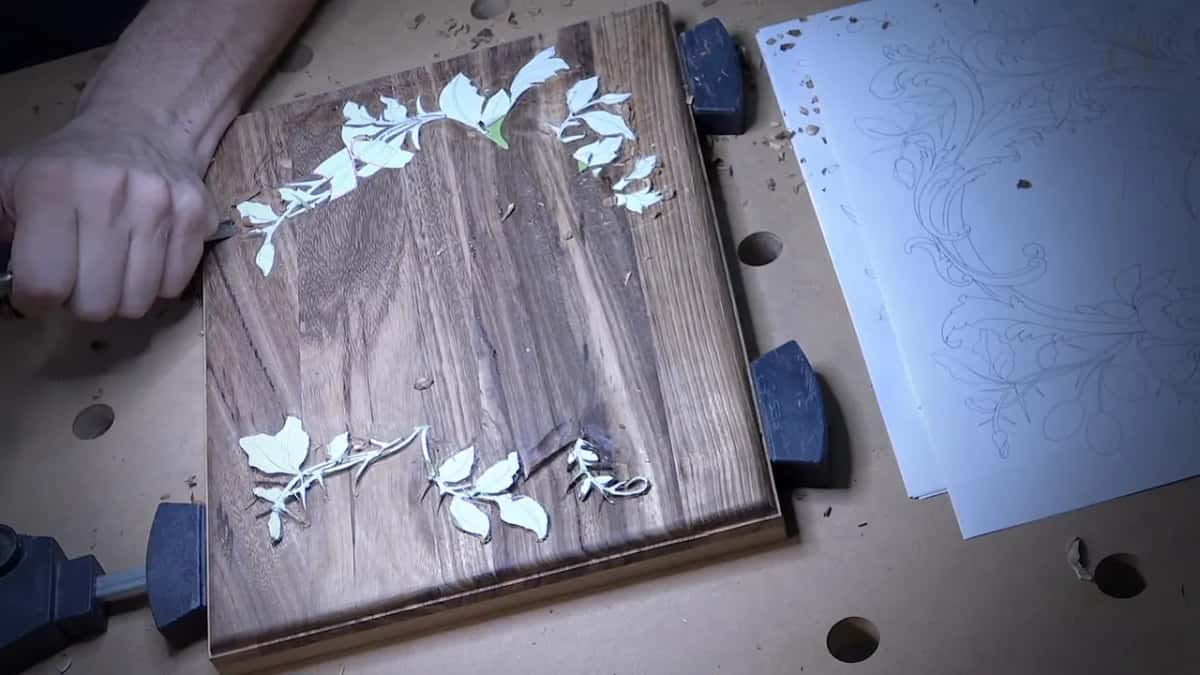
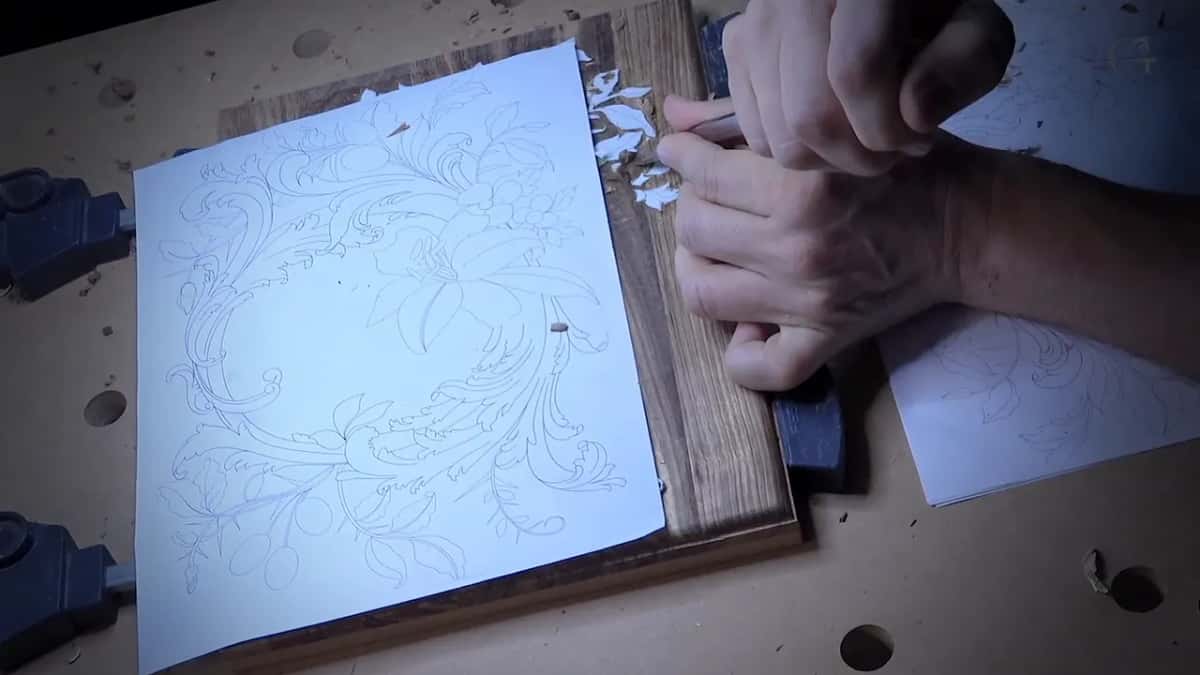
White design, brown board, and the ground already taken away.
Then again, plenty of people start on walnut anyway, because walnut is often just what somebody left in the garage. The fix there is light, not a different board. The beginner course uses softer stock on purpose, while reading grain direction is the one skill that carries over to every species you will ever touch. The 2010 edition of the Wood Handbook is free, and it beats any forum thread as a shopping companion.
Bring your walnut. Bring the board with the pale streak you were about to burn, and the panel that went flat on you. I will show you what your gouge is really doing to those fibers. Shall we carve? The whole course catalog is open to you, and what access costs sits on one plain page with no surprises on it.
Frequently asked questions
Is European walnut different from American black walnut?
Very. On a European board you see all the variations of the colors, right through white and yellow into really dark brown. The American kind is quieter, and its grain is not too pronounced. I plan a panel the same way on either one, which I cannot say about oak.
Will a walnut blank move much as it dries?
Less than you would expect. Published Wood Database figures give it 12.8 percent volumetric shrinkage, which is ordinary, but a tangential to radial ratio of only 1.4 against a typical 2. Even movement means the flat face and the quarter face argue less with each other over the years.
Does walnut resist rot and insects?
Half of that is yes. Wood Database data rates black walnut very durable against decay, so damp air treats it kindly compared with most timbers. Insects are the weak side, since those same references list it as susceptible to attack. Indoors and finished, neither one is what decides how a carved panel ages.
What dust protection does walnut need?
Wood dust from any species belongs outside your lungs, and this one carries a specific warning on top of that. Use a mask rated for fine particles whenever a machine runs, empty the shop vacuum outdoors, and give the air a while to settle before you sweep up.
Can walnut shells really make a stain?
They can, and the recipe is short. Shells, water, a little baking soda, boiled roughly four hours until the liquid goes thick. Brush it on, wipe the surplus away with a rag before it dries, then let it cure. The finished tone is the wood itself.
Filed under
- best carving tools for walnut
- carving challenges walnut wood
- carving walnut wood benefits
- creating designs in walnut wood
- easy walnut wood projects
- finishes for walnut carvings
- how durable is walnut wood
- is walnut wood easy to carve
- is walnut wood good for carving
- techniques for carving walnut
- tips for working with walnut wood
- tools for carving walnut
- Understanding Wood for Carving
- walnut wood carving patterns
- walnut wood carving projects
- walnut wood carving techniques
- walnut wood carving tips
- walnut wood characteristics for carving
- walnut wood detail retention
- walnut wood finish options
- walnut wood vs other woods