
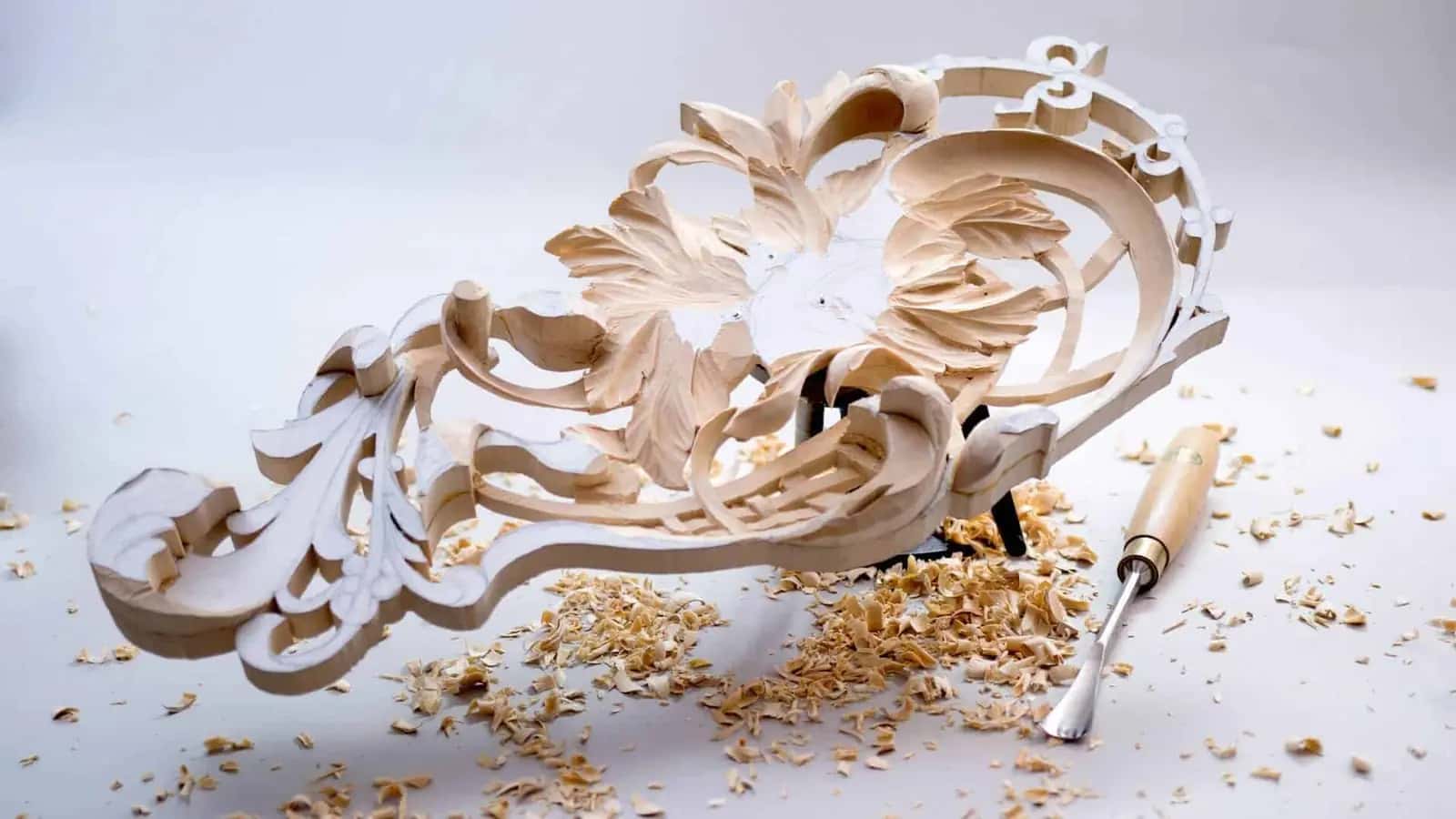
August 28, 2024 · Updated August 19, 2026
By Alexander Grabovetskiy — Master Woodcarver · Founder, School of Wood Carving · 17 min read
What does the crushing strength of wood mean?
The crushing strength of wood is the load it takes to squash the fibers along the grain until they fail. USDA Forest Products Laboratory puts American basswood at 4,730 pounds per square inch and white oak at 7,440. At the bench it decides one thing, whether your carving stays crisp.

Every hanging thread you see was a fiber I shoved sideways.
You finished a leaf tip on Sunday, and by Wednesday the rim had gone fuzzy again.
Most carvers open a hardness chart after that. Wrong chart. What beat you was compression, and the wood books call it crushing strength. Over forty years I have watched it ruin petal rims that looked finished, and buying a harder board never fixed a single one.
So the real numbers come first here. Then the bench habit that keeps fibers whole, which is worth more than any table.
- Crushing strength names the squash, never the dent.
- Downward pressure beats basswood at 370 pounds where lengthwise pressure needs 4,730.
- Bruised fiber rises again while you sleep, so a tidy looking pass can betray you two days on.
- The stropped edge parts fiber cleanly, and a tired edge shoves that same fiber off to one side and packs it down.
- Wet off the log, basswood gives at roughly half the load a dried plank of it carries.
Why does a finished leaf tip go fuzzy days later?
Pressing too hard bruises the fibers sideways instead of slicing through them, and bruised fiber swells back up after you have walked away. I say this mid-panel in a walnut workshop, with a knife in my hand.
I am not going deep with the knife. There are a couple of reasons why. The obvious one, I do not want to struggle with the harder wood, and yes, walnut is a little harder than lime wood and basswood. Going deeper is still possible. But when you press, those fibers smush both ways, and later on, even if you clean it nicely, those fibers are going to pop back. That is not good.

Look under my blade at the hairy fringe running the whole length of that undercut.
Smush is the word I use for it, and it is the right one. The fiber does not vanish. It folds over, packs down under the steel, and waits. A day later the wood trades moisture with the room, the packed fiber stands part way up, and your crisp rim has become a soft rim.
What does that number actually measure?
Compression down the length of the grain, on a short block squeezed end to end in a machine until the fibers buckle. The result arrives in pounds per square inch, psi for short.
The USDA Forest Products Laboratory Wood Handbook is the federal reference, and its current edition runs 543 pages. It defines compressive strength parallel to grain as the top stress a specimen holds when its length stays under 11 times its least dimension. Short and stubby, so it fails by squashing rather than bowing. The method is ASTM D143, the test for small clear specimens of timber, and ASTM D2555 sets how the published averages get built.

The broken patch here is what a squashed fiber looks like once the shaving comes away.
Now the part almost nobody quotes. The same chapter carries a second compression figure taken across the grain, and it is a different animal. Dried basswood holds 4,730 lengthwise. Sideways it gives up at 370. The federal text reports that across-grain figure at the proportional limit, because no clearly defined ultimate stress exists.
Thirteen times weaker. Your gouge presses in exactly that direction whenever you push down on a panel, so 370 is the number your carving really lives on.

One shaving, peeled in a spiral, still attached at the root.
Is crushing strength the same thing as Janka hardness?
Two separate tests, and the famous one says almost nothing about what happens under a gouge. Hardness is a dent test.
A steel ball 0.444 inches across, or 11.28 mm, gets pressed into side grain to half its own diameter, and that force is the Janka number. The Wood Database keeps the clearest write-up of the Janka method, which also predicts how hard a wood will be to nail, sand or saw. Basswood reads about 410 pounds, while the white oak entry reads 1,350 and lignum vitae reads 4,390. There is a whole page on what Janka hardness of wood means.
A dent and a squash are not the same failure. The ball test loads one small spot straight down, while a crush test loads a whole face down its length. Two more numbers wait behind those, bending strength and springiness. So a board can dent easily and still refuse to squash, and if you have been using density as a stand-in for strength, drop that habit first.

Three buds roughed to depth, every rim left ragged.
Here is something I still cannot explain, and people have asked me many times. My tools get dull a lot quicker on basswood than on oak. Kind of a paradox. Basswood is a much softer wood, it does not look abrasive at all, and it is really nice and smooth. Some woods really do carry abrasive inside the fibers. Basswood does not.

A bead chain along the rib is where soft wood either holds its edges or turns to fuzz, and this one held.
How much force does it take to crush the wood on your bench?
Between 3,960 and 10,180 psi across the species a carver is likely to own, a spread of about two and a half to one. Every figure below comes out of the Wood Handbook tables, measured on clear straight stock.
| The species on your bench | How much it takes to crush lengthwise, in psi on dry stock | Side hardness, in pounds | What the pair of numbers tells you once a gouge reaches the wood |
|---|---|---|---|
| Northern white cedar | Only 3,960, the lowest figure on the whole list | A mere 320 pounds | Bruises under a dull edge before it ever slices |
| American basswood, Tilia americana | A steady 4,730 on a board dried down to 12 percent | Just 410 pounds of force | Fibers smush sideways, then lift again a few days later |
| The same basswood, still green | Only 2,220 with the sap still inside it | Down at 250 | Half of what dry stock holds |
| Quercus alba, the white oak | A solid 7,440, measured by the very same method | Over three times basswood, at 1,360 in the federal table and 1,350 in the Wood Database | Crunchy, and it fights every fine detail |
| Teak, Tectona grandis | 8,410, one step above white oak | Right at 1,000 pounds | Silica in the wood dulls edges fast |
| Black locust heartwood | 10,180, over twice basswood and the hardest here to squash | Fully 1,700 pounds | Blunts good steel and shrugs off a heavy mallet |
Read the bottom row against the second one. Locust takes 2.15 times the load basswood takes before its fibers give, and the wood database puts black locust at 10,200 with a moderate blunting effect on cutting edges. Fair warning. Teak sits above oak here and carries up to 1.4 percent silica, so the teak profile flags a pronounced blunting effect too. Yet the cedar entry sits at the bottom, softer than basswood, and still resists rot better than most. Strength and durability are separate properties.

Four hollows scooped into the blooms, with loose chips still sitting inside them.
One thing the word hardwood will never tell you. Hardwood and softwood are botanical labels, and the federal text says plainly that not all hardwoods have hard heavy wood. Basswood is a hardwood, and also among the softest boards you can buy, which is why the woods that are genuinely hard to carve surprise people. The rest of that sits under softwood against hardwood for carving and in what makes one wood less dense.

Those walls are still square, so you can read how much stock is holding every shape up.
How hard should you strike, and what does the blow cost the tool?
Hard enough for that one small area, which is a judgment you make blow by blow rather than a setting you dial in once. On the recordings you can hear me deciding, mid-panel.
Actually, you know what? I could hit harder here, I think. It is a strong area.
In another workshop the answer flips, because the grain has turned. Be careful on this part, the grain goes this direction, and that is kind of weak, so you have to keep an eye on how hard you strike when you are using a mallet. You can easily break it. Over a sunken background the rule shifts again, just make sure you do not strike too heavily.

No mallet anywhere in this shot, because a guided push does most of the deep work.
Oak asks for something else. Oak is a harder wood, and to carve oak you most likely have to use a mallet. You really have to use a mallet. And depending on how heavy that mallet is, you have to establish the bevel, how you want to hit. Two weights live on my bench, a light 12 ounce and a heavy one around 32 ounces. A half pound brass mallet sits beside them.
The bevel is where hard wood punishes a careless tool. Make a really long bevel and that metal becomes really weak at the point. Use it on oak or on cherry and it gets a little dangerous. Not all oaks match, either. Brown oak is a little softer than white American oak, and red oak is also really hard wood. So for hardwoods I keep a really short bevel.
Eight minutes of me showing the short bevel I grind for hard wood, and nothing in it measures a strength number.
My heavy mallet is rubber faced, and that choice is about the edge. I can bang with that mallet with no problem, really heavily, and I am not damaging my tool at all. That head absorbs the stroke itself. With a traditional wood mallet all the stroke goes into your hand and you feel it. Still deciding? There are pages on whether you need a mallet for wood carving and on what a carving mallet actually is.

That post stand takes a load my shoulder would otherwise fight.
Sometimes the resistance you feel has nothing to do with the wood. When you have a rounded bevel on the outside, it is much, much harder to carve. Much harder to push through the wood, believe me. So look hard at the steel before you blame a board.
Where does crushing strength decide a whole carving?
Four places live or die on it, and all four sit where the wood has almost nothing left underneath. The worst offender is an undercut petal. A lattice bar with air on both sides comes next, then a background you mean to punch, and then any long element running crossways to the grain.

Three blue pencils and a drawing, and every reach in that scroll is already decided here.

Barely wider than the blade working them, and each bar carries its own weight now.
Take the ground away and every surviving strand becomes a small beam held at two points, sometimes at one. Press on it and nothing beneath pushes back, so 370 stops being trivia and starts being your Wednesday.
David Esterly hit this too. In The Lost Carving he describes the Gibbons overmantel he recarved after the Hampton Court fire, where he found period leaves whose backs had been cut away so hard that the gouge came through the front face in places. Three hundred years old. Same failure as yours.

My jeans show through every opening in that finished panel.
A punched background is the odd one, because there I want the crush. I still have to consider that I am going to use punches later to make my background, and that is going to push down and compress some fibers, and it is going to end up a little lower. So I barely remove any wood there, and it stays almost the same height as my border.

Each petal edge throws its own shadow now.
Grain slope is the other killer, and it is arithmetic rather than bad luck. A 2020 study in the journal Materials found that a 15 degree grain deviation dropped strength by 60 percent in ash and 56 percent in hickory. Energy absorption fell by half or worse in all five species. Fifteen degrees is nothing. A scroll turns that much in half an inch, which is how the strongest wood on paper still crumbles in a tendril, and why even the densest wood ever measured could not save it.

Count how far that top bloom reaches past its own base.
Spoon bent tools do the undercutting, and the whole game is keeping your palm off the finished surface, which is the habit the low relief workshops drill hardest.

My left finger stays behind that ribbon, doing the job the missing ground used to do.
How do I test a board before trusting it with a thin petal?
Take two offcuts off the same plank, work the first with a stropped edge and the second with a tired edge, then come back tomorrow. No laboratory needed. One honest answer about this board is enough.
Step 1, plane two offcuts off the same plank to your finished thickness
Same board, as near the same growth rings as you can manage, and a strip an inch wide by a hand long will do. Mark the face that was up.

Those pencil numbers are my depth levels, 2, 3 and 4, written before any modeling.
Step 2, press a gouge corner into the end grain, then into the flat face
Same pressure both times, and pay attention to your own hand. Lengthwise the wood pushes back hard. Straight down it sinks. You have just felt the gap between the two numbers the handbook prints, 4,730 one way and 370 the other, without owning a testing machine.
Step 3, slice a trough with each tool
Strop the first gouge until its edge throws back no light. The second one stays exactly as it came off the bench after an hour of work. Then slice a shallow trough in each offcut, same wood, same angle, same push.

Two fingers pointing at the roses I skipped.
Step 4, come back tomorrow and read both troughs again
This is where the honest answer lives. That first trough looks the way it looked yesterday. The tired one has grown a soft fringe along both walls, because fibers that folded over stood part way back up overnight.
Step 5, mark the board you trust and shelve the other one
A pencil circle and a date is plenty. Wood that fringes in a scrap will fringe worse in a petal 40 hours in, and an offcut teaches you that for free.

Chips packed into the bud I am working right now.
How far off the table can one real plank sit?
Those figures describe flawless little sticks, and your plank came off a tree in a hurry. The variation starts inside one board and it never stops.
Sometimes the wood itself changes on you, the density or the softness, even within one species. I mean the same lime wood. Even with the same lime wood you see variations of softness, and you can see the color changing. This is a lighter color against this darker color, and on the darker color here the wood is a little softer. Kind of mushy, and you can tell by the color. Which is absolutely okay.

That yellow line along the thickness is glue, because this blank is two boards joined.
Water moves the figure further than species does. Green basswood crushes at 2,220 and dry basswood reaches 4,730, so drying more than doubles it. Most properties in those tables climb as moisture content drops below the fiber saturation point. Wood also never stops trading water with the room, which is what equilibrium moisture content means, and that relationship has been in print since before 1920.

Several depths at once, each with a wall left square, and that knife handle has an olive tint.
Then there is rot, the quiet one. By the time decay has taken 10 percent of a board's weight, most strength losses exceed 50 percent, and a microscope is the only way to find it at that stage. Toughness starts dropping at 1 percent weight loss. A board can look perfect, smell fine, and have half its crush strength gone already.
Long soaking does its own work. A federal research note on century-old bridge piling found red pine sitting well under its book strength after decades under water, while two other species pulled from the very same lot came out almost untouched. Species decides what a long soak costs you, and of those three the red pine paid the most.

Leaf edges have started lifting off the ground.
None of that makes the published figure useless. It makes it a starting point, and the same values print in the 2010 edition of the handbook. What changes your outcome is the edge and the direction of the push. Never the species on the invoice.

My hand presses on the solid primed area, well away from the thin lattice bars.
Two more pages belong beside this one. The elastic modulus tells you about springback and modulus of rupture tells you where a part finally breaks, plus a short note on bending strength as a measured property. Crushing ruins a surface you thought was done. One page covers walnut as a carving wood, one on the honest reasons carving is hard, species notes in the wood guide, and the white oak work on my blog.

The brass collar holds that block dead still.
Have you pressed a gouge and felt the wood give without a shaving coming off? Did you ever find a finished petal standing up fuzzy a week later, after the tools were already put away and you had told somebody the piece was done? Do you know which gouge in your roll is the tired one? Then this number is not trivia for you, and the whole path, first blank through pierced panel, is laid out inside the course library.
I would rather you ruin two offcuts on purpose this weekend than lose a rim at hour 90.
Frequently asked questions
What counts as a good crushing strength for a carving wood?
Around 4,700 psi suits most relief work, which is where American basswood sits. Cedar down at 3,960 bruises sooner under a tired edge. Oak up at 7,440 resists the squash and then argues with every fine detail, so a higher figure buys a trade rather than an upgrade.
Does crushing strength change while a board dries?
Drying more than doubles it. Green American basswood tests at 2,220 psi, and the same species dried to 12 percent moisture reads 4,730, per the Wood Handbook tables. Every published figure names the moisture it was measured at, so check that line before setting two tables side by side.
How is crushing strength different from modulus of rupture?
Squashing takes a short block and loads it until the fibers buckle, while rupture bends a longer stick until the stick snaps. American basswood reads 4,730 psi on the first test and 8,700 on the second. A carver meets the squash far more often, because a gouge presses rather than bends.
Can I stop the fibers from popping back up later?
Sharpen first, then lighten the push. A stropped edge severs fiber instead of folding it, and a shallower pass leaves less bruising behind to rise. Where a background will be punched, leave the wood high on purpose, since the punch compresses fiber and lowers that surface for you.
Why does basswood bruise so easily if it is a hardwood?
Hardwood is a botanical word, not a strength word. The Wood Handbook says outright that not all hardwoods have hard heavy wood, and basswood proves that at 4,730 psi with 410 pounds of side hardness. It grows on a flowering tree, so it counts as a hardwood, and a thumbnail still dents it.
Does a heavier mallet crush more wood?
A heavier head does more work per blow, so a careless blow does more damage. Mine runs about 32 ounces, with a 12 ounce for light work, and the rubber face matters more than the weight, since it absorbs a stroke that would otherwise reach my wrist and my edge.
Filed under
- applications of wood crushing strength
- basswood vs other types of wood
- best type of wood for carving
- best wood for carving
- carving wood blocks for beginners
- choosing wood for carving projects
- common wood types and their strength
- comparing hardwoods for carving
- crushing strength in wood explained
- factors affecting wood strength
- grain direction effects on wood
- how to measure wood crushing strength
- ideal wood for detailed carving
- importance of wood crushing strength
- moisture content and wood strength
- Understanding Wood for Carving
- understanding wood properties for carving
- which wood is best for carving
- wood blanks for carving
- wood carving techniques
- wood strength ratings explained