
August 3, 2026
By Alexander Grabovetskiy — Master Woodcarver · Founder, School of Wood Carving · 12 min read
Wornum's Analysis of Ornament, read at the bench
By Alexander Grabovetskiy, International Woodcarver of the Year. Updated August 2, 2026.
Quick answer: Analysis of Ornament is Ralph Wornum's course on the history of ornamental art, first printed in 1856, and it sorts three and a half thousand years of ornament into nine styles. I keep sending carvers to it because nothing shorter does the same job. The book is out of copyright and free to read.
You save photos of carving you love. Folders of them, maybe years of them. And when you pin one to the bench and copy it, the leaf comes out clean and the whole panel still looks off, and you cannot say why, because you do not know what the ornament in the photo was doing before you borrowed it.
I know that wall. Every serious carver hits it. Ten more years of practice will not move it either, because the missing piece is not practice. You are missing names.
There is a book for this, and it costs nothing. One hundred and seventy years old, written for design students who worked for a living, and short on purpose. Below is who wrote it, what it is actually for, who cut its pictures, how it is organised, whether it still holds up, and where your free copy is waiting tonight.
What should a carver know before opening it?
Six facts put the whole book in your hand.
Ralph Wornum wrote it as the abstract of lectures he gave to Britain's design students in 1848, 1849, and 1850.
First edition, 1856. What everyone reads now is the free 1860 second edition.
It sorts all ornament into nine styles. Three groups of three.
Female students at Marlborough House cut the plates, working from the Department's casts.
The principles and the style tests still hold. Its archaeology is 1850s work and has moved on.
Getty Center Library owns the scanned copy, and the Internet Archive gives it away free.
Who was Ralph Wornum?
Ralph Nicholson Wornum ran the National Gallery in London as its Keeper and Secretary, and before that he was the man Britain paid to teach ornament to its design students. Both jobs sit on the title page of the 1860 edition. Chapman and Hall published it from 193 Piccadilly, and the date is set in Roman numerals, MDCCCLX.
Lectures came first. Between 1848 and 1850 he delivered them in the Government Schools of Design at Somerset House and in the provincial schools across England, Scotland, and Ireland, then again at Marlborough House under the Board of Trade's Department of Science and Art. His other job was keeping the Department's library. So the man telling students which books to study was the same man handing those books across the desk.
Keep one date in your pocket. Wornum died in 1877, and that is the reason every page of this book now belongs to you.
What is the book actually for?
It is the printed abstract of a lecture course, built to send a student into the big illustrated folios with a system already in his head. Wornum says so in the preface, dated July 1855, and the honesty of it is refreshing. Never once does he claim the book is complete. Just a guide to the standard authorities, he says, never a replacement for them.
His problem in 1855 sounds familiar. Illustrated books on ornament existed in great profusion, his words, but each one covered a single monument or one narrow slice of time. All pictures, no analysis. Learning the characteristics that make a style a style took what he calls great labour, across costly folios most students could never touch. So he compressed three years of lectures into about 112 printed pages that tell you what to look for before you look.
Swap the folios for an image search and nothing has changed. A thousand saved photos, still loose. This little book is the map, and your photos are the territory. You need both. Only the map ever goes missing.
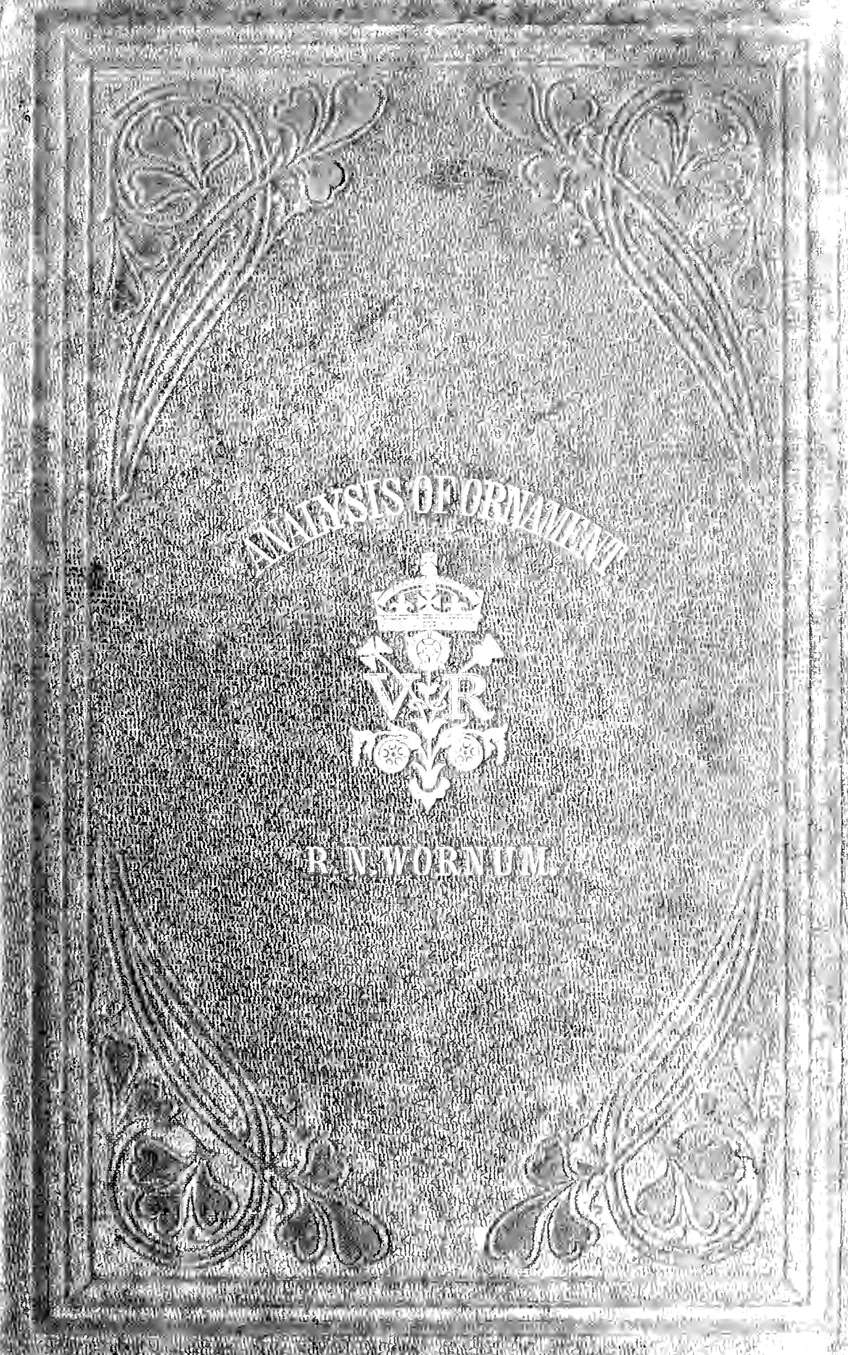
The 1860 second edition, a small book on purpose. Lecture notes in print, not a treatise.
Who cut the illustrations?
Female students at Marlborough House cut most of the blocks, working from casts in the Department's own collection. Right in the preface he credits them, plainly, as a class and by their place of work. In 1856 that credit was not a small thing.
Think about what the work was. A block of end-grain boxwood, a graver, and a drawing that has to survive the cutting. Teaching women a print trade that paid was the point of that class, and these plates are their work. Students learning one cutting trade, making the plates that would teach students of another. And some of them signed their blocks in the corner, the way any tradesman proud of a clean job signs it. Their signatures survive in the scan.
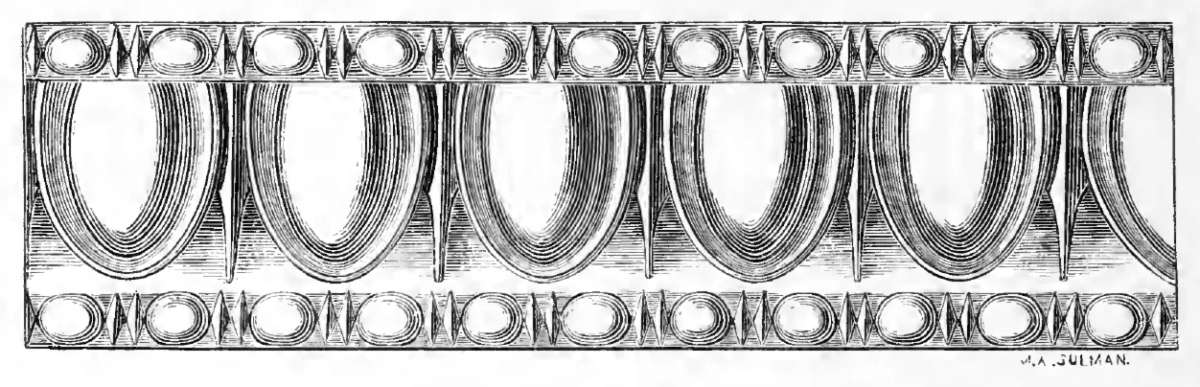
Echinus and astragal from the Erechtheium, cut into an end-grain block. Look in the corner, the student who cut it signed it, and the name is still there.
Casts they copied belonged to the Department's collection at Marlborough House. That collection moved to South Kensington a year after the first edition and is the Victoria and Albert Museum today. So the plates in your free PDF are three steps from the stone. Stone to cast, cast to block, block to page. Every step was cut by hand.
How is the book organised?
Four chapters of principle, then nine styles in three groups of three, then a conclusion that walks the whole line again in five pages. That is the entire architecture. You can hold it in your head after one reading, which is exactly what he built it for.
Here are the nine, in the book's own order. Egyptian, Greek, Roman for the ancient world, then Byzantine, Saracenic, Gothic across the middle thousand years, and the modern three, Renaissance, Cinquecento, Louis Quatorze. Together they cover upwards of three and a half thousand years. Under several of them he files the varieties. Doric and Alexandrian sit under the Greek, the severe and the florid. Byzantine carries the Romanesque, Lombard, and Norman. And the Louis Quinze and the Rococo he files as debased varieties of the Louis Quatorze. Debased is his word, and he means it.
Two of his rules do most of the work in that chapter. First, style is only another name for character. A style is what a piece of ornament keeps doing, not where it hangs or what it cost. Second, style is not date. A carving belongs to a style when it carries the characteristics, and plenty of work from any period carries none at all. Every carver who has been told his Baroque panel is wrong because it was cut last winter can hand that argument straight back.
Bench work starts in the style chapters. Greek carvers cut Acanthus spinosus, the narrow prickly leaf. The Romans took Acanthus mollis, the soft broad one, the brank-ursine, and built their whole scroll vocabulary on it. I put those two leaves side by side, with the gouge cuts that follow from each, in Greek versus Roman acanthus.
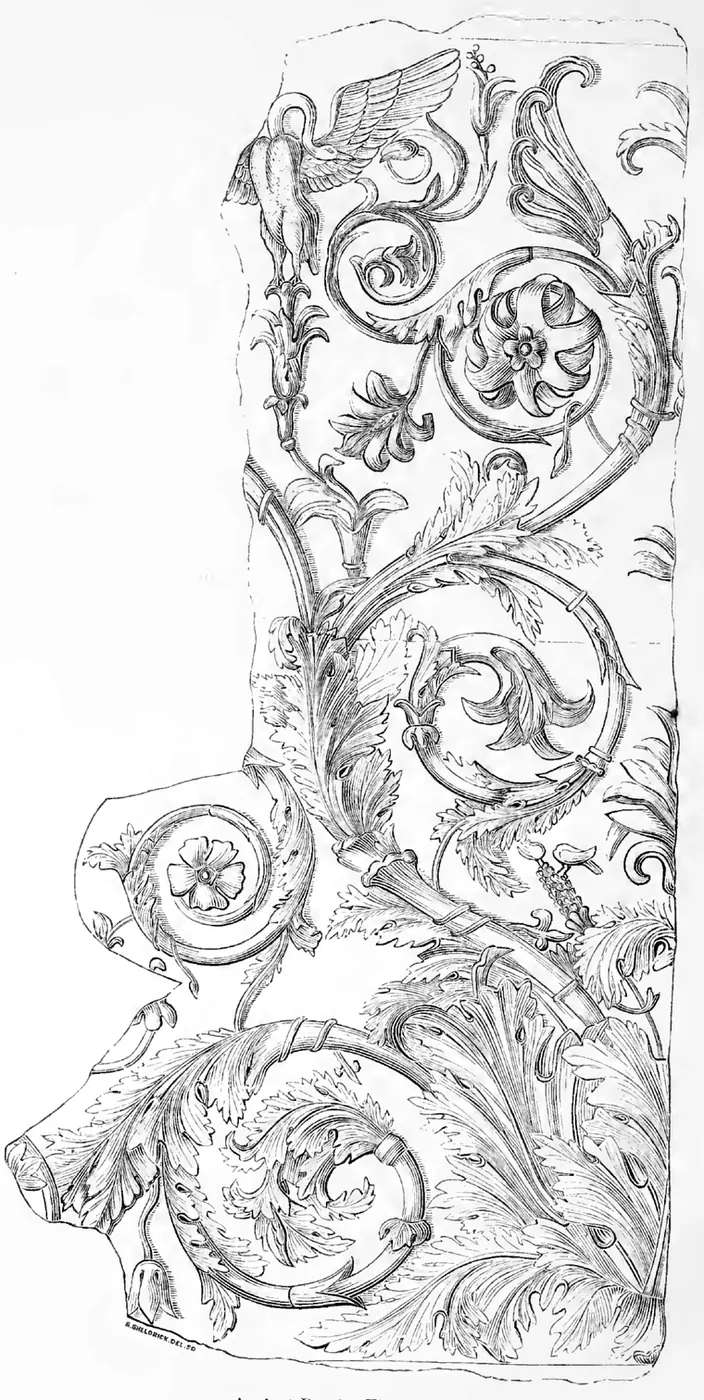
Frontispiece of the book, a Roman acanthus pilaster. Wornum calls the scroll and the acanthus the most Roman things in the whole vocabulary.
Here is the map I use, by PDF page of the free scan. Trust the PDF numbers, not the printed ones. The plates sit between pages without numbers of their own, so the printed count drifts as you go.
If you want | Read | PDF pages |
|---|---|---|
The principles, what makes ornament work at all | Chapters I to IV | 11 to 31 |
The nine styles and the three periods | Chapter V | 35 to 36 |
One style carved deep, the Roman acanthus and scroll | Chapter VIII | 63 to 78 |
The quick tests that name a style | The date rule, then the per-style tests | 36, 73, 119, 136, 152 |
The case against copying nature straight | Chapter II | 14 to 20 |
The whole book in five pages | The Conclusion | 166 to 170 |
Is it still worth reading?
Yes for the principles and the identification tests, and no for the archaeology, which is 1850s work and has moved on. That is the honest split, and it is the same split I would give you for any book this old.
The part that aged best is the part carvers still get wrong. Chapter II takes apart what he calls the naturalist school, the belief that copying a beautiful natural object closely enough guarantees a beautiful design. Fashionable London shops of his day were selling a gas jet with the flame coming out of a flower, a basket riding on an animal's head, a bell made of leaves. He calls the results aesthetic monstrosities, and worse. His point is structural. Ornament is an accessory. The moment the leaf stops decorating the spoon and becomes the spoon, the design is false no matter how true the leaf.
I see the same failure every month, one hundred and seventy years later. A student carves a leaf from a photograph, every vein in place, and nails it to a frame it has nothing to say to. Clean leaf. False panel. Wornum named the disease before your great-grandfather was born.
Where does the disease come from? He tells you that too. At the Great Exhibition of 1851 the prevailing English taste was Louis Quinze and Rococo, in silver, in wood-carving, in carpets, in damasks, even in lace. Nobody chose that. Designers without history could only copy their neighbours, so the whole trade drifted together. He answered with knowledge. His conclusion carries the one line I have never improved on. Real knowledge of the styles, he writes, is not the mere copying of what has been done before. Wornum calls it a power that supersedes all copying.
That line is the whole reason this post exists. Copying against understanding. Pick a side.
I do not read a book like this as gospel. For me it is a record of what was already solved, so I stop solving solved problems on my own time. My great-grandfather carved mahogany in the Chippendale style, and Chippendale reached his workshop as a book of plates, the Director of 1754. A good book travels farther than the man who wrote it. When I wrote out the scroll failures I keep seeing in student work, in carved acanthus scroll mistakes, half of my bench notes were already sitting in his Roman chapter, said in 1856 words.
Now the limits, because trust is built on them. His Egyptian and Assyrian chapters lean on what had been dug and argued by the 1850s, and the digging did not stop in 1860. And his rankings are Victorian. He crowns the Cinquecento the most perfect style and files the Rococo under absurd, which is a position, not a law. And he stops before Art Nouveau existed, so the last century and a half of ornament is simply not in the book. Keep the principles, check the dates somewhere newer.
Where do you get it?
Free from the Internet Archive, and the copy to take is the Getty Center Library's 1860 second edition, digitised in 2013. Grab the PDF, or read it online, at Analysis of Ornament on the Internet Archive. The identifier is analysisoforname00worn, and every page number in my table above points at that exact file, 174 PDF pages with all the plates. On the last page sits the Getty's stamp, barcode and all. Neither keeper charged you a cent. The Getty held the book safe for us, and the Internet Archive scanned it. So thank you to both.
Then read it the way it was built to be read.
Start with the four principle chapters, PDF pages 11 to 31. One evening covers them.
Read one style chapter at a time, and after each one pull up photographs of real carved work and name what you see out loud.
Save the conclusion for last, then reread it every few months. Those are the best five pages in the book.
This book trains the eye. The hand is a separate schooling. Space, rhythm, repetition, the laws his principle chapters point at, are the first pillar of the craft, and they are what I teach in principles of design in wood carving.
Do you have a folder of carvings you cannot put a style name to? Have you ever cut a leaf that was right in every slice and still wrong as a whole? Would you give one evening to fix that? Your copy is waiting, and the first four chapters cost you nothing but the evening.
Frequently asked questions
Is Analysis of Ornament in the public domain?
Yes, the whole book is public domain everywhere in the world. Ralph Wornum died in 1877 and the book appeared in 1856, so every edition is out of copyright. You can read it, print it, and reuse the plates freely. The scan on the Internet Archive is the Getty Center Library's copy, and crediting them costs one line.
Is this the same book as The Grammar of Ornament?
They are different books from the same year. Owen Jones published The Grammar of Ornament in 1856 as a giant folio of colour plates with his design propositions up front. Wornum's Analysis of Ornament is the opposite tool, a short history course that tells you what you are looking at. Read Wornum first for the system, then go to Jones for the plates.
Which scan of the book should I download?
Download the Internet Archive copy with the identifier analysisoforname00worn. The file is the Getty Center Library's copy of the 1860 second edition, scanned in 2013, and it runs 174 PDF pages with every plate included. My reading map above uses that file's page numbers, so the two will match exactly.
How long is the book?
The text runs about 112 printed pages plus the plates, because it is the abstract of a lecture course rather than a treatise. Its four principle chapters read in one evening. Each style chapter is short enough to finish and then test against photographs of real carving on the same day.
Filed under
- acanthus carving
- Acanthus Carving
- Analysis of Ornament
- architectural ornament
- Art Reference Books
- carving design
- carving inspiration
- carving reference book
- Carving Techniques
- Classical Ornament
- decorative arts
- decorative arts history
- design principles
- Design Principles
- Gothic Carving
- Gothic ornament
- Greek ornament
- historic ornament
- ornamental art
- Ornament History
- public domain books
- Public Domain Resources
- Ralph Wornum
- Renaissance Carving
- Renaissance ornament
- Rococo carving
- Rococo ornament
- Roman ornament
- Victorian design education
- wood carving
- Wood Carving
- Woodcarving Education
- woodcarving styles