
August 1, 2026
By Alexander Grabovetskiy — Master Woodcarver · Founder, School of Wood Carving · 12 min read
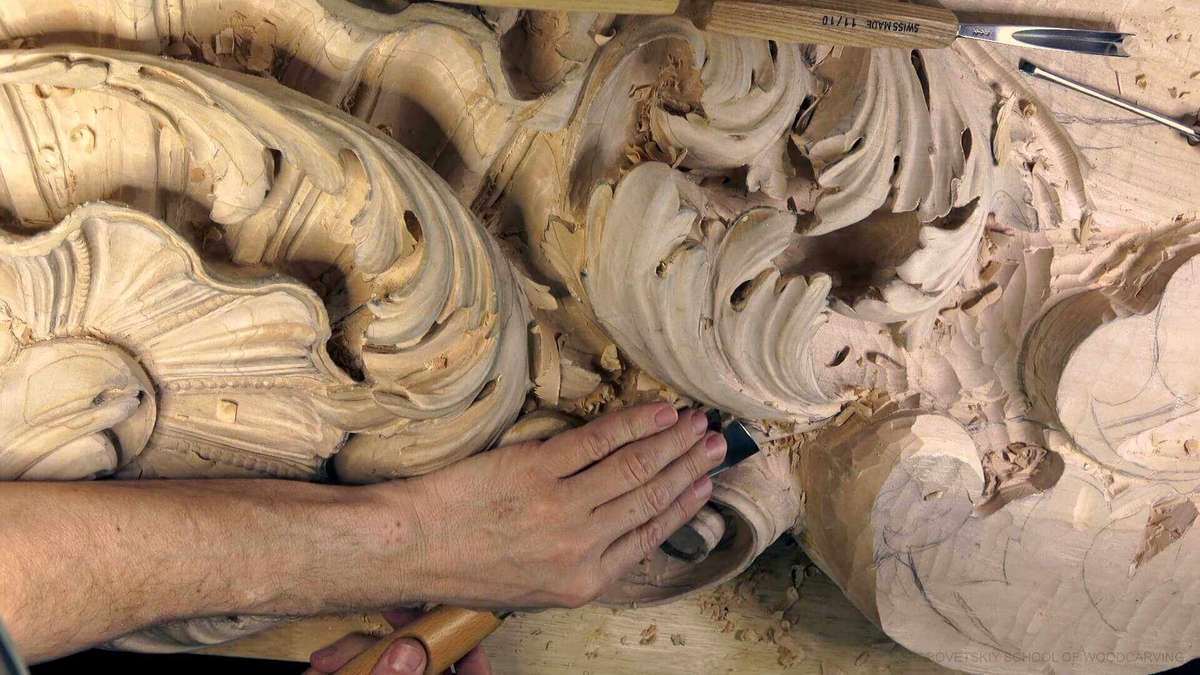
Why Your Carved Acanthus Scroll Looks Wrong
By Alexander Grabovetskiy, Woodcarver · Updated August 1, 2026
Quick answer: A carved acanthus scroll that looks wrong is almost always a stem problem, not a leaf problem. Real foliage thickens where the load is heavy and thins as the load drops. Ralph Wornum counted that thinning among the real beauties of foliage. Cut every stem one width and the whole panel goes dead, no matter how clean your leaves are.
You carve the leaves well. The eyes are clean. The lobes flow, the undercut is crisp, and the light sits down in the hollows the way it should.
Then you stand back six feet and the thing looks like a rope.
You cannot point at any one cut and call it the mistake, yet the whole panel sits there wrong. I have watched students go back into a panel three times, sharpening, then re-cutting, then deepening, then sharpening again, and every pass makes it worse, because they keep fixing the part that was already right.
The fault is under the leaves. It is the stem.
The law that fixes it is below, and so is the one place where the law does not apply. Wornum caught Raphael's own shop breaking it, so at least you are in good company.
Key takeaways
Most scroll faults live in the stem, and the leaves take the blame.
The greater the burden, the thicker the stem. As the burden drops, the stem thins.
A running scroll on a molding does not need the taper. A completed, framed scroll does.
Weight sitting on a tendril too thin to hold it reads as wrong even when nothing was copied from nature.
Set your stem widths on paper before you draw one leaf.
What is the tapering stem law?
The greater the burden, the thicker the stem, and the stem has to thin as its burden drops. Ralph Nicholson Wornum printed that law in Analysis of Ornament, second edition, London 1860, and his own wording is worth having: "Natural foliage teaches us that the greater the burden the thicker the stem." He goes on to say the slow thinning of a stem as its load falls away is one of the real beauties of foliage. Notice where he filed that. Under beauty.
Go outside and look at any vine on a fence. Down at the root it is a thumb thick, because it carries everything above it. Up at the tip, where it holds one small leaf, it is thinner than a pencil lead. Nobody had to teach you this. You have been looking at it your whole life and your eye knows it cold, which is exactly why a scroll of one even width the whole way up feels wrong before you can say why.
Wornum tested the law against the best carving in Europe. He found it "admirably observed in nearly all the best examples of the Cinquecento, especially in the sculpture."
When I was sixteen I was the only apprentice to a fine-art master in Russia. The lesson that never left me is that design is not drawing on paper. Design is the laws of space, rhythm, repetition, and understanding the tools. He taught me to think like a tool. This stem business is one of those laws of space, and it is why a good drawing beats a sharp gouge every time.
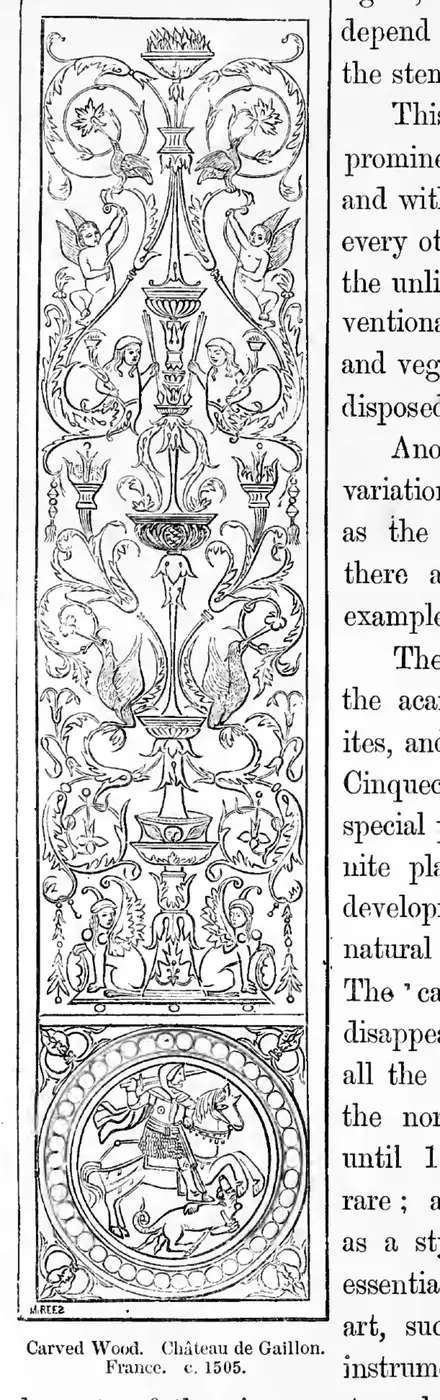
Carved wood from the Chateau de Gaillon in France, about 1505. The stem is heavy where it carries and thin where it stops carrying.
Why does a running scroll not need it?
A continuous scroll is indeterminate, so no piece of the curve carries more than any other piece. Wornum is precise here, and most carvers skip right past it: "in a continuous scroll we do not require this variation of thickness, as it is a mere ornamental repetition, every portion in itself being complete."
A running scroll along a cornice can hold one stem width for twenty feet and look perfect. It has no start and no finish. Nothing is loading anything.
Which is how good carvers get burned. You lift a detail off a frieze, drop it into a framed panel, and the rule changed on you without a word.
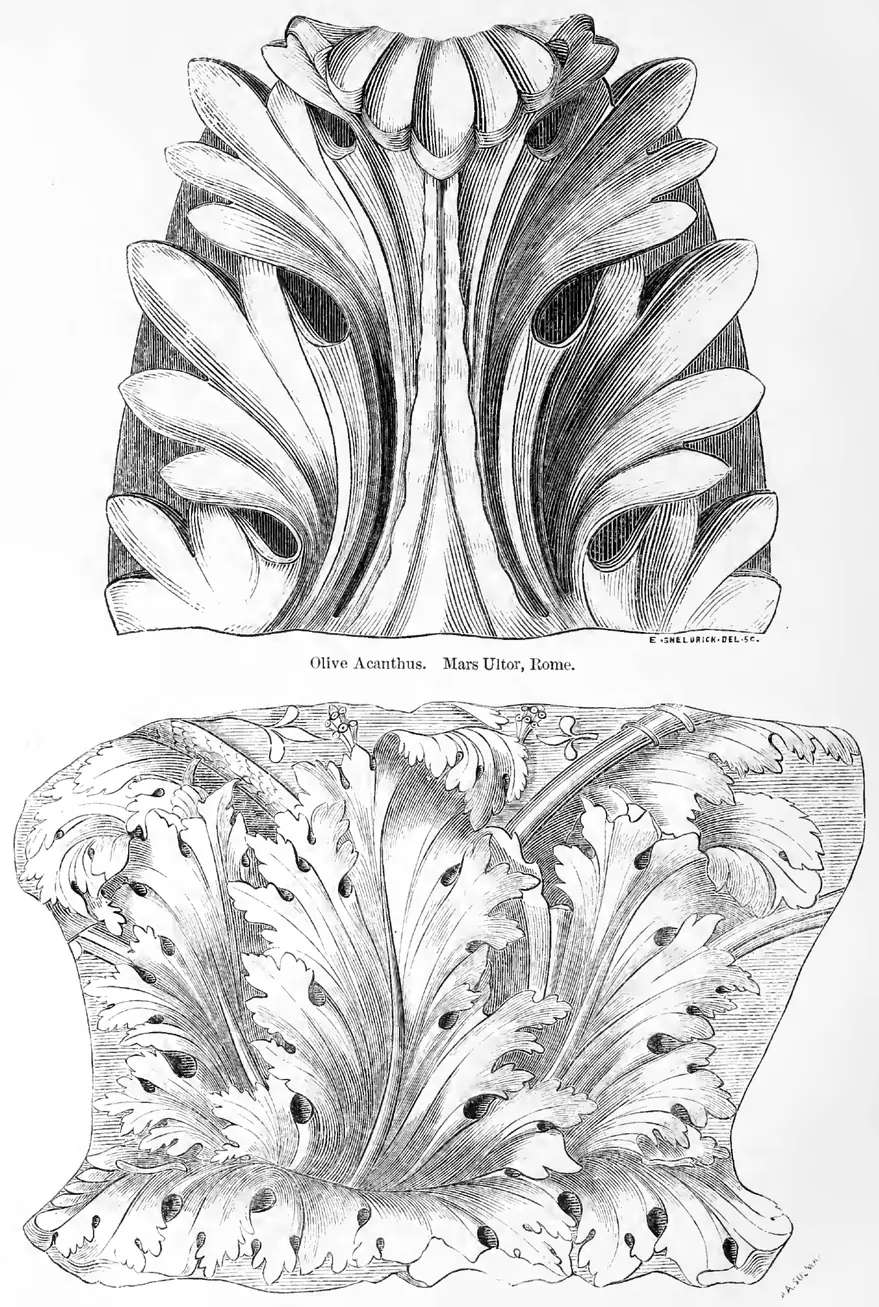
Wornum labels his plate of the Florence panel below "Nest of Scroll. Ancient Panel, Florence." He gives no date and no building, and whoever cut it left no name.
Nest of Scroll, an ancient panel in Florence. This one runs on with no root and no tail, so a single stem width is correct.
What is the difference between a scroll and an arabesque?
An arabesque scroll is completed. It is a determinate figure, and its lightness depends on the proportions of the stem. Wornum again: "in the arabesque curves the scroll or spiral is always completed; it is a determinate figure, and its elegance or lightness will depend upon the relative proportions of the stem."
Running scroll | Completed scroll or arabesque | |
|---|---|---|
Where it lives | Cornice, frieze, molding, border | Panel, pilaster, cartouche, door stile |
Beginning and end | None. Cut it anywhere and it still reads | Yes. A root at one end, a tail at the other |
Stem thickness | One width is fine | Has to taper, thick at the root |
What carries the load | Nothing. Every part is equal | The stem below every leaf and flower |
Fails when | The curve spacing wanders | The taper is missing or backwards |
What else breaks a scroll?
Weight on a tendril that could never hold it. Wornum does not call that improbable. He calls it offensive: "mechanical disproportions and impossibilities, violations of the most palpable laws of gravity, cannot be otherwise than offensive."
He starts out generous, and the generosity is what makes the judgment land. A carver has his licence, he says. Carve a griffin. A chimera with a lion's body is fine too. Nature is not the test, so the monster is allowed: "There need be no limit to our chimeras, for nature is not their test." Then the knife goes in: "but if we combine monsters in our scrolls, or place animals upon the tendrils of plants, we should at least proportion them in size to the strength of the stem or tendril upon which they are placed."
So the impossible animal passes. The impossible engineering underneath it is what he throws out of court.
Wornum compares the bad feeling to a discord in music, and that comparison is exact. I carve to Mozart, Vivaldi and Bach for hours at a stretch, or to an audiobook once the carving turns automatic. One wrong note and your whole body knows it, even if you could not name the interval to save your life. A fat cluster of grapes hanging off a stem the width of a wire does that same thing to the eye.
Did Raphael get it wrong?
In places, yes. Wornum says some of the Vatican compositions are, "from their mechanical absurdities, ludicrous and offensive." He is talking about the Loggie, Raphael's design, painted by Raphael's shop.
Then the story turns. Giovanni da Udine and Giulio Romano executed those Loggie. The same two men later did the Villa Madama in Rome and the Ducal Palaces at Mantua, and about that later work Wornum writes that "many of the licences in the Vatican arabesques have been in a great measure avoided," and that "the scrolls are particularly fine."
They learned it. On the job, after the famous commission. Not completely, either, because Wornum still catches the fault here and there in the Mantua rooms, and he calls those designs the standard types of the cinquecento arabesque anyway.
He also says Pliny and Vitruvius made this same complaint about the arabesques of Pompeii, the better part of two thousand years before him. Raphael's shop just joined a very old line.
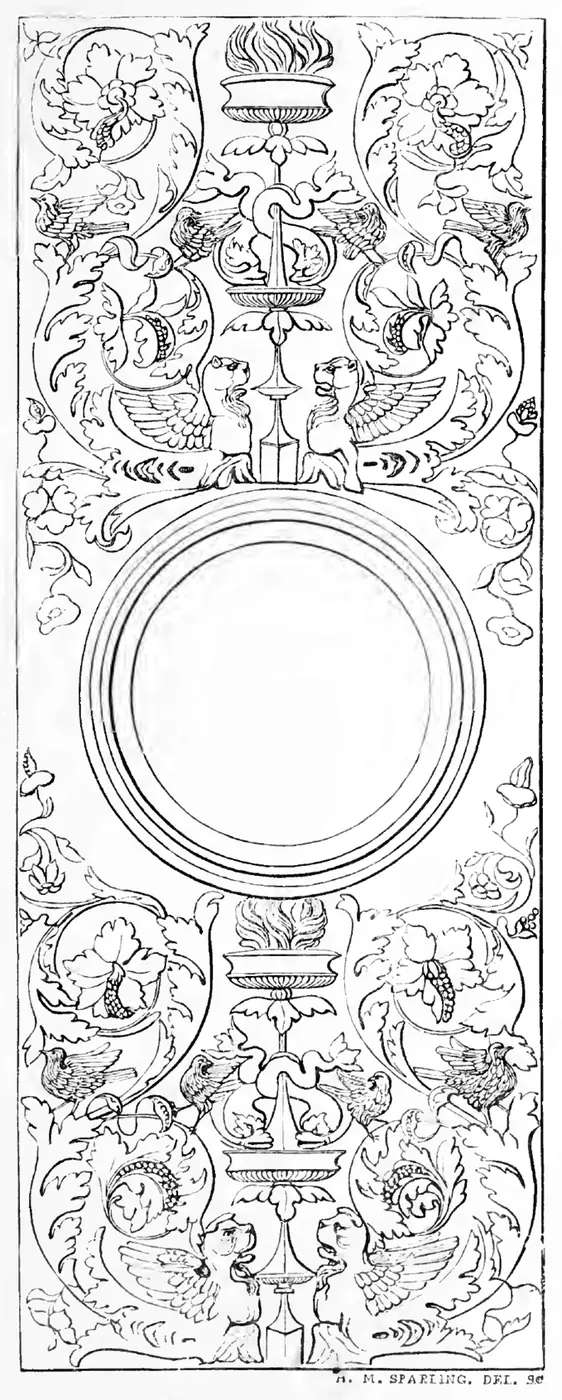
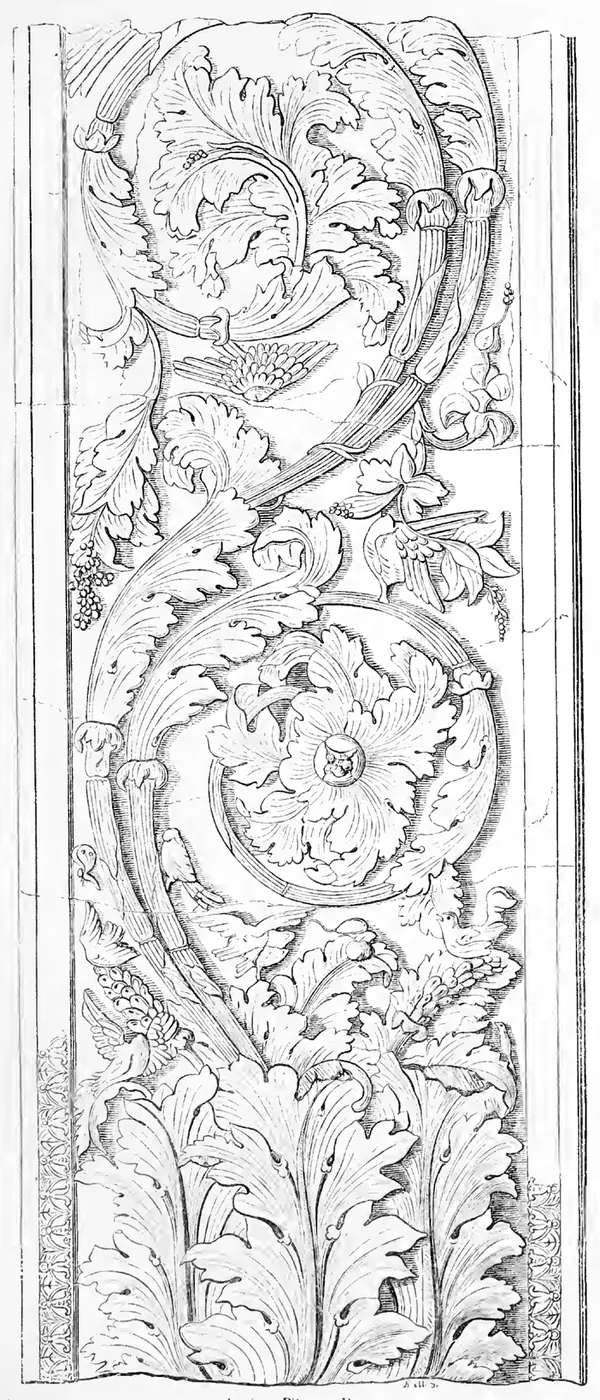
A Cinquecento pilaster panel. Every spiral closes, and every stem gives up thickness as its load falls away.
How do you fix it at the bench?
Set the stem thicknesses before you draw a single leaf. Steps 1 through 5 happen on paper. The wood comes last, and that order is the entire fix.
Step 1. Decide which kind of scroll you are carving
Running or completed. If the design has a root and a tail, it is completed, and the taper is not optional. If you could cut it in half anywhere and both halves still read, it is running, and one width is fine.
Step 2. Mark the root and the tail
The root is where the whole thing grows from. The tail is the last curl. Everything between them gets thinner in that direction, so draw an arrow on the paper showing which way it grows. You will thank yourself in three days when the drawing is upside down on the bench.
Step 3. Draw the stem alone, as one line
Just the spiral, with no leaves and no flowers on it yet. Then set three widths on it with dividers, at the root, at the middle, at the tail. On a panel scroll I use roughly 1, then 0.6, then 0.35, but check that against your own load instead of trusting my number. If dividers are not yet part of your layout, start with carving layout with dividers.
Step 4. Hang the load on the drawing
Now hang everything on it, the leaves, the flowers, whatever bird or beast the design calls for. As you place each one, look straight down at the stem underneath it. If a heavy thing sits on a thin stem, either the thing shrinks or the stem grows. There is no third answer, and pretending otherwise is how a panel ends up busy and dead at the same time.
Step 5. Squint at it
Stand back and squint until the detail disappears and only the masses are left. If a mass looks like it would fall, it will look that way in wood too, only worse, because wood adds real shadow to the argument.
Step 6. Cut the stem before the leaves
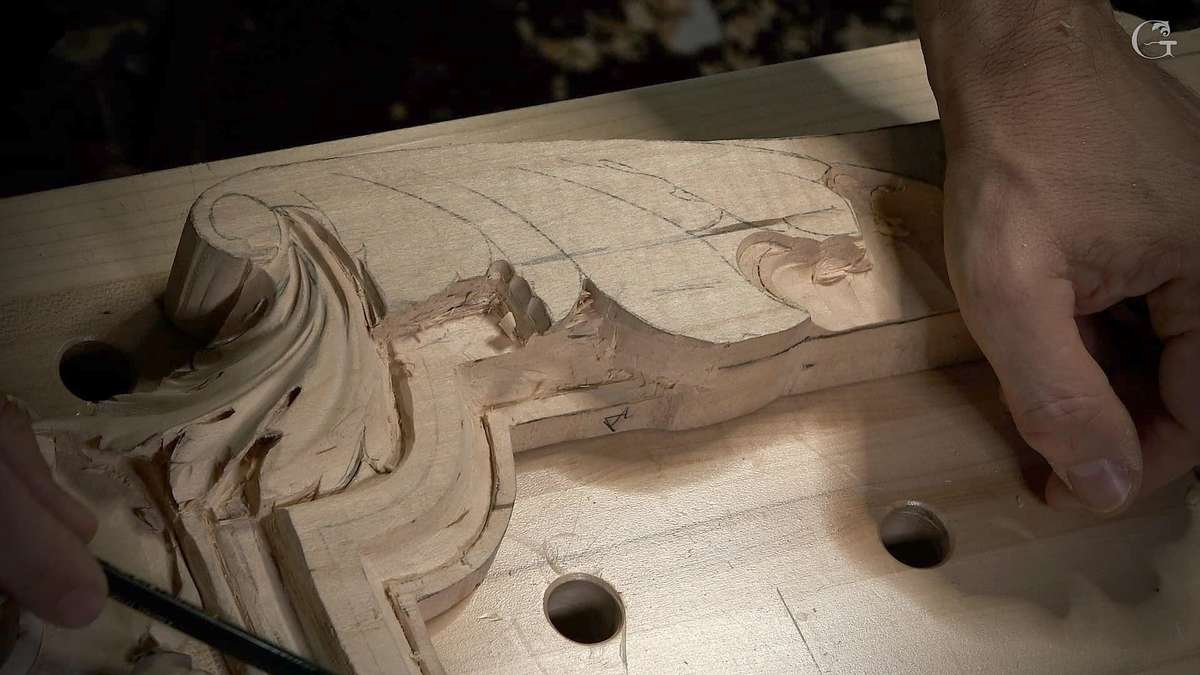
Set your ground, then establish the stem levels. A shallow #3 for the grounds, a V-tool to define the stem edges, then the #7 for the leaf hollows. Cut leaves first and you will end up bending the stem to fit them, and that bend is where the snake comes from.
Step 7. Stage the leaf depths
Same-depth leaves flatten a scroll faster than anything else on this list. The leaf nearest the root sits deepest and boldest. The one out at the tail stays shallow and light.
Which scroll fault is yours?
Most bad scrolls are one of six faults, and five of them start on the drawing. Find yours in the left column and go fix the cause instead of scraping at the symptom.
What it looks like | What is actually wrong | The fix |
|---|---|---|
The scroll reads like a rope or a snake | Stem is one thickness the whole way | Re-lay the stem with three divider widths, thick at the root |
A leaf cluster floats free of everything | The stem behind it got lost in the ground | Carry the stem visibly behind the cluster, then thin it past |
A bird or a monster looks silly | Its size is not proportioned to the tendril under it | Shrink the animal or thicken that tendril |
A nest of scroll goes flat | Every spiral sits at the same depth | Drop the inner spirals, keep the outer ones proud |
The panel is busy but lifeless | All leaves cut to one depth | Stage the depths, deepest at the root |
The taper looks backwards | Root and tail were reversed on the drawing | Mark the growth arrow before carving, never after |
Who is telling you this
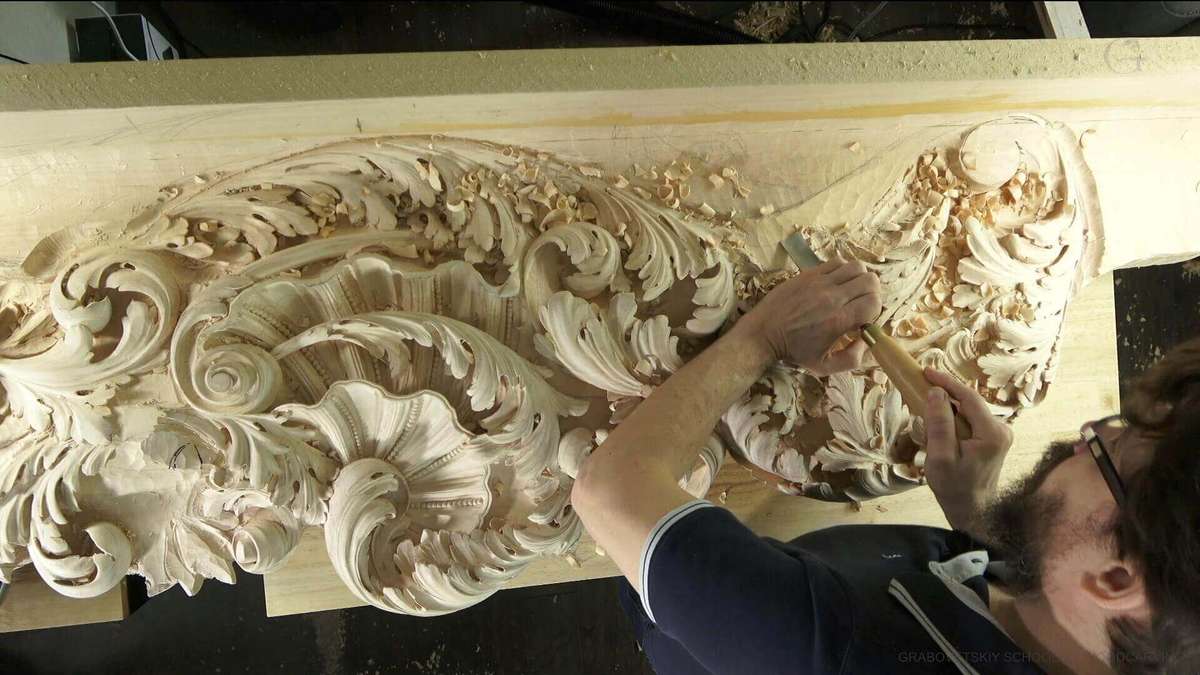
I carve architectural ornament and high relief for a living, and the International Woodcarver of the Year award came out of that work. My great-grandfather worked mahogany in the Chippendale style, so wood is in my blood, and my own training was a traditional European apprenticeship, one master and one student, starting at sixteen.
The law here is not mine. It belongs to Ralph Nicholson Wornum, who wrote Analysis of Ornament for the government drawing school in London, and you can read every page of the 1860 edition free at Archive.org. The complaint he traces back to Vitruvius is a great deal older than that.
What I add is that the law survives contact with a gouge. Lay the stem in first and the scroll breathes. Leave it until after the leaves are drawn and you will fight that panel for a week.
FAQ
Does the tapering stem law apply to Gothic and Byzantine scrolls too? It applies anywhere a scroll is a completed figure with a root and a tail, whatever the style on the label. Wornum found it best kept in Cinquecento sculpture, but the reason is how plants grow, and plants do not care about period styles. A Byzantine vine scroll carrying heavy grape clusters on an even stem looks just as wrong as a Roman one does.
How much should the stem taper? Enough that somebody at normal viewing distance sees the difference without measuring it. On a panel scroll I set roughly 1 at the root, 0.6 at the middle and 0.35 at the tail with dividers, then push it further if the load asks for it. A heavy cluster sitting low means a thicker root.
Is the acanthus scroll Greek or Roman? The acanthus capital is Greek, but the developed scroll is Roman, and Wornum treats the scroll and the acanthus together as the two most characteristic Roman elements. The Greeks used Acanthus spinosus, the narrow prickly one. The Romans used Acanthus mollis, the brank-ursine. The finest surviving Roman work came out of the Forum of Trajan, built early in the second century by Apollodorus of Damascus. More on that split in Greek vs Roman acanthus.
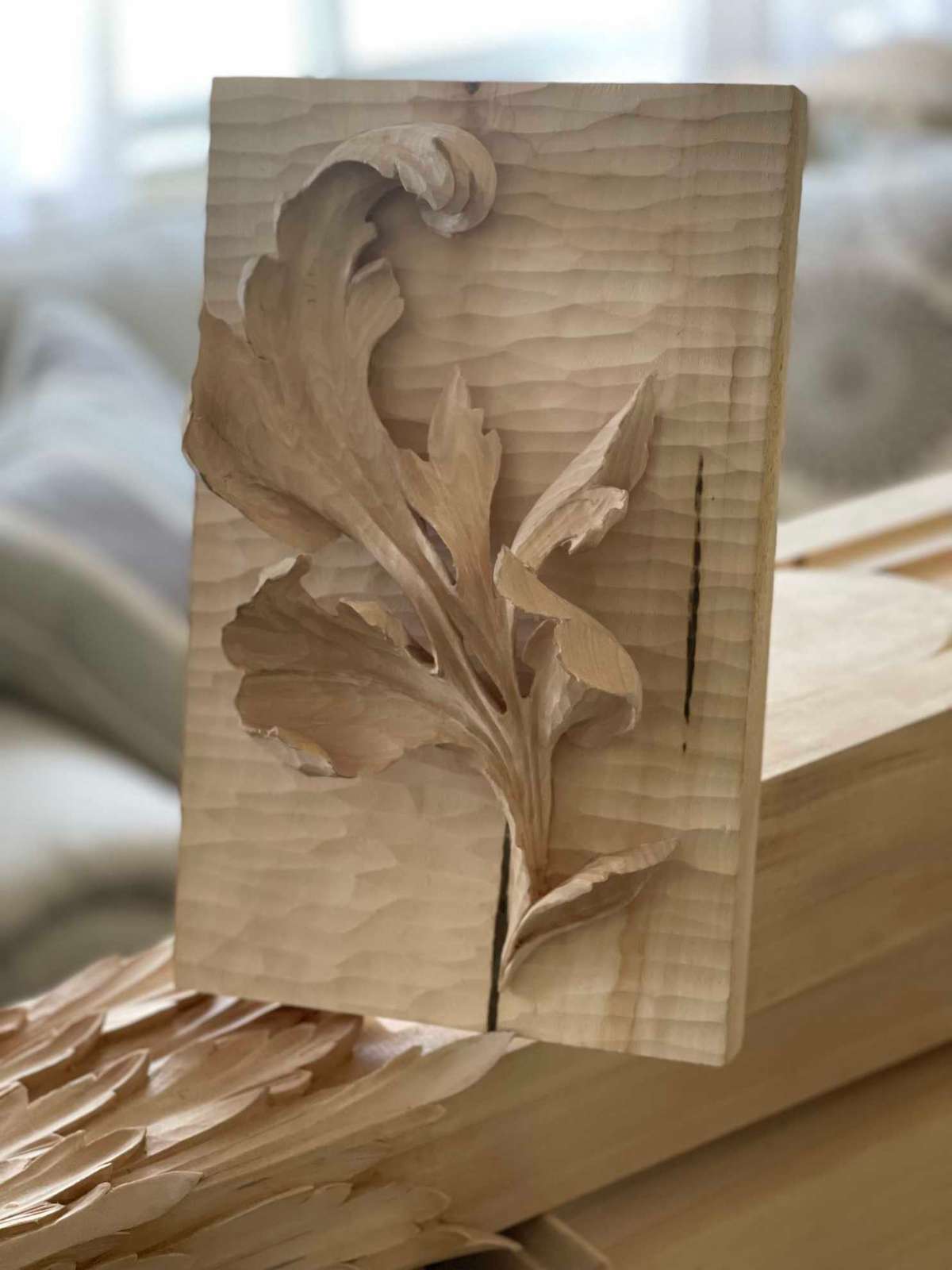
My leaves are good but the whole design looks flat. Where do I start? Start with the drawing instead of the gouge. Get the leaf itself laid out properly in learn acanthus leaf carving, then come back to the stem law and run it across the whole panel.
Can I rescue a scroll that is already carved? Sometimes you can, and it depends entirely on which direction the mistake runs. Thinning a stem toward the tail is honest work, since you take it down and re-blend the ground, and dropping the inner spirals buys back some depth. Nobody has ever put wood back on a stem they already cut away. And that is the real reason the drawing comes first.
Shall we carve?
Do you already cut a clean acanthus leaf and still feel the panel is not alive? Have you fixed and refixed a scroll and watched it get worse each time? Do you want the laws of space instead of somebody else's pattern to trace?
The acanthus work is where all of that lives. Shall we carve?