
Alexander Grabovetskiy, woodcarver, School of Woodcarving · Published 2021
What does a wood carver mean by "a couple of reasons"?
Quick answer: In Venice Room lesson 146, video 3, I said why I use the 1 millimeter, and two reasons came right after it. Other lessons use the same kind of line ahead of a mallet, a V tool, a wheel and a livestream, each with reasons of its own.
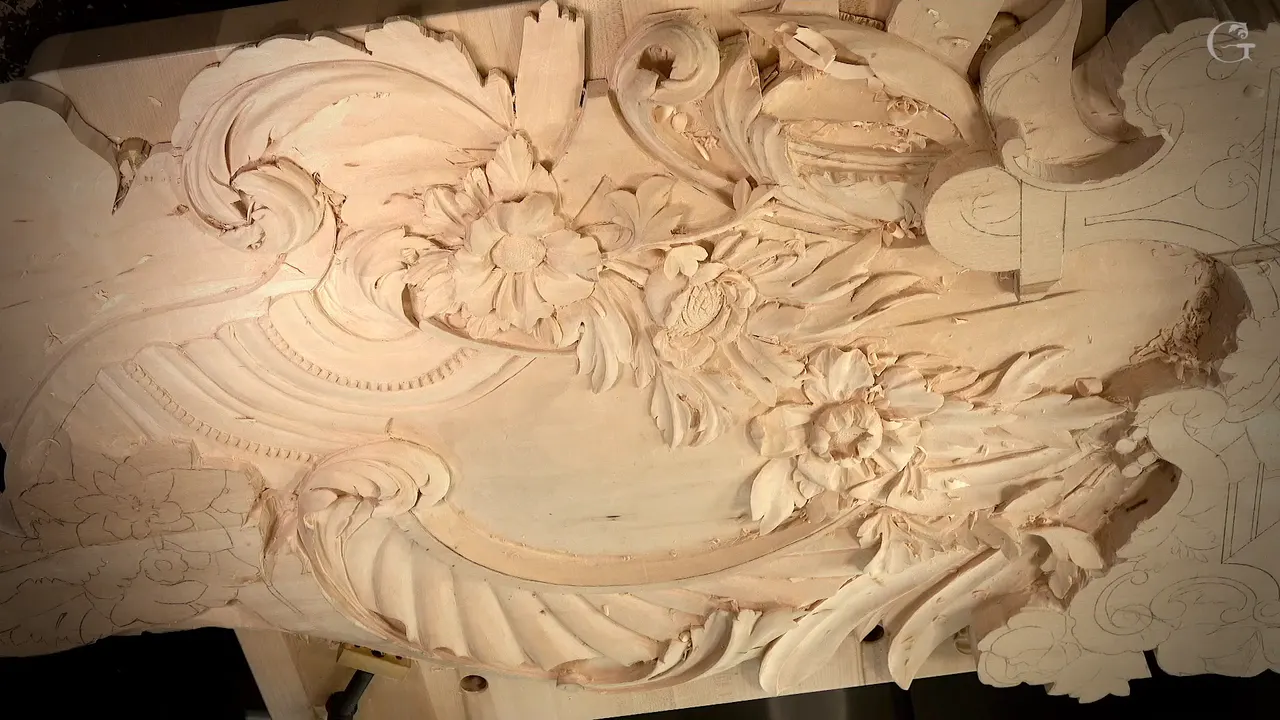

In lesson 146, video 3 of the Venice Room, I said "Okay. So pretty much why I use the 1 millimeter, a couple of reasons." Two reasons follow it. Other lessons of mine give reasons in the same way, ahead of a mallet, a V tool, a wheel and a livestream, and each one is linked below.
Ever picked up a tool and then had to say why that size, and not the next one? That is the spot this page is built on.
What reasons did I give for the 1 millimeter in lesson 146?
The video opens on them. "First of all, I want to see if it's going to be sufficient, 1 millimeter cut." Next, "And secondly, I can get really close to the line and see much better the edge." After that comes "I don't think 1 millimeter is enough" and straight after it "I'll just follow with 2 millimeters."

Video 2 of the same lesson has the same tool. "You know what? I can actually start with the 1 millimeter." Then "Why I want to start with 1 millimeter? I want to check." And on the cut itself, "really just on the line."
How did the 2 millimeters go next?
I plan to start "right in the middle" and on one of the sides "I'm going to hit my previous cut, that line." After that, "Again, I don't have to be a hero and create a really long cut. But looks like I'm able to." After it, "I'll give another pass."

"And 2 millimeters is much better, but it's not the end yet." I plan to start again from that same point and go the opposite direction. Later I say "I still didn't do my concave on this side, but it's okay" and after it "Let me get another pass."
Then I look for more depth. "Let me see if I can get even deeper." I will try to get as deep as possible with the 2 millimeters, and after them switch again to a 1 millimeter "for the shadow again." About that I say "Everything going to help" and "a much darker shadow right on the side."

What about the tool size and my table?
I name another size. "Yeah, I could go millimeter and a half, like 16th of an inch first" (1.5 mm is about 0.06 in, and 1/16 in is about 1.6 mm), with a "number 11." But "I think in this case, I could go right away pretty much with the 1 millimeter" (about 1/25 in), and "1 millimeter, obviously, it's number 11."

A shaky table is next, and "something not too stable. Let me stabilize my table." "That's shaky." "Hold on just a second. I need to put some kind of shim underneath." After it, "Okay. Now it's more stable." The work goes on with "like I said, it's 1 millimeter, number 11" and I say I plan to get even deeper excavation on the inside. "So that detail is more architectural."

"A really dark shadow. Well, not really dark shadow, but still somewhat dark shadow." Half a millimeter (about 0.02 in) is one more option, "and exaggerate that" and then "Really unnecessary. But that's okay."

What was my plan for the convex in video 3?
"So now I need to create the convex." And "I can't use just a simple convex tool because it's wider on this end and narrow right here." Back bends are the plan. "I'm going to use back bends, and I have to just be really careful how I attack that." The outside edge comes first: "Let me attack first outside edge. I'll use just a back bent."

The last lines are about the point and the edge. "And what I am keeping an eye-- I'm not sure if you can see on the camera, that point and the edge." With my back bent I try to be, "one of the edge right in the middle, and it just goes all the way." Then "So that way, I know my cut is going to be consistent." The video ends on "I hope it makes sense."

Where else do I give reasons like this?
The lines below are mine, each from a lesson page that you can open. They cover tools, depth, how a lesson runs and the school itself.
Which tools came with reasons?
A mallet comes up in Hashemi Flowers 10, video 1. I don't use mallets made of wood much, I say, and I give two reasons. One is "just to protect my handle" and I add "I don't want to smash it." The second is "it's just too noisy sometimes." My preference, I say, is "always a rubber one," although I collect different styles of mallets "just for collection." For everyday work, "I use rubber" and sometimes a brass or metal mallet.
During a livestream in April 2020, someone asks why I don't use "a bore like rotary machines." My answer opens with "There's a couple reasons why I don't" and goes on with "it doesn't make it quicker, and it lacks finish what you're getting out of the knife, out of the chisel." The dust line is next, "I don't like dust" and I close with "I hope that makes sense."

On one flower in Lily Box 10, video 9, I turn down a V tool. "Reason number one, it's much easier to break a tool such as a V tool in areas like that with a wood like this." "And the second, a V tool creates a sharp V on the inside." In its place, "I really want to see more like a U shape on inside." I also say "Nothing wrong if you would use a V tool. I use a V tool all the time." On that project I say I'll use "just number 11s" and "I'm using two millimeters" (about 0.08 in).
History gets a line there too. A V tool "was invented much later in the history," I say, and the Byzantine wood carvers "never used any V tools. They used only gouges and chisels."

The direction of rotation comes up in the Maine Coast sharpening class, and that workshop says which way I choose. "I usually like to do outward rotation." It's okay on some tools to go toward yourself, "but it's better to do outward." Of the leather wheel I say "you definitely can't use that" there, "because you're going to dig in" and the same goes for a felt wheel. Then "we call it like a saw tooth effect." "You don't see that by human eye, but it damages the edge when you rotate toward yourself." The stones "jump on top of the bevel, and they just damage that bevel."

Why go deep, and why smooth?
Venice Room 43, video 3, is where depth gets its reasons. It starts with "I have to be careful how deep I go underneath, because there is a certain point" where it is "almost too deep." The first answer is "I can make it too weak" and the second runs a little longer, "again, I have to finish it. Okay. I have to get inside somehow."

Smoothing a transition is explained in Venice Room 9, video 10, and I say I will repeat "the reason why I'm using number 11, why I'm not creating really sharp connection." One reason follows, "I want to paint that, and I want to make it look really nice." Beside it sits "with the smooth transition, I can actually create the undercut like this on inside."

Over in the Grinling Gibbons class in Maine, video 2, I'm carving against the grain and I say "Sharp Tools a must." One of my reasons is "you not always able to cut with the grain" and I add "I know it's not always possible." "And you have to attack from whatever the angle. It's more convenient."

A shorter one sits in Lily Box 3, video 3, where I say I'll take a small number three, carefully, to "attack my edge" and "I am working against the grain." There are reasons for it, I say, and "one of them just because of the camera angle."
Why does a lesson run the way it does?
A tool list is asked for in Venice Room 21, video 7, and "I am not planning to." My words are "I try to name." Then "you will hear every tool I'm using" and next comes "Secondly, I'm not expecting anybody to carve that huge of a project."

That makes "two of the three reasons," I say. The third, final and "the biggest probably reason," is "this project is huge, and it takes a long time to carve it, and it takes time to edit."
Paper meets bare wood in Lily Box 1, video 1, and I would rather not glue it "right on top of the wood, on bare wood." Of the reasons, "there's actually a couple reasons why." The wood is olive, "a harder wood." On a scroll saw at higher speed, "it has a tendency to burn" and I would not want to burn the material. Another reason is that I would not leave "any glue or residue on my wood." And "there is a third reason." "So I want to save my blades." Then "Make a triangle where I'm not going to forget which side I'm supposed to glue on."

Sanding is the question in workshop 14 of the beginner course, the curly kitchen cutting board. Someone asked why I'm "not going to use any sandpaper." "That is a really good question." I start with "I don't like when you sand, you're actually pressing fibers together" and with a water-based finish, for example, "it's going to raise up all the fibers." I add "And besides, it looks more human-like when you see all those cut marks and they not sand it out." "It looks like it's not done on machine, but it's done by human hand, which is the whole idea, actually."
One more sits in the April 2020 livestream. "That lion I just showed you a couple of times, before I touched my gouge, I had to model it." For the customer, "not everyone gets that on a paper because paper is just a 2D." I also "modeled that in a real-life size." And "for me, sometimes it's a lot quicker to model than to develop multiple angles, the drawing."
What did I say about the school itself?
Venice Room 58, video 3, explains a livestream, and it is "by no means replacement for a school website for membership." The first reason is "you can communicate directly with me and ask me in live, okay, any of the questions." The next is "it's for people who actually not members of my school yet."
Comments on the site come up in the same video. "I read them and I try to answer every comment." Another reason is "nowadays we are in a Google war" and "Google looking for the sites with the most comments."
Not answering you is the subject of Venice Room 56, video 11. I start with "I do have a really heavy anti-spam filter" and "marketers are trying to send me emails all the time." I add "I never mark anybody as a spam." And "Sometimes your emails also ending up in my spam box and I'm not checking spam box every day."

What do the reasons look like side by side?
The table keeps one row for each video, with what I was deciding and the reasons I gave.
| Lesson and choice | Reasons I gave |
|---|---|
| The 1 millimeter tool in the Venice Room, workshop 146, video three | Sufficient, and the edge |
| Mallets made of wood, in Hashemi Flowers lesson 10, video one | Protect the handle, too noisy |
| Rotary machines, asked in the livestream of April 2020 | Not quicker, lacks finish, dust |
| Leaving out a V tool on a flower, Lily Box 10, video nine | Easier to break, a sharp V inside |
| Which way a wheel turns, at the Maine Coast sharpening class | Dig in, a saw tooth effect |
| How deep to go underneath, Venice Room 43, video three | Too weak, and finishing |
| Smoothing a transition in Venice Room 9, video ten | Paint, and the undercut |
| Skipping a tool list, Venice Room 21, video seven | Naming, a huge project, editing |
| Paper on bare olive wood, Lily Box, lesson 1, video one | Burning, glue, saving blades |
| No sandpaper, beginner workshop 14, the curly cutting board | Pressed fibers, human-like |
| Doing a livestream, Venice Room 58, video three | School members, new people, Google |
What choice did you make at your bench today that you could give two reasons for? Every lesson named here opens with access to the school, paid monthly or yearly and renewed automatically until you stop it. This third video belongs to lesson 146 of the Part 13 course, and lesson 147 follows. The wood carving I do here also sits in the Lily Box course, Hashemi Flowers and the first Venice Room course.
How it's done
- Name the tool. Name the tool you reach for, the way video 3 starts.
- Give the first reason. Checking whether the 1 millimeter is sufficient is my first.
- Give the second reason. Getting near the line, to see the edge much better, is my second.
- Say what comes next. My view in the video is that a single millimeter falls short, and the 2 millimeters follow.
- Steady the table. A shim underneath the table is needed, I said, and then it is more stable.
Frequently asked questions
Why the 1 millimeter in lesson 146?
Whether it would be sufficient, and getting near the line to see the edge much better.
Was the 1 millimeter enough in lesson 146?
I said I don't think it is enough, and the 2 millimeters were next. I called them much better, though not the end yet.
What about the shaky table in video 3?
It was shaky, I said, and a shim underneath was needed. Soon after, I said it was more stable.
Which tool did I plan for the convex in video 3?
What to carve next