

Alexander Grabovetskiy, woodcarver, School of Woodcarving · Published 2022
What does "no problem whatsoever" mean when a wood carver says it?
Quick answer: Venice Room 149-3 has the line at a section I might draw on plastic with a marker first or draw in place. I said why not, and the chunk in my way could be chopped out. Other lessons of mine have the word after a heavy piece in a vise, a paper method and a scroll saw.
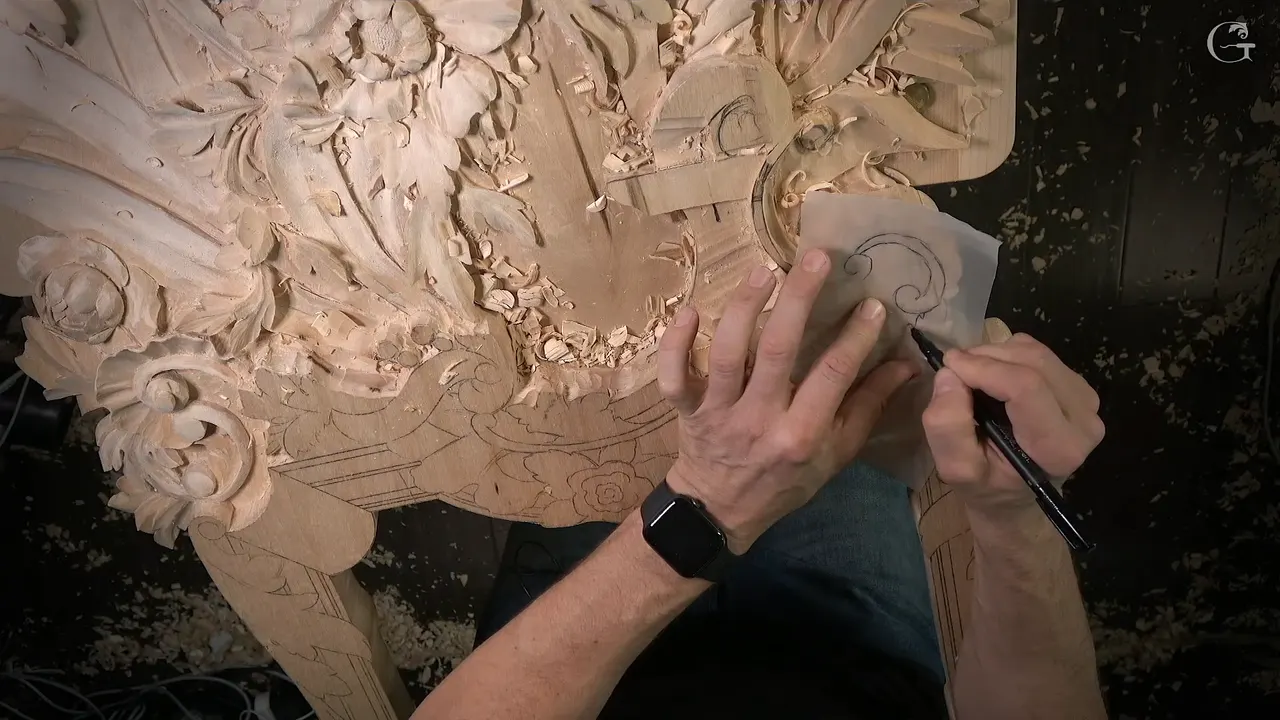

In the third video of Venice Room 149 I said I could probably draw a section right in place, and then, "But why not? It takes only a couple seconds." The word I used was "whatsoever." Other lessons of mine have it after a heavy piece in a vise, a paper method and a scroll saw. It follows a block of glue lines too.
Below is what stood next to the word in this video, what the other two videos of lesson 149 say about trouble, and the many things I have said it about.
What stood before the first outline in lesson 149-3?
This part starts with a doubt, "And I still don't know if I'm making a mistake or I'm doing the right thing." After that, "Let me take number 11 and 7 millimeters" (0.28 in), and "I'm carefully going to blend and outline my middle part."

The word "problem" is in this video earlier too. It looked like I could do that "without any problem," but "I'm going to need smaller number 11." My need was 5 millimeters (0.2 in) "because I need to outline this way without damaging too much the main movement."
My list went on with "I need smaller tool, maybe number seven" and with what stood in the way, "And I can take this out. It's in my way anyway." A question for myself followed, "how am I going to do this side" and then "I need to roll this side also down."

For the sides, "the same number 7, 14 millimeters" (0.55 in), "about half an inch or so," going "around with the same tool." One thing made me glad, "I'm happy that I do have plenty of material I left on that detail, so I'll be able to use it."
How low could the section go in lesson 149-3?
"So now I need to redraw this part," I said, and "I'm going to lower down that section." At first that section would sit at about the level of that part, and then, "Or actually, no, it's going to be much lower."


Again a number 11 of 7 millimeters (0.28 in) was the tool, and I had to "attack that from different points" and "attack that from this side." A limit was named too. "At least the height of this going to be reflecting on that side, so I can't go lower than that placed right here."
Closer to one end, I said, it would give a beautiful shadow, and I added "I can go lower from this point also."

What was my other idea in lesson 149-3?
Plastic came up, "maybe it's a good idea for me to use, again, plastic and marker and just preliminary draw that section before I wouldn't forget the lines because all that is going to go down."

Then came the other thought, "Although it's not a big deal, actually. I could probably draw that right in place with no problem whatsoever." And then, "But why not? It takes only a couple seconds, and I can probably chop out that chunk because it's on my way."

On the chop I said that chopping it would open up that section and make my work a lot easier. I would "take just a huge tool and chop it all the way."
It would be "maybe about quarter inch high at this side," 6.4 mm, and "No more than that, okay?" Then, "It's a quarter inch, so it's going to go all the way sloping."
The whole thing would be much lower, I said, "but I don't want to do it now because I don't want to lose lines."


What about trouble in the other two videos of lesson 149?
In video 1 a number two with a straight down cut was the idea, and I told you why, "That way, I'm not going to lose the position of that line I just placed." It was not the only way, "I'm pretty sure there's more ways."
The same shrug is there, "Although it's not a big deal, I can always redraw, but still, why not do it that way if it's easier?" Another line was about moldings, "So make sure don't undercut if you're working with moldings. So that would be a big mistake."

There was this one too, "So position of the tool should be 90 degrees, and if it gives you trouble because it's end grain, so just cut one more time with number 11. Relieve it." Then, "But if the tool is sharp, you shouldn't have any problem to do that."
The second video starts with "perfect line, and I can follow with the smaller one." Later, a number nine of 20 millimeters (about 0.8 in) came up, with "Although I need probably to use a mallet." Across the grain was the way, "It is always safer, go across the grain, and a lot more control."
Video 1 has heights. Of the first line I said, "In this point, it's six millimeters. In this point, it's about 10 millimeters." That is 0.24 in and 0.39 in. The next line was to be "about six millimeters higher than the first line" (0.24 in).

Where else did I talk about trouble?
Lily Box 2, video 5, has a longer talk about working one small area until it was done, "And it's okay. You could do it." I added that it is much better to concentrate "on the overall picture, okay, on the main big idea."
The next lines gave my reason, "So that way, you can visualize all together. And also, if you have a tool in your hands, you really don't need to change the tool all the time. So that way you're actually saving some time."


In Venice Room 81, video 9, the piece was "super huge and super heavy," held in the vise at its thickest part, with "only about a half an inch stem which holds" (about 13 mm). My words were "But I have no problem with that whatsoever. I've done a lot of work with that."
Paper is the subject of Chamomile and Bow Rosette 2, video 3, "You can see that paper method holding really well. Have no problem with the paper whatsoever." The downside I named was the spray, "See all that dark spots? It's like a dust and whatever, rubbing hands and so on. It's a spray and it becomes kind of dirty, and it's not really appealing." And then, "But I'm okay with that, okay?"
Where did it follow pressure, force and effort?
In Venice Room 43, video 2, I said, "Let me use a bigger number 11 and recreate this cut." Then, "I need to go from this side" and "Almost no pressure whatsoever. Just shaving little by little."
A sharp tool is the subject in Venice Room 58, video 6, "Tool must be super sharp. I'm not pushing at all. I just let that tool ride on the surface. It actually cuts itself." The line follows, "I barely create any pressure whatsoever."
Sharp tools come up again in Venice Room 36, video 6, "Let your tool do the work. So that's why sharp tools, they're always helpful. So I don't have to press too much at all just because it's really sharp. Just a slice. Slicing through the fibers with ease, with really no effort whatsoever."
Video 7 of Lily Box 11 calls a part a "really, really interesting section." Then, "I'm just using side of my tool and carefully remove it. Okay. Without forcing. I barely, I almost absolutely no pressure whatsoever."
Force is the subject in Grape Onlay 11, video 3, with a tiny tool, "Again, have to be really careful in this point. No force slicing, only no force whatsoever. And just you have to feel what the grain does. If it fights you don't force it."
An undercut is in video 13 of that same lesson, "Be careful of what kind of force you apply when you're doing a cut like this. You can hear I'm hitting on the inside of my undercut." Then, "There's almost no force whatsoever."
Next, Furniture Panel 20, video 8, where "careful cuts" were my plan with a smaller number 11. The line was "Almost no cut whatsoever, but still, see, it still cuts." In Acanthus over Moldings 7, video 2, I said it was "Almost no Cuts whatsoever."
Resistance is the subject in the Maine Coast sharpening class, video 5, about my skew, "Take a look how fast I can do my stuff because there's no resistance whatsoever. No fighting inside of the fibers."
What else did I say whatsoever about?
My scroll saw gets it in Venice Room 76, video 9, "it's actually powerful, no vibration whatsoever." Of really tiny micro tools, in Floral and Molding for the Panel 13, video 1, I said "Those tools, they're not too expensive whatsoever."
Rushing is the subject in Venice Room 77, video 7, "For me, probably it's a good idea not to rush it. Not to rush it whatsoever because that would be a big mistake."
Two more come from the Floral and Molding course. In video 3 of lesson 8, after the opposite side, "It's exactly the same idea. So there's no difference whatsoever." Then, "which is not as complicated whatsoever, what's left to do." Lesson 10 asks in video 2 how much lower a part must go, "Not that much whatsoever, but still lower."
Taking a piece out of the paper is the subject in video 3 of lesson 13 there, "I use just a chisel or gouge. You pretty much just crank and remove it. See, it's already moving. It's really, really easy, so no complications whatsoever."
Gaps are the subject in Carving an Antique Style Rosette, workshop 1, about blocks I made, "The main idea, it has to be absolutely square, so no gaps whatsoever."
A clean inside is the subject in Roman Acanthus 16, video 2, with a number 17, "Hopefully, you can see how nice and clean it leaves an inside. No mess whatsoever."
In my April 2020 livestream on wood movement I pointed to glue lines in a block that looks solid, "And it's staying right there with no movement whatsoever. It doesn't move." My reason was this, "Just because I altered my direction of the grain." In another April 2020 talk I showed a piece and said, "Look how deep the excavation is. There is no CNC machine whatsoever able to do that."
Blending comes up in Venice Room 70, video 1, where I said I can use just the side of those tools, "Of course, no sharp lines whatsoever. Just really, really nice and smooth lines."
Moldings come up in Venice Room 159, video 1, "Well, nothing complicated about creating moldings whatsoever. So pretty much just accuracy."
Design is the subject in the Dining Table Apron course, workshop 6, "Again, no limit on design whatsoever. So the limit is only your imagination." Hashemi Flowers 15, video 4, has "And I have absolutely almost no ridges left whatsoever."
A surface beside a leg is the subject in Modern Acanthus 1, video 3, "Right away. Do not touch that surface whatsoever." Of the tiny parts I said, "Please don't push it. Let the tool do the work. That's why we slice."

Which video said it about which thing, and what did I say around it?
| Video (Venice Room unless named) | What came before | What I said around the word |
|---|---|---|
| 149-3 | A section to lower, with lines I did not want to lose | A template on plastic, or drawing in place |
| 149-1 | A tool at end grain | If it is sharp, no trouble |
| Lily Box 2-5 | Working one small area until it is done | The overall picture |
| 81-9 | A piece held only by a stem | A lot of work done that way |
| Rosette 2-3 | The paper method of holding | Only the spray |
| 43-2 | Number 11, going in from one side | Just shaving |
| 58-6 | A super sharp tool riding on the surface | Barely any pressure |
| 36-6 | Slicing through the fibers with ease | Really no effort |
| Grape Onlay 11-3 | A tiny tool, careful in one spot | No force |
| 76-9 | My scroll saw, a powerful one | No vibration |
| Roman Acanthus 16, video 2 | A clean inside left by a number 17 | No mess |
| 70-1 | The side of a tool, blending | No sharp lines |
| 159-1 | What it takes to create moldings | Just accuracy |
| Dining Table Apron, workshop 6 | Design, picture frames | The limit is only your imagination |
Which small step on your own board would you skip, and which would you take anyway? Every lesson named here opens with access to the school, paid monthly or yearly and renewed automatically until you stop it. The Part 13 course page holds lesson 149 with all three of its videos. Wikipedia has plain pages on wood carving, gouges, chisels, mallets, shadows, wood grain, pencils and Venice.
How it's done
- Start with the outline. In lesson 149-3 I planned to start the middle part with a number 11.
- Go smaller near the movement. A smaller 11 was needed for the outline near the main movement.
- Name the limit. The height was reflecting on that side, so I could not go lower than the place I named.
- Weigh the template. I thought of plastic and a marker, and I thought of drawing in place.
- Ask what it costs. Seconds, I said, so why not, and the chunk in my way could be chopped.
- Keep the lines. Lowering the whole thing waited, so that no lines would be lost.
Frequently asked questions
What was my other idea in lesson 149-3?
Drawing the section on plastic with a marker first, so that I would not forget the lines, since all of it will go down.
How did I plan to open up the section?
With a huge tool, to chop out the chunk that was on my way. That would open up the section and make it a lot easier to work.
Which tools came up in lesson 149-3?
An 11 to blend and outline, a smaller 11, and maybe a number seven. For the chop, a huge tool.
How much pressure went into the cuts in Venice Room 43-2?
What to carve next