

Alexander Grabovetskiy, woodcarver, School of Woodcarving · Published 2020
What does it mean when a wood carving doesn't feel right?
Quick answer: A carving that feels off to me is one where following the design is not enough. In Venice Room workshop 29, part 12, one subdivision didn't give the leaf the right feel, so my plan became one extra eye. And when something feels wrong to me, it probably will to somebody else.
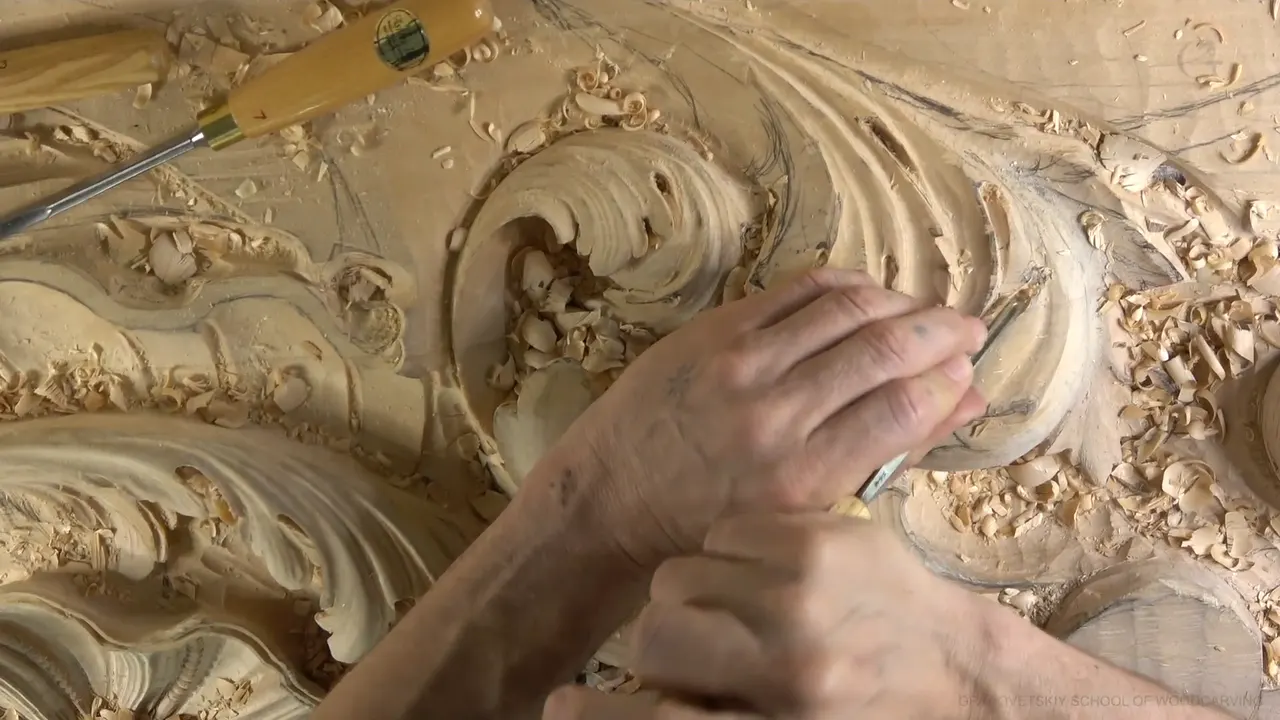

A carving that doesn't feel right is, in my shop, a spot where following the design is not enough. In the last part of workshop 29 of the Venice Room, I had a subdivision inside the leaf, and I didn't think it was enough. It didn't feel too light yet. My answer was an extra eye there, with the pipe making room for it.
Have you ever looked at something you made and felt it was a little off, even though you followed the plan? Was it hard to say what was wrong? Here are my own words on carving by feel, side by side, from the Venice Room and from my courses on a furniture panel, Roman acanthus, Hashemi flowers and moldings, each with the lesson where it happens.
What the feeling decided in these lessons
- The ceiling leaf needed more than one subdivision, so an extra eye went into my plan, even if the pipe had to shift.
- Feeling good is not the test by itself, and the real geometry still has to be there.
- On the furniture panel I erased a drawn return that didn't feel natural.
- Train your eyes by feel, then check if they were accurate.
- A number three running smoothly, without digging in, tells my hands I'm doing the right thing.
- Once, a half-millimeter tool for an even deeper pass felt wrong, and I stopped.

What didn't feel right in Venice Room 29, part 12?
A single subdivision, in the very last part of that workshop. The part opens on an eye of the acanthus, and I made that eye right away. A smaller number 11, a veiner, went in first. An even smaller tool, maybe 3 mm (about 1/8 in), could get deeper, I said, but I was not going to do it too much right now. I still had to develop that eye.

Next I could see a division. I had a subdivision there, but it was not enough for me. My words were that it didn't feel too light yet, and it didn't give me that feel. Maybe one extra movement on the inside, I said. Extra subdivision, extra eye.
Yes, I'd need to move my pipe a little bit for it, and that is absolutely okay. I thought it would be a much better movement. Leaving it like that was possible, but I didn't think it gave the right detail, or the right feel.

Right after, I explained what I mean by feel. Sometimes I just have to go by whatever feels better, not just by what's supposed to be by the design. And when a spot feels wrong for me, probably for somebody else it's the same thing.
The rest of the part is plain work. I chipped a little too much in one spot and said I don't want to do that too quick. It's okay, I'll fix it, I said, because I still have to create the pipe right there. The divisions got a number 11. Chips came off with a number five, about 5/8 of an inch, about 15 or 16 mm. Those tools have no marking, so I'm just guessing at the size.

Inside, a number 11 of about 2 mm (about 5/64 in) was probably the smarter tool, and it got rid of whatever I didn't need. Deep was not needed there, since that part will sit high above. For the concaves on the sides I used just the side of the number 11, the flatter side, like a number three. It's a U shape, so the closer to the pipe I got, the more pronounced the concave. Almost flat on one side and more pronounced on the other.

Near the end I said this tool gives me a lot of manipulation power. I carried the pipe all the way after that and separated it, which makes sense. Why the number 11 is called a veiner at all is a story for my course page, Venice Room Part 3.
Is carving by feel the same as doing whatever feels good?
The furniture panel answers no. In design lesson 5 of my furniture panel design course, I said that since the 1950s and 1960s, the true art was minimized to just some kind of soul therapy, like it makes you feel good. But the true art is the real math, the real geometry, and that takes knowledge. It is not just strokes of different colors and random composition.

My youngest daughter wanted to be an artist, and we found a teacher here in the United States. We thought the teacher was going to teach all the composition rules and all the color palettes. It didn't happen. The teacher said, "Oh, if it feels good, so that's good, and you don't have to know anything, just draw whatever you feel like." It just doesn't work like that, I said.
My own training started at 16, as the only apprentice of a fine-art master in Russia. He taught me that design is the laws of space, rhythm, repetition, and understanding the tools.
The same course shows both at once in lesson 7. In this type of carving you draw something and you change something, and that is a normal process. When it does not feel right, I'll change it. In the same breath I told you about the golden ratio, one to 1.62, roughly, and about root rectangles, root two up to root five. That panel was close to root four, two squares, and I still wanted the feel of my central point sitting somewhat in the golden section.
Venice Room 133 puts it the other way round. There I told you to get on the edge with whatever gouge feels right, since it doesn't have to be exact on a leafage. Some of the classical rules we can apply. Not all. A leaf looks better with some of those rules, and that lesson sits in workshop 133.
Why would a carved line feel unnatural?
Straight lines, on the furniture panel. Design lesson 8 had me drawing a return, still not liking it, and erasing it. It just doesn't feel natural, okay? I explained why right after. In nature, in creation, you can't find any straight lines. Everything has an arc or a sweep or a curl, and only two elements are found in nature, lots of dots and lots of different curls.

Art adds vertical, horizontal and diagonal lines to those two. One part is the human part and one is the divine part, and that panel is meant to show a unity of the two. The divine stays dominant, I said, because I'm still going to add flowers, leaves and foliage. At least that's how I see it.
Lesson 5 has the same worry in fewer words. A line came out too straight, and it doesn't feel too organic to me. Please forgive me, I said, I'm just trying to develop the idea of what I want to see, so it looks like it is organically moving the right directions. By lesson 9 I was thinking of subdividing a part in a couple more movements, from underneath, and I still kind of didn't like it. It doesn't feel too natural, I said.
The ceiling board has one too, in part 11 of Venice Room 33. I said I could fix one area, then changed the word, since what I wanted was to make it feel right. It still didn't look as organic. More of that area had to come out, maybe even with the mallet.

How do I check a feeling before I trust it?
With a mark, and with a step back. In lesson 12 of my Roman acanthus course I was eyeballing, and I told you that you don't have to if you don't feel comfortable. Take a piece of paper, put it at the end of the eye, make a mark and carry it to the other side. I'm pretty much actually accurate, right on the mark.

But I still suggested you train your eyes, because that is really important. Work by feel, and then check whether it's accurate or not. On more complicated pieces there is absolutely no way you can measure, and your eyeballing will help you a lot.
Workshop 69 adds the step back. In its twelfth part a concave already gave me some shadow, which was really good, and still one spot did not feel good. Stopping and taking a moment helps me see better what's going on. I step away and look from different points of view, because a part can look good from one angle and not from another. If it makes sense, it's good, and if it doesn't, change. Just change it.

Earlier in that same workshop 69, in part 5, a number seven at 14 mm (about 9/16 in) was carrying my pass while I kept checking from all the positions how it feels overall. It still did not feel like it's supposed to feel, which is okay. Next I reached for a 20 mm, three-quarters of an inch, called it a number 11 and corrected myself, since it was a number 17, a specialty tool that only looks like an 11.
Can you feel it through the tool, as well as see it?
My hands tell me too. On that area of workshop 33 I knew I was doing the right thing because my number three could still run smoothly without digging in. Even if it is not possible to see on the camera, and sometimes it is impossible to see while you're carving, you can always feel it, how it goes. People who study touch call it haptic perception, the way we know a thing by touching it.
The grain has its say too. Over in lesson 49 of my Hashemi flowers course, I was undercutting with a number eight at 5 mm, like 3/16 of an inch, when the grain didn't feel like it was in my favor. I attacked it with the knife instead.

Some wood just feels wrong to me. In lesson 1 of Acanthus over Moldings I said I highly suggest not to use poplar, even for a painted piece. It's okay, but it's a little harder to carve, and it doesn't feel good when you carve that. Maybe it's my own opinion. Much better to use cherry, or even oak.
One pass felt like no carving at all. In part 8 of workshop 70, a quarter-inch number nine, 6 mm, was going deep, and I said it doesn't feel like I'm even carving, it looks like I'm just drilling holes. I doubt anybody will look inside, but I still wanted it to look really clean.
When did a feeling tell me to stop?
Venice Room 101 has it, in the ninth part of workshop 101. A 1 mm number 11 (about 0.04 in) went in for another pass, and I had to be super careful. Maybe I'd take even half a millimeter, about 0.02 in, I said, and go even deeper. But no, it didn't feel right.

It was plenty and it was enough, I said, and I didn't go deeper than that. I divided my bits into tiny squares by eye after that, because drawing them takes too much time, and started them with a small skew.
Back on workshop 29, the ceiling leaf has a quieter version. With the eye at the start of part 12, my words were that I was not going to do it too much right now, because I still had to develop it.
Where else did a carving feel off to me?
On the first Venice Room course, for one. There, in workshop 8, part 10, I was fixing a movement a little and still kind of didn't like it. I shouldn't say kind of. Overall, it doesn't feel like it's flowing, so I needed to move that line a little to get it to my taste. That one is in Venice Room 8.

Workshop 11 had me kind of happy with the overall feel and thinking I had missed something. A rasp came out to find the high spots, because I didn't like how it felt right there. A couple of spots bugged me, and in my opinion they were not flowing. You can see that in Venice Room 11.
Flat is another. Part 9 of workshop 72 had a leaf with its main movements, main concaves and main convexes, and it still didn't feel three-dimensional to me. It was a little too flat for my taste. I also didn't like how one section looked, and that's why it was not carved clean yet. My plan was to exaggerate that movement, and partially the next one.

Empty space counts. My negative space in lesson 8 didn't feel really good, because everything else goes to the narrow and that space did not. So the law of repetition had to run narrow, then wider, even on that space. In design lesson 10, a curl was too close to the size of its neighbors, and that one doesn't feel good. Adding a curl meant adding the movement somewhere else, so I made my design more complicated for just myself, and I'm okay with that.
Then there is the mess, in part 5 of workshop 39. If you have clutter in a house or in your shop, I said, sometimes it just does not feel right and you can't even create. Once in a while that applies to carving too, and you have to clean up all the clutter.

Where did it feel off, and what did I do?
Every row below comes from one lesson, with what I did about the trouble and what I said. The line from lesson 7 of that panel course fits every row. You draw something and you change something.
| Where | Trouble | Move | Words |
|---|---|---|---|
| Venice 29.12 | One subdivision, the leaf still not light | Extra eye | I thought, a much better movement |
| Panel 8.2 | A drawn return I still didn't like | Erased it | Everything in nature has an arc |
| Workshop 8.10 | That movement on the leaf wasn't flowing | Moved line | Then it would suit my taste |
| Lesson 11.4 | A couple of spots still bugged me | Rasp work | Not flowing okay, in my opinion |
| Board 33.11 | An area that still didn't look organic | Chopped more | A number three now runs smoothly |
| Venice 72.9 | Main concaves in, but still too flat | Exaggerate it | I wanted to exaggerate that movement |
| Part 101.9 | A half-millimeter tool after the 1 mm | Stopped there | That is plenty, that is enough |
| Panel 10.4 | One curl too close to their size | Smaller, maybe | I'm okay with that, I said |

Have you ever walked past something you made and had one spot bug you? Would you like to see what I do with a spot like that? Watch the relief on that ceiling leaf in workshop 29, where I wanted one more eye and called moving the pipe absolutely okay.
How it's done
- I open the eye first. A smaller number 11 veiner went in. An even smaller one, maybe 3 mm (about 1/8 in), could go deeper, but not too much yet, since there was more to develop.
- I look at the subdivision. One was not enough for me, and the leaf did not give me that feel yet.
- I plan one more eye. Maybe one extra movement inside, an extra eye, even if the pipe has to move a little bit.
- I chip out the chunk. My number five, about 5/8 of an inch or 15 to 16 mm by my guess, since those tools carry no marking, and then a number 11 of about 2 mm for the inside.
- I carry the concave to the pipe. Using just the side of my number 11, I keep it almost flat on one side and more pronounced on the other, until the pipe stands separated.
Frequently asked questions
Should you carve by feel or follow the design?
Both, the way I work. In workshop 29 of the Venice Room I went by whatever felt better, not just by the design. My furniture panel course is just as plain about the other side. True art is the real math and the real geometry, and just drawing whatever you feel like doesn't work.
How do you train your eye to carve without measuring?
Do it by feel, then check it. In my Roman acanthus course a piece of paper with a mark carried the check across the eye. On a piece where there is absolutely no way to measure, your eyeballing helps you a lot.
What do you do when a carved leaf looks too flat?
On workshop 72 of the Venice Room, a leaf had its main concaves and convexes and was still too flat for my taste. I hadn't carved it clean yet, so my plan was to exaggerate one movement, and partially another one.
What to carve next