

Alexander Grabovetskiy, woodcarver, School of Woodcarving · Published 2020
What does maybe yes, maybe no mean when a wood carver says it?
Quick answer: It is a line I said in this part of workshop 29 while a part of the leaf was still undecided. A short question followed it, then my own yes. In other lessons the same words ended in a new tool, a pause, or a no.
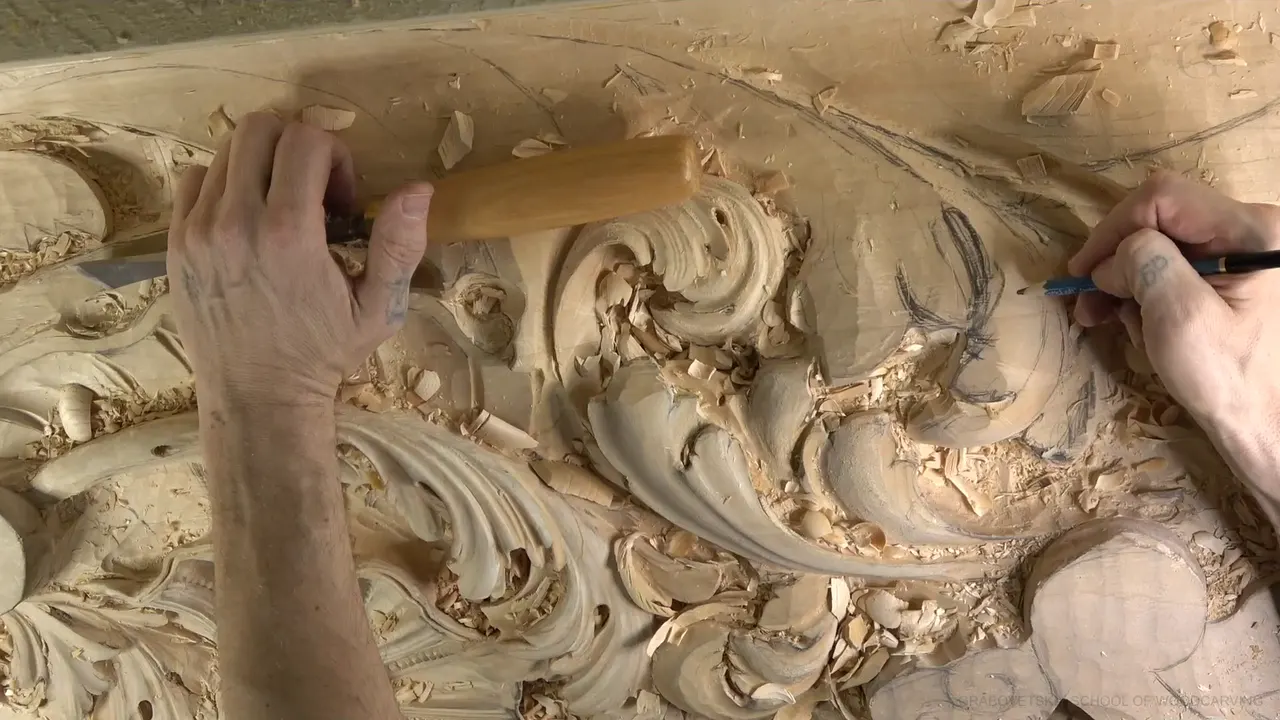
"Maybe yes, maybe no" is a line I said in part 2 of Venice Room workshop 29, about two extra separations I had just pointed to on an acanthus leaf. I added "we'll see." A few seconds later I put a real question to myself: should I take this down? Then I answered it. I think yes.

Have you ever stood over a half-carved board and not known which way to go? Did you wish somebody would hand you the rule? I can't hand you one, but I can show you where those words sit in my lessons and what happened after them.
My lesson captions hold the line on about 100 lines, spread across Venice Room, Hashemi Flowers, the Furniture Panel and the Hazelnuts. The answer that follows is different from place to place, and that is why this page follows it.
What was I deciding in Venice Room 29, part 2?
The part opens with "That is good. Now I can see what I am able to do." I pointed to a main separation and a center line. I stopped there, because the shape was still not right all the way, and I reached for a number 3 to give it a little better shape. "Even if it's not the final, but still, it's going to give me an idea," I said.

Later I changed my mind out loud. "Well, actually, no. This is going to be my center point." A subdivision would sit right there too. An eye would go near it, and I wanted to keep one movement there higher.
Next a number 11 gouge chopped out roughly where the separation would happen, and I did the same on the other side. Something was a little too big. With 4 millimeters (about 5/32 in) I could start excavating around it, I said.

Two ways were open to me. One piece could go down while the other flipped above it, or the reverse. "Let me think." Trying it was my plan, to see how it looked, but on another hand it would be visible from the bottom, "I'm going to lose it, and I don't want to lose it."
So I moved the eye a little and made one part bigger. A skew came next, to refine the movement and check whether I was going the right way.

"This part is going to be raised," I said, and an extra separation could land on that spot, "or maybe closer to this point." That is where the line came, with "we'll see" behind it. My question followed in seconds: "should I take this down like that?" Then my answer: "And I think yes."
Back to the number 11 for a preliminary pass. Checking from all the positions came next, I said, and I thought I had kind of screwed this one. Another question was waiting: which small part sits on top, and which one goes down? That needed a decision. This one had to go higher than that one.
I added that this held only for this case, because both ways are possible. "Let's do it." Near the end I said there would be an eye.

What happens when the answer is no?
One word can end it. In Venice Room workshop 82, part 3, a drill was an option, because I do have one. "Maybe I'll just use the drill," I said. The line came next, and then "No." The old way would probably do it, my number 9 and a 6 millimeter gouge (about 1/4 in), and I gave a reason: going deeper could damage this side.

The Furniture Panel gave a plainer version. In design lesson 10, part 2, I said something would look better, and the line came with a flat "No." It does not look good, I said. Too thick. It distracted from the main movement, and I started to say where else I could place it.

A short one sits in workshop 1, part 5. The right decision was on my mind, and I thought I was making a mistake that might mean moving it slightly down. I said I didn't think so, and that we were on the right track, though for just one second it scared me.
A smaller no came in workshop 70, part 7. An extra movement this way was the question. I didn't think so, I said, but I could make that part a little wider, and that is what I said I would do.
Copying my own move is what the line argued against in workshop 45, part 1. Same as I did right there? That was my first thought. The reason came out fast: it doesn't have to repeat everywhere, otherwise it looks the same. A much bigger opening might do it. "Do I have to?" I asked myself, and an opening there would mean taking care of the piece underneath.
What happens when the answer is yes, but the tool is wrong?
Several lessons carry a yes that needed another tool. In workshop 40, part 1, I was happy with a ridge and wanted a feel that it goes in. Same tool, 7 millimeters (a little over 1/4 in), was where I started, and a thought came: maybe a bigger one. Maybe yes, I said. A bigger tool would give me a cleaner result pretty much right away, like 12 millimeters, half an inch (12.7 mm).

Part 7 of workshop 54 ran the other way. I wondered whether a number 9 at 5/8 of an inch (about 16 mm) would fit. Next came 16 millimeters, and then "no, it's not going to work." Then a number 7 at 14 millimeters (about 9/16 in) was much better, and I could make really clean cuts.

Over in workshop 5, part 3, a number 7, one inch, was on the spot. Would it fit? A number 5 could take over, I said, "much better in this area." Part 7 of workshop 43 went the same direction: I thought of a back bend, saw the grain change direction, and called it a tricky area and not a good tool to use. That pass went to a number 7.
Then there is a height, in workshop 6, part 9: I said about 14 millimeters (about 9/16 in) for a starting point, and then wondered about going higher. "Well, no, actually, no," I said, then "Yeah, I will go higher, approximately quarter inch." That would be my starting point for the bead, and the first bead would go right there.

How does it sound when I start anyway?
A few lines end with a start instead of an answer. In workshop 72, part 11, I told you I was not too happy with one side and was kind of limited in what I could do, though I still wanted to create the feel. Then: "but let me start," and "hope I'm not making mistake." The tool was the same number 11 as before, 7 millimeters (a little bigger than a quarter inch), and I began excavating.
Workshop 69, part 2, has the same turn in fewer words. The plan was 5 millimeters (about 3/16 in) for a concave, and I said I was not sure I should do that. Then the line, and "but I'll do it anyway."
I started first and decided later in workshop 85, part 2. I was setting up a movement with a separation on both sides, and I could not say yet if I wanted another one right there. The separations I had would get done first, I said. After that I would see what to do about that big section.
What does it mean when I say let's wait?
Waiting is the other ending. In Hashemi Flowers 49, part 9, a flower looked maybe too big next to the ones coming. "So let's wait," I said. That one would stay unfastened until the other three flowers were in place, and I could make it lower if I needed to.

The Lily Box has one in part 4 of its fifth workshop. A little angle on the inside was done, and I said I could go even deeper. "Maybe I will. We'll see." Then: "But for now, it's good." Back in workshop 8, I said in part 1 that I would not remove too much, because who knows. A look from far was the plan, and maybe I would want to add something.
Hashemi Flowers 46, part 4, has a try-first version. I could make one piece grow from underneath another, and I said that would give me even more depth. I was not sure I should. Try that first and make the separation cut, I said. After that came "we'll see" and "maybe not."

When did I stop even though a pass could do more?
In Furniture Panel workshop 19, part 16, the work looked three-dimensional, and I said it looked wonderful overall. I wondered whether I could clean a spot with a number 7 or something. "I think it would be a big mistake," I said, and I stopped right there. It looked actually not bad at all.

A similar run with other numbers sits in workshop 143, part 1. The shape already cast some shadow, and that gave a much lighter look. I could excavate a section with a smaller tool, maybe 12 millimeters (about 1/2 in) or so. Then 10 millimeters (about 3/8 in) came to mind, with a deeper shadow, and I said "that's enough, I guess."
And in workshop 37, part 4, I thought about taking a little out of one part. The reason that followed: "when I look from the bottom, it looks actually good. Not bad at all."
Is the line a fear of losing the shape?
In a few lessons it sits next to the word lose. One of them is workshop 41, part 7. Getting a little deeper underneath was possible, I said, but maybe I didn't have to, because I wanted the feel of a round movement and excavating too much would lose it. Instead, I could make a separation and get rid of this part and that part around it.

That sounds like the worry in the part you read above. The line opens workshop 44, part 6, too. I really wanted to raise a part, and I said let me think. Yes, I probably wanted it raised, but I needed to clean it first, and I did not want to lose the ridge.
Losing shows up in workshop 26, part 9: I just lost a beautiful chunk of wood that I should not have lost. Maybe I would glue it back, I said, and we would see. But I really liked how high it looked, and it made me happy.

Does saying it mean I am guessing?
Workshop 87, part 6, has me say I had a kind of problem that needed to be solved. Next I said there may be a problem, or there may be none. I called one spot the right position, then took it back: I had to measure from both sides.
Another way shows in workshop 68, part 3. Convexes were next, and I wondered about using even a skew. It might be a little too big, I said, but we would see. It was a back bent, a number 5 sweep, which I had reshaped as a skew. In part 12 of the same workshop I wanted to bring another concave around and make one side a little lower. Blending a little came first, I said, "and then I'll make the decision."

Look beside the line in the lessons above and you find pencil marks, tool numbers, sizes in millimeters, measurements. None of it is a guess in the dark.
Where did it appear, and what came next?
Read the last column as what happened in the video after I said it.
| Where | What I was weighing | What came next |
|---|---|---|
| Venice 29.2, the part on this page | Two extra separations | A question about taking it down |
| Drill lesson | A drill I had on hand | My number 9 gouge instead of it |
| Panel design | A shape that looked too thick | I dropped it |
| The ridge lesson in workshop 40 | My 7 millimeter tool | The 12 millimeter gouge went in and the result came out cleaner |
| Workshop 54, part 7 | Number 9 at 5/8 inch on the leaf | The number 7 gouge carved cleaner |
| Hashemi flower | One flower that looked too big | I waited for the other flowers |
| Last cleanup | One more cleanup, number 7 | I stopped |
| Round movement | A deeper hollow under the shape | A separation protected it and kept the leaf round |
What do these lessons leave you with?
Four words, and a lot of different next steps in wood carving: a drill put away, a bigger gouge, a flower left loose, a pass stopped on purpose. The one that started this page is in Venice Room Part 3, where an eye moved, a part grew, and the line led to a question and a yes. One tool at a time.
How it's done
- Say what you see. This part opens with a main separation and a center line, and I told you the shape was not right all the way.
- Try a small tool first. The number 3 gave a better shape, and I said it only had to give me an idea. Then a number 11 chopped out where the separation would go.
- Think about the view from below. One part would be seen from below, and losing it was off the table. The eye shifted over, and one part grew.
- Ask the question plainly. I asked whether that piece should come down. My answer was yes, and a preliminary pass followed, using the number 11.
- Check from every position. After the pass I told you I had to look from all the positions, and I said I thought I had kind of screwed this one.
Frequently asked questions
Does the line mean you are guessing?
In the lessons I cite, a tool, a size or a measurement follows it. Venice Room 87, part 6, goes to measuring from both sides. Workshop 54 tried a 5/8 inch number 9, said it would not work, and used a number 7 at 14 millimeters.
Should you stop when a pass could do more?
Furniture Panel 19, part 16, answers it. One more cleanup with a number 7 was on the table, I called it a big mistake, and I stopped. The piece held up fine.
What if the first tool does not fit the spot?
Workshop 5 saw a number 7 give way to a number 5, which I called much better in that area. A 12 millimeter gouge replaced a 7 millimeter one in workshop 40, and the result came out cleaner.
What to carve next