

Alexander Grabovetskiy, woodcarver, School of Woodcarving · Published 2020
What does no bueno mean in wood carving?
Quick answer: The phrase no bueno is my plain way of saying no good about a spot on the wood, and I say it out loud when I see the spot. On a Venice Room acanthus leaf I said it about one area near the end of a part, then named the fix in the next breath.
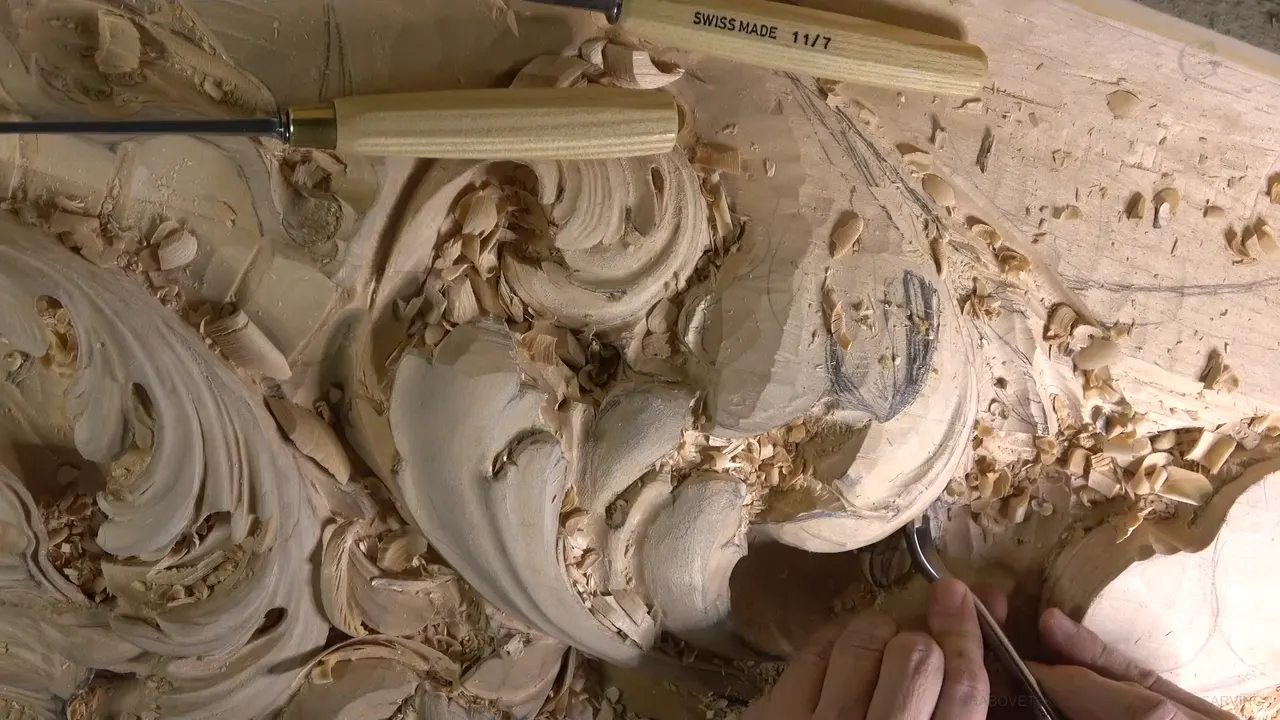
No bueno is my two words for no good, and I say them out loud when a spot on the wood goes wrong. Near the end of workshop 29, part 6, of the Venice Room, I stopped on one area of an acanthus leaf and said it plainly, this is no bueno. Less than a minute earlier I had called the same piece absolutely wonderful.

Have you ever spoiled something small with your own hands and said a word out loud before you could stop yourself? Did the very next thing you did depend on how bad it was? The same two words come out of me in video after video. Here you get what earned them, one moment at a time, and what my hands did after.
What earns a no bueno from me
Grain that catches or splits under the edge.
A tool pushed straight in.
A weak spot that breaks if I press too hard, or a tool I break by rushing.
Extra separations on one leaf, even ones I love.
A spot with no shadow, where an eye should be.
A slip, and in the lessons on this page the next line was often some kind of "but it's okay."
Where did I say it in Venice Room 29, part 6?
At the very end, after nine minutes on one leaf. The part opens with a number 11 spoon gouge at 10 millimeters (about 3/8 in) and a rule I keep repeating. Everything is supposed to go to the center line.
Right away the grain was wrong. Here's against the grain, I said, not in my favor. I also wanted to raise one side back a little, not much, because another pipe was coming there anyway.

A much bigger tool, maybe a number nine, would give me a much better overall shape, I thought. That same tool was too big for the opposite side. A little too big, I said, then took it back. Maybe not even little. Maybe it's really too big. This one is a bit too big also, I said. That was a number nine, by the way, and the one I was using right then was a number nine at 10 millimeters (about 3/8 in).

With it I raised the wood to make a pipe, one I said I should be able to see somehow. Now I could see it. Right here it was a little too messy for me, and maybe I should knock that down, I said. Not much, but a little bit.
The back bend came out next. I could probably knock one ridge out with it, I said, and move my leaf toward that direction. The middle part got cleaned to make it more concave, and a new concave went along the side of a separation.

On this side my tool was maybe a little too big, so I used a smaller one, a number nine at 3 millimeters (about 1/8 in). I wasn't sure you could see it, or even that I should do it that way. But at least it's a good start, I said, and I blended it with the back bend. And yes, that is exactly what I wanted to see.

I knocked one part down with the back bend and undercut it right away, so I could see how it was going to look. Those notches could probably go in right away, too. Wonderful, I said. That is just absolutely wonderful. One part would sit a little on top of the next, so I excavated slightly underneath it for another eye.

Then came the line this page is named for. We would pick up whatever is left next time, I told you, and a few seconds later I looked at one spot. Okay, this is not good right here. This is no bueno. The plan came in the same breath. I still had to knock down a little bit in that direction, and another separation would go right there, which is going to give me beautiful details.
Why would a Russian-born carver say it in Spanish?
I was born in 1973 in Dimitrovgrad, in the USSR, and I landed in America with zero English. During my April 2020 livestream, a viewer wrote in that no bueno was a famous Russian saying. Oh, yes, absolutely, I said.
My answer was that I live in the United States. If you live here, I said, you got to speak the land's language, and no bueno counts as a language of a land. A lot of people here actually speak it. Then I went straight back to the eye I was carving, turning a number nine and popping the plugs out.
A minute later, answering another comment, I said there are places in Miami where you can't get anything without speaking Spanish. Spanish is the second most spoken language in the United States, after English.

Which wood carving mistakes get called no bueno?
Grain trouble earns it in many of my lessons. On my hazelnuts, in lesson 1, I said that on detailed work it is a good idea to always attack from the outside edge inward, to the center, and then from the other side toward the center again. Don't be tempted to attack along the grain, I told you. You're going to catch the grain and you're going to split it. It's no bueno.

The Byzantine acanthus class put it in one line. If the grain bites, just rotate the piece and work from the opposite direction.
In workshop 41 of the Venice Room I was taking off one side, said oops, and named what I had just done. Too much stress to the wood. Stress against the grain.
A knife catches grain too, and mine did on the flower of my lily box. Working close to the bottom, I said I was catching grain and called that no bueno, then corrected myself. Well, I shouldn't say that is not good. That's normal, but I try to avoid it, because I don't want to break it.

Is a straight push no bueno?
In that same Byzantine class I called the slicing cut one of the most important cuts. A lot of people just push, I said, and that's no good. You place the tool on the board, rotate it to the left or to the right side, and start. While I push, I make a rotation movement, and the edge slices. There is a lot less resistance in the wood, just by the logic of how it works.
The class had a second one. Run one line into another so it makes a letter T, a T-stop, and it is no bueno. In lesson 3 I said that in wood carving you really have to be flowing, and everything is supposed to go to the center line. Those are the very words I opened part 6 with on the Venice Room leaf.
When does no bueno mean something will break?
My lily box had a kind of weak spot on its first layer. Press too hard and I could break it, and that's not going to be good. So I reached for a small double bevel number 1, approximately 1/16 of an inch (1.6 mm), one of those small, tiny tools that are not expensive at all and do a lot of work in carving like that.

Rushing breaks things too. Workshop 56 has me telling myself I didn't have to be that aggressive, and then saying why. When I rush and get more aggressive with each pass, I can break a tool. Not that I'm breaking them all the time, but I broke before, so that's no bueno, and it is not the mark of a professional man.
Even a new tool can earn it. In my sharpening course I held a brand-new tool whose bevel was really short and really high. I had to raise the handle a big four inches (102 mm) above the surface, then five inches (127 mm), before it grabbed the material at all. That's no good. Stage number one is to grind and reestablish your bevel, and only then do you sharpen and strop it.

Can there be too much of a good thing?
Workshop 35 had exactly that. I got carried away and carved too many separations, ones I should not have. I love those separations, I said, but too many, it's no bueno. So all I'd do, I said, was make that just one single part and chop out this section, because otherwise it doesn't look too organic.
It happens before carving, too. While designing my furniture panel, I wanted some kind of fillers. It looked a little messy for now, but worse, it contradicted the movement, so it was no good. Let me get rid of it, I said, and then I said it again.
One time the words even meant hands off. Back in the Byzantine lessons I told you not to touch one section and called it a no-no. A moment later I fixed myself. I mean, it is bueno, I said, but not touchable.
How does a missing shadow earn the words?
That livestream leaf had eyes with really deep shadows, because I had excavated them out. Then there was one area where you couldn't see any shadow. It just blended together with everything, so it was no bueno. I placed a number nine there, an eighth of an inch tool, let's say (about 3 mm). I went around like a plug, rotated, and took the plug out. I call it plug cutting, and it doesn't matter what brand of tool you use.

How deep depends on the shadow I'm after. My leaves sat close to each other and almost got lost in the picture, which was no bueno too, so I went about three-eighths of an inch (about 9.5 mm) deep. Wood carving is all about the lights and the shadow, pretty much. Painters have their own name for that, chiaroscuro.
Workshop 60 had the same trouble at a pipe. Two parts sat too close, and I saw almost no shadow whatsoever. That is, I guess, no bueno. So I took a skew.

Is it still okay after I say it?
I broke an edge in workshop 13, said no bueno, and then said it's still okay. It happens. That part was just going to be lower now, which means it's meant to be that way. That's my usual excuse when something breaks, I told you.

I dug in during workshop 8. It's not the end of the world, I said, because at that stage I can always go back and carve it again. My floral and molding panel got one too. Carving along the side of a line, I undercut slightly underneath it by mistake. I'll fix it, it's not a big deal, but I should be more careful.
Back in workshop 35 there was a rush. I just rushed too much, I said, but it's okay, it's still fixable. Workshop 46 had a different trouble, too small a tool, so I needed a little bigger one and a better blend, and the spot was not final yet anyway.

The back bend was in my hands in workshop 62, the ceiling was in my way, and I had to be really careful because of the grain. Then it went wrong. It's okay, I said, but it's not good. Maybe my tool was a little too dull for that operation. I had chopped too much, which was not a big deal, and I hadn't lost it yet. I'm not planning to lose, I added.
Does it ever have nothing to do with carving?
Sometimes it's the shop. My jigsaw came out in workshop 75, and I sawed a rough outline with it. If I didn't raise the board a little, the blade was going to hit my workbench, and that's no bueno. Three bench cookies went underneath. A little later it was the dust. I hate dust in my shop, I said, but of course there is a solution, and there's always a solution for that.

Eight times I said it, and the next move
| Where | What went wrong | Fix | Next |
|---|---|---|---|
| Venice Room 29.6 | One area right after absolutely wonderful work | Knock down | Another separation right there for detail |
| Hazelnuts lesson one | Following the grain line will split it | Outside in | Edge inward to the center first |
| Byzantine leaf two | People just push the tool straight in | Slicing cut | Rotate to one side while pushing |
| Lily Box 2.11 | Pressing too hard would break weak spot | Number 1 | A tiny number 1, double bevel |
| Stropping and compound | Bevel so short the handle rose high | Grind first | Reestablish the bevel, then sharpen it |
| Workshop 35 video | Got carried away with too many separations | One part | Chop out a section, more organic |
| April 2020 livestream | One spot blending in with no shadow | Plug cutting | Went around it like a plug |
| Venice Room 75.1 | Jigsaw blade about to hit the workbench | Bench cookies | Raised the board on three cookies |
Where does this panel go after part 6?
Part 7 opens with me trying to explain what I'm doing, because from the camera view it doesn't make too much sense. The whole workshop 29 runs twelve parts, workshop 28 comes before it, and workshop 30 picks it up after. All of them sit in the Venice Room Part 3 course, and every part opens with tuition.
Do you want to hear what I say at the bench when a spot goes wrong, and watch what my hands do in the next breath? The last words of part 6 were about beautiful details.
How it's done
- Attack from the edge inward. On detailed work, go from the outside edge to the center, then come back toward the center from the other side.
- Stay off the grain's line. Don't be tempted to attack along the grain. The edge catches it and the wood splits.
- Rotate when the grain bites. Turn the piece around and come at it the other way.
- Slice instead of pushing. Set the tool on its left or right side and rotate it while you push. The wood fights you a lot less that way.
- Fix a short, high bevel first. A brand-new tool may not grab until the handle sits five inches (127 mm) up. Grind and reestablish the bevel, then sharpen.
Frequently asked questions
Is every no bueno a mistake?
Not every one. A Byzantine section got called a no-no, and right away I said it is bueno, just not touchable. A jigsaw blade close to my workbench earned the same words, and so did the dust in my shop.
What do you do right after you say it?
After I dug in during workshop 8, I told you I can always go back at that stage and carve that spot again. On part 6 of workshop 29 my next sentence was the plan, knock one area down a little and add another separation for detail.
Does catching the grain always ruin the carving?
Catching grain is normal, I said while carving the lily, though I try to avoid it, since I don't want to break the part. When grain bites on the Byzantine leaf, my answer was to rotate the piece and work the other way.
What to carve next