

Alexander Grabovetskiy, woodcarver, School of Woodcarving · Published 2020
What makes a wood carver happy at the bench?
Quick answer: In my videos I say I am happy when a cut comes out the way I wanted: a clean chip, a division that looks nice, a number that lands on the golden ratio, or a cut I could get nicer. The part above had a nicer cut underneath.
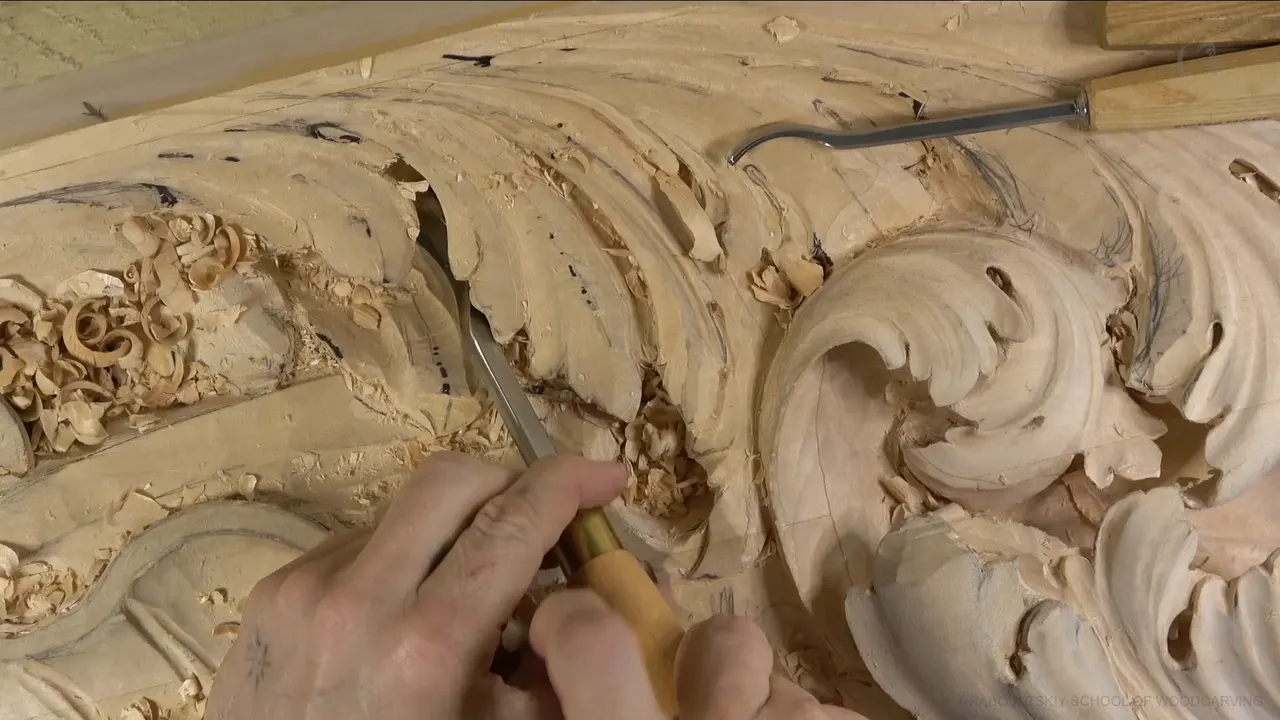

I get happy at the bench when a cut comes out the way I wanted, and I say so out loud. It might be a nicer cut underneath, a small chip that comes out clean, a division that looks nice, or a number that lands on the golden ratio. In Venice Room workshop 35, part 11, a cleaner cut got that out of me.
Do you pause at a cut that goes right? Or does the next one take over before you notice? Below are the places where I said it, from the part above and from lessons across my courses, each linked so you can hear it yourself.
What happened in part 11 of workshop 35?
Part 11 opens mid-task. "But for this, I probably should use a bigger tool." Then: "Let me see if 5/8 will work." (5/8 in is 15.9 mm.) Soon after I said, "16 millimeters, 15 millimeters, number 11." And: "most likely it will work."
"And that's going to give me even more movement, even more beautiful look." Next, a plan for the shape: "that part right here is going to be convex."

The other side followed. "Now I need to do exactly the same on this side. But I'm not sure if I'm going to be able to or not." The same tool, I said, "because it's already going underneath." Then: "Yes, I am able to." And right after, "maybe even deeper."
"I really want to be close to the original as possible." That was my reason for it. "To the ideas, what they had about acanthus and so on." And of course, I added, it "depends on the master who did that."

Then came the minute this page is named for. "But look at that. I'm able actually to get even nicer and cleaner cut underneath. And that makes me happy. And I can go even more this direction, which is really awesome."
Happy was not the same as finished. The very next line was a need. "Except now I need to create some kind of convex. It's kind of rough-looking one." Then "even deeper," and "give even more shadow."
A bent tool came up after that. A big one might not fit, I said, "but at least some back bend." My tool: "number 5 and 10 millimeters" (about 0.4 in). The plan: "let me establish that middle part as a convex."

The rough side did not worry me. I could still fix it, and the goal sat in the middle. "All I'm after, that middle part has to be almost perfect and gradual."
The part ends on a plan, not a result. "It's going to go from underneath. And now I have to attack again with number 11 and clean those concaves." The last question was whether the same half an inch would work. (Half an inch is 12.7 mm.)
Which clean cuts did I call happy?
Lily Box 6, part 6, has the smallest cut on this page. The tool's little wiggle came first, a jewelry maker's technique, I said, for small details in precious metals like gold or silver. I called the result a "nice and clean chip." "A really small thing, but still," I was happy "just because it's a really clean cut."

A division that shows from below is the subject in Venice Room 48, part 10. I planned "a little more of a concave," which might be "a little exaggerated, but I'm okay with that." Then: "that division is nice and somewhat big."
Another plan followed: "create more separations if I wish," but first "let me excavate around this separation." Then came "movement number one," and it made me happy, I said. I called it "really good movement," not detailed yet, but "somewhat what I want to see."
Part 4 of Venice Room 24 gave me "almost perfect result." I showed it from another angle so you could see how gradual and nice the movement was. The surface could go to really smooth, I said, but "I don't really need to," since the piece will be paint.

The tool marks, I said, "creates beautiful tool marks." That was "not the finish," and I still had "to do something else." I put that one in the happy pile too. After that I said I could get "all the way to the edge."
Hashemi Flowers 44, part 7, opens with a knife in my hand. "Looks like I am successful. I got my separation." Then I could "excavate on inside with no problem." "Let me clean it," I said, and "hopefully, you can see what I'm doing." I was happy about "stuff like that."

Do numbers count too?
A few do. Furniture Panel 19, part 15, holds a line I could not cut deep, because it was the same height as my molding. That line, I said, will be invisible. But if you take one point to another and divide that in 10, "it still falls to about six parts out of 10, which is by the golden ratio."

I told you the rest in one sentence: "you can find that golden ratio everywhere." Right after, I planned a number 3 at 6 millimeters (about 1/4 in), and said I could, little by little, round the area down.
Carving Vase with Grape Leaves 1, part 2, has me measuring. "I've got a space right here, a little bigger. Let me measure it." Maybe I had a golden ratio, I said, and after a turn of the piece, I found a smaller opening that was "perfect." And: "So I'm really on a golden ratio again." That left me happy.

Not every number is a ratio. Floral and Molding 4, part 2, shows a check. The need was a really smooth transition uphill, I said, and then: "let me double-check that section. I'm not sure if I'm there or not." After checking, "I am right on the money," I said, and then "exactly at the spot, which is really good." I was happy to see "that it hits the surface."

My goal after that was a smooth uphill cut. "I don't need to draw anything. Just eyeball it." Any flatter tool "will work, like number three."
A number nobody can see shows up in Venice Room 17, part 9. Two millimeters (about 1/12 in) was fine, I said, after 3 millimeters was too big. A 1 millimeter (about 1/25 in) could "completely connect the concaves underneath, which is, again, invisible to the naked eye." Also: "I know what it is, and where is it." I'm happy, I said, "when I'm doing it the right way."

Do I say it when something goes wrong?
I do, and a perfect result is not the cause. Damage to a side is the subject in Venice Room 64, part 1, and I called it "absolutely okay because I can clean that." A "super sharp number nine" would do it. A small section was showing up, "absolutely okay." Then: "Wonderful, and that makes me happy, and a couple more spots to clean up."

A harder one came in Venice Room 26, part 9. "When you start to go in too deep, you can make this side too weak, which I just did." It moved. "I just lost a beautiful chunk of wood, what I shouldn't lose." Glue it back? "Maybe yes, maybe no." Then: "But I really like how high it looks." That left me happy.

A number 11 at 3 millimeters (1/8 in) appears in Venice Room 33, part 6, and I said, "I can go as deep as I wish and create beautiful shadow." Of one element I said, "Beautiful. I'm talking about just this element." Seconds later: "What doesn't make me happy that I used a marker. But that's okay. I'll take care of it."

Sometimes a marker, I said, "goes really deep in the fibers." So: "let me work my way in," and recreate the center line. The good line and the slip came seconds apart.
Do saving time and extra detail count?
Time does. Chopping one side after another fills Venice Room 54, part 5. "It's just really quick." And: "That's what I like about it." Then: "So that saves me time, and if something saves me time," then I'm happy. Then: "Sounds like almost a song."

Next I planned "exactly the same, but on inside," and to "create that movement toward the overall movement." With the same tool I could probably give "little bit of cleaning," not the final one.
Extra detail counts too, when nobody needs it. Venice Room 16, part 9, has me seeing the separation, "but I'm still not too happy," and wanted this side lower underneath. "Ask me why. I have no answer. I just think it's going to look much better. Again, it's just my opinion."
My view of it came next: "extra detail" that I did not need to do. Even so, it was going to look really nice, I said, and I'm happy with "something extra like that." "It's not boring every day, the same thing."
Venice Room 46, part 3, shows the other side of that. "Now it's really good, actually." In my words, how it looks made me happy too. But "I'm not going to do too much right now because I still have to fill this spot later on somehow." I needed movement there, "because you don't want to see just empty spot right there."

Is it only about the wood?
No. In Lily Box 9, part 4, I was working toward a crack when I said, "if you can hear my granddaughter, please, she's visiting with me today." And: "happy actually to hear her." Next came "let me use a smaller spoon," a number 11 at half a millimeter (about 1/50 in).
And in Lily Box 11, part 11, some spots were blurry on your screens when you zoom in so close, I said, and I did not want to refocus the camera all the time. Then: "I'm really kind of happy with this." Of the piece I said, "that's the shape I'm after."
What did the next parts say?
The next part opens with "that works fine on this side." It is "really nice and deep," I said. "Beautiful. I really like it, actually." A bit later: "Make it a little more. Until it blends nicely."
Near the end of that part I said I had achieved what I wanted to achieve. "So it's beautiful. Even if you don't see the main separations, I've got beautiful movement, like concave, convex, concave." Then: "I love it. I love that movement."
The one before it, part 10, had a deep spot in it, and I asked, "Isn't it beautiful? I think it is." My own words: I was trying to get it "as beautiful as possible." That line was about a deep hollow, not a clean cut.
Where did I say it all?
| Passage and lesson | My words about it |
|---|---|
| A cleaner cut underneath, the part above | Nicer, with more to come |
| A clean chip, Lily Box 6, part 6 | Small, I said, but still clean |
| A nice division from below, Venice Room 48, part 10 | Somewhat big and nice |
| Tool marks, Venice Room 24, part 4 | Beautiful, though not the finish yet and more work still to do |
| A separation, Hashemi 44, part 7 | Done with a knife, so excavating inside came next |
| A cut that hit the surface, Floral and Molding 4, part 2 | Exactly at the spot |
| A golden ratio, Furniture Panel 19, part 15 | A line divided in ten, falling near six parts, by the golden ratio |
| A second golden ratio, Grape Leaves Vase 1, part 2 | A smaller opening, measured |
| Hidden concaves, Venice Room 17, part 9 | Invisible to the naked eye, though I know where they are |
| A quick pass, Venice Room 54, part 5 | Time saved |
| Extra detail, Venice Room 16, part 9 | Something extra that I did not need, so no boring day |
| A side I could clean, Venice Room 64 | Damage on one side, then a super sharp number 9 |
| A slip, workshop 26 | A chunk lost, and I still liked how high it looked |
| A voice nearby, Lily Box lesson 9 | My granddaughter, visiting that day |
Look at your own bench for a minute. What was the last cut you stopped for? Was it a clean one, a number that came out right, a pass that was quick? Say it out loud the way I do, even if only the pencil hears you. For all my lessons in one place, start here.
The workshop 35 lesson and the Venice Room course for workshops 26 to 37 hold the rest of this carving. Every line in quotation marks is mine, from my own recordings, and every lesson linked above is public. Across the grain of my lessons, the same bench keeps turning up.
How it's done
- Try the bigger tool. A bigger tool came first, and 5/8 was the size I wanted to try.
- Match the other side. On the other side I needed to match it, and I was able to.
- Look at the cut underneath. Underneath, I was able to get a cleaner, nicer cut.
- Say what is still needed. Still needed: a convex, even deeper, with even more shadow.
- Name the next pass. Next came another attack, with the concaves to clean.
Frequently asked questions
What got me happy in part 11 of workshop 35?
A cut underneath. An even nicer, cleaner cut was within reach, I said, and the path went on that way. Right after, I still needed a convex.
Did I fix that rough spot?
The roughness on one side did not worry me. Next, I said, I had to attack again and clean those concaves.
Which numbers did I call happy?
A golden ratio, twice. In the Furniture Panel course, lesson 19, a line divided in ten fell near six parts. In the Grape Leaves vase course, lesson 1, I said I was really on one again.
Did I stay happy after a slip?
What to carve next