
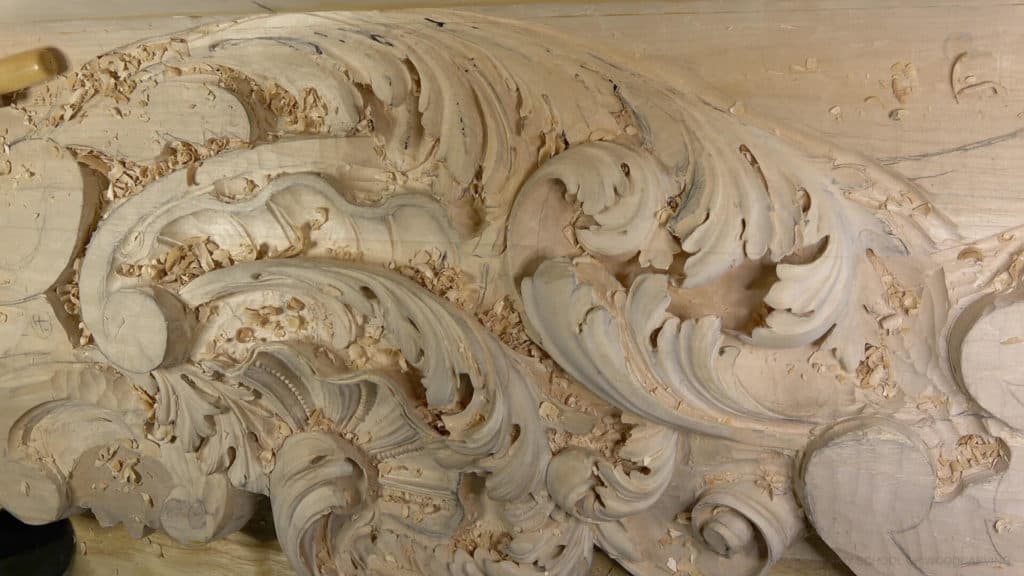
Alexander Grabovetskiy, woodcarver, School of Woodcarving · Published 2020
Is wood carving noisy, and how do you keep the noise down?
Quick answer: Wood carving noise is something I name on camera. A brass mallet made more noise than I wanted, a wood mallet is one I would rather not hear, and a rubber one was quieter. In the last part of workshop 35, I said noise was why I had not used a quick clean-up before.

The noise in my carving videos comes from my tools, my bench and sometimes from outside, and I say so when I hear it. The brass mallet made more noise than I wanted. I would rather not hear a wood one either. In Venice Room workshop 35, part 12, I told you the noise was why I had not used a quick clean-up before.
Ever put a mallet down because of how it sounded? Does one stroke after another start to ring in your ears by the end of a day? Below are my own words about noise, from the part above and from lessons across my courses, each one linked so you can hear it yourself.
What did I say about noise in Venice Room 35, part 12?
Part 11 ended on a plan: "Now I have to attack again with number 11 and clean those concaves." I wanted to see if the same "half an inch" would do. The next part opens in the middle of the work.
"And that works fine on this side. Really nice and deep." A little later: "Make it a little more. Until it blends nicely." Then came a plan, "let me cut this way also a little more," and a need, "now I need to clean this side same way."

About a minute and a half in, I said it looked like I had "achieved what I wanted to achieve." Even if you don't see the main separations, I said, "I've got beautiful movement, like concave, convex, concave." Then an option: "I could get a little closer to this edge."

Then came the minute this page is named for. "Let me clean a little bit all that mess," I said. A few seconds on: "See? It takes a couple seconds, but I love that idea. And I didn't use it before because of the noise. I didn't want to create the noise. But on the other hand, it's not much noise at all. And if it bugs you, just let me know, please."
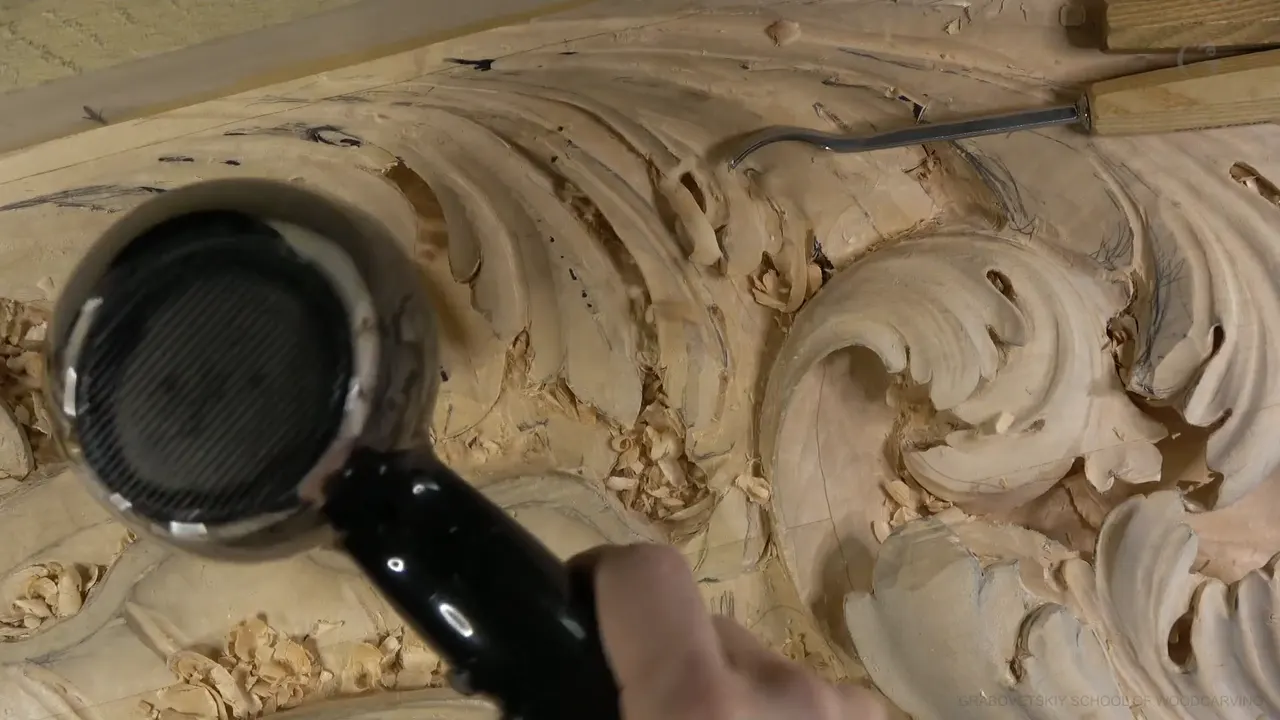
The tool goes unnamed in that line. The picture at that moment shows a hair dryer near the board. So the idea I loved, as far as the video shows, is a hair dryer on the chips, and the noise is what had kept me from it.
After that I went back to the carving. "Let me undercut underneath of this division," I said, and I could probably outline that side "pretty much right away." Another separation, I said, "could be outlined" too. The tool I named was a "number 11, that's what I'm using. Just a small one, four millimeters" (5/32 in), and I said, "let's take out all those chips underneath."

"Probably the final for today, it's going to be this," I said. "Just go in and clean it." I told you I love that movement, and that next time we would pick up from another spot.
Next I said, "look how it looks overall." And: "I've got a bunch of tools on my workbench." I had said "too many times even" that I don't like it, "but I still keep accumulating once in a while." That is usually a sign I got a little bit tired, I said, and leaving tools right on my work is "not the best practice."

My last plan in the part was short: "Let me blow, actually, and you can see much better." The picture right after shows the hair dryer above the board again. I closed with "in overall, it's going to be gorgeous composition. Beautiful composition."

Which mallet did I say makes too much noise?
The brass one. Venice Room 27, part 11, opens with it: "It just gives me too much noise, the brass mallet. And I don't want to hurt my ears." About a minute later I named a number 11, seven millimeters (about 9/32 in), as the tool in my hand.

Brass was not always about the sound. Back in Venice Room 1, part 9, I said I use a rubberized mallet to protect the ends of my gouge. The reasons I gave were the noise for a wood mallet and heavy-duty work for a brass one, "when I'm removing a lot of material."

Mallets came up again in Venice Room 85, part 4, where I said that for work I prefer a rubber head because it protects my handles, "at least for now." Maybe in the future I'll use mallets made of wood, I said, "but they produce a lot of noise." I said "this one" absorbs noise, and "I have that mallet for a long time, and it still works fine."

Acanthus over Moldings 2, part 1, comes at it from another side. Usually I don't use a wood mallet, I said, "just for the noise sake," and that I "just don't like to hear that noise all the time." Mine, when I use one, has "those ugly green heads." I also have a blue one with "some kind of silicon cover," and it "does not produce the same noise."
A livestream I did about mallets, Livestream April 2020, gives the weight and the sound together. The rubber mallet is 32 ounces (about 0.9 kg), I said, "still heavy," but "you're protecting pretty much the edge." It "absorbs the stroke on its own," where with a wood mallet "all the stroke goes inside of your hand and you feel it."
Then the sound. A wood mallet just produces "not-too-pleasant" noise. It gets to your ears, I said. "It's okay, I guess, but if you bang that all day long, it's not too good." With a rubber mallet, I said, "see how much quieter with the same amount of stroke."
Does the noise change how much I use a mallet?
Furniture Panel 26, part 1, has me outlining. "Going to use a mallet. It's gonna sound little bit noisy, but it's okay," I said. "If it bugs you, you can always turn the volume down." Right after that: "That is actually why I don't use mallets too much because of the noise."

Furniture Panel 18, part 7, goes the other way. My plan was a small number 3 "to chop around here," and I said, "I know it's a lot of noise when you're using mallet, but that's a really good tool." Seconds later it came again: "Mallet is a really good tool."

In Furniture Panel 38, part 2, I said the noise was "kinda not really good," but that carving it like that was fine. I would get a number 11, I said, to go "pretty close to the line."
Why did I choose a hair dryer over an air compressor?
Venice Room 50, part 1, has me pointing at a lot of chips on the carving. Carvers usually "just blow on it, and it's flying away," I said. "But there's another trick. So you can use just a hair dryer if you have an old hair dryer and if you don't like the noise of just the air compressor." Then, "Couple seconds, and it's all gone."

The reasons come in Venice Room 54, part 10. "I like my hair dryer technique actually much better than air compressor," I said. An air compressor "accumulates some water." I don't want water on my piece. You could use one with no problem, I said, "but I feel much safer not to." "And noise, of course." I named the noise an air compressor gives you as a downside.

A vacuum cleaner works too, and I said, "I do that sometimes also." Back in part 8 of Venice Room 1, I said, "Of course, it's better to use a vacuum," and that I'd use one later, but "I don't want to make a noise on the camera. Maybe in future, not now."
On the Floral and Molding panel, lesson 6, I said, "Let me blow that. I don't want you to hear it." Blowing this piece, I explained, does not mean "create an explosion." It means "just a hairdryer, a hair fan," and "that's a really good idea. Really wonderful idea."

So you hear three attitudes to one sound. In Floral and Molding 6, I did not want you to hear it. The compressor's noise was a downside for me. And in workshop 35, I called the dryer's noise small and invited you to tell me if you minded.
Which of my tools were quiet?
Lily Box lesson 1, part 2, finds me at the scroll saw. "And that is another thing why I like this saw," I said. "It's not noisy at all." Next: "I can actually just talk to my microphone, and it doesn't create any noise."

In Lily Box 13, part 11, I said I could use a normal drill for the holes. I said I did not want to over-drill it. "It takes a couple seconds, but it gives me a lot of control." We would install the hinges, I said. Later: "And of course, when you're using that hand tool, it's a lot less noise. That's also plus."

Another quiet one was a machine for stropping. In Stropping and Compound 5 I showed a Koch machine with four wheels. "First of all, it's really quiet." I love it, I said, because it's "really quiet and it's stable and safe."

What about noise that is not a tool?
My bench makes some of it. In Venice Room 58, part 9, I said, "apologies for that squeaking noise from my bench, because the carving is a little away from me, and I have to lean against that bench." After that: "I know some of you even didn't notice that until I said that, but it's okay." Part 8 of Venice Room 59 has the same apology, "because I'm just pushing against my workbench."

The squeak in Venice Room 4, part 2, came from "a tool chest on wheels," which was my bench there. A squeak got an apology in Furniture Panel 21, parts 1 and 14, too, and I said, "That is just my magnifier lamp."
Some noise was outside. It shows up in Venice Room 13, part 11: "the noise you hear, it's probably just my landscapers doing the grass, and I can't stop recording because I really need to keep moving." Landscapers were doing lawn mowing in Lily Box 8, part 5, and in Hashemi Flowers 19, part 4, I said somebody was trying to do a backyard grass mowing.
A jigsaw came with an apology too. Before using it in the first Venice Room lesson, part 2, I said, "Sorry for that noise. But I'm going to use a Festool jigsaw. I really like it because it gives me really nice cut, 90 degrees cut." In part 6 of that lesson: "Let me make a noise. Apologize for that noise, but this is the way to do it anyway."
Where did each noise come from in my lessons?
| What made the noise | What I said about it, and where I said it |
|---|---|
| Brass mallet | Noise that put my ears at risk, in workshop 27, part 11 |
| Wood mallets | They produce noise and my rubber head absorbs it, I said, in Venice Room 85, part 4 |
| A mallet on an outline | A little bit noisy, and I called it okay, in part 1 of the panel lesson 26 |
| Air compressor | A downside I named, next to water, in Venice Room 54, part 10 |
| A hair dryer in the frame | A small noise, I said, with an invitation to speak up, in the video above |
| A scroll saw | Not noisy at all, so I can talk to my microphone, in part 2 of Lily Box 1 |
| A hand tool | A lot less noise, and I called that also a plus, in part 11 of Lily Box 13 |
| A Koch machine | Really quiet, stable and safe, I said, in Stropping and Compound 5 |
| My bench, squeaking | Apologies for the squeak, since I lean on that bench, in Venice Room 58, part 9 |
| A magnifier lamp | I apologized for the squeaking noise and said it was the lamp, in Furniture Panel 21, part 1 |
| Landscapers outside | I could not stop recording, so I asked you to excuse the noise, in part 11 of Venice Room 13 |
Look at your own bench. Which tool do you reach for last because of how it sounds? Is there one you would swap for a quieter one, the way I preferred a hair dryer to the compressor? These lessons show me thinking it through a tool at a time. For all my lessons in one place, start here.
The workshop 35 lesson and the Venice Room course for workshops 26 to 37 hold the rest of this carving. The words in quotation marks are mine, from my own recordings.
How it's done
- Name the noise. In the part above, noise was the reason I gave for holding the clean-up back.
- Weigh it against the job. The clean-up is quick and the noise is small, I said.
- Pick the quieter mallet. Brass came with a worry for my ears, and on a livestream a rubber mallet was much quieter than a wood one.
- Choose a hair dryer for chips. I liked my hair dryer much better than an air compressor, for the water and for the noise.
- Let people speak up. I invited you to speak up, and in the Furniture Panel lesson I said you can lower the volume.
Frequently asked questions
Why did I put the brass mallet aside?
Brass came up in two lessons. My ears were the worry in Venice Room 27, and I said I didn't want to hurt them. The first Venice Room lesson, part 9, gives a different reason against brass: heavy-duty work, with a lot of material to remove.
Is a rubber mallet quieter?
On a livestream about mallets, I said mine is 32 ounces (about 0.9 kg), still heavy, and that it protects the edge and absorbs the stroke. With the same stroke it was much quieter than a wood mallet.
What is wrong with an air compressor for chips?
Water collects in an air compressor, I said, and I feel much safer not using one. Its noise I named as a downside. My pick was a hair dryer, for the water and for the noise.
What to carve next