

Alexander Grabovetskiy, woodcarver, School of Woodcarving · Published 2020
What does opportunity mean when a wood carver says it?
Quick answer: In the lessons below, opportunity names the next step a pass just opened. In part 3 of workshop 35 I protected an edge first, and then a number six gave me a nice twist, which I blended back where the tool went past what I had in mind.
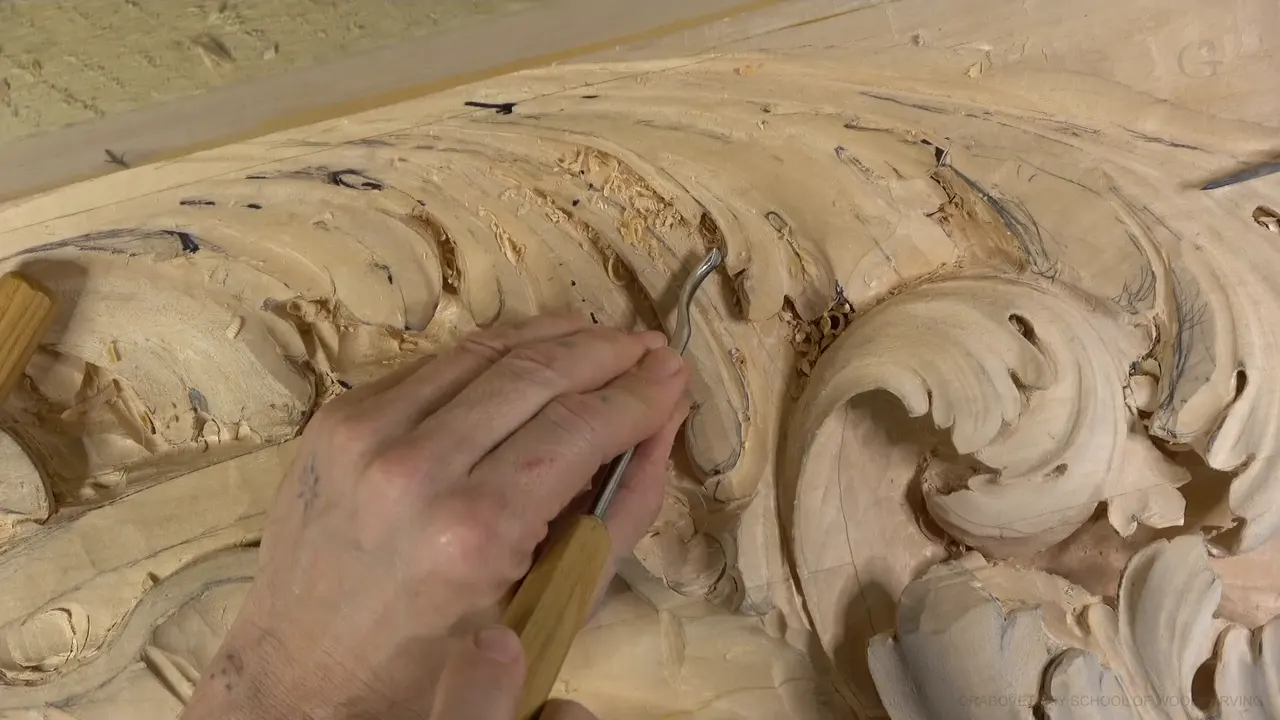
In my videos, opportunity names what a pass just opened, as the lessons below show. In workshop 35, part 3 of my Venice Room course, I protected one edge and then spotted a twist coming. The same word shows up across my wood carving videos, so I followed it.

Ever made one good pass and found a second job waiting right behind it? Did you take that job, or leave it for later? I went through the Venice Room course, grape onlay, lily box, the panel course and acanthus over moldings. Good passes brought it up. So did slips.
What does opportunity mean when I carve?
In my videos it is a next step that exists only because of the last one. A pass takes out wood and leaves a new shape, and that shape may let me go deeper, clean a spot I could not reach, lower a neighbor, or build a shadow. I say it the moment I spot the chance, and I decide after.
Two kinds turn up. A good pass can open a door, like a shell lowered a little or a hollow dug deeper. Or something goes wrong, a void in the wood or a slip of the tool, and I turn it into the next design step. Both kinds get the same word on camera.

What was on my bench before the word came?
"One of the challenges is the grain of the wood," I told you, since some spots are much easier than others. I dug one corner first, made a small slicing motion, and went in. I took my time.
A part of the piece sat below an element where I could not see it. I still wanted it taken care of and clean. Spots left rough are okay for a while, I told the camera, but when you look back you understand it would look much better if you spent a couple more minutes on it.

Next I wanted a little more depth on one side for extra shadow, plus a nicer overall look at one movement. I paused over which tool, then picked a five. One small turn gave a nicer look, and the same five went in again for more cleaning.
The bigger step used a 3 millimeter number 11 (about 1/8 in), set in around a spot I planned to excavate into a deep spot. Then came a nine for what I called a plug removal idea, not that deep but deep enough. I reached about 20 millimeters (about 3/4 in), or three-quarters of an inch.

Beneath two nearby elements an undercut was planned, and that spot would turn into a beautiful shadow spot. A skew gave the movement a little more shape, and it had to go underneath.
What opened the door in that video?
The edge did. "I have to be careful with that edge," I said. "I do not want to destroy that." And right after: "I also see opportunity to make a really nice twist and make a rotation this way." I expected a beautiful movement from it.
A number six chopped, and the shape rotated a little bit inside. "So beautiful." Seconds later I judged that the six had overshot, so I eased it back the other way. The twist was a try, not a promise: I saw it, carved a little, and looked. Care for the edge bought me the chance.

Can one pass open the way to a deeper pass?
It did in workshop 40, part 11. My middle line ran along the piece, and I wanted convex and concave shapes on it. One side got a light chop, since it would sit a little above. The other side got one too, which "actually gives me the opportunity to dig even deeper right here." Why not, I asked myself. A seven finished the job for a more three-dimensional shape.
Workshop 20, part 4, has the same step. One concave had a transition a little too sharp, and it did not make me happy. A bigger concave came to mind, and I knocked the edge down. "That's actually for me opened more opportunity to cut even deeper right here." My tool grew a little too big for the spot, so I could use a nine again for cleaning, and a seven for a pipe movement.

A plug came out in workshop 54, part 9, once I rotated the tool. "See how nicely I can just get that plug out." Beautiful. From there I could go deeper and come at the sides, which opened a way to clean underneath a small detail. A back bend came to mind. Then maybe a smaller 11 at 4 millimeters (5/32 in), for little nicer movements. Across those three, one pass took wood away, and the new space gave the next tool a way in.

Does an opportunity change the design?
Sometimes the shape that opens up changes what I planned. Over in workshop 29, part 8, I wanted a unified form, three separations and three main parts. I counted out loud again: two eyes, three different parts. Then came the line I like: "I have a really nice opportunity right here to create something beautiful."
I could make a nice opening that you would detect from the bottom, since from the side I could see that twist. I began to say excavate, caught myself, and apologized. What I wanted was a round shape and a spot a little deeper. I said a little deeper more than once, and an even better shape was in reach. A seven knocked down some of the side. Forcing it was out, since the sides of the pass could take damage.

Workshop 38, part 5, brought a smaller gift. One place would not let me dig too deep, since the shell had to sit level with its neighbor. All looked good, yet the pass gave me opportunity, actually, to lower the shell a little bit, because it did not look too right. "See how much material I freed up for myself." A separation came next with the same 11, 5 millimeters (close to 3/16 in), and a nine looked like the tool for the concave.
A corner came out in workshop 45, part 2. Earlier in that video I had wondered about a bigger opening, which you see sometimes in original work. Taking out the corner gave me opportunities for a nicer movement. A pipe pointed the wrong way, since it was supposed to go from the eye, so I picked up a three and carefully removed what I did not need. Inside a spot like that, care matters. My tools have a long bevel and are super sharp, like a surgeon's tools.
With the pipe going the right way at last, I said I loved the development I had just created.

| Where | Tool | Job | Words |
|---|---|---|---|
| Venice 29.8 video | No tool named, a round shape next | Twist opening | A really nice opportunity right here |
| Workshop 40.11 clip | Number seven, used all the way through | Dig deeper | The opportunity to dig even deeper |
| Lesson 54.9 video | Back bend, then 4 mm number 11 | Clean underneath | Gave me opportunity to clean underneath |
| Venice 20.4 part | Number nine to clean, number seven next | Go deeper | More opportunity to cut even deeper |
| Grape Onlay 4.2 | Number nine going right underneath, section lowered | Change design | Slight change, sometimes it does happen |
| Lily Box 4.4 | Number five, a quarter inch, dug out | Redo design | Gives us new opportunity to recreate |
| Acanthus Moldings 6.3 | Number five, forced a little too much | Fix grain | Good opportunity for me to fix |
What do I do when a slip or a flaw hands me the opportunity?
This is the other half of the word. In grape onlay lesson 4, part 2, a nine was heading right underneath one area when I slipped. I called it a change of design. Glue could have put the piece back, yet I lowered the whole section instead.
Looking again, I saw why. I had already excavated that spot a lot, and it was already undercut, so the pass went further than I planned. Everything had to blend together. "That is okay, that is just a slight change," I said. "Sometimes it does happen, and it is not a big deal." Then the line this page rests on: the slip "just gives me an opportunity to create a little more."

The wood itself did the same in lily box lesson 4, part 4. A two at 12 millimeters (a little less than half an inch, I told my viewers in the United States) was working, and I felt I had to recreate the design because of what showed up. The look did not please me. A five at a quarter inch (about 6 mm) dug it out.
"There was a void inside, right inside of the wood." A blemish, which is okay, and "just gives us new opportunity to recreate." Blending that lower was a good idea. I was pretty sure I could still keep the same design, and pretty sure is all I claimed.

Back in the same box, lesson 9, part 2, held a bigger gap, a couple of millimeters wide. Too big, I told you. Filler or epoxy would be too noticeable once the finish went on, and it would not look nice. So I took advantage of it and made extra details right above, sloping both downhill, then planned to develop the upper part.
"Yes, it is a change to the design. But it is what it is." You cannot know what is inside of the wood, I told you, though basswood usually does not give you those issues. Not really an issue anyway, just "another opportunity" for something different. Once it was done, I hoped, people would not even know it was not part of the original design.

Acanthus over Moldings lesson 6, part 3, caught me forcing a five too much, and a little bit of the grain gave way. "It's a good opportunity for me to fix it," I said, and I planned to move the center cut slightly to the right. I named the slip, and I used it.
In panel lesson 7, part 1, a piece let go while I pressed too hard. "Oops, that is not what I want to see." That happens sometimes. Gluing it back was possible, but I did not really need the piece, and I still had material. I called it "a good opportunity to show what you do if stuff like that happens."

Put those four side by side and the shape repeats. I name what went wrong in plain words. Then I carve it.
When is an opportunity only a plan?
Opportunity can stay a hope until the wood agrees. A big chunk for a volute in workshop 45, part 8, was too thick, so some had to go. "So that's going to give me an opportunity." A beat later: "I believe it's going to give me opportunity." Should it disappoint me, down it comes and I recreate something. I believed it should look good, then fixed my own wording: I believed it would. That mix of hope, try and way back is enough to start a pass. A heavier tool and a mallet came next, and I warned you not to go all the way to the end, since that end was weak and the grain ran that way.
Another grape lesson sets up a try. In lesson 9, part 1, I wanted one deeper shadow, so I outlined it with an 11 at 4 millimeters (5/32 in), not too deep yet. "Although, let me tell you something. I have a really good opportunity," I said, to build extra shadow, and a flip might fit right in that section.
Workshop 12, part 5, has the opposite kind. I reached for an 11, maybe 2 millimeters (roughly 5/64 in), and warned myself about making it too weak again. That part would not show from the street, only from the bottom. "So it gives me actual opportunity to create a stronger detail." A notch? I did not know yet.

Why do I say the opportunity out loud?
You cannot see the chance I see. A camera shows a hand and a gouge, and nothing about a neighbor that can come down or a void that is a gift in disguise. Say the word aloud and you hear me stop, then hear the call I make.
It leaves a record too. When an idea fails, like the six I blended back in workshop 35, you watch me back out. Try it at your own bench the next time a pass opens something up. Say it out loud, even to an empty room.
How it's done
- Protect the edge first. Before any twist, I was careful with an edge I did not want to destroy. That care came first.
- Look at what the pass opened. A pass takes wood out and leaves a new space. The question is what the space lets me do, such as dig deeper, clean underneath, or lower a neighbor.
- Say the plan out loud. Naming the opportunity on camera keeps it a plan. On the volute I believed it would look good and knew I could take it down.
- Try one pass and look. I carved a small amount, like that first chop with the six, and looked at the shape before going on.
- Blend back after an overshoot. A small blend fixed the overshoot.
Frequently asked questions
Is an opportunity in wood carving a promise?
No promise there. On the Venice panel I believed one would look good, and I kept a way back: I could remove it and recreate something.
Can a flaw in the wood become an opportunity?
Yes. A void turned up inside the wood in the lily box, and it was a blemish of the wood, which was okay. A gap of a couple of millimeters in a later lesson led me to extra details above it.
What tool made the twist on the Venice panel?
A six. I chopped and rotated the shape a little bit inside. Then the tool overshot what I had in mind, so a small blend fixed it.
What to carve next