

Alexander Grabovetskiy, woodcarver, School of Woodcarving · Published 2020
What does sufficient mean when a wood carver says it?
Quick answer: Sufficient is how I name a tool size I try and then judge. Over in the seventh part of workshop 35 I put 2 mm to an undercut and asked if it would be enough. Wanting more shadow later, I said it did not fit and went down to a millimeter.
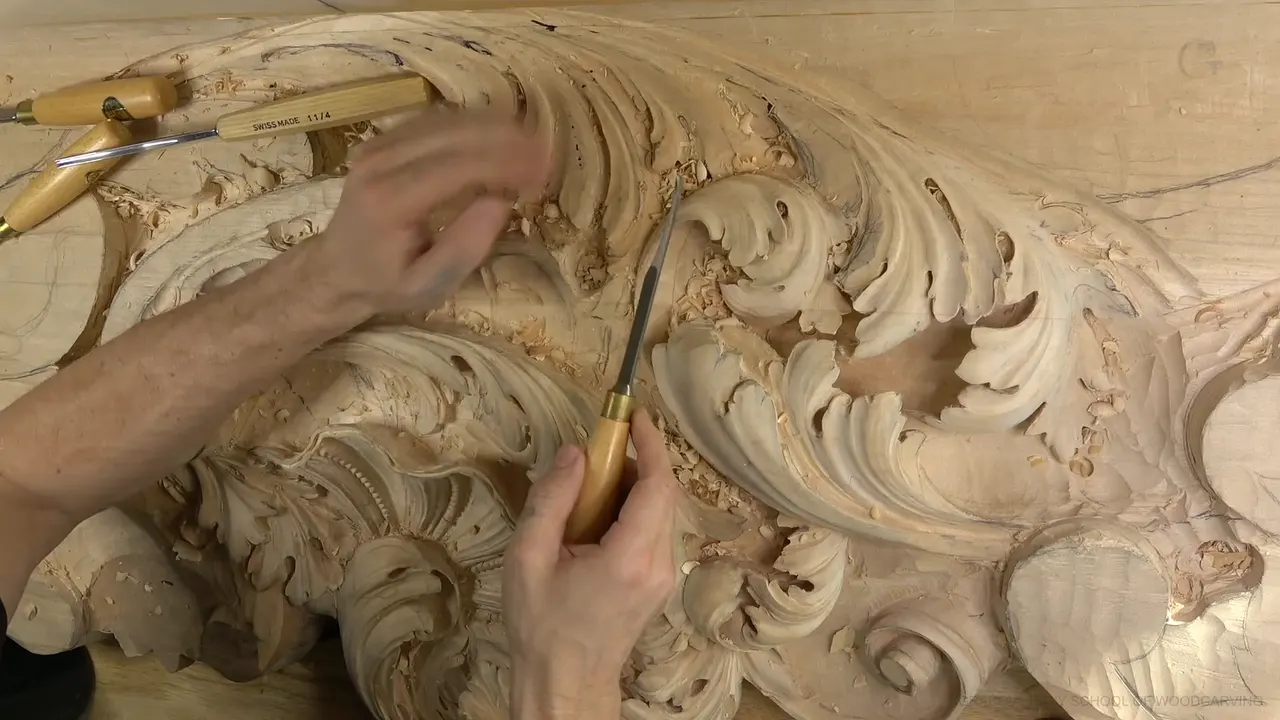
Sufficient is my word for a tool size I try and then judge: will it do this job, or do I need another one? In Venice Room workshop 35, part 7, I picked 2 mm (5/64 in) for an undercut underneath and said I wanted to see "if it's going to be sufficient, if it's going to be enough, or I should go with the smaller one."

Ever stood over a wood carving with a gouge in your hand and wondered if the size was right? Did you carve with it anyway, or change it? I changed tools on camera more than once. My transcripts carry the word sufficient in 79 videos, from the Venice Room and the Furniture Panel to a lily box and a rosette, and I followed it through a good part of them.
What did sufficient mean in this Venice Room video?
The part opens with an undercut. "I can probably undercut underneath of this one, get closer to the edge," I said, and "very much right away." Next came a number 11 to get rid of "whatever junk I just created," and I could go deeper still. A long bent or a short bent number 11? I weighed the pair out loud and picked the long bent, and then I took it upward.
I liked what I saw. I called it beautiful detail and said I really loved it. The underside still needed work, because "otherwise, it just doesn't look right." Then came the test this page is named for: 2 mm, and the question of whether it would be enough.

An eye was next. "For the eye, I usually like to do number eight," I said. I also said to use a smaller one, about one-eighth of an inch (3 mm) or even smaller, maybe 2 mm, which I called like 3/32 of an inch (2.4 mm). "Remove that plug," I said. Wherever an eye goes, that is what I would do.
More shadow underneath was what I wanted after that. "Looks like two millimeters is a little too big, and I have to go with the one millimeter." Twice I said just one millimeter, a number 11 (1/32 in), and then "get deeper." The earlier size no longer fit here, so I changed it.

From the other side I wanted some undercutting too. It looked like I could use even 4 mm (5/32 in) for the beginning. "Once you start undercutting," I said, movements show up that show whatever you want to show. One leaf in this part cannot be seen from above. From below I could see it, so I moved a line on it, and it gave me "extra dimension," which I said will be beautiful in real life.
I said I could excavate deeper and deeper, with one reminder: there was an element I could not forget and did not want to lose. I called that probably enough depth, as far as I wanted to go.

Next I took care of the chips, then picked up a number 5 of about a quarter inch (6 mm) to get inside and try for even deeper. A shadow under the leaf and an undercut beneath a separation were the aim. Some of the next cuts could use the same number 5, I said, and a mallet if I had to. The rest could come out with number 7, and probably the same number 11 after that, "a really nice, smooth transition up here."
How did I test a gouge in other Venice Room videos?
The same test shows in workshop 36, part 5. A smaller number 3 came to mind first, then maybe a 5 or even a 6. My plan was to see if the number five was sufficient. "And yes, number five right here would be the right tool," I said a moment later. That 5 was about five-eighths of an inch (16 mm), and I was right on the line.

That video holds a second thought. I could have used the same number 3 and gone all the way, I said, but changing the profiles gave me a lot more accuracy as I tried to fit the line.
A concave was the job in workshop 34, part 3. Number six or even number seven could do it, I said, and I tried six first. Later in the same pass came "Maybe number six is sufficient." It had to be a spoon, because a straight tool would have put a part of the carving in my way.
The word turns up again in workshop 37, part 7. I asked whether a cut would do, and added "deep enough." After that I needed a convex cut and a back bend, then maybe a smaller number 11, about 2 mm, 5/64 in or so, and the answer to that was "Maybe, maybe not."

Older videos sound alike. A convex side in part 12 of workshop 14 could take number 5 or number 3. We would see if the 5 was enough, I said, and then, "Maybe number three." A number 9 came first in workshop 11, part 2. If it fell short, I said, a number 11 was next, a spoon gouge of maybe 5 mm (3/16 in) to excavate right below it.
When does a tool stop being sufficient?
The wood can say so. A big shell was my job in workshop 2, part 2: "the straight tool would not be sufficient anymore because I'm hitting this side." I picked up a big number 7 for the same pass.

Part 7-2 of the floral panel course tells the same story. "Looks like my straight tool is not sufficient anymore, so I have to switch to some kind of spoon." I took a really short spoon, 1/8 of an inch or 3 mm, a number 8, and then a straight number 9 of the same size, to attack the spot from one side. Lesson 7 of that course has the whole carve.
Workshop 70, part 9, put the question first. I wondered if the straight tool was enough or if I should switch to a spoon. Ten seconds later: "I think I need to switch to a spoon." The hole there was about 25 mm (1 in) deep. A veiner of maybe 7 mm (9/32 in) took over, and a number 9 could give about the same result, I said.

Sometimes the first guess held. A plug cut using a number 9 gouge came up in workshop 82, part 3, and I said, "I'm not sure if the quarter inch will be sufficient or not." Then: "Yes, it will be." I thought about a drill, since I do have one, then went with the old way, a number 9 of 6 mm (1/4 in). Going too deep could damage the side, I said, and a slightly different aim was probably needed.
How small can a sufficient gouge be?
Small, and numbers show it, starting with the one I gave in workshop 146. My reasons for starting with 1 mm (1/32 in) came in workshop 146, part 3. I wanted to know whether that cut was sufficient, and I could get really close to the line and see the edge much better. After that I said I did not think 1 mm was enough, and I followed with 2 mm (0.08 in).

"I don't have to be a hero and create a really long cut," I said there. The 2 mm pass was much better, though not the end yet, and I planned to start from that point again and go the opposite direction. One size had been a start. The next one took over from it.
I put 4 mm, or 5/32 in, to the same test in workshop 110, part 1, asking out loud whether it was sufficient. A little later I planned to undercut underneath. In the next breath I took 2 mm, a little under 3/32 in.
Over in the Furniture Panel, lesson 23, part 2 had "One millimeter should be sufficient, number 11," for the petals on the inside. Part 13 brought the same size back: "or even one millimeter will be sufficient in this case." I added that a half millimeter gives a lot more shadow, a lot more pronounced shadow. "Let me show that to you," I said, and I carved around.

In Acanthus over Moldings, lesson 6, part 2, the first cuts went in using a number 11 at 2.5 mm (about 3/32 in) and the flute straight up at 12 o'clock. That was enough for me, I said. About a millimeter deep, and no deeper. A flatter tool came after that, a number 3 in a quarter inch, about 6 mm, and the number 11 stayed close by.
The Grape Leaves vase gives an eye. In part 3 of lesson 3 I said an initial cut of 3 mm (1/8 in) is a straight-down cut, and 4 mm (0.16 in) or 5 mm (3/16 in) would make a bigger eye. "But 3 millimeters should be sufficient." For a deeper shadow I took 1 mm, a number 11, and exaggerated the cut inward. For something really extreme, I said, a number 8 of about 1/16 of an inch (1.6 mm), placed upside down, makes a plug cut inside and lets you go as deep as you want.

The eye in this page's own video was a number 8 too, with a plug to remove.
Does sufficient only describe a tool size?
At times it described a depth. In the Lily Box, first layer, I called a one inch (25 mm) tool sufficient, and the deepest point there was probably 1/8 of an inch, about 3 mm, maybe even less, maybe 3/32 of an inch (2.4 mm). I was not going to force it, I said. If I forced it I would break my wall, and that is no bueno.

Greek acanthus lesson 2 used the word on a first pass. Part 2 had me taking a gouge straight to the line, a number 7 of 14 mm (about 9/16 in), and make my preliminary cuts, and that would be sufficient. Hitting the wall did not scare me, I said, since that spot gets undercut later on.
A knife was the tool that fell short in Chamomile and Bow Rosette, lesson 4. I could pop the center of the triangles with it, but I said it would not do for me, so I took a number 3 spoon of about one-eighth of an inch, 3 mm. Later in that lesson, a small piece of 240 sandpaper was "completely sufficient," since that project is for the paint.
Is a V tool sufficient, or only a number 11?
In Floral and Molding for the Panel, lesson 10, a triangle needs a relief cut, which is what I call it, and I said you can call it whatever you like. Asked what kind of tool to use, "I really like to use number 11s on this project," I said, and you could do even a V tool. "It's not a big deal."

My aim was to be more authentic to the original carvers, and I said they did not have that V tool back then. Still, "V-tool would be sufficient," I said. I showed a number 16 V tool going right inside. "Yes, I do have a good form, good shape, and I'm happy."
What do the examples line up to?
This table puts seven of them side by side. Read the last column as my own words, or a few words squeezed from them.
| Where | Tool | Verdict | What I said |
|---|---|---|---|
| Venice Room 35.7 | A 2 mm try, then one millimeter | Too big | A little too big, one millimeter |
| Workshop 36.5 clip | Number five, five eighths of an inch | Right tool | Five would be the right tool |
| Lesson 34.3 video | Number six spoon, or even number seven | Sufficient, maybe | Let me try number six first |
| Venice 70.9 part | Straight tool first, then a spoon veiner | Switch tools | I think I need to switch |
| Part 146.3 video | A one millimeter cut, then two millimeters | Not enough | Don't think one millimeter is enough |
| Panel clip 23.13 | Just one millimeter, then half a millimeter | More shadow | Half millimeter gives much more shadow |
| Moldings lesson 6.2 | Number 11, two and a half millimeters | Sufficient, shallow | That's gonna be sufficient for me |

How do I read sufficient and still carve?
In these lessons I tried a size and saw whether it was enough. The number 11 at 1 mm was sufficient in the Furniture Panel, and a half millimeter still cast more shadow. The straight gouge was enough until the side of a shell got in the way.
Would you like to hear me weigh two sizes with the gouge in my hand, the way I did on camera in this lesson? Have you wondered why 1 mm, then 2 mm, felt right in one lesson? The Venice Room course, part 3 holds this video and eleven other workshops.

How it's done
- Name the size you will try. In workshop 35 I said I would use two millimeters and see if it was sufficient.
- Ask if it is enough. I asked out loud if 2 mm was enough.
- Keep a smaller one in mind. If it fell short, I said, the smaller one was next.
- Change the size. Wanting more shadow, I said 2 mm looked too big for that spot and switched to one millimeter in a number 11.
- Go deeper where wood allows. I took a number 5, about 6 mm wide, to get inside and try for even deeper.
Frequently asked questions
Does sufficient mean the smallest tool that works?
In my lessons it meant a size I judged enough for the job at hand. A 1 mm number 11 was sufficient in Furniture Panel lesson 23, part 13, and I added that half a millimeter would give a lot more shadow. Workshop 146 began with 1 mm and followed with 2 mm (0.08 in).
What do I do when a tool is not sufficient?
I switched, in the lessons above. A straight tool was not sufficient anymore in workshop 2 because I was hitting the side, so I took a big number 7. Part 7-2 of the floral panel course and workshop 70 sent me to a spoon instead.
Was my first guess right in this video?
For an undercut I chose 2 mm, then wanted more shadow underneath and said that size looked too large for the spot. Then one millimeter in a number 11 took its place. Workshop 82 went the other way: I was unsure a quarter inch (6 mm) would do, then said yes.
What to carve next