

Alexander Grabovetskiy, woodcarver, School of Woodcarving · Published 2020
What does wiser mean when a wood carver says it?
Quick answer: Wiser is my word for the better of two ways I can see. In workshop 35, part 5, I held a straight tool and named a bend, short or long, as the wiser choice. Then I called my tool still good. I carved.
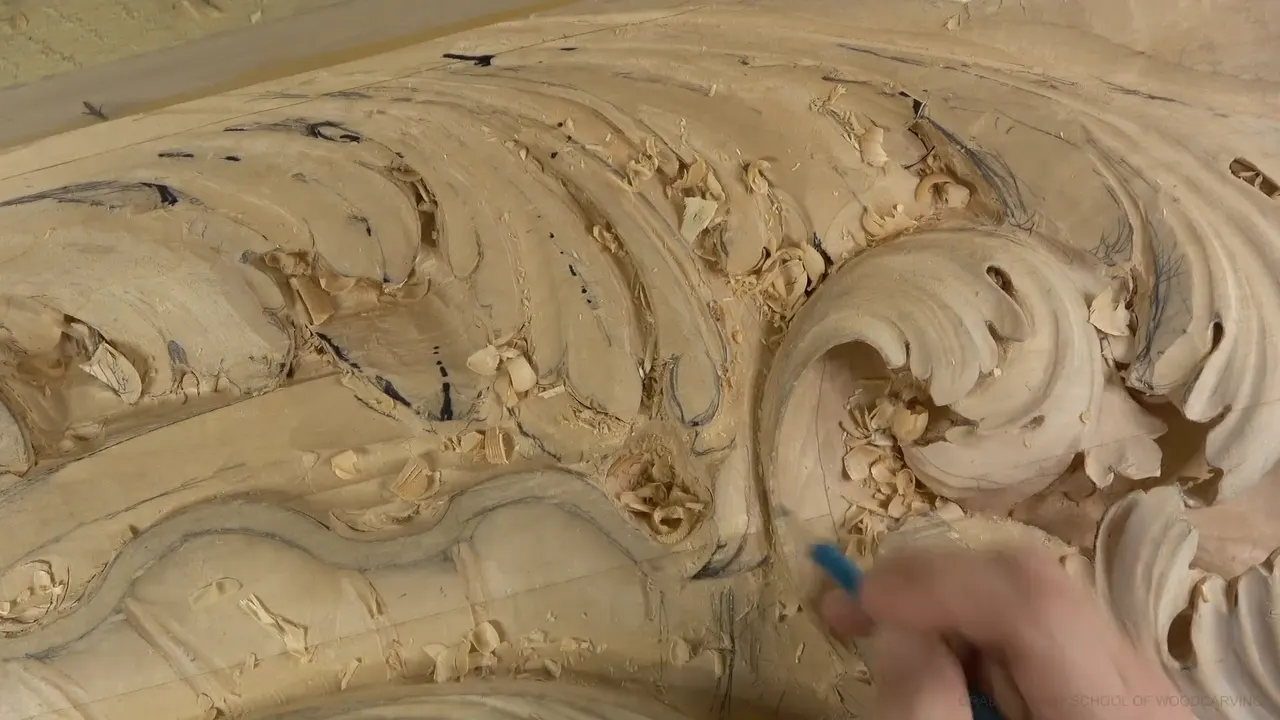
In my videos, wiser is the word I use when two ways are open and one looks better to me. In Venice Room workshop 35, part 5, I held a straight tool and called a short bend or a long bend the wiser pick. Right after that came "But even that, still good."

Ever stood over a wood carving with a tool in your hand and felt a different one would suit the pass better? Did you carve with the first one anyway? I did, on camera. My transcripts show wiser in 29 videos and smarter in 11, so I followed both words through the Venice Room, Hashemi, Furniture Panel, Roman acanthus and lily box courses.
What did I call wiser in this Venice Room video?
The part starts mid-pass. "I'm using number three, but I should use probably right away number seven," I said. "Let me see." One area would match the one beside it, even wider, with the concave on one side only. Going upward took a number 7, about 5/8 of an inch wide (16 mm), and I told you I was going "without pushing too hard."
Underneath was next. The camera could hardly see that spot, so I said I needed to change the camera position. A smaller 7 followed, maybe half an inch (about 13 mm). Next, the shell. It was supposed to go inside, which meant carving around it, and that job started with an 11 at 4 mm (5/32 in).

Here is the line this page is named for. "Yes, I am using just a straight tool, but I think wiser would be if I would use short bend or long bend. That would be much smarter." Then, "But even that, still good," and a plain "let me cut to it." A better way existed, and I called what I had still good.
My beads came up soon after. Some space had to stay for them, since beads were still going to sit inside, somewhere around that spot. "I can't take too much material," I said, because they would give me "a really beautiful detail." The hollow matched the concave beside it, roughly, and it would go a little deeper once I worked around the spot.

Secondary separations came "right away." Two got named out loud, and we could probably finalize all the concaves and convexes on that piece. A doubt followed. I kind of liked it, but not as much, and wanted more movement there. Another separation was the plan, though chipping it out the quick way was open to me.
"But why would I do that if I have some material? And I kind of like that idea." Soon after, I said to be careful, and maybe I had to penetrate that spot with diluted glue. Carving under a small detail could give me an extra small eye. Later: maybe I did not need that eye. "I don't think I need it."

Near the end I talked about concave, convex, concave, with not too much concave, maybe even a straight gouge like a number 5. And this: "I really love the idea that this part is raised up, and I really don't want to lose it." The line I keep from that part is this: "That's what I'm trying to communicate."
When is a bent tool wiser than a straight one?
Four lessons put that choice into words. Over in workshop 33, part 1, I said it was probably wiser to use a bent one, and I went on to give another piece a downhill shape. A number 5 upside down, a quarter inch (about 6 mm), was in my hand for workshop 30, part 4, and an edge was in my way.
So a back bent was needed. "Back bent would be smarter approach right now because I can go as deep as I wish." It gave me a spot for the shadow, though I still had to keep the finish in mind.

Two sizes of bend sit in one breath in workshop 40. "It is not going to work, so I need to use number 11," I said, for a much deeper excavation, and then I weighed the bends. A long bent, not a short one, was "probably a little wiser, I would say." Five lessons earlier, workshop 35 had raised that same short-or-long pair, and I came back to it.
A spoon got the label in part 7 of workshop 21. My tool was not the best one for the separation, I said, and the best would be some kind of spoon, maybe a number 5 at 8 mm (5/16 in). I called that wiser, and added that the right direction would help too.

Is a smaller tool the wiser pick, or is it the other way around?
Both happened.
The small one is in part 11 of workshop 27. The brass mallet gave me too much noise, and I did not want to hurt my ears. "I'm raising that," I said. "That is what I don't want to see." And then: "That is why sometimes it's wiser to use smaller tools. Not always, but sometimes it's much wiser." The next tool was an 11 at 7 mm (about 9/32 in), and I said I was using it.
Hashemi has it too. In lesson 21, part 4, I had cleaned a spot with a V tool, and a smaller one would be wiser "in this case." About 5 mm (3/16 in) was my pick. I corrected myself, since it was not exactly 5. "It's actually less."

A half millimeter beat one in Furniture Panel lesson 23. Undercutting deeper took a one millimeter tool, really carefully, and I said that a half would probably be wiser. That promised a deeper pass, a more three-dimensional feel and deeper shadow casting. One millimeter is about 1/32 in, and half of it about 1/64 in. Over in workshop 95, part 3, a number 11 at one millimeter comes with the words "I think it would be wiser."
Smart means the same thing here. My tool in Acanthus over Moldings lesson 9 might have been a little too big, so I could use its corner or "be smart and use a smaller tool." The pick was a number 4, and I said, "That's probably smarter I'll use."

Bigger can win.
A chunk of wood had to come down in part 1 of workshop 50. A skew chisel could do it, but that was going to take me too long. The wiser tool, I said, was a big gouge: "Maybe I can use a number two," at 60 mm (about 2 3/8 in), and chop some of it off, I said.
Can one side of the piece be the wiser one?
A side came with that word more than once. Part 2 of workshop 19 wanted a smooth, nice transition from a bigger number 9, maybe three-quarters of an inch, and I said 20 mm (about 0.8 in) was what I was using. "It is better, of course, to attack that from this side. It's always wiser."

Roman acanthus gave me a longer one. On a second side in the third lesson, part 3, I was going to do exactly the same, "although wiser would be to cut with the right direction of the grain, which is going to be that side. I mean from outside in." Then came a confession. I know I break that rule all the time, I said, against the grain or with it. "As long as you have really sharp tools, and if it's not the final form, really doesn't matter." Wiser and "really doesn't matter" sat in one breath there. The Greek acroterion, lesson 4, shows a number 3 at 16 mm (about 5/8 in), and I said I had to go from one side: "I think it's wiser because my grain." In the Venetian flowers rosette course the grain's direction needed watching, and attacking one spot from the opposite side was probably wiser.

Back in Venice Room workshop 1, part 7, two directions went into one plan. I could approach a notch straight on, or make one pass this way, come from the other direction, and then remove the rest. That second way was "probably going to be wiser." And then, "Let me do that."
Can skipping a pass be the wiser move?
The same word came up in part 9 of workshop 24. I was probably not going deeper than that, I said, since I did not really need to. Right there I stopped myself. "I shouldn't say that. I could, but I don't really need it. And maybe it's even wiser not to do it, because like I said before, it has to be strong."

Glue was the reason.
The lily box course, lesson 13, part 2, has the spot. Shaving a spot, almost taking out nothing, I asked you to leave the middle alone because you need some gluing spots. That is why it was wiser, I said, not to touch the middle parts. The glue had a place to go.
The same course, lesson 12, part 5, has a broken piece. "Just that leg broke," I said. I had at least done the main shape, and I could work with my hands, holding the piece between my fingers. Then a general line: smaller details are sometimes wiser after you glue the piece in place, since it will be a lot more solid. "Maybe I should do that."

Staying back came up in Furniture Panel lesson 18. An 11 at 3 mm (about 1/8 in) was outlining a tiny area, and I was going really close to the line. "But really you don't have to," I said, and it might be wiser to stay a little bit away from it.
Is wiser the same thing as safer?
Part 5 of workshop 57 put the two words side by side. I was excavating toward myself with my hand set solidly, and I called that a little bit dangerous. Rotating the piece or walking around to attack from the opposite direction "would be smarter. Okay? Safer, I should say."
So why skip it? On huge pieces I could not walk around, I explained, since I would spend too much time. I told you I had a kind of deadline, not a real one. If I could save a minute, I would rather save it. "Only if it's still safe, okay?"

The safer version is in part 4 of workshop 35, without the word wiser. My 4 mm 11 was maybe "a little too big," and I could see it move. A 3 mm tool (close to 1/8 in) still moved. So I tried a 2 mm 11, roughly 5/64 in, to see if it would be safer. "And yes, it is much safer." The grain ran that direction, I added, so going too deep would make the part really weak.
Grape onlay lesson 3 has a smarter step. I had not dug right away because the leaf was going uphill, and more stress on that spot could break it off, since I had already removed some wood on that side. "So this case, I could probably get little smarter and just outline in this way also."
What else did I call wiser?
Two more lines belong to neither a tool nor a side. Hashemi lesson 15, part 2, has me reclamping because of my camera view. "I think it's wiser just to do that way," I said, since I did not want the clamps to block it. A clamp moved for the lens.
Order is the other one, in the Floral and Molding lesson 10. I compared one part with my previous piece, said it would be much lower, and went on: "Let me actually first establish that form, and then I'll jump on that side." I thought that was wiser.

What do the wiser lines have in common?
Here are seven of them side by side, with the tool in the story and the move I called wiser.
| Where | Tool | Move | What I said |
|---|---|---|---|
| Venice Room 35.5 | A straight tool, a bend named wiser | Bend suggested | A short or long bend wiser |
| Workshop 30 clip | Number five upside down, back bent named | Go deeper | Back bent smarter approach right now |
| Lesson 27.11 video | Number eleven at seven millimeters, smaller tool | Smaller tools | Much wiser sometimes, with smaller tools |
| Panel lesson 23.5 | A one millimeter tool, then half millimeter | Carve deeper | Probably wiser, a half millimeter tool |
| Venice 50.1 part | Skew chisel too slow, big number two | Bigger tool | Big gouge, since skew too slow |
| Workshop 19.2 video | Bigger number nine, three-quarter inch, twenty millimeters | Other side | Better to attack from this side |
| Lesson 24.9 part | Blending the backside, tool not yet chosen | Leave it | Maybe wiser to leave it out |
Most of those lines come with a reason in the same breath: an edge in the way, a job that would take too long, the grain, strength, noise, a camera lens, glue. In that video I gave no reason for the bend. Wiser was my label for the better of two ways I could see at that moment.

This page's own video shows the other side. A bend was wiser, and I still called my own tool good. Roman acanthus shows it too, where I named the wiser grain direction and said it really does not matter with sharp tools on a form that is not final.
Would you like to hear me weigh two tools while the gouge is in my hand? Have you wondered why a 2 mm 11 felt safer to me than the 4 mm one? Those lessons have the talk, and the carving that comes after it.

How it's done
- Name the tool in your hand. I started with a number 3 and said I should probably use a number 7 right away.
- Say which tool is wiser. With a straight tool in hand, I named a bend as the wiser tool, and as much smarter.
- Say what still works. Right after that I told you even the tool I had was still good.
- Carve the pass. Let me cut to it, I said, and the carving began.
- Leave wood for the next detail. Beads were still to come inside, so I could not take too much material.
Frequently asked questions
Is wiser a rule you have to follow?
On this page's video a bend was the wiser pick, yet the straight tool in my hand was still good. I went to carve. In Roman acanthus lesson 3, cutting with the grain was the wiser way, and I said I break that rule all the time when my tools are sharp.
Is a small gouge the wiser pick?
Both sizes won, depending on the job. In part 11 of workshop 27 I called smaller tools sometimes much wiser, with an 11 at 7 mm (about 9/32 in). The big gouge won in part 1 of workshop 50 because a skew chisel would take me too long.
What does smarter mean when I say it about a tool?
I used it like wiser. A back bent was the smarter approach in part 4 of workshop 30, because I could go as deep as I wished. A smaller number 4 got the same label in Acanthus over Moldings lesson 9.
What to carve next