

Alexander Grabovetskiy, woodcarver, School of Woodcarving · Published 2020
What does a wood carver mean by "it depends"?
Quick answer: When a carver asked how I hold that relief, I started with "It all depends," in Venice Room 49.7. After that came my bench and my vise, then a board too big for either. Other lessons give job, wood, finish and light.
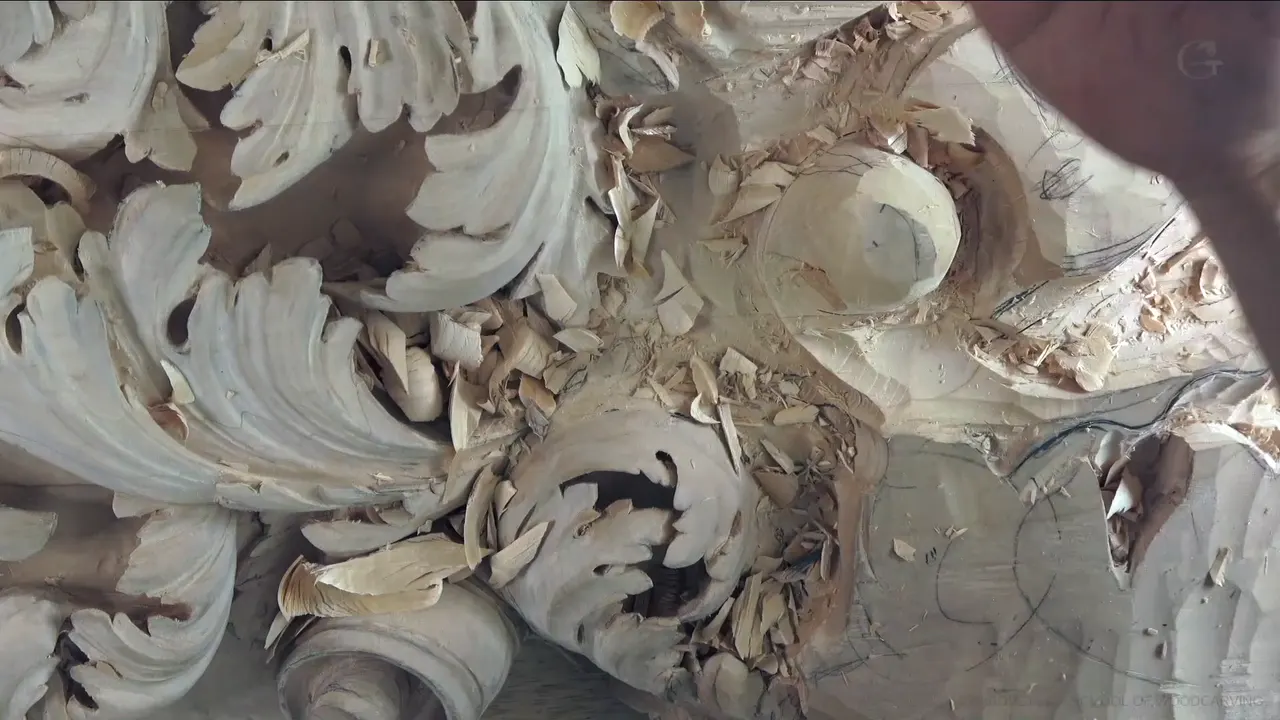

When someone asked me in Venice Room workshop 49 how I hold a big relief, my first words were "It all depends." Then came one answer for that board, another for smaller pieces, and a third for work that is already installed. Plenty of my other lessons open an answer the same way, and each one goes somewhere new.
Ever asked a carver a plain question and got "it depends" back? Did that sound like a dodge? Below is what I said it hangs on, in my own words, with the lesson each line comes from, so you can open it in wood carving and check me.
What did I say in the part where it came first?
A question came in while I was carving, "Well, I'm not sure if I understand that question correctly." The answer was short: "It all depends. This is a big one."
The board "is going to go all the way to the ceiling." My plan was "the support underneath, which is going to hold like this on a 45 degrees," and it was for later. "Right now, it's good."

My bench came next. "The height of my bench is good," I said, and "usually, in wood carving world, if you want to save your back, your carving bench supposed to be by the elbow." Mine was "just approximately right there," and "later on, I could raise it."
What do I use when the piece is small?
"On a smaller scale, when I'm working on another pieces, I'm using a carver's vice." Then: "Which is by Veritas. It's the brand of it." And right after: "Right here, I think you can see that. That's Veritas."
"I can do a lot of different wood carving with this vice." The inserts come in "the different sizes," and one is "a two-inch," which is 51 mm.

The big one was "also project from school." In my words, it "mounts at the plate, three inches plate on the backside, and it goes inside of this vice, and I can rotate any direction," and three inches is 76 mm. Then: "I can work upright, upside down, it's actually really handy to have."
My ceiling board is a different case. "In this case, it's just too big," I said, and a vise is out. Instead I said "you have to be creative." Some jobs are different again: "Sometimes I actually have a project I have to carve right in place."
A restoration project is one example. "Everything is already in place, and I have to actually use a step ladder and just go right there and carve it."
Where did I put the middle line?
"See what I did, it's just a ball, sphere shape or dome shape. And now I can just start my movement." The piece was acanthus, I said, and the center would run "somewhere right here, go on inside, and go on the backside right there."

While I drew, I said "you're looking at this piece from above, and that's really important when you look from above."
My way to find the line is short. "I usually divide this line, this point and that point, in 10 approximately." Five parts sit on one side, and "that would be five parts right there." After that, "I move slightly, little bit, just eyeballing to the side," for "approximately six parts out of 10."
The golden ratio came up on the way: "It's 0.62. It's a 62 parts out of 100," and I closed with "my middle line of this design."

How many divisions does a leaf get?
"Every acanthus leaf supposed to have divisions. I call them subdivisions. You can call them whatever you want."
I took a head of acanthus on a bigger scale as an example. "But this is a division right here." And: "Every division has an eye, that part is called eye." Of the main head, or the point, I said "exactly the same, just different movement."
For this leaf I would "divide in three parts." Of the boundary I said "Doesn't matter what style," and mine was "Venetian style." Later, "the main three divisions of the head." And "most of the time, actually, acanthus has five divisions, the main five divisions." Then: "So that applies to most of the acanthus leaves."

The smaller ones follow the same rule, "divided in three, all of them. And that way I can develop any movement." Before the smaller ones I said "Let me get rid of some of the lines." Everything else on the piece is "just based on the main divisions, then the subdivisions, and even smaller divisions or smaller subdivisions, if you can say that."
One line was about the camera. It "located little bit away from me, and that just doesn't represent exactly the way I'm looking at it."

Does the job decide it?
The same two words show up well outside that board. In Venice Room 37 I took a depth "without any measurement," "all by feel." Then the other side: "Sometimes you really do have to measure," though "I don't measure that on acanthus work."

On a livestream in April 2020 someone asked about butternut. My words on butternut were "the only thing I don't like about butternut, the grain." Then: "Depends on the job, what you do."
Where there are "really big movements," too many stripes from a "pronounced grain" would "not be too nice." Where the work has "a lot of details, butternut is a really great wood."
A tool can follow the work as well. My tools in workshop 41 include one with "a really long bevel," and I "can break actually the tool if I going to force it too much because I have almost no metal at the end."

So "on some of my tools, I have a long bevel, and some of my tools I have a higher bevel." What decides it is "the job I'm doing right now." I would not put that long bevel on a hard wood, since "you can break the tool."
Where a piece ends up matters too. For the ceiling piece in workshop 52 I gave a second reason for not undercutting too far: "it depends how this piece is going to be used, where it's going to be installed." It was headed for the ceiling, and "the people not going to touch it so much."

Where does the wood come in?
At my sharpening class in Maine a point came up about the wood. My answer was "Yes and no." The soft example I gave was "a case of basswood." In the next video, "let's say oak, it's a hardwood," and "you can break the edge."
A brand-new tool came up too. I started to call its bevel "wrong bevel," then took it back: "Not wrong, I shouldn't say wrong because it's not wrong, it depends how you're going to use it." The maker, I said, supplies "the higher bevel just in case if you want to use mallet."
A spoon gouge got the same treatment. "I have some really, I mean, just a short bevel, and I have some long bevels for some." By hand, or with a mallet? "It also depends." For hard wood, "you have to do a shorter bevel." But "I'm staying on the longer bevel even for the hardwood."
When workshop 52 came to the wood I use, I said "it's one of the best woods for wood carving," and "if you are in USA, it is a basswood." In Great Britain "that wood would be limewood," in Germany "linden wood," in Russia "lipa." Then: "It's not the best for the furniture, I would say. All depends what kind of furniture you do."

A few lines on, "Well, it all depends, I really like to carve walnut also." Someone also asked where to get basswood blanks, and I said "Yes, absolutely I do. It all depends where you're located." My own place was "in United States," with "a few different places I can buy" there.
The grain decides which side to attack from. In furniture panel 37 I was slicing, not pushing: "I am slicing, see what I'm doing?" You can try two sides, I said, and "it all depends on the grain."

For my piece, "I can actually attack that from both sides, and I have absolutely no problem. But sometimes only one side actually is good."
In the tray lesson I started on the left of the tool's edge and finished on the right, and I said "it could be both." Which end? "It depends how you feel and what angle you attack." Then: "I could start on this side and go opposite direction. It's also legit."
How does the finish change it?
I read out a question about dust and hand oil on a finished section while the next one gets carved. It began with the project, "how I'm going to finish it."

For a paint grade piece I said it would be painted, and "if I'm planning to stain, I'm not doing anything." If no stain or paint is coming, "you just get a cloth or just a paper towel" and lay it on the finished section.
A sandpaper question got the same start. "Let me tell you my opinion. It's all depends," I said, about the finish to come. The piece was to be "water gilded," and for gilding, "the surface has to be stabilized."
Depth, too, comes down to what you want. With a 7 millimeter (about 9/32 in) tool I said "it could be 5 millimeters. It could be 4 millimeters, 3 millimeters, same thing." Those are about 3/16, 5/32 and 1/8 in, and how deep I wanted to go was the call.
What does the light have to do with it?
In Hashemi 44 I said "it's going to create beautiful light movements, it all depends how the light going to hit that piece."

In workshop 59 I said "It's probably just my light." Then: "It depends how I cast that light, it just gives me that straight shadow. I don't like straight shadow, but it is what it is."
On the Greek acroterion I left a depth open: "Maybe I'm going to go a little deeper later." That hung on how I would see it. Earlier I had said the distance is "about 3/16, I would say. So which is about 5 millimeters."
In Venice Room 39 I said "I really like the idea of this as kind of raising up, but maybe I have to just knock that down a little more later on." The call hung on "how I want to develop this one yet."
What if a question has no single answer?
A question can turn on one word. In workshop 60 the line was "I'm doing from wrong side." Then: "Well, again, it all depends what you mean by wrong side, because one side right now it's clean and another side is not."

Old work gave me another case in workshop 72. A pipe on some historical pieces ran the opposite way. "Sometimes it looks good, sometimes it doesn't look so good," I said of how it looks. Then: "It just depends on overall design." For my own pipes, I said I would "do the normal way."

A panel's direction comes from its use. In furniture panel 1 I gave "27 and a quarter long" and "15 and a half inches wide," which is 692 by 394 mm. "It all depends how you want to use it horizontally or vertically." For mine, I wanted it to "just go in a vertical direction."

A margin comes down to space too. On the dining table apron I stayed "away from the main design about 1/8 of an inch, about three millimeters." Then: "You can stay more, less, a little bit." The cause was "the space where you're working it."
Side by side
Each row below is my own wording from the lesson in the last column, so you can open that lesson and check it.
| What it hung on | The words I used for it, as I said them | Where |
|---|---|---|
| A restoration job | I have to actually use a step ladder | Part 49.7 |
| Where to start | I could start on this side and go opposite direction | Tray of Blessing 1 |
| A softer wood | in a case of basswood, it's a softer wood | Maine class |
| Which wood for furniture | It's not the best for the furniture, I would say | Workshop 52 |
| A pipe turned the other way | Sometimes it looks good, sometimes it doesn't look so good | Workshop 72 |
| A panel's direction | just go in a vertical direction | Furniture Panel 1 |
Where does workshop 49 go from here?
The Venice Room Part 4 course holds workshop 49. In this video I answered a question, drew a middle line and split a head into three. To keep going with the whole room, the tuition opens it one video at a time.
How it's done
- I say what the answer hangs on. Its size decided how I held the ceiling board, and I said so at the start.
- I match the holding to the piece. A carver's vice for smaller work, a support later for the big board, and a step ladder for a piece already installed.
- I divide the line in ten. The middle is five parts, and a small move toward six gives the middle line.
- I split the head in three, then smaller. Main divisions first, subdivisions after.
- I leave a depth for later. At the Greek acroterion I stopped at 3/16 inch (about 5 mm) and said I might go a little deeper later.
Frequently asked questions
What did I say it depended on for a big relief?
The board was headed for the ceiling, so my plan was a support underneath at 45 degrees, for later. For smaller work I use a carver's vice. On an installed piece, "I actually have a project I have to carve right in place."
Does a long bevel depend on the wood?
My workshop 41 answer: I can "break actually the tool if I going to force it too much," and I would not use that bevel on a hardwood. In my Maine class my first answer on the wood was "Yes and no."
Do I measure the depth of a carving?
The Venice Room 37 board got a depth "all by feel." I do not measure "on acanthus work," I said, but sometimes measuring is needed. The livestream and the workshop answers hang on the job.
What to carve next