
Alexander Grabovetskiy, woodcarver, School of Woodcarving · Published 2020
Do wood carving tools and woods have different names in the US, the UK and Europe?
Quick answer: UK makers call a skew chisel a number two. European makers mark it number one with an S. My wood is lime wood in Europe, basswood in the United States, linden in Germany and lipa in Russia. Sizes come with an inch version too.

In part 4 of Venice Room 49, I talked about a skew chisel and said "If you are in UK, that would be number two." Then I said that in Europe it would not. Europe calls the same tool number one, marked S. This little phrase turns up before tools, wood, sizes and even a clock face in my lessons, and this page follows it from course to course.
Have you ever read a number off a tool and wondered whether your tool says the same? Is the wood in my lesson the wood in your lumberyard? Our students come from all over the world, I told beginners in my first lesson. Australia, New Zealand, Argentina, Holland, Belgium, Denmark, Canada, everywhere.
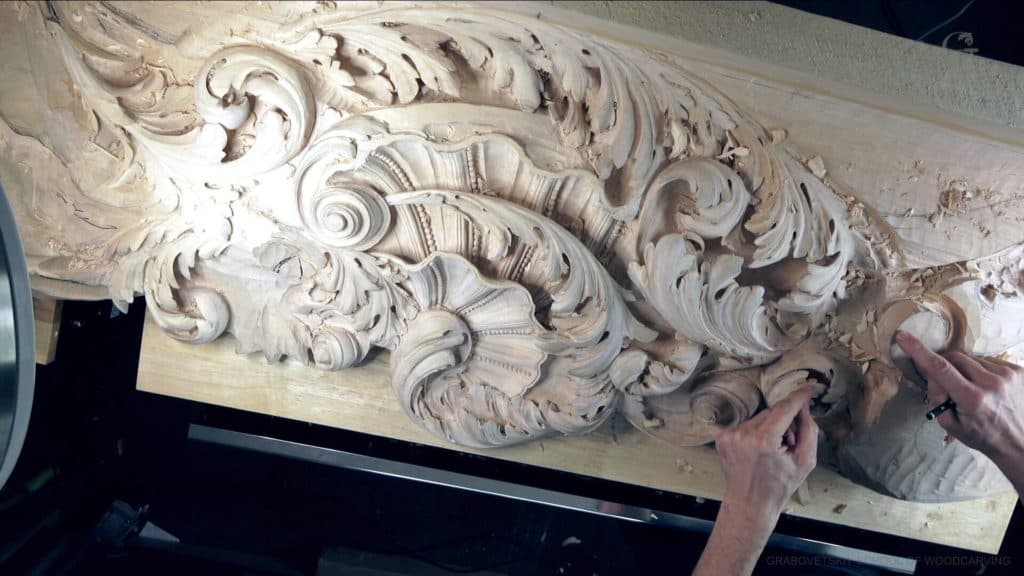
What was I carving when I said it in part 4?
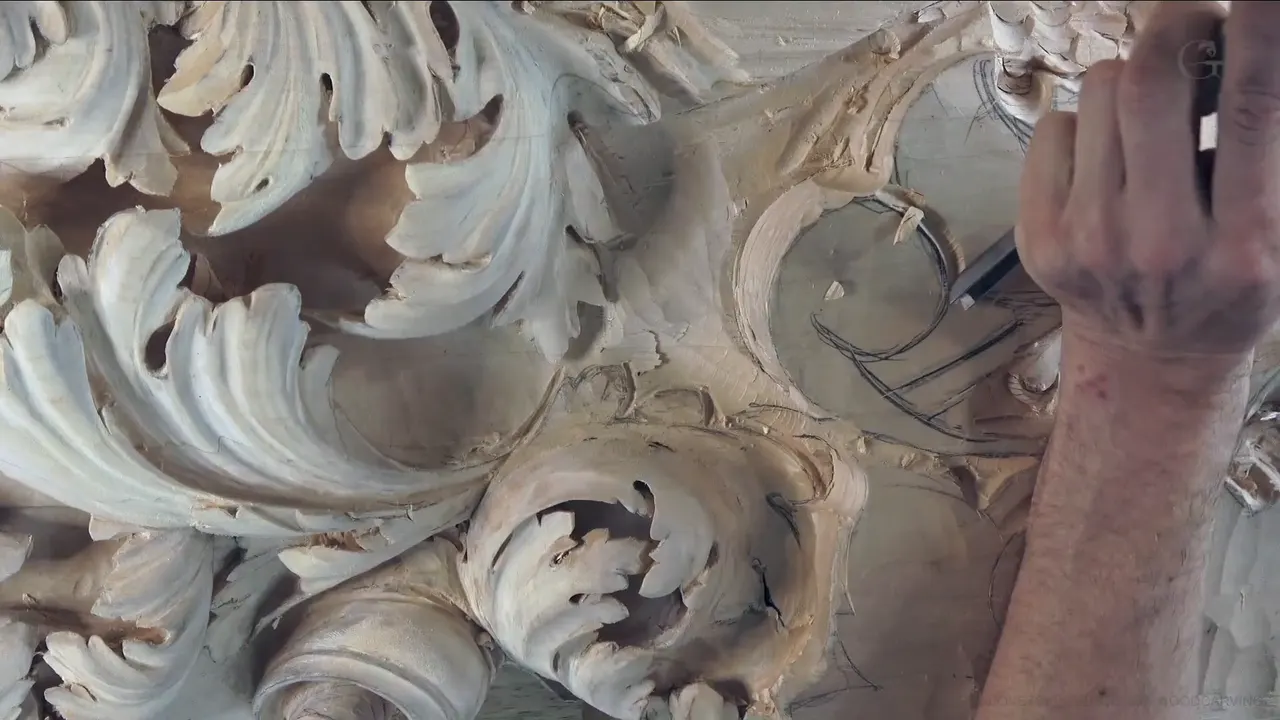
Let me concentrate on this detail, I said. That acanthus. It is acanthus, even if it doesn't look like acanthus, but it is. And as you know, there's a lot of different acanthuses, with a lot of different styles and different periods when people worked on those acanthus. Then there will be intersection.
Someone asked me what type of wood it is. I call it queen of woods. It's lime wood if you're in Europe, and in the United States it's just the best wood. It's the best for the wood carving.

Then I got started. My approach is usually to establish the main form first, and I use a lot of veiners, which are number 11 tools. My plan was a number 11 of seven millimeters, a little bigger than a quarter inch. Outlining, just outlining, which is setting in, and European countries call that process setting in too.
A bigger number 11 could probably work here, so I said let me use 15 millimeters, approximately 5/8 of an inch for anyone in the United States.
My chat window gets a look once in a while, to see if there is any activity, and I do appreciate people already watching. My computer is a little away from me, so a short walk gets me to it. That was step number one, just setting that in.
I didn't want to remove too much of this height, because I still wanted to keep my overall movement. I had already removed most of my carving. It had low and high spots and an overall feel, and I wanted to keep it just like it is.

What does number two mean on a chisel?
Next came a skew chisel, which is just a normal chisel, double bevel, but it has a skew. The UK would call that number two. European makers do not. Most manufacturers just say number one and mark it S, which means skew. It's still number one.

I was going to keep that high spot, and I still had to dig a little deeper. So I needed to establish my main form, and I'd take 15 millimeters again. Even bigger could work. Maybe 18 millimeters, a little less than three quarter of an inch, really close to it if you like imperial measurement.
Roman Acanthus 16 has the same split. In part 2 I was talking about sweep, and pretty much only number one is a chisel, I said, absolutely flat. Say you are in England, or the UK, I should say. A number two chisel exists there, and it is a skew chisel. It could look like that or like the opposite direction, but the sweep is still really, really flat. That is lesson 16 of the Roman course.

Germany and Swiss-made tools change the picture. Take a number two from there, and it is already a gouge. The curvature is slight. Of course I exaggerate that on my board, but it's almost flat, with some radius or a sweep, which is how we call it.

My April 2020 livestream on sharpening a number 11 veiner lists it in a row. Chisels get number one. Most makers in the UK add another straight chisel marked number two, and that one is usually a skew. Skews come in 22.5, 45 and 60 degrees, and all of them are still chisels.
Later in that stream I ran the list again. European countries start gouges at number two, which already has some sweep, while chisels have none. From the UK side, gouges run from number three all the way to number nine.

In workshop 16 of the kitchen cutting board, I showed a chisel and called it number one, absolutely straight, single bevel or double side bevel. It all depends also where you are at, I said. For the UK or Germany it will be a little different. After the gouges come veiners and V tools, then a macaroni and a fluteroni, which are just specialty tools.
Lily Box 2 adds a number four of 10 millimeters (0.39 in). Number three would do as well, or number two if you're not in England, where number two would be a skew chisel. In Germany, I said, it would be a gouge, almost flat but not completely flat.
A U-shaped tool in Roman Acanthus 15 works approximately like a number nine gouge, I said, but on its sides it creates about maybe a number two sweep, or number three in England.

What is the wood called where you live?
One line in part 4 gave lime wood for Europe. Venice Room 52 gave me more. The question about wood pops out again, I said, and three times I already did the live stream with the same question. I call it queen of woods, and that's my own opinion. It's one of the best woods for wood carving.

My answer was basswood for the USA and limewood for Great Britain. Germany says linden wood, and Russia says lipa. It's pretty much the same wood, I said, and the scientific name is linden. It carves easily and it holds form.
Somebody on an October 2020 livestream asked what kind of wood I carve. It's the same question almost every live stream, I'm guessing, I told them, and whenever I can, I use lime wood. Same names again, I said, with basswood in the United States, linden wood for Germany and lipa for Russia. Actually one of the best woods for the carving.
Softness is not the reason. It is kind of soft, but there are other woods that are soft too. Look at it and it doesn't have a grain. It does have a grain, but it's not visible, and that is good. Any type of curvature is still going to look really, really nice.
My first beginner lesson sends you to a plank of basswood, which you can probably get in some craft store in your town. England would call it lime timber. I'm from Russia, and we call that wood lipa. Some other cultures call it tea tree, since the linden flowers go into brewing tea.

In the Hazelnuts course I said the material will be basswood or a limewood if you're in Europe, a linden wood. American basswood, in my case. And on the April 8 stream my answer was short. Same wood, same species, and the best for the wood carving.
Do sizes change with the country too?

They do. Greek Acanthus 9 has a number nine of 10 millimeters (0.39 in), or three-eighths of an inch in the United States. The V tool in Hashemi 5, a number 16, is 6 millimeters (0.24 in), a quarter inch in the USA, and Hashemi 8 gives the same pair again.
Boards change too. For Floral and Molding 1, I said about 19 or 20 millimeters, about three-quarters of an inch, maybe a little thicker. Three-quarter-inch material works, or four quarters in the United States, about 20 millimeters. One inch (25.4 mm) works too.

The piece in the Venetian rosette was about one inch and seven-eighths (about 47.6 mm), which would be eight-quarter stock in the United States. Kind of big, I said, a little over 40 millimeters (about 1.6 in), and bigger than that.
For hazelnuts I chose a printer paper size, which is the US size. Europe would be about 28 centimeters (11 in) by 21 centimeters (8.3 in). It doesn't have to be exact, eight and a quarter by 11 inches (about 21 by 28 cm).
The big gouge in part 4 was a number seven, and it's huge, I said. It's three inches and one-eighth of an inch (about 80 mm), and my plan was to chop down the main form.

What is hook out, and what is hoik out?
A small word splits the same way. In Furniture Panel 19, I said to get underneath of it and remove some of the waste. Hook it out. Hook out in the United States, hoik out in Europe, and I create a nicer notch right there.

Hashemi 14 repeats it. All it takes now is just hooking out, or hoiking out in England. Hoik that material out. I wasn't sure I liked the movement, so I left it for now.

What did I say about a clock face on a gouge?
In Venice Room 89, I'd take the same number 11 of 7 millimeters (0.28 in), undercutting on the left-hand side, the left wing of the tool. If you like the idea of a clock, the flute is the concave of the tool. Straight down is 12 o'clock, and I'm going to rotate to approximately 10 o'clock, or even to 9 o'clock. In Europe, I added, it would be 21 o'clock, and anyone who has been in military knows what I'm talking about.

Where do I send students to buy a tool?
To a local source. My knife link in the first beginner lesson goes to Amazon for the USA, and I added that we have students from all over the world, so you just find the local source of carving tools. Probably you have Amazon in your country too.
For my dining table apron I had to match the original. I was blessed enough to have different punches that I am still able to buy, and so are you. One supplier in the United States sells matching punches. I believe a maker in England or Europe has some too, and I don't think you can buy those in the United States. The apron course has it.
In Greek Acanthus 12, I could see my shadow line, and I usually use this tool, pulling it toward myself, though it's also possible to push it and kind of clean. It's a really useful tool, sold and made by one English maker. Sold in the USA, I said, by one supplier. Furniture Panel 19, part 9, gives the same split. If you would ask me where to buy it, that supplier sells it in the United States, and in Europe you can probably buy directly from the maker, I would say, if they're still making it.

Gloves came up in Hashemi 15. Buy ones with the rubber on, and any Home Depot or Lowe's in the United States has them. They won't save your hands, so you still have to be really careful how you carve, but they give you a better grip.
What did I do with the rest of part 4?

I didn't want to lose the overall picture I had right there, and another part is going to go underneath. By the way, I have a dedicated page for the livestream on my site, and you are welcome to check it out. There's a menu, you can click, and hopefully it gives a little better quality.
There is a law. In this design I do not want to repeat too much. There is a law. So if you have a detail somewhere, you have to repeat somewhere else, which is a law of design, maybe a different scale, but you still have to repeat that. And yes, there is going to be repetition, for example for this detail, but the movement itself is going to be different. It's still the same movement.

From the side you can see that it goes like that, with extensions going all the way to the sides, which are going to go later underneath of this big detail. Here I'm not going to do that. It still heads that direction, but the movement itself goes like that. If it makes sense, and I hope it makes sense, that is my goal.

Which names change with the country?
Here they are, one beside the other.
| The thing | What I called it for each country | Where |
|---|---|---|
| The skew chisel | Number two for the UK, number one marked S for Europe | Part 4 |
| A German number two | Swiss made, and already a gouge with a slight sweep | Roman 16 |
| Where gouges start | At two in European countries, and at three for the UK | Livestream |
| The wood itself | Lime wood in Europe, American basswood, German linden, Russian lipa | Venice 52 |
| A six millimeter V tool | Number 16, a quarter inch for the USA | Hashemi 5 |
| Waste lifted out | Hook out for the USA, hoik out for Europe | Furniture 19 |
| A clock face on a gouge | Nine o'clock in my lesson, 21 o'clock in Europe | Venice 89 |
Where can you watch each of the lessons I named above?
Each one sits inside a course of mine, and Venice Room Part 4 holds workshops 38 to 49. Every course is one click away if you start here.

How it's done
- Name the tool. A skew chisel is a normal double bevel chisel that has a skew.
- Check the number that your country uses. The UK says two, and Europe says one and adds the S.
- Say the size both ways. Part 4 gives 15 millimeters with its inch size and 18 millimeters with its own.
- Name the wood. Basswood, limewood, linden wood and lipa, the names I gave in workshop 52.
- Go on carving. A big number seven gouge, to chop down the main form.
Frequently asked questions
What number is a skew chisel?
UK makers call it number two, I said in part 4 of lesson 49, and it is a normal double bevel chisel with a skew. Europe marks it S, for skew, and still calls it number one.
Is basswood the same wood as lime wood and linden?
In workshop 52 I said it is pretty much the same wood, and on an April stream I said same wood, same species. Americans say basswood, Great Britain says limewood, Germans say linden, and the Russian word is lipa.
How big is a 15 millimeter gouge in inches?
Approximately 5/8 of an inch, I said, for the American viewer. In the same part, 18 millimeters came out really close to three quarter of an inch.
What to carve next