

Alexander Grabovetskiy, woodcarver, School of Woodcarving · Published 2020
Why is acanthus carving so confusing at first?
Quick answer: Acanthus carving is confusing at first because a single leaf carries many lines, eyes and sloping movements before you know the final result. It confused me as well when I began. Begin with the eyes, since each one splits two leaves, and mark which part goes underneath.
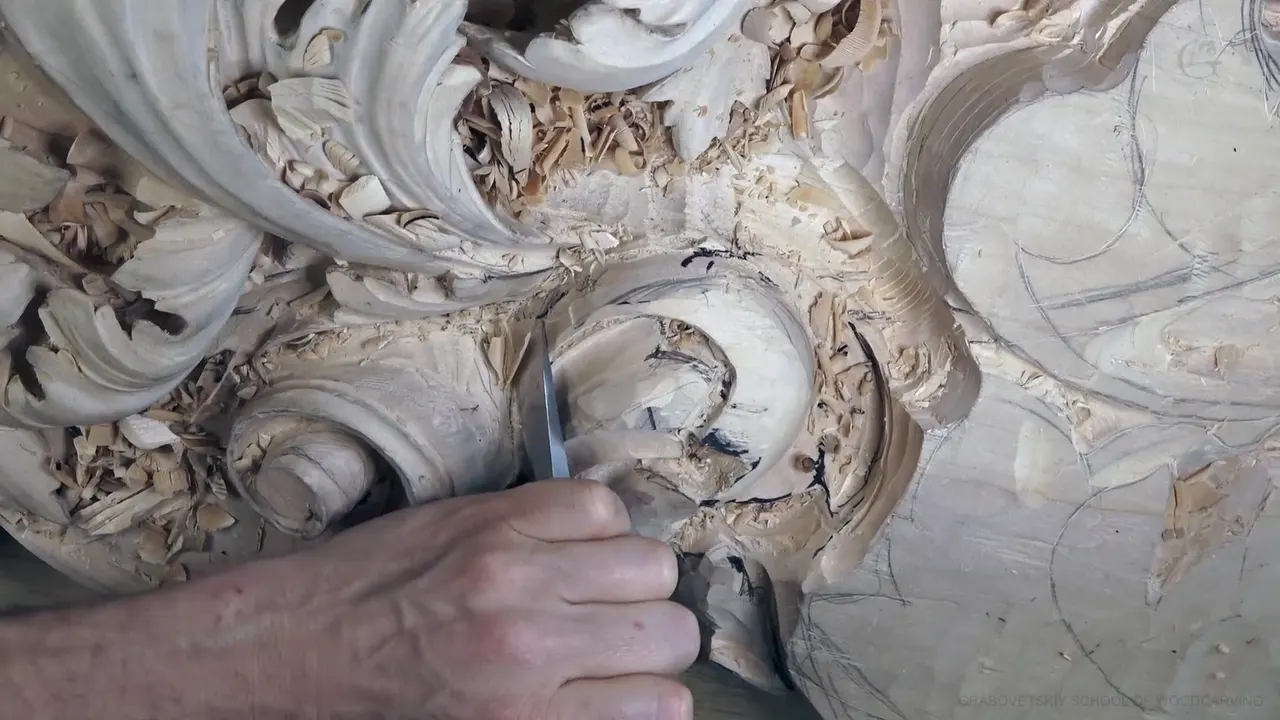

Acanthus carving is confusing early on because one leaf is full of lines, eyes and sloping movements, and you can't tell yet where each one ends up. Movements like these confused me too, when they were new to me. In Venice Room 49, part 1, I talked through where one more eye could go, and which side would tuck under which line. I stopped right there. Sorry if I confused you, I said. Didn't want to confuse you.
Have you stared at a drawn acanthus leaf and lost track of which line is which? Has one of your passes looked worse than the wood before it? Start from the eyes, mark what goes under, and give the lines a little time to make sense.
Part 1 of workshop 49 is short. So next to it I put other lessons where I used the same word on camera, and I name each one, with a link to its page.
Five things that clear up a confusing leaf
- Begin with the eyes. Each one splits two leaves, and a middle line runs between them.
- Say out loud what goes under what, then put a mark on it so you remember.
- Clean off a stale pencil line before it leads you into a mistake.
- Expect a fresh pass to look bad first. Part 1 has it in my own words, it doesn't look good, but it will.
- Keep the design lines. I called mine really important, even while they looked like a tangle on paper.
What does a confusing moment look like in workshop 49?
The part opens on a choice. There were a couple of ways to attack one area of the board, and one was to chop it off completely. Maybe I should, I said, and not worry about making small detail there. I really don't need to. So I chopped it, and then it looked like I needed to chop even more, almost an undercut.

Soon after, I said it twice. Now it makes sense. The shape would round, with the movement coming from underneath and then rotating this way. That is wonderful, I said. Now I could work on details and separations, and one division needed to be bigger.
Next came the eyes. I could make other eyes, I said, and it makes sense, though I don't need to. Not in one spot, but in the next spot I could. One more eye could send this piece under that line, or the opposite direction. Probably this one goes under this line and that one under that line. Then came the apology, and right after it, three words. Let me start.

Why does the wood look worse before it makes sense?
A couple of passes went in first, and they needed to go a little deeper. What did I use, I asked myself, and answered that I could probably use 2 mm (about 0.08 in) to get a little deeper there, and in one more spot too. Then I told you. I know it doesn't look good, but it will.
The new eye was the reason. We had made the eye, so now this ridge and that ridge had to blend. Go right there, on the inside, I said. Soon, I said, it's going to make sense, with the shape growing inside.

The blend runs concave to convex. I didn't have to, but I could still make a concave and go in, and it would still look really nice. It depends how deep I want to go. I could go extreme. I don't really need it, so the plan was to just blend that in, and the same, I said, applies to one more spot.
Maybe a different tool, I said, a little smaller something. A short while after, the spot began to look like it was going in. A little mess too, and I said that twice.

Near the end I wanted to excavate a little deeper in two places. It will be visible from the bottom, I said, and I really need that shadow. Wonderful. It's actually wonderful. One point was getting a little too weak, and I had to watch it. My last plan in part 1 was maybe a number nine, a quarter inch (about 6 mm), to remove some of the mess.
Is acanthus confusing for the carver too?
For me it was. Venice Room 62 is where I stopped to tell you it's confusing when you start, and that it was confusing for me also, when I started to carve movements like those. I meant complicated movements, like a slope that still has to be visible from all of the points.

Not that easy when you just start, I said, even if it looks simple. That day I was using just a number 3 on the high spots, without too much pressure, because I needed a canvas and had to clean up before I could draw.
Lines can lose me too. On the first Venice Room workshop I kind of lost myself, where I was at. I had generated that detail on the computer in 3D, and it had a lot of lines, somewhat confusing for me, even for me. Yes, I made that model myself. The wireframe mode gives me a perfect line, I said, and that's why I did it the way I did.
Over in Venice Room 2 I stopped over one part and asked if it would be below. It would. That one confused me a little bit, I said, and my plan was to carve one part first, to know exactly where the other one sat.
The Lily Box was no different. Its first layer looked messy and a little confusing early on, I said, but it should be fine. About a minute later I said it confused me a little.
Which lines should you read first on an acanthus leaf?
The eyes. During my Byzantine acanthus lesson I asked people to look at my piece and said I know it's a bunch of lines. It's really confusing. I counted them next, one eye, two eyes, three, and each eye is always a separation point between the leaves.

Somewhere in the middle of the eyes runs a middle line, and it should be convex. Put that line back between the eyes with the pencil, I said, which is a lot easier than a marker like mine. Then you clearly see three leaves, three sections only.
Some minutes on, I came back to it. Every eye is the point to keep your eyes on, because the eye is a starting point, and it always sits between leaves. Then it's not going to be confusing. Each eye, I said, should look like a water drop.
How can one pencil mark lead to a mistake?
It confuses you first. I needed to get rid of a pencil mark for an eye on Venice Room 84, otherwise it would confuse me, and if it confused me, I would make a mistake. I really didn't want any more mistakes. Not a huge one, I said. A common thing, and not one that can't be fixed.

On a furniture panel I said to clean one spot a little better, and that I could knock a piece out, so it won't confuse me. That way I'll remember. Just put the mark on the part that goes underneath, I said.
The hazelnuts lesson had the same worry. The plan there was to leave about 3/8 of an inch or 1/2 an inch (about 10 or 13 mm) for the future stem, an opening, so I would not confuse myself.

Marks can help you, too. In Byzantine acanthus lesson 8 I said I would put the marker on the ridges that had to stay high, just so you would remember.
And in Venice Room 43, with one part that had to go underneath, I can plan that right away, I said, before the confusion.
Why do drawn lines look so confusing before any carving?
You don't know yet what you're after. On Venice Room 50 I said it could get really confusing when you look at those lines and you don't know the final result. If you did not design it yourself, if you're trying to repeat somebody else's work, sometimes it gets so complicated it's almost impossible to figure out what he is trying to do.

My furniture panel design had the same problem on paper. All of those lines are kind of confusing, I said, but they will make sense later on. Believe me. Those are really important lines.

On my grape onlay I planned to go maybe about three sixteenths of an inch (about 5 mm) deep with a flatter number 5. Don't complain, I said, I know it's confusing. It'll make sense, a little later. One piece would go right underneath and one on top, just like knot work.
What makes a carving lesson hard to follow on camera?
Small pieces are hard to read. On my Lily Box lily I said it looked a little confusing on a camera, since a lot of different movements were going on, even with a really small tail. On the grape onlay I said it's kind of confusing when it's zoomed in.

Sometimes I'm the reason. My bench has wheels, so in Venice Room 1 I moved one side a little to see much better, and I knew I would block you that way. It's going to be a little confusing for you to watch, I said, with a different angle from our other camera.
Back in Venice Room 40 I apologized if I confused you a little bit, which I shouldn't have, since I hadn't done too much yet. With the Hashemi flowers I mixed up the concave side and the convex side out loud, and said sorry for the confusion. Venice Room 50 got an apology too, with the words it's hard to explain sometimes.

In a room, faces tell me. During that lesson 8 I asked if it made sense or if people were confused, and told them I could see it by the expression, so nobody needed to ask anything.
Workshop 49 kept going that way after part 1. In part 2 I stopped halfway through a sentence. I'll try to explain again, I said, and showed you the eye and the way the movement is supposed to go. One part later it made sense for me, at least, I said, and I hoped it made sense for you.

Do tools and grain words confuse beginners too?
They can. I asked someone in my Work Bench Organization lesson why they placed a tool the way they did. Upside down, you get really confused about what tool is lying in front of you, and not every maker marks them. A couple of tools is okay. A bunch of tools becomes a problem, so I lay mine toward myself, where I can read the sweep fast.
Words about grain do it too. When you Google it, I said in my Carving with the Grain lesson, you get all kinds of terms, carve with the grain, short grain to the long grain, and it's somewhat confusing. Start with the short grain and follow to the long grain.
And sharpening. In a livestream in April 2020 I said people are confused about how to sharpen a front bent gouge. Professional carvers made a lot of mistakes before they found the right way. I said I'd show you my way, and that I'm not saying my way is the best way.
Where did the confusion come from, lesson by lesson?
Seven moments from this page, one per row, with what I did or said next.
| Lesson | The confusing thing | What I did or said next |
|---|---|---|
| Workshop 49.1 | Which line the new eye should go under | Sorry, and then let me start |
| Venice 62.12 | Sloping movements that must show from all points | A number 3, light pressure |
| Byzantine leaf 9 | Lines all over one carved leaf, really confusing | Count the eyes first |
| Venice 84.8 | A leftover line once drawn for an eye | Get rid of it |
| Panel design 5 | Lines drawn on paper before any carving | Will make sense later |
| Lily Box 11 | Lots of movements going on, seen through a camera | Waste to take care of |
| Tools lesson | Tools lying upside down in front of you | Place them toward yourself |
The last row has nothing to do with a leaf, and it still trips people.
When does a confusing leaf start to make sense?

I said nothing was confusing in Venice Room 45, even though it looked a little confusing at the beginning, and all of it would make sense. The same words came back in Venice Room 48. Nothing to be confused about.

And in Venice Room 44 I knew there were too many divisions, a little confusing, but a big chunk sitting at the same level was not what I needed. So I said I would take a bigger number 11 and start moving like that.

Scale counts too. On a small flower of my furniture panel, I said some people have a confusion about how it is supposed to be. That's not as hard on bigger carving. On that scale it's a little more challenging, and easy to mess up.
The workshop 49 page covers the whole lesson, and the Venice Room Part 4 course holds all twelve workshops of this relief board. If you want to carve along with me, start here.
How it's done
- Count the eyes. One, two, three. A middle line belongs between them, drawn back in pencil.
- Name the piece that tucks under. Two ways were open for a new eye on this board, and I picked one out loud, with a probably in front of it.
- Mark the piece that goes below. Mark that piece, I said while carving a panel, so the order would stay in my head.
- Clear stale lines. I wanted a leftover line for an eye gone, or it would have me making mistakes.
- Blend after the eye. Once we had made the eye, two ridges had to blend, concave to convex.
- Give it a little time. Don't complain, I said on the grape onlay. Give it a little while.
Frequently asked questions
Was acanthus confusing for you when you started?
Very much, and I told you so on camera in Venice Room 62. The hard ones were complicated movements, like a slope that must still show from every point, and a leaf like that can look simple and still not be easy for someone just starting out.
Where should I look first on a busy acanthus leaf?
At the eyes. I counted three of them on my Byzantine acanthus leaf, and each one marks where two leaves split. A middle line runs between them, and once that line is back in pencil, the leaf reads as three sections instead of a mess.
Can a leftover line on the wood lead to a mistake?
On one Venice Room board, a line I had drawn for an eye had to come off, or it would mix me up. When I'm mixed up, I make mistakes, and I really didn't want any more of them. Not a huge one, I said, a common thing.
What to carve next