

Alexander Grabovetskiy, woodcarver, School of Woodcarving · Published 2020
When do you carve outward from a middle line instead of inward from the edge?
Quick answer: In video ten of Venice Room workshop 49 I carve the letter S. The line I give for where it goes is "from middle line, it has to go out." In other lessons I carve concaves that run outward, curl a detail outward, and slope a wall outward.
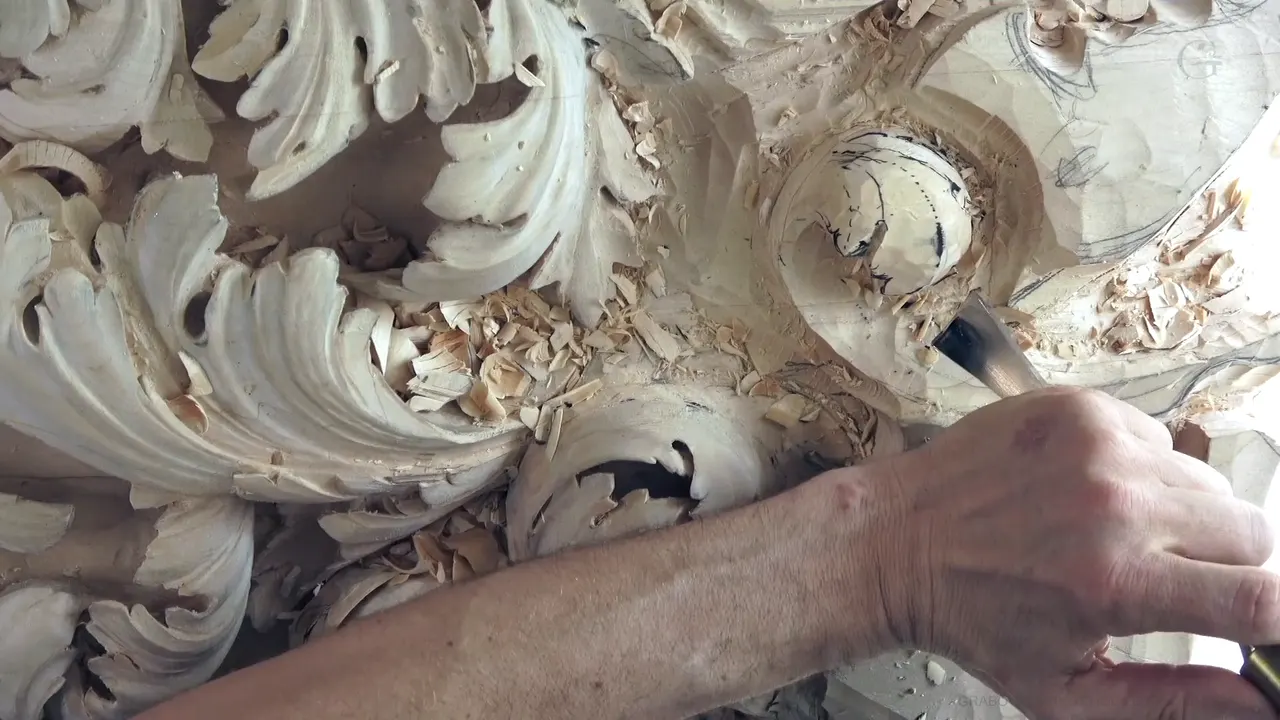

In video ten of Venice Room workshop 49 I carve the letter S. The line I give for where it goes is "from middle line, it has to go out." In other lessons I carve concaves that run outward, curl a detail outward, and slope a wall outward. One lesson has me going inside outward for a reason about the grain.
Have you ever set a gouge on a leaf and wondered which end of the cut to begin from? Did the mark in the middle pull you one way and the wood another? Below is my own wording from each lesson, open for you to check in wood carving.
What did I do in this video?
- An S went in.
- Each pipe got a concave on both sides, and I marked it as an indication only, not the finish.
- For the ridges I held a number three upside down, and its bevel is 16 millimeters (5/8 in).
- Late in the video only one direction was open to me.
- Details for later went to my school site.
Where did I begin?
The video opens in the middle of the shaping. "That way, I can shape right now much better," I said, and a bigger number five would "create a much better shape right here."
An undercut came straight after. "I'm going to go right away undercut." I added that "there is a different approach to undercutting," because "some people really don't like to do a deep undercut."
My own habit is the other way. "I call it extreme undercut," and "I'm actually one of those guys." Still, I know why others hold back, since "I know the logic behind" it.
It depends on how the piece will be used. "If it's going to be hit every day by people, absolutely you don't want to undercut that extremely because it's becoming too fragile." The other side of it: "when you do an extreme undercut, it looks much better."
How did I describe the S?
It began with a name. "So I call it the movement letter S," I said, "like S letter, okay?" You could see the shape in my hand: "I started moving like this, and then movement like that."
My verdict was short. "Really nice look." Done "a lot everywhere else," I added.

Another spot got the same word: "see that is also letter S shape." My rule for it was "only on one side," and "only an outside movement."
A third spot turned inward, and I kept the word anyway. "Right there is also letter S, but it's going in, but it's still outward."
My reason fit in one breath: "there is a middle line." I wanted the shape to leave it. After that I marked the spot, "that is the middle line, and I have to do letter S right there."
I planned another one: "Some letter S right here in the opposite direction, pointing that direction on this side." My word for it was "Wonderful."

The Part 5 course has the same line, in workshop 56. There I said "I can envision letter S movement," and "when you're doing a letter S, it's supposed to face always out if there's a middle line of the main piece." Then: "usually, it goes outward, that direction, out of middle line." And: "sometimes it goes toward in."

The shape was coming along: "pretty much establishing good shape right here." The details were for later, since I was "not going to do the details right now."
How do the pipes and the ridge fit into it?
Pipes came next. "I need to establish the pipes." Then: "the pipe has to be convex."
A convex needs a hollow on each side of it, so "to create that convex, I have to create the concave on both sides." I did not want to create "too deep concave or convexes."
My tool was "maybe just the number eight right now," and I would "go little by little." Of the cut beside the pipe I said "this one is a quarter inch, about six millimeters, right on the side of the pipe." It was an indication, not yet the final cut.

The other side was next. "I am going to go on this side also." Then: "Let me little bit make it more sharper," and I would "do exactly the same."
Two things protected the pipe. "I also don't want to hit my middle line." Each side still needs a concave. I also wanted something: "I want to raise slightly this ridge," and "the way to do that, exactly the same tool."
I gave a short definition of a convex in Lily Box 12. "For those of you who don't know what the convex is, it's a raised part, just like that. Concave is a inside cut and convex, outward cut."
And a rule for a middle: a convex wants opposition, so "concave right in the middle."
Which tool took the ridges, and why one direction?
Two ridges bothered me. "Get rid of this ridge and that ridge," I said, because "it does not look good." And "it's always like that if you're doing a lot acanthus work." My pick for them was "number three upside down."

Look at the tool, I asked: "please see how big my bevel on this tool is, okay?" Then: "we're talking about 16 millimeters bevel." That is about 5/8 inch. A "really, really, really long bevel," and "it just slices through the fibers of wood really easily."
Digging inside the pipe was not final, and I did not worry: "I'm digging little bit inside of my pipe." The details would come "probably on my school site." Final cuts would wait: "I'll take care of final cuts little later." Some of it I "could probably take care right now."

Some of the final work could happen right then: "So I could just attack like that." Then came the rule I was breaking. "Yes, I am breaking the rule of working with the grain because I do have a ceiling on another side, and I can't use tool from opposite direction." So: "the only way I can work, it's only one direction right now."
How did the cuts run in my other courses?
Part 7 of that room has it in workshop 74, on a pair of leaves. "Concave cuts with the number seven going from the middle line outward," and then "also opposite direction the same way."
That line, I said, would "become ridge."

Hashemi Flowers 38 has a number five. "Pretty much take number five and create movement inside of the leaf. Going from the middle outward." The cuts were veins, "if I can call them veins, inside of that leaf." And "number seven will work."

On furniture panel 24, it's a leaf again. "Some kind of concaves, like I've done on this leaf. Okay? Coming from the center outward." Not on every spot, though: "not everywhere I'm able to." Depths vary, "some of them deeper, some of them less deep."

The lily box course has it too. Lesson 9 used "just the small gouges," and "I guess number eight." My words: "kind of go from this ridge outward." It is "almost impossible to see the effect," I admitted, and yet it "created micro movements on inside."
If it looks too stripey, "you can always take a bigger gouge, kind of remove some of the ridges." After the last pass, "now it look finished."

The petals of lesson 12 got a direction too: "I should go from the center, go outward like that," and that "would be more accurate center part of the flowers." Later I added "think about the logic, how the petal's supposed to grow."

Where does a curl go outward?
In the Hashemi course, lesson 45, a spot had a natural movement. "I kind of like it right here. So it can curl out like this." Next: "looks like I can create a curl outward and then inside," for "really nice movement." Next up: "I'll take number four."

In Hashemi 47 the curl is smaller. "Let me use just the number one and try to blend it, although I think I could make a micro curl outward." Then I said to "use a small gouge, create a concave cut." The wood was end grain: "although I'm working with the end grain."
A flower fact came next. "Usually, you don't see too many curl outs on that type of flower on a peony. It's mostly on roses. When you carve roses, you can see that movement outward." I liked it anyway: "I think it just creates beautiful effect when you do that."

One limit followed. "Once in a while, in some spots, I can do that. Not everywhere, but some spots."
The Hazelnuts course has it on a husk. "I'm also going to do with this husk what I did previously, just to get some curl outward from inside out," I said in workshop 6, and "in this location." A little later: "I'm also going to roll it outward this way."

Hazelnuts 5 comes with a caveat. "I know not everything is supposed to curl, but I think it's going to be a good idea to just curl it outward slightly." In Hazelnuts 3 I said, with a number nine, "I going to introduce some motions outward." What I meant: "it goes inside and then goes out."

Two more from that room. In workshop 63: "a little twist outward to that detail right here." And in 75, "another movements like this. Okay? Going outward." The condition I gave there: "all of them has to have a motion like returning backward like this."

When do I choose a sloped wall over an undercut?
One of my no-undercut cases came in Floral and Molding, lesson 9: "I'd like to get that part sloping outward." I wanted no undercut there, so the cut was "just a straight down."

Hazelnuts 1 has the same call. "Do not undercut. Just make sure the position is straight." And my reason: "It's actually better to just slope it outward because you can always take material out later."
The order matters too. Lesson 13 of that course calls sequence "really important," and a line that points the other way followed: "it's always better to attack from outside toward the center."
In furniture panel 19 my heel was "pretty much straight to the background," and the cut would be "more like outward."
Why would I start inside and go out?
The grape onlay gave me a reason in the grain. My plan in lesson 5 was a number 11 of "seven millimeters," a spoon, because "I need to actually attack from inside outward." Seven millimeters is about 9/32 inch.

My concern was the grain: "I'm gonna catch the grain." So "I'll just use my spoon and go outward all the way to the escape." A gap stayed at that point, "approximately one eighth of an inch," about 3 mm.
Lily Box 11 used a knife. "I'll use just a cheap carving knife and try to blend this concave." The sound gave me a reason to go outward: "At the beginning, you heard the sound, it's like a cranking." That was "without any slicing motion." The fix, in my words: "if you start closer to the center and move outward while you're giving a cut, you should eliminate that sound."
"Later to make a nicer, cleaner cut, I can move from inside out, okay?" Another time, in the Hazelnuts course, I had my mallet: "I got to go from inside outward with the help of a mallet." Number seven came with "five millimeters" (about 3/16 in), and "just don't go too deep to the background."
Side by side
Each row below is my own wording from the lesson in the last column, so you can open that lesson and check it.
| Which way it runs | What I said in my own words | Where |
|---|---|---|
| An S | it just goes letter S outward | Venice 49.10 |
| Concaves with a seven, on two leaves | also opposite direction the same way | Venice 74.11 |
| Veins | I'm actually creating veins, if I can call them veins, inside of that leaf | Hashemi 38.1 |
| A petal | think about the logic, how the petal's supposed to grow | Lily Box 12.4 |
| A flower curl, kept small | I think I could make a micro curl outward | Hashemi 47.3 |
| A wall | I'd like to get that part sloping outward | Floral and Molding 9.2 |
| A spoon | I'll just use my spoon | Grape Onlay 5.2 |
Where does workshop 49 go from here?
This is workshop 49 of the Venice Room Part 4 course. Here the pipes were only indicated, and the rest was left for the school site. To watch where the rest goes, the tuition opens the whole Venice Room, one video at a time.
How it's done
- I mark the line down the center. The S shape leaves that line, and it goes out.
- I run the concaves outward. Seven in the Venice Room, five in Hashemi.
- I keep the first cut light. The pipe cut here was an indication, and the final cut waited.
- I let a wall slope outward when I skip the undercut. Floral 9, and Hazelnuts 1.
- I start inside and go out when the grain would catch. A seven millimeter (9/32 in) spoon in Grape Onlay 5.
Frequently asked questions
How does the S relate to the center line?
The S shape was "only an outside movement." One of the shapes was "going in, but it's still outward." My reason was a line down the center, because from it the shape goes out.
Which tool did I pick for the ridge?
A number three held upside down. Its bevel is 16 millimeters (5/8 in), "a really, really, really long bevel," and it "slices through the fibers of wood really easily."
Why did I work in one direction late in the video?
I was breaking a rule about the grain, because I do have a ceiling on another side and "I can't use tool from opposite direction." So it was one direction right then.
What to carve next