

Alexander Grabovetskiy, woodcarver, School of Woodcarving · Published 2020
What does a wood carver mean by "adapted"?
Quick answer: On a Venetian leaf the hollows and the raised part between them came from Byzantine carving, taken on by the Italians, as I said in Venice Room 52.7. Other lessons of mine give the word to Romans and Greeks, to Byzantine and Venetian carvers, and to knot work from Celtic countries.
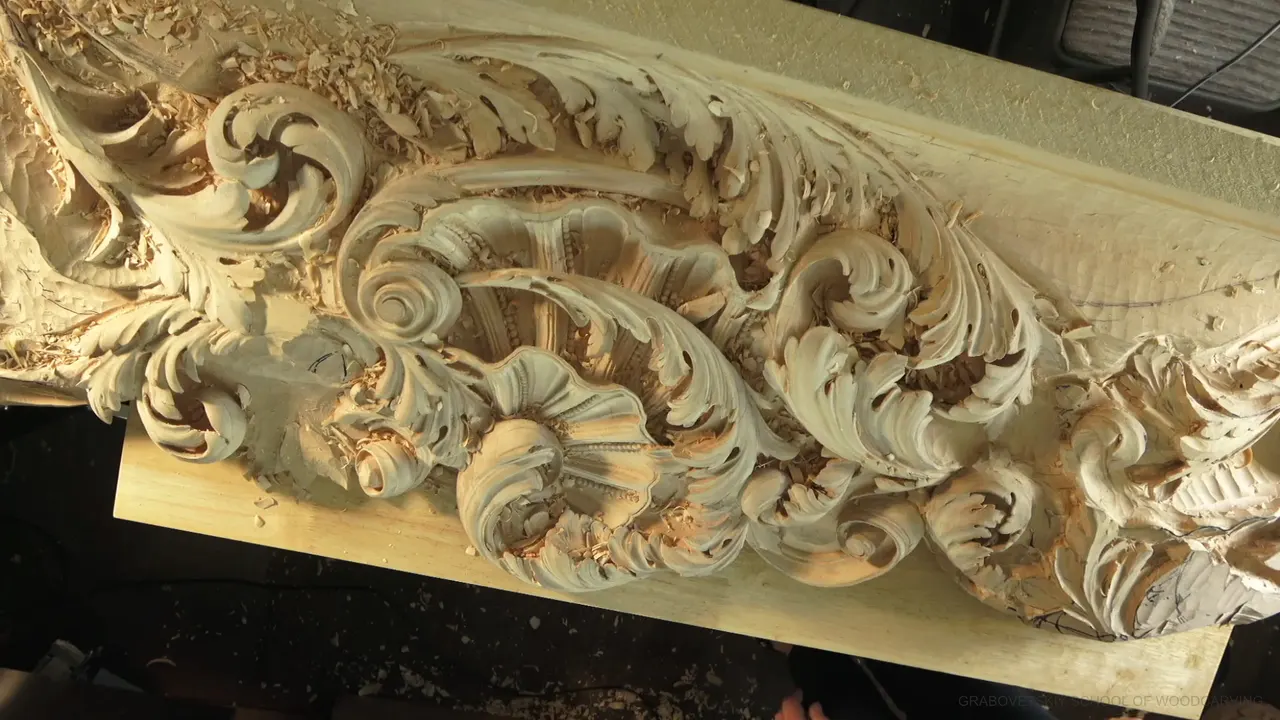

What does a wood carver mean by "adapted"? In Venice Room 52, part 7, I said it about the Venetian leaf and where its shape came from.
Ever wondered how a leaf carved in one country ends up on a panel in another? Maybe you would like to hear which word I pick for it. In this part the Romans stole it. Then Venice got a different word. My other lessons use "adapted" for Greeks, Romans, Byzantines, Vikings and one concave. Here are the places, with the lines around them.
What was on the bench when I said it?
A plan opens the part. "Today, what I want to do, I want to work on this part." I would develop a little bit more of this movement. Of course I could jump somewhere else, but as of now I would just do that. I planned to concentrate on one chunk, "kind of a big chunk." You can't see beyond that point, and a lot more carving will come on this side. My camera can't get higher than that. So I could probably do partially this side.

Right then it didn't look too appealing, "like I said, big chunk," and I have to think about it. A corbel will be attached on the other side, but maybe I have to get rid of that part first. Ask me any carving-related questions, like about sharpening. I'll try to answer as much as I can. But my first tool, the one I plan to use, is just a skew.
"Skew chisel, to be exact." A chisel, double bevel, skewed to approximately 22 degrees. For some reason my bench was moving, and that is not good. There is a shell on this piece and I don't want to hit it, with not too much space around it. Behind the shell another element goes on from this one, also acanthus, and it's going to go all the way down.

Is the acanthus the same in every country?
Far from it. This element has to be really, really authentic to Italian design, and people are sometimes confused about the designs. "Acanthus is not just acanthus." Different types of acanthus exist, regionally developed.
Go to Morocco and the movement is absolutely different from a German acanthus. Germany alone has two, a Northern German acanthus and a Southern German one. France has an absolutely different acanthus. Belgium has another, and England its English acanthus. Slavic countries, Russia and Ukraine, have an acanthus movement too, and it's a different acanthus. You can go as far as Mongolia. There the movements are different again. China does as well, "and I can go on and on and on."

"Almost all the cultures who actually carve stone and carve wood, they somehow connected to the acanthus leaf." The one on my bench is Venetian style, Italian style, authentic to the 15th, 16th century, and the overall movement develops differently.
The April 2020 livestream lists the same countries from another angle. China also likes acanthus movement and carved it a long time, "but it's absolutely different acanthus." So is Mongolia. Russia's differs too, although it stays close to Byzantine because it was inherited from the Greek Orthodox Church, and the Russian carvers developed even more techniques. "In every culture is different acanthus." In my opinion no book yet covers the full range of it, and the limitation of any book, I said, is the time period. What type of acanthus is a book talking about? Hundreds and hundreds of different acanthuses exist. The ancient one has a V cut on the inside of the leaf, the Roman one a concave. Byzantine has a concave, convex, concave, and the French one a concave, concave, concave. And which acanthus leaf are those books writing about? The best book, I would say, is not the book itself, but going to those palaces and those ancient places to study. If it's not possible to go, just go online: "nowadays on Pinterest, you can find all of the ancient pictures." The books are not even going to be able to show you everything.

What did the Greeks and Romans do?
"Also really important to understand concaves and the convexes." Cultures differ on both. Take Greece, one of the most ancient cultures as far as the development of art and acanthuses. The early Greek acanthus would be only concaves, with a groove and a middle line left in it. Nothing would be raised, and there would be no convexes. Everything would be just like a V cut, and that would be a Greek acanthus leaf.
The same applies to the Roman leaf. But the Romans actually stole the idea from the Greeks. They did not use just a knife to cut and create that middle line like a V cut. They used some kind of gouge, and that became just a concave cut. Such a cut would also point to a leaf that is more Roman style, "not Italian. Even if it's in Italy." When I say Roman style, I would probably refer that only to ancient Roma, the Roman Empire. Venetian style is also from Italy, but it's not from the Roman Empire anymore, so that would be a much later development.

Part 3 of Venice Room 162 words the same Roman step another way. "Romans, Roman Empire, they pretty much adapted the idea of acanthus leaf from Greek Empire, or Greek culture, I should say, not empire. Greek culture."
In Corinthian Acanthus 3 I called the Corinthian design the most ancient one for the leaf. It's also sort of Roman style, I said, but "it's a Greek style, which is adapted later by Romans." The leaf section I was carving always cuts on the inside like a concave, which is really important to understand. A lot of different designs apply to the acanthus leaf, I said.
My Roman Acanthus course has a line about the Romans themselves. "One good thing about the Roman Empire, whenever they conquered the new areas, they tried to learn something new, and they adapted that to their own culture." In that lesson the main leaf divisions go in three, and the small sections subdivide even more in threes.

Where did the Venetian leaf get its shape?
"And the idea of Venetian style from Italy actually was not stolen, I shouldn't say, but was adapted." The concave, convex, concave on the leaf came out of Byzantine, the early Orthodox movement. Greece and the modern Turkey were the Byzantine Empire, the Christian Byzantine Empire, and they developed beautiful ideas.
One spot on my panel would get a bigger, a little better angle, I said. It's like a head of acanthus, a movement going up and up, "and really deep excavation on the side." Can you see my pencil? That piece is solid. I did not apply or glue anything. If you are a member of my school, you'll see exactly how I develop stuff like this, without even gluing. The Byzantine acanthus leaf was before the development of the Italian one.

"What I'm trying to explain, this was adapted by Italian culture and actually made it even beautiful." I meant the later period, but still the early Italian development of the 15th, 16th century. "They really love curliness." Look at the curls: a lot of movement, a lot of curvatures, a lot of divisions. That's what I'm trying to stick to, and what I want to develop.
The spoon gouge livestream has the Venetian side. Russian, Romanian and Bulgarian wood carving, a religious style, took roots from Byzantine a long, long time ago. Think of the 10th century, about 1,000 years ago, a developed style that I really admire for the complexity of carving acanthus leaves. Then: "this is a Venetian style, but see this movement right here?" That is called head of acanthus, a movement rotating like this, with a really deep excavation on the inside. Mine is done in a solid piece, and chalk paint is the plan for it.
Orthodox churches in Bulgaria, Romania, Russia and Ukraine show something similar, taking roots in Byzantine. "Pretty much Venetians, they adapted that style, but it is gold leaf on inside and also on outside." One of the projects I am planning for my school is to show the idea of how they did it, because if you carve from a solid piece, you're not going to be able to gold leaf on the inside.

Did the Byzantines invent the leaf?
Not by my account in the plastic tool stream. Of one movement on my panel I said "it was inherited from Byzantine." A Byzantine leaf should have gold leaf and really deep excavations on the inside, and Byzantine was an early development of head movement like this. "But Byzantine, on another hand, adapted from Greek empire the movement like that." So it wasn't a Byzantine invention. It was just the volute, which sat in history before the Byzantine development. "So they all adapted from each other."
Venice Room 162 tells the Byzantine side too. In the time of Christianity in the Roman Empire, Byzantine is the eastern part of the Roman Empire, pretty much when they divided. It was a Christian nation, and it adapted that from the Roman Empire. So they got an idea. The Romans did not use gold leaf, while the Byzantine Empire used acanthus leaves in churches and wanted gold leafing. They started to make carving more beautiful by applying gold on it.

It seems like a long time ago when Solomon built a temple, and even when Moses built the tabernacle and the Ark of the Covenant, it was covered with carving. "And all of it was covered with gold."
Part 12 of Venice Room 55 has me wanting to raise the right-hand side, that ridge, a little bit, on a Venetian style acanthus. Then a short line: "Concave idea was first developed actually in Byzantine, and then it was widely adapted."
Does the word fit knot work too?
I used it on a plate about butterflies. If you asked me why that flower looks so weird, I did not design those flowers, and I was not the author of them. Look back in history and it was a common detail. You find that ornament on the outside of houses, carved on boats, like the boats of the early Vikings.

When the talk is about Viking style carving, most of the people think of knot work, "which was adapted by them out of traveling to some Celtic or Celtic whatever you call it." I call it Celtic countries, "and it became like a Viking trademark later on." Like the 10th century and so on. Before that it was pretty much that style all over Europe: Norman style, Slavic style, Germanic style. Next I would use that small tiny detailing knife and pull it toward myself.
Did the Venetian heads stay short?
One small chunk on my panel has "really, really short divisions." In France, this part, for example, would run really long before the division comes like this. "So that's the big difference." People who studied the history of the development of acanthus can see it.

The next part of the workshop, 52.8, says it too. I am authentic to the original Venetian design, and "this part not supposed to be really long." The head is the subject. "They did not have, back then, the really long ones. Longer ones developed a little later." That part also names what every acanthus is supposed to have: main divisions of three or five or eight, connected to the Fibonacci sequence, though most of the time it's three or five. Eyes and pipes belong there too. "The pipe is the raised part," and the eye is "a flipping over part."

Before it, part 6 leaves the history for the tool. To take care of a convex, I'll use a back bend. It's a bended tool, but backward, so the main bevel is on the opposite side. I'm explaining on my school site much deeper about those convex and the concaves.
Where do these lines sit?
Here is the table of the places I said it, from Venice Room Part 5 and my other courses, with the lesson that holds each line.
| Where I said it | What I was talking about | The line |
|---|---|---|
| Venice 52.7 | Hollows and the raised part on a Venetian leaf | was adapted from Byzantine |
| Venice 52.7 | What the Italians did with the Byzantine leaf | adapted by Italian culture |
| Venice 162.3 | The Romans and the Greek leaf | they pretty much adapted the idea |
| Venice 162.3 | A Christian nation in the eastern Roman Empire | adapted that from Roman Empire |
| Corinthian 3.3 | A Greek style, and then the Romans after it | Romans adapted it later |
| Roman Acanthus 1.2 | The Roman Empire and the new areas it conquered | to their own culture |
| Plastic tool stream | A movement the Byzantines had from Greece | they all adapted from each other |
| Spoon gouge stream | A solid piece, and gold leaf inside and out | Venetians adapted that style |
| Venice 55.12 | A concave idea that began in Byzantine carving | widely adapted |
| Butterflies 7.1 | Knot work, Celtic countries and the Vikings | Vikings adapted knot work |

Two of the leaves in this story have courses of their own on my school site, the Byzantine Acanthus course and the Greek Acanthus course. That stream gave my plan for the next acanthus as either the development of Byzantine, the way they did it, and how the gold leaf goes in, or maybe also Moroccan. The Roman leaf has its own course as well, and the Venetian panel runs through the Venice Room workshops, 52 among them.

How it's done
- Look at the regions. Morocco, Germany, France, Belgium, England, Russia, Ukraine, Mongolia and China each carry a different acanthus, as I named them in part 7.
- Find the Greek line. The early Greek leaf is only concaves, a groove with a middle line, nothing raised.
- Note the Roman gouge. Some kind of gouge, I said of the Romans, and that became just a concave cut.
- Trace the Byzantine hollows. The Venetian leaf took its hollows and its raised part from the Byzantines.
- Keep the divisions short. My Venetian divisions run really short, and a French leaf would run long before it divides.
Frequently asked questions
Was the Roman leaf stolen or adapted?
I used both words. In part 7 of workshop 52 I said the Romans stole the idea from the Greeks. Workshop 162 has them pretty much adapting it from Greek culture, and Corinthian 3.3 says the Greek style was adapted later by Romans.
Which shape came to Venice from Byzantine carving?
A concave, then a convex, then a concave, I said, from the early Orthodox movement in Greece and the modern Turkey. Workshop 55 adds that the concave idea was first developed in Byzantine and then it was widely adapted.
Why are the heads on a Venetian acanthus not really long?
Part 8 of workshop 52 says the head is not supposed to be really long. Back then the really long ones were not around, and longer ones developed a little later.
What to carve next