

Alexander Grabovetskiy, woodcarver, School of Woodcarving · Published 2020
What does a wood carver mean by "I'm blessed"?
Quick answer: The word came in Venice Room 52.2 with six inches of material to the bottom, so I could dig as much as I wish. Other lessons of mine use it for splinters, a bevel and a busy shop, and for a small mallet, a career change and punches for an original piece.
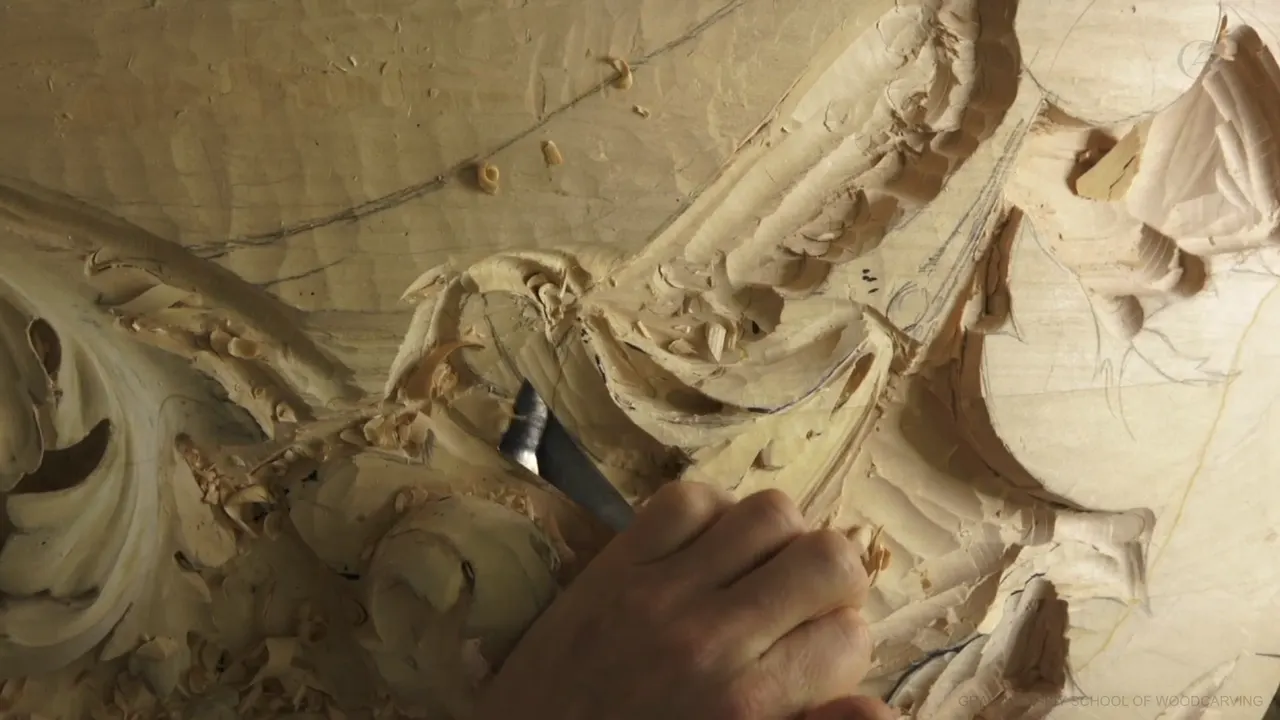

What does a wood carver mean by "I'm blessed"? In Venice Room 52, part 2, I said it about the amount of material I had, six inches of it.
Ever heard a carver call himself blessed and wondered what was behind it? Maybe you would like to know what I had in mind each time. In this part it was the material around my gouge. That word turns up in other lessons of mine, about punches, a bevel, splinters, a mallet, a career and a full schedule. Here are the places, with the lines around them.
What was on the bench when I said it?
The part opens with "I need to probably just fix little bit." Then comes "I'm going to take a skew. Skew chisel." A knife can do it, or the flatter gouge, and the result is about the same, I would say. The thing was to make it a little wider, like this. "Then it's going to look better." The other side got the same treatment: I had to chop a little bit and probably open it a little bit in that direction. My skew chisel was one inch, about 25 millimeters, the same one again.

Underneath of there I needed to create the cut, a concave one with number 11 again. My plan was about five millimeters, number 11, so 3/16 of an inch, and I would go that way.
Material in this area
Here is the line. "I'm blessed that I have a lot of material in this area." Six inches (152 mm) to this point, all the way to the bottom, I said, so I can dig as much as I wish without making too much impact on the design.

The tool in my hand got a few words. I used it a lot yesterday, and it's cool. "The beautiful thing" about it: I can use one tool and create whatever requires multiple tools.
"So it has to feel like it goes underneath." Another division was coming, and later on I would subdivide, with this part above. Right then I could fix my center line, and that one would be a center line too. More divisions would come a little later, right there.
I cleaned a little bit around, and I was not going to touch too much of the material right there, because there is still another detail going to go underneath. Look at the overall picture, I told you, and you can see another movement going all the way inside, continuous. One more detail was still waiting for me.


A tool, a pattern and a division
The tool I used here is about the same as a normal skew chisel. The English or London pattern would call it number two, and a German or Swiss-made pattern number one, so the European pattern. "So it's number two." By then the division was developed, and more details were coming in this area.
This part was going to go underneath the leaf. My next movement would be a little more complicated, with a couple of ways to attack it. I could make this part go underneath of both lines, or get this side going underneath of this one line, "which in this case is going to be more logical, I would say." "So I think it's going to look much better."

For my first cut I planned number 11 again, with 3 millimeters, one-eighth of an inch. Leaning a little bit on the inside, I did not carve straight like this. "So I'm slightly under-carving. Not deep, but slightly." That would give me a really nice movement pretty much right away.
"Let me think about what I should do on this side." On this side I could do the opposite and bring that part underneath of this division, so it will be different. A cut I planned as not final, with the same tool again. "We are just developing the main shape, the main movement, if you wish."


On to the blend. "What I'm after, I want to create an eye." Right here and right there, I said, "just like that." "I don't need to draw. I'm actually drawing just because I'm filming and I'm using pencil." Usually I don't like to use pencil at all on my carving: it leaves a lot of dirt, and that's not good. Blending went on with the same tool, and it felt like this piece was going right underneath. The point of the tool could go also underneath. "See what happened?"

Which punches matched the original?
My Q and A course has a lesson on dotted background texture, and there the original piece had texture on the background that I needed to match. In furniture carving it gets used a lot, I said, and in architectural carving not as much. Then this: "I was blessed enough to have different punches I am still able to buy and you still able to buy." A supplier in the United States sells punches that match the original piece.
Price: about $40 to $45, I believe. I did not remember exactly. Five come in a set, three round ones, one square one and a small rectangle. Can't buy a set? A punched background is still possible, and I have done that a lot. Take a piece of thick nail, grind it flat, and cut a series of cuts with a triangle file to make the pattern. "You're still going to be able to use as a punch." No regular mallet for the background, mostly this punch, about 5 millimeters (about 0.2 in).

More from that lesson: if you are not in the United States and can't find those punches in your country, or you would rather not spend money on it, there is nothing wrong with that too. Take the thickest nail you can find. Multiple times, I said, I did it, especially for different patterns, "because you have a lot more freedom what kind of pattern you're going to create with your small files and your nail." And in this case? "I had to match, and, like I said, I'm blessed that the sets I have match exactly the original design." Without them, I would have made one from just a nail, or a framer's nail, should I say.
Who told me to concentrate on carving?
In Venice Room 56, part 9, I told you about the businesses I used to run. I had multiple businesses at once, pretty much. Even while carving, I was a builder of custom homes for about nine years, mostly high-end. A kitchen and bathrooms company was mine too, like a cabinet company, and a pretty big shop doing the cabinets and the furniture and bathrooms. Multiple employees worked for me for years. There was a business to run, and carving too, because I would still accept some custom work, some commission, while I was running a business building homes and building cabinetry.
But one day, a few years ago, a really famous woodworker came to my shop. He runs one of the biggest woodworking companies in the world, and I have known him for a long time. His words: "Why don't you just concentrate on wood carving? There's a lot of companies who can do cabinetry, and there's a lot of builders, but not too many people who left in the world who can actually carve." My answer: "Yeah, why don't I do that?" I switched to carving full time, pretty much, quite a few years ago.

Did I lose anything economically, financially? Probably a little bit in the beginning. Yes, it's a different type of business in the beginning. After a few years of that work, I lost nothing. I actually gained. "So I'm blessed, I guess." And it doesn't matter what kind of profession you have right now. Wondering whether wood carving and custom woodworking can bring in any money? I would say absolutely yes. No doubt.
Was the bevel luck or a blessing?
In the V-tool sharpening course, part 3, I was working one side first. "You have to concentrate on one side first," and then we move on to the other. About 10 millimeters, so 3/8 of an inch, from the edge. That is the bevel I kind of like for the V-tool, and I just eyeballed it. I guess I was lucky or blessed to get my right bevel on the first try. Then: "I'm really close."
Splinters and a blessing

Lily Box 3, part 9, from the Lily Box course, has a small one. It is possible to make that mistake with the lines, and it won't look too good. There was a lot of waste on the inside. My tendency is to clean with my fingers. With basswood, it's okay. With this wood, "I'm still blessed. I did not catch any splinters, but you could." For some reason, splinters are something I don't like. Now I could work on this leaf and give it a nicer shape, that twist inward, and I still needed to attack my edge like this. "Still don't like how it looks."
A skewed gouge, and a number three
In Hashemi 43, part 5, I could actually do some of the cuts with just a V-tool, and with the knife we take down each layer, down and down. "Now we're going to concentrate a little bit on work itself, and you can just watch what I'm doing." "Or a knife. Or if you are blessed like me, you could actually use a skewed gouge." The goal is to do exactly the same everywhere.
Over in Grape Onlay 9, part 2, how deep I would go was set by "this little guy." No deeper than that, because it would give me trouble a little later. My previous tool was number three, one of my favorites, like five eighths of an inch (about 16 mm). About that maker, the steel is just amazing steel. "I think people in England, if you're watching me from UK, you are just blessed people." Dig the iron out of the dirt and throw it in the stove. Just get beautiful tools. The cut itself would use number three again, a gouge of about half an inch (13 mm).


The mallet I won't use
In Acanthus over Moldings 2, part 1, I talked about a famous man who was teaching a class and has millions of views on YouTube. Then the line: "So this time I got, you know, blessed." It was a teeny tiny mallet from the same man. Really cool. I won't use it, really, because I don't want to damage it.
Busy, and not taking orders
A viewer from England asked in the April 2020 livestream how I find my jobs. Not looking for jobs, I answered. These days a lot of different emails come in, with people asking me to do stuff, and no orders are being taken. Some people have waited on me a long time. "I'm not marketing, if you understand what I mean. I'm not trying to market myself because I am busy, and I'm blessed with that, I guess. And I'm blessed."


A ceiling in part 3
Workshop 52, part 3, on depth: "And here I could go much deeper. So much deeper. Because it's a flipping, so I can excavate a lot more if I need to." The part also says: "But there is a ceiling, and I can't do too much." I cannot use a tool from the opposite direction, "unless if I have a small tool, then yes."
For the concave there, probably number eight was the plan, "or number nine will work also. It will give me the same result." About six millimeters, so a quarter inch. I still wanted to see "a little bit of a ridge in the middle." Then, I said, it will be authentic to the original period, Italian Venetian style. I thought I could use number seven, half an inch or 14 millimeters (about 0.55 in), and continue the concave, though I would not press too much.
Here is the table, with the lesson that holds each line, from Venice Room Part 5 and my other courses.
| Where I said it | What I was talking about | Quote |
|---|---|---|
| Venice 52.2 | The amount of material in one area | six inches to this point |
| Dotted background | Punches for the background of an original piece | blessed enough to have different punches |
| Venice 56.9 | A business, then a switch to carving | blessed, I guess |
| V-tool sharpening 3 | The bevel on a V-tool, set by eye | lucky or blessed |
| Lily Box 3.9 | Cleaning waste on the inside, by hand | I'm still blessed |
| Hashemi 43.5 | A knife, or a skewed gouge, for taking down each layer | blessed like me |
| Grape Onlay 9.2 | A number 3 gouge, its steel, and viewers in the UK | you are just blessed people |
| Acanthus over Moldings 2.1 | A small mallet from a famous man, one I won't use | I got, you know, blessed |
| Livestream April 2020 | Being busy, and not taking any orders | I am busy, and I'm blessed with that |
How it's done
- Count the material you have. With six inches, or 152 mm, below the point, deeper cuts would not hurt the design much.
- Match the background of the original piece. The set in the dotted background lesson has five punches, about $40 to $45, I believe, and it matches that background exactly.
- Make a punch from a nail. Without a set, take a piece of thick nail, grind it flat, and make a series of cuts with the triangle file to create the pattern.
- Eyeball a V-tool bevel. In V-tool sharpening 3 the bevel was eyeballed at about 10 mm (3/8 in).
- Leave a prized tool unused. In my moldings lesson I won't use the small mallet, really, because I don't want to damage it.
Frequently asked questions
Which part of workshop 52 has the word blessed?
Part 2, while I was working on a concave cut with number 11. The line was about the area I was cutting: six inches, about 152 mm, to the bottom, enough for deep digging with little effect on the design.
What did I say about buying punches for a background?
The sets I have match the original design exactly. When you can't buy a set, a thick nail ground flat and cut with a triangle file stands in.
Did the switch to carving cost me money?
In the beginning, probably a little bit. It was a different type of business in the beginning, I said. After a few years I had lost nothing, and I actually gained. That is Venice Room 56.9.
What to carve next