

Alexander Grabovetskiy, woodcarver, School of Woodcarving · Published 2020
What does a wood carver mean by "a different approach"?
Quick answer: In part 9 of Venice Room 52 I used the words "a different approach" for acanthus, in one stretch of the movement, while I was blending it. My other lessons use them for another tool, a different order or another country. Each place is below, with my own words.
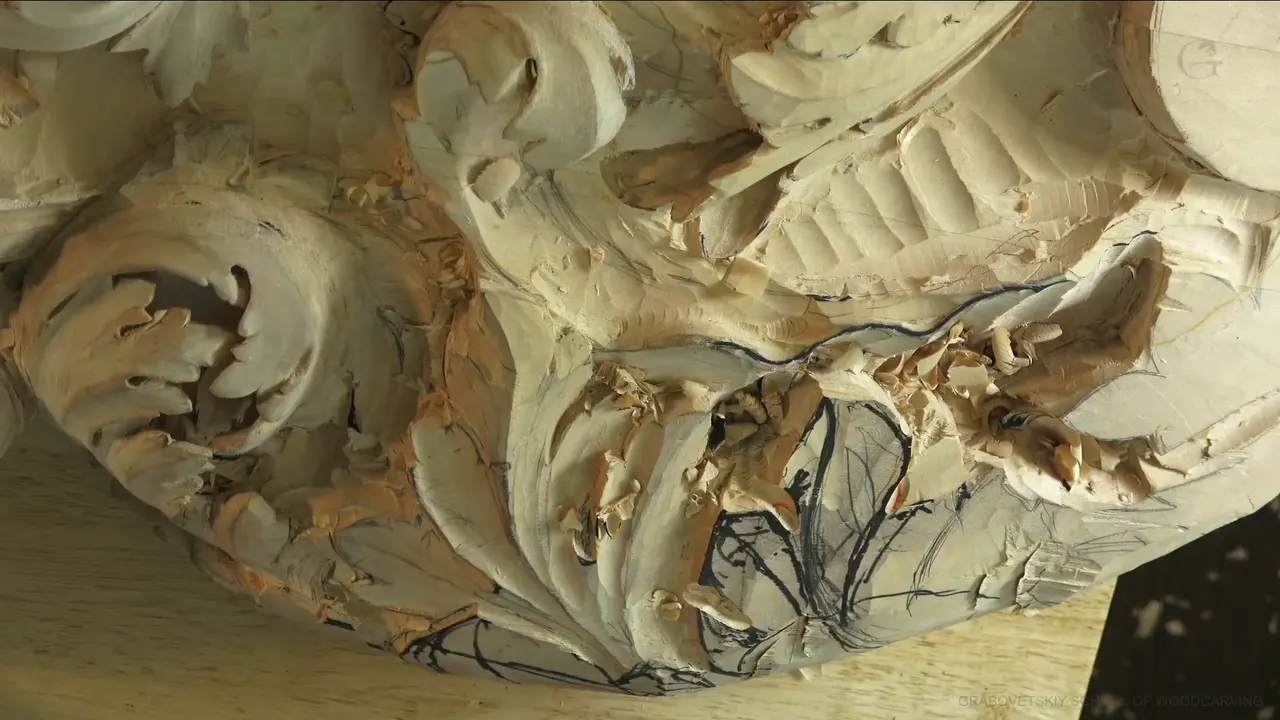

What does a wood carver mean by "a different approach"? Part 9 of Venice Room 52 has it for acanthus. My other lessons use it with another tool, a different order or another country. Each place is below, with its lesson.
Did you ever hear me say it and wonder what changes? The video is short, so I went through my other courses for the same two words. Every lesson I link is public.
What did I say in part 9?
The first words in the file are about a skew: "Just skew. Just like that." Right after them: "Also, there's a different approach to acanthus, how you treat this part of this movement." Next, I added: "But see what I'm doing? I'm just blending it."

Next came "I know it doesn't look finished, and that's not supposed to look finished yet." I could see that I'm able "actually, to create even more divisions," and I called that my point. "It just gives me that ability." The same part has to be repeated on the other side, "and let me do that right away. Again, really important."

Then the shape. "So this part, not really long. It's more almost like a round, if you can just circle it. So it's almost a circle part. So you don't do a really long one like in the French style." Then: "Well, I shouldn't say French style because it also all depends what part of France I'm talking about." After that came "Okay? So let me relieve those triangles."
For one line, my plan is to attack it "with probably number five, I would say. One inch" (25.4 mm). "And pretty much right away, it gives me the shape I'm after." This part will be like a letter S movement: "I'm going to hit once, and that's already giving me that movement."

For another part I would keep "probably the same tool, just like that," and remove some of it. Not deep, though. "Otherwise, I'm going to damage the surface," and then tool marks would be hard to get rid of, "which I don't want to do." Then: "So I've got the main shape." The same tool, I said, can maybe refine "a little bit this corner." Next: "If you have any question about acanthuses and so on, please feel free to ask me. It's probably a good time to ask."

How did I work on the middle line in part 9?
"Okay, so I've got the pipe. I've got this movement. So that is a middle line of this movement." And that, I said, will be my development right here. On the inside I will make the divisions like that, while one of them goes underneath of this part, "exactly the same on this side." My plan: "But let me clean a little bit the surface, because right now, it just doesn't look too good. It's too messy." Then: "I usually do that because I want to see much better."

I will have more divisions like that. "And it's going to give me that curliness." Then a second look at the line: "Although this line doesn't look good. I need to probably move it a little bit, my middle line." I would clean it, then shift it a little bit this direction, and "this part is what I need a little bigger." The rest goes underneath of that movement.
The triangles again: "let me subdivide, take care of those triangles. Same idea." I plan to use "just the number 11 veiner. Relieve it." I don't do it too deep, "because I really don't want to hit that surface, and then" I would "have another problem to clean, to deal." The file closes on today's result, "which I did not do too much."

That is part 9. The lesson page holds the rest of workshop 52, and below is every other place I used the same two words.
Is a different approach another country's way?
Venice Room 54, part 11, sets two cities side by side. The design was mine, I said, "but I had to be authentic to Venetian style." Then: "And Venetian style is not the same as, let's say, if you go to Milan. Even in the same 16th, 15th century, you would say it's acanthus leaf. But in Milan and Venice, Venezia," I said, "absolutely different approach" in carving those acanthus movements. What you see, I said, "is authentic, pretty much to Venice."

Workshop 69, part 9, has a tool and a correction. I can take a bigger number 11, and "I think it's a good idea to use a little bigger because I really need to, again, to raise one of the parts of that movement up." I corrected myself: "To the original acanthuses, I should say, because there's multiple different acanthuses and different approaches for development of those acanthuses. But in this case, it's a Venetian style, which I really like." The workshop 69 page has the rest.
The Hashemi Flowers course has me saying wood carving is a trade, and I had asked in a workshop whether it is a trade, a craft or art. "And definitely, people do have a different opinion." It "could be all. Craft, art, trade." Then: "For example, there is different countries, even in Europe, and different approach" toward the wood carving. If you go to Sweden and other countries, I said, "it's like a hobby, I would say. And they would teach you to do that type of work as a hobby. So then it would be just a craft."
In the Furniture Panel course I told you that nowadays "not all wood carvers in the world even know about the existence of V tool. I know it sounds strange, but it's the truth." And "even in some European countries, I'm not talking about Far East countries, they have absolutely different approach" there in the Far East. Some European wood carvers "never use V tool." Back in history "they had lots of veiners and gouges, but not all of them had a V tool."

Does the tool change?
In the Grinling Gibbons class, lesson 15, I had about maybe two millimeters deep (about 0.08 in) and only one millimeter left (about 0.04 in). I said "let me grab a different tool," and "it's a different approach you can use," with the number 16 as my pick. From the side I can attack it, and I can do about the same operation, but with this stuff.

The Flower Rosette course starts lesson 5 with it. "I just want to show you a little different approach, like I said. So it's not always you have to have all the tools, the whole complete set for the carving." Simple tools, like a chip carving knife and maybe just one small gouge, still let you "do that type of carving," with some challenges, and "not the easiest thing." One knife does it, I said, and I've got multiple, and I use a lot the No. 12.

Corinthian acanthus, lesson 5, puts the words on an undercut. "There's different approaches to undercarving, and I like to do extreme undercutting. And also, even in undercutting, there is a different approach how you can start even undercutting." Step number one, what I usually do: "I would take probably just a V tool, and any V tool will work." A low angle, like 45 degrees, "would be the best probably," and I set it beside the normal 60 degrees so you can see the profile of the two. After that I'll take a mallet and place my V tool on a side.

Furniture Panel 35 names a micro gouge, "number eight, number nine, doesn't matter." I want to make sure I excavate this area. Then: "Actually, you know what, I could show you different approach. I believe I showed you this way." One cut first. Next I could do the same on another spot, but I want a bigger gouge there, "like number seven or so."

Is it a different order?
In Lily Box lesson 4 I said the concave cuts start "from this one and go toward that one," with the last one right there. These are one-millimeter concave cuts (about 0.04 in), separation cuts, and "that's one of the approaches, by the way." A big one right there may wait ("We'll see," I said).

Lily Box lesson 7 has a turn in it. I'll place a concave and a concave, with maybe about one-sixteenth of an inch (1.6 mm) and number eight. Then: "Maybe yes, maybe no, maybe that's wrong. Let me use a different approach. Forget about this pipe because I will have a flip right here." Just because of that I will need to create a fillet this way, and I need to take care of this side. "I apologize for confusion."
Over in workshop 72, part 1, I said it of a part I would bring underneath of a line. "So maybe I should not do that way. I think that was not really good idea." Not a mistake, I said, just not a good idea, and "let me blend that." The next words were "So little different approach," and after them I said I'm ready to do some concaves.
Workshop 25, part 7, has a flip over to form. "I'm doing a different approach from that what we've done on this piece." It will be visible from the bottom. "It's turning this way," I said, "and I want to see that hole and I want to make something different on this side."
Roman acanthus, lesson 5, starts with a lost pipe. "I completely lost this pipe on that side, and I need to recreate that. What is the solution going to be? There are actually different approaches you can take." You can eyeball it and place it approximately, or follow the grid lines on a section where I did not remove paper. Printing two drawings, one to lay beside and one to glue on top of the wood, was a wonderful idea, I called it. Here is the lesson page.

Of some sections in the Greek Acroterion course, lesson 3, I said "I have to do somewhat different approach. Okay, let me draw that."
The first Hashemi lesson uses the words too. A design like that looks really complicated and "can scare you off," but "believe me, I can prove to you, you are able to do that." Then: "There's a different approach" for carving like that. You could take a solid piece and just dig everything out of it, I said, but that means a lot of waste, and some areas you can't get to at all, which I called "impossible."

Hashemi lesson 27 lists them. "So there's different approaches to do that layer. Okay? At least three, as I know." One takes a solid piece four inches (102 mm) tall, sixteen quarters, and carves everything from the single block. The second carves "all the leafage and all the flowers" separately and applies them, which was done also in the 18th and 19th century on carvings you can find in some really beautiful palaces. "And the third approach, that is probably what I will take in this carving": carve sockets, drill through the middle, and insert a screw or a dowel.
Hashemi lesson 22 has it for the end of a piece. "I'm not creating too much pressure because it's fragile. We are working right on the end, so don't create too much pressure. You can break it easily. Or just get a different approach just to get some support like we've done before."

Is the other way wrong?
Venice Room 49, part 10, has them for undercutting: "And yes, there is a different approach to undercutting. Some people really don't like to do a deep undercut. I call it extreme undercut, and some people do like to, they really do undercut a lot. And I'm actually one of those guys." I added that I know the logic behind not undercutting.
Then: "It also depends how this piece is going to be used." If people hit it every day, I said, extreme undercutting is out, "because it's becoming too fragile." But on another hand, "when you do an extreme undercut, it looks much better."
Where do all these lines sit?
Here is the table of every place, from Venice Room Part 5 and my other courses, with what each one was about.
| Lesson | What I was working on when I said it | Topic |
|---|---|---|
| 52.9 Venice Room | Acanthus, one stretch of the movement | how you treat this part of this movement |
| 54.11 Venice Room | Design that had to stay Venetian, set against another city | Milan and Venice |
| 69.9 Venice Room | Movement raised to stay near the original | development of those acanthuses |
| 24.4 Hashemi Flowers | A talk about craft, art and trade across countries | countries in Europe |
| 19.3 Furniture Panel | A V tool, and carvers who never use one | the Far East |
| 15.2 Grinling Gibbons | A cut with only one millimeter left | another tool, number 16 |
| 5.1 Flower Rosette | Simple tools: a chip carving knife and maybe one small gouge | not the whole set |
| 5.1 Corinthian Acanthus | The start of an undercut with a V tool | how you can start |
| 4.13 Lily Box | Small concave cuts, one millimeter each | from this one toward that one |
| 7.8 Lily Box | A line with a flip coming near a pipe | forget about this pipe |
| 72.1 Venice Room | Part brought underneath a line, after a try I called not a good idea | bring this part underneath |
| 5.1 Roman Acanthus | A pipe I lost on one side of a leaf | eyeball it, or follow the grid lines |
| 27.1 Hashemi Flowers | A second layer of flowers on a carving | a solid block, separate parts or sockets |
The wood carving in these courses covers acanthus, rosettes, flowers and boxes, with a Byzantine leaf beside a Venetian one. The Hashemi Flowers course, the Furniture Panel course and the Lily Box course each have their own page.
How it's done
- Blend the part. A skew comes first in the file, and I told you I was just blending.
- Keep the part round. The part here is not really long, more like a round, almost a circle part.
- Pick the tool for a line. Probably number five, my words went, at one inch (25.4 mm), for one line.
- Mind the surface. Digging deep would damage the surface, and tool marks would be hard to get rid of.
- Clean to see. I planned to clean the surface because it looked messy, and I usually do that to see much better.
- Move the middle line. I said my middle line probably needs a small move in one direction, and that I would clean it.
Frequently asked questions
What was my line on acanthus?
Acanthus came with a different approach, I said, and right after that I told you I was blending it.
What about the French style?
A really long part, like in the French style, was my comparison. Then I said it all depends what part of France I'm talking about.
Which tools did I name in part 9?
A number five for one line, probably, and the number 11 veiner for the triangles.
Do all carvers undercut deep?
What to carve next
- Venice Room 52
- Venice Room 54
- Venice Room 69
- Hashemi Flowers 24
- Furniture Panel 19
- Grinling Gibbons class
- Flower Rosette 5
- Corinthian acanthus, lesson 5
- Furniture Panel 35
- Lily Box lesson 4
- Lily Box lesson 7
- Venice Room 72
- Venice Room 25
- Roman acanthus, lesson 5
- Greek Acroterion 3
- Hashemi Flowers 1
- Hashemi Flowers 27