
Alexander Grabovetskiy, woodcarver, School of Woodcarving · Published 2020
What does a wood carver mean by "really important"?
Quick answer: In part 3 of workshop 52 it sits beside keeping a line really tangent while a concave starts from almost nothing, and beside a ridge and the overall design. In other lessons of mine it stands next to a straight cut, a slice, a low angle, grain, a shadow, a final cut and a flower.

What does a wood carver mean by "really important"? In Venice Room 52, part 3, it sits beside a line I wanted to keep tangent, and beside a ridge and the overall design. Elsewhere in my teaching the same words stand next to a straight cut, a slice, a low angle, grain, a shadow and a final cut.
You may have heard me say "really important" while I carved, and wondered what to hold on to. Here is where it sits, line by line: this part, and my other courses after it, each with the words around the phrase.
What was I carving when I said it in part 3?
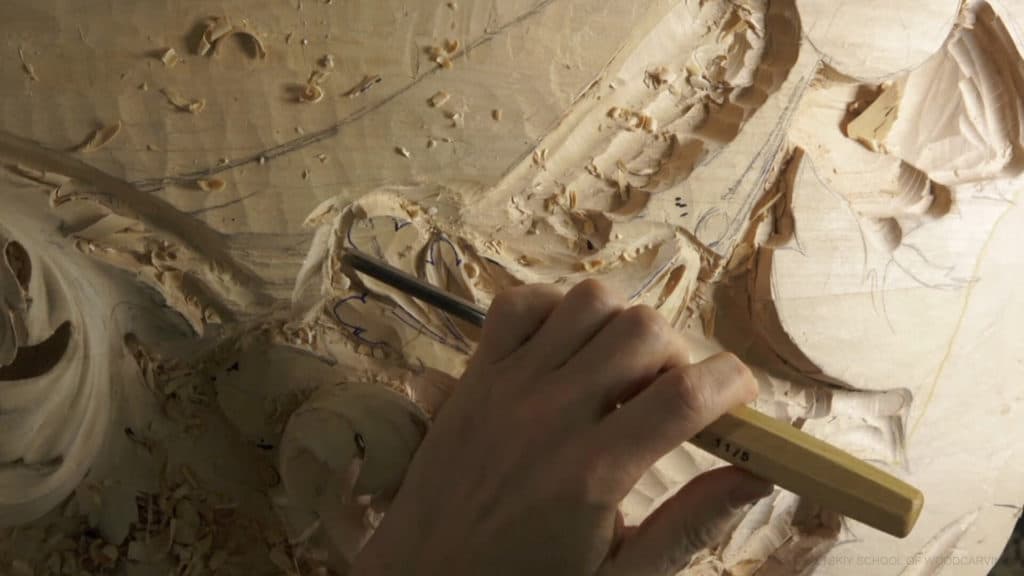
The part opens with "I create more divisions and more concaves and convexes." What I like to see is the ridge. "If you look close, it has to be raised up a little bit." So I have to cut a concave on one side, and I also have to cut one on that side. The pipe will go to the center, and this pipe also.

My pick for the concave was probably number eight, and number nine "will work also. It will give me the same result." On the size I started to say "about 10 millimeters or less actually," and stopped myself: "No, I'm sorry," it is "about six millimeters, so a quarter inch." Six millimeters is 0.24 in, and a quarter inch is 6.35 mm.
The first concave would be "almost nothing at the beginning," and "much deeper once you're going to get in." Again, in my words, "almost from nothing."
Which line in part 3 carries the phrase?
These are the words this page is built on: "Really important for me, really important to keep that line really tangent." Those lines I would not hit, I said. Drawing was just for the purpose of showing.

The middle got a mention too: "I still want to see a little bit of a ridge in the middle, then it's going to be authentic to the original period, Italian Venetian style." Questions were welcome: "please go ahead and ask me." While I carved, I told you, "I'm just carving right between those lines." The tool in my hand was a small tool, but I could use a little bigger one "because I really need to raise this ridge." It was "already raising actually. Maybe it's enough." The choice I stated: "But I'll use a little bigger."
Going all the way like that and stopping right there was the plan. "It's not the final cut." What I needed was to create this ridge and indicate where my pipe movement will be. "And here I could go much deeper. So much deeper." Excavating a lot more is possible if I need to.
What stopped me from pressing hard with number seven?

"I think I could use number seven," I said, a tool from a French brand, "half an inch or 14 millimeters." Half an inch is 12.7 mm, and 14 mm is 0.55 in. My concave would continue right there. "But I'm not going to press too much because I have to attack from opposite direction, and I'm going to do that little later." About the ceiling I said: "there is a ceiling, and I can't do too much." I cannot use a tool from the opposite direction, "unless if I have a small tool, then yes."

Carefully, carefully, I said, I would create my concave cut. Like I said, the final cut is not this one. "But on the other hand, I could right away hit little bit this curvature." And: "And this direction also. And this direction."
What happened with the divisions and the ridge?
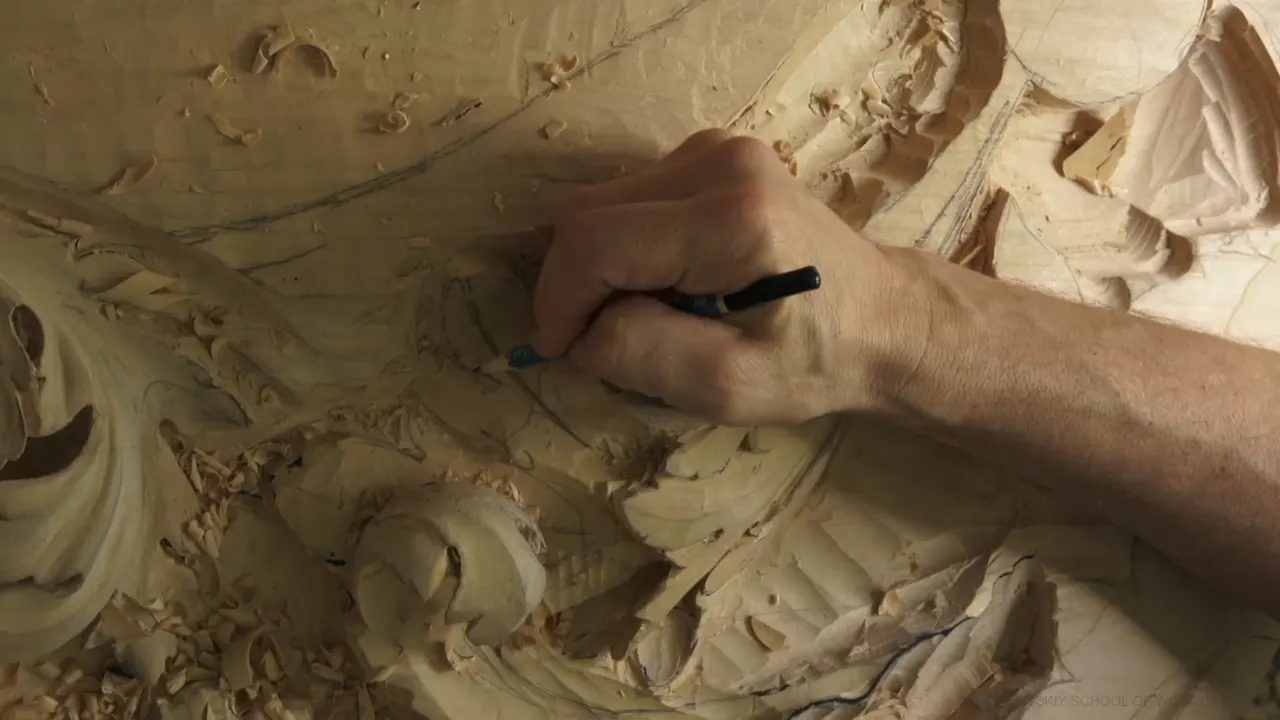
"I am ready actually to create more divisions" on this piece, at the top of my acanthus. A marker could help you see much better because of the light. One more division will go like that. Another could go right here. The edge will get more of them, and here I also want to do one.

This is how it will look, I said: "Okay, that is the ridge, okay, double check." The line before it ends with "the overall design." My next line, word for word: "So for me, it is important, really important."
Where do relief cuts come in, in part 4?
Part 4 of the same workshop opens with "So that is complicated." The subject is the relief cuts: "I'm always doing those relief cuts." About them, "they are really important." Chopping to approximate form comes up in the same part: "I did the relief cuts," and I meant to just chop: "Chop to approximate form. It's not the final form yet, but approximate." One more line: "at least I have something to work from."

Where else did I use the phrase on a cut?
Knife work, Carving Greek Acroterion 3. I held the knife in my palm with the blade toward myself. "Just angle it." My line: "Really important for me to keep an eye on this line." The final cut was for later: "I'll take a gouge and make the final cut."
Depth is the subject in Greek Acroterion 5, part 6. "Again, I can see right here that needs to be micro cut." I called it "really important that I'm not going deeper than a 1/16 of an inch right now." That depth is 1.6 mm. Checking how it looks first, then deciding, was my plan. And: "as of now, a 1/16 of an inch looks actually really good."

Do straight lines and slices count as really important?
The beginner course has a long cut in workshop 4, the curly kitchen cutting board. My cut would go away from myself, and a finger would help me make that cut more accurate. "Also really important, if you are able to manage to make a single cut as long as possible without pulling your knife out," and the cut will be much cleaner. "Just don't rush." And: "You always can come back and make deeper cut."
A cut toward myself is in workshop 5 of the same board. My plan: place my knife right in the corner, hold my piece and cut toward myself really slowly. "I'm not rushing this cut." That cut is "actually really important because that shows your ability to keep that straight line straight." I noticed some waviness of my own, a micro waviness that will not be noticeable.

Square connections are the thing to avoid in Carving Grape Onlay 1: "It's not always possible, but try to avoid." The dig used only the right corner of my tool, then slicing, and I said: "I'm not pushing, okay, I am slicing." I called that "really important." Of the cleanup I said: "It's just impossible to clean those after you cut. So it is better to carve them clean from the beginning."
Sharpening Straight Gouge shows two tools side by side. "When I'm carving oak, I'm using this tool because it's much stronger," and for lime wood or basswood, "I'm using that one." The angle: "most of my tools, they do have a really low angle like this, really important." A high angle means you really can't carve anything, and you have to raise your hand really high. Is it possible? "Yeah, absolutely." For fine detail in lime wood or basswood, "I prefer a really low angle." The degrees I can't name: "It could be just about five degrees, even lower than five degrees."

Which lessons tie the phrase to light, wood and grain?
You would ask me, in Carving Hashemi Flowers 7, why I undercut extremely a backside, when most of it you will never be able to see. From the top, "this is flat part, and right here it's no more than maybe 16th of an inch deep." That is about 1.6 mm. "I think I could actually go even more extreme right here." My easy answer: "It's all about lights and the shadows." Even a small amount of light traveling behind "is going to create a shadow. And that is actually tiny detail, but really important, okay, really important." Overall, it makes the piece "much, much lighter."
Heights matter in Carving Hazelnuts 2. The stem "is higher than those hazelnuts itself," and "this leaf is higher than those hazelnuts, and that's really important." Under those leaves I like to create a really deep undercut, which will give me "a really good shadow." The full size, like a full 3D, is something I still have to get.

Grain gets a mention in Carving Roman Acanthus 16. The thickness showed some inconsistency, and I said I'd "attack that from inside, from my undercut side, and also work on this side at the same time." I spoke about the direction of grain, or the grain of the wood, and added: "Really, really important."

Tool size is the choice in Carving Hazelnuts, lesson 7: number six, about 10 millimeters, or about three-eighths of an inch. Three-eighths is 9.5 mm. My pick is a small tool, "just because it's going to bite little smaller sections." Breaking the rule is needed here: usually I like to work from outside inward, but in this case I can't. "As long as my tool is sharp, which is really important, I should be okay."
Do the order of the steps, the eye and the flower count too?
A combination lock sits in the Hashemi course, lesson 24, beside "train yourself to sharpen this." There is one at my gym. "It's really important what number's first." You could know all the numbers and still screw up with the wrong combination. "Same with the V tool." And a wider one: "I shouldn't say just a V tool, because pretty much every tool."
Eyeballing is the topic of Carving Roman Acanthus 12. "You don't have to eyeball if you don't feel comfortable." A piece of paper can mark the end of an eye, and you transfer it to the other side. "But I still would like to suggest if you can train your eyes, that is really important." On more complicated pieces there's no way to measure, and then "your eyeballing abilities of the brain going to help you a lot, actually."

Flowers are the topic in Hashemi 47. I showed number four, about 10 mm (0.39 in), and told you that whatever gouge you feel like using is "absolutely fine." The flower will not be exactly the same as mine, I said. "And by the way, that is actually also one of the really important things probably to understand." Even a copy will be different. "So that's the beautiful thing, actually, of carving flowers."
A big chunk comes off in Carving Hazelnuts, lesson 1. I would like to stay approximately three-sixteenth of an inch, about five millimeters, from the final line. That is 4.8 mm for 3/16 in. On the way you do it, I said "really important." I saw "a lot of guys who made the mistakes" with a mallet: "it's still a wedge," and "you're creating a lot of stress inside of the wood." My way is "better just to remove it by hand," and no deeper than about one-eighth of an inch, about three millimeters. An eighth of an inch is 3.2 mm.

Where did I use the phrase, line by line?
The table gives the lesson that holds each line, from Venice Room Part 5 and from my other courses.
| Lesson | What it was about | The words next to the phrase |
|---|---|---|
| Venice Room 52.3 | The first concave | almost from nothing, much deeper further in |
| Workshop 52, part 3 | Ridge, design | double check, and the overall design |
| Part 4 of that workshop | Relief cuts | just chop, to approximate form, with something to work from |
| Greek Acroterion 3.1 | The line before a final cut | keep an eye on this line |
| Acroterion 5.6 | A micro cut | how deep to go right now |
| Tool Sharpening, straight gouge | The angle on most of my tools | just about five degrees, even lower than five degrees |
| Beginner course, cutting board 4.2 | One long knife cut | a single cut without pulling the knife out |
| Beginner course, cutting board 5.3 | A knife cut with no rush | keep that straight line straight, and my hand on the line |
| Grape Onlay 1-2 | Digging only with the right corner of my tool | slicing, not pushing |
| Hashemi 7.1 | The back of a leaf that nobody sees | it's all about lights and the shadows, believe me |
| Hazelnuts 2-1 | Heights | stem and leaf, both higher than the hazelnuts |
| Roman Acanthus 16.3 | The direction of grain | the inconsistency in the thickness I could see |
| Hashemi course, 24.3 | A combination lock at the gym, and a V tool | all the numbers, but the wrong combination |
| Roman Acanthus 12.1 | Eyeballing, and training the eye by feel | train your eyes, so you can do it by feel when you can't measure |
| Flowers, Hashemi 47.1 | Trying to copy a flower I carved before | not the same every time you do |
| Carving Hazelnuts 1-1 | A big chunk | by hand, not with a mallet |
| Hazelnuts 7-1 | The tool for small bites, number six | my tool is sharp |


How it's done
- Raise the ridge with concave cuts. That ridge has to be raised up a little bit, I said, so I have to create a concave cut on one side and on the other side.
- Pick a gouge size. My choice was number eight, with number nine as the other option, near six millimeters (a quarter inch).
- Start the concave from almost nothing. That first concave would begin as almost nothing and get much deeper further in. Keeping the line tangent was, in my words, really important.
- Leave a little ridge in the middle. The middle should still show a little bit of a ridge, authentic to the original period, Italian Venetian style.
- Double check the ridge. My words were "Okay, that is the ridge, okay, double check." About the overall design I said, "So for me, it is important, really important."
Frequently asked questions
Which line carries the phrase in part 3 of workshop 52?
Two do. One is about keeping the first concave tangent, and the other has the overall design and the ridge.
Which gouge did I plan for the first concave?
Number eight, and I said number nine would work also. The size was about six millimeters, so a quarter inch (6 mm is 0.24 in).
What did I say about number seven and the ceiling?
I would not press too much with it, because I have to attack from the opposite direction, and I would do that little later. There is a ceiling, and I can't do too much.
How important did I call relief cuts?
What to carve next