

Alexander Grabovetskiy, woodcarver, School of Woodcarving · Published 2018
Who decides how finished a carved commission has to be?
Quick answer: The client and the carver settle it together before any wood is removed. For this panel we agreed not to chase every detail, and that agreement rested on hours, on expectation and on price. A surface left semi rough is then a specification, not a shortfall.
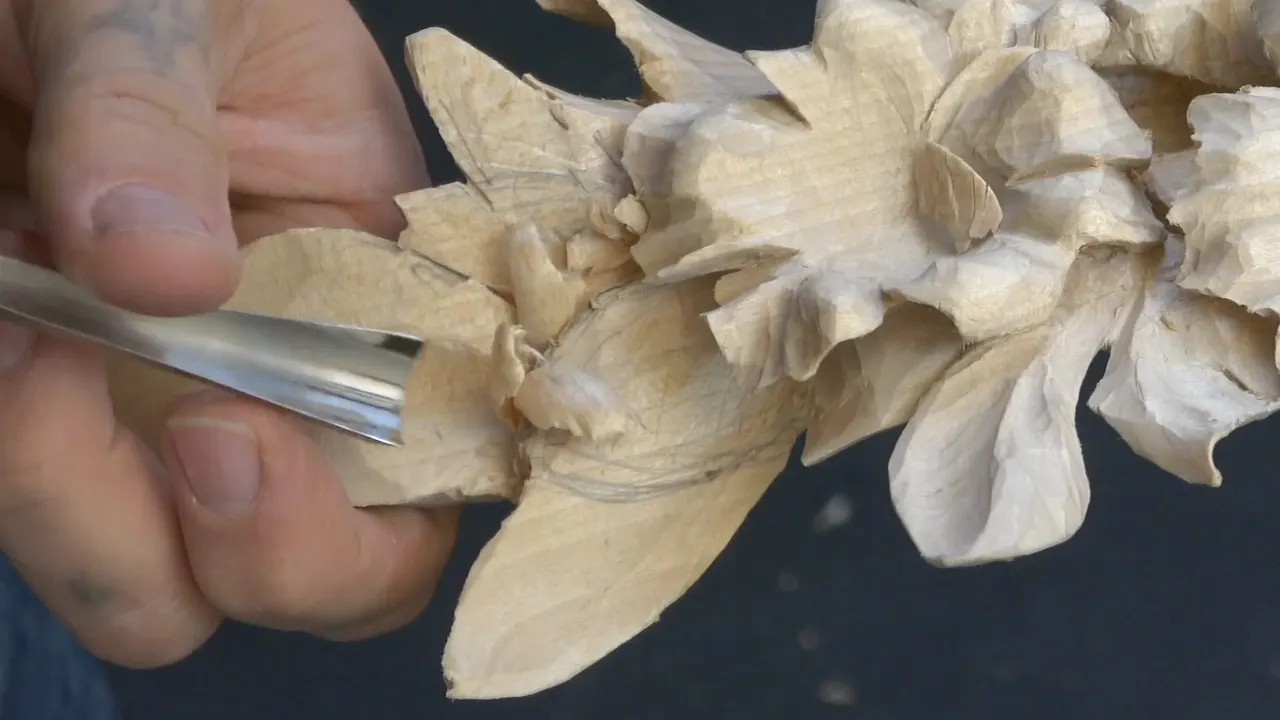
The customer did, before a single cut. We agreed this panel would not be taken all the way into detail, and that agreement was built out of three things: the hours it would cost, what the client expected to see, and the price. So it gets a semi rough finish, which is not at all the same as a rough one.
Ever priced a job by the hour and then carved twice as long because you could not leave it alone? Did the customer pay for that second half? Almost nobody does, and almost every carver has done it anyway.
Lesson 40 of the Hashemi flowers panel opens with me saying out loud what most carvers keep quiet. There is a level of finish written into this commission, I am carving to it deliberately, and I like the result. Two more leaves go in after that, and both of them are undercut from the very first pass.

What this lesson settles
- Who chose the finish level, and what that choice was made out of.
- A surface left semi rough on purpose.
- Undercutting on the first pass.
- End grain, which I describe on camera as a straight fight and lose twice.
- Cleaning, done with the camera switched off.
- An undercut a millimetre deep at the rim and three times that in the middle.
Who decides how finished a carved commission has to be?
The person paying, in conversation with the person carving, and the conversation happens before the work starts. On this piece we agreed I would not chase every detail.
Three things went into that agreement. The hours, because detail is bought with time and nothing else. The expectation, because a client who wants a jewel and a client who wants a warm architectural panel are asking for different objects. And the price, which is really the first two added together. None of that is a compromise on quality. It is a specification.

What does semi rough actually mean?
Forms fully resolved, tool marks left exactly where they fall, and no attempt at polishing every surface into evenness. My own phrasing on camera is that it will not be rough rough.
The distinction matters. Rough means unresolved, with shapes still approximate, movements unclear and waste standing. The other word means every decision is already made and only the chasing flat was skipped. From two metres nobody tells them apart. Up close, one looks alive and the other looks abandoned, and that gap is the whole reason the word matters.
A second reason to like it is worth naming. A cut face catches light in a way a scraped one never does, so a semi rough relief panel reads better across a room than a perfectly smooth one. I say I kind of like it, and that is not consolation for a shortcut.

Does less detail mean less skill?
Usually it means more. Knowing where to stop is harder than knowing how to continue, and anyone can keep cutting.
I have taken pieces like this one to the extreme before, and I say so in the same breath, and I also say what it cost. A lot of time. That time is real money on a commission and real weeks out of your life on a personal piece. Knowing when a carving is finished is the same question asked from the carver's side; this lesson asks it from the invoice's side.

How do you undercut while you are still outlining?
You lay the tool over rather than holding it upright. Held vertical, a parting tool gives a symmetrical groove straight down into the wood. Tip it onto one wing and that same pass cuts under the shape.
That saves an entire operation. The usual way is to outline first, then come back and undercut, which means going round every shape twice and disturbing an edge you already finished. Doing it in one pass means the shadow appears immediately, and it does: I point at it on camera within about thirty seconds. The cost is that you cannot press. A tool cutting sideways under a shape has far less support than one going straight down.

Which tools carved this lesson?
Eight, and two of them were swapped out for being physically too big for the space.
| Job on the panel | Tool | Why that tool and nothing else on the rack |
|---|---|---|
| the borders of two new leaves | the 16 parting tool | it undercuts on the very same pass that draws the outline |
| the same job, jammed into a corner | a 16 at three millimetres | the bigger one was about to strike a finished flower |
| lowering | the 7 at 20 mm | several preliminary passes, not a single one forced |
| the hollow inside a leaf | an 8 at five sixteenths | reach |
| taking that one hollow much further than I had planned | a 9, quarter inch | depth |
| blending | a 5 at 10 mm, then a skewed spoon | a spoon works the face a straight tool never reaches |
| notches and edges | a Pfeil knife, the one numbered 12 | speed |
| the deepest undercutting | an 11 at one millimetre across | a veiner, which I use here as a parting tool |

Why does layering order decide which way you cut?
The tool leans toward whichever shape is meant to go underneath, always. Before touching either new leaf I work out loud which grows from beneath which, and then both of them from beneath a third.
That order is not decoration. A parting tool laid over on its left wing undercuts the left side and leaves the right side standing proud, so the shape on the right ends up on top. Get the order wrong and you have carved a leaf that appears to pass over its own stem. Decide the stacking first, on the wood, out loud if it helps, and the direction of every pass afterwards follows from it. Attaching a carved flower to a panel is the same logic one scale up.

When should you swap to a smaller parting tool?
Swap the moment the tool in your hand is bigger than the space around the cut. I swap here for exactly that reason, and the reason is a finished flower sitting right beside where the pass has to land.
Size is not about the cut you want. What matters is the clearance behind and beside the blade while you make it. A quarter inch parting tool needs a quarter inch of room it will never use, and that room is often occupied by something you spent an hour on.

What makes end grain so hard?
The fibres end at the surface instead of running along it, so the edge is cutting across a bundle of tubes rather than slicing down one. My words in the first part are that it does not help, that it is almost impossible, and then that it is possible but a fight.
All three are true at once. It crumbles rather than shearing, tears on the exit side of a pass, and blunts a tool noticeably faster. The only defences are a freshly honed edge and a shallow bite. Carving detail in end grain gets a lesson of its own on this panel, which tells you how often it comes up on a flower.

Why not force a cut?
Whatever you are forcing is usually the piece about to break. Late in the first part I stop and say that if I force this, it becomes really fragile and I can easily break it, and that the answer is to approach with different tools, several times, letting the grain give way instead of making it.
Force is what you use instead of a plan. Two shallow passes with the right tool beat one heavy pass with the wrong one, they take the same total time, and only one of them can cost you an hour of repair. How thin a carved leaf can go is the other half of this, because force and thinness fail together.

How do you know how much thickness is left?
You check, and then you check again. The phrase that opens the second part is constantly checking and checking, and it is not a figure of speech.
Two numbers come out of those checks in this lesson. Three sixteenths of an inch, about five millimetres, left in one leaf, which was enough to go deeper. Ten millimetres from top to bottom of another after lowering it. Both were measured by looking at the panel edge on and by feel, not with a gauge, and both decided what happened next. The centre line that vanishes when you clean is the other measurement this panel keeps losing.

Why is the cleaning done off camera?
There is nothing to watch. I say it plainly: cleaning takes a long time, it is the same tools making the same cuts, and there is nothing exciting about it.
Worth knowing for anyone timing their own work against a video. What you see in a lesson is the deciding, not the hours. A panel like this carries far more cleaning time than shaping time, and that ratio is exactly why a finish level gets agreed before any price is quoted.

Should an undercut be the same depth all the way round?
Never the same right around a shape. On the leaf in the third part it runs from about a millimetre at the outer edge to three millimetres, an eighth of an inch, near the centre.
The reason is structural before it is visual. Out at the edge there is barely any wood beneath, so a deep undercut takes away the thing holding it up. Toward the middle the material is thicker and can afford it. The eye reads that deep part as the leaf lifting off the panel, and never notices the edge is barely undercut.

What blends a cut you cannot reach?
You come at it from the other end with a bent tool. The last minutes of the second part are a skewed ten millimetre spoon gouge working a face that a straight sweep cannot touch.
A straight gouge can only cut where its shaft has room, so on the inside of a deep hollow it bottoms out against the wall before the edge reaches the floor. A spoon puts its edge ahead of the shaft, and a skew puts it off to one side as well. Between them there is very little left on a panel you cannot reach. Blending the ridges a gouge leaves behind is the whole craft of that last step, and it is where most of the cleaning time goes.

What is a centre channel, and why leave it until later?
A groove running down the middle of a leaf, cut with the parting tool, which reads as the spine. I look at four leaves here, say I could put one down every single leaf, and then say I will do it later.
That is sequencing, not procrastination. A centre channel is a finishing move: it sits on a surface, so every later pass that changes the surface takes it with it. Do the shaping, the lowering and the undercutting first, then go round once and spine them all in one sitting. The veins on a carved leaf follow exactly the same rule for exactly the same reason.

Does running a shop change how you carve?
It changed everything about how I price and plan, and nothing about how I hold a tool.
I landed in America on a Saturday and had a framing carpenter job by the Monday with no English at all. Later I built a woodworking firm across Michigan and Indiana up into the top four per cent of quality shops in the region, and then sold the machinery to carve full time. Running that shop is where I learned that a quoted hour is a real hour. A carver who has never had to invoice will chase detail forever and call it dedication. How much detail is too much in a carved panel asks the same thing about the drawing rather than the bill.

Where this leaves the panel
Two more leaves, undercut from the first pass, hollowed inside, blended and notched. A semi rough surface that is going to stay semi rough. And a pile of cleaning waiting for a day with no camera in the room.
All 49 lessons sit behind tuition at the school. The panel is basswood, the American lime every panel course here uses, carved with Ashley Iles, Pfeil and Henry Taylor tools. Anyone carving for money should look hard at what a commission actually buys, and then at the sculpture rooms at the V and A, where almost everything on the walls was somebody's paid job. Read whether carving is really just concaves and convexes beside this one.

How it's done
- Agree the finish level before quoting. Detail is bought with hours and nothing else. Settle what the client expects to see, then price the hours that produce it, then carve to that.
- Decide which shape sits under which. The stacking order sets the direction of every pass afterwards, because a parting tool laid on one wing undercuts that side and leaves the other proud.
- Undercut on the outlining pass. Tip the tool onto a wing instead of holding it upright. One pass gives the boundary and the shadow together, and saves going round every shape twice.
- Swap down when the tool crowds finished work. A 3 mm parting tool where a quarter inch one would strike a carved flower. Clearance behind the blade matters more than the width of the cut.
- Vary the undercut depth around a shape. About a millimetre out at the edge, where almost no wood sits underneath, and up to three millimetres near the middle where it can be carried.
- Leave the centre channels until the end. A groove down a leaf sits on the surface, so any later pass carries it off. Shape everything first, then go round and spine the lot in one sitting.
Frequently asked questions
How much detail should a carved commission have?
As much as the agreed hours pay for. Detail has no natural stopping point, so the brief has to supply one. Here that meant a semi rough finish, settled with the client before anything started.
Is a semi rough carving unfinished?
Hardly. Unfinished means the forms are still approximate. Semi rough means every decision is already made and only the chasing flat got skipped, which reads better across a room anyway.
Can a V tool undercut and outline in one pass?
It can. Hold it upright and you get a symmetrical groove; tip it onto one wing and the same pass cuts beneath it on that side. You lose the ability to press hard.
What to carve next
- Carving Hashemi Flowers
- Is carving really just hollows and rounds
- The centre line that vanishes when you clean
- The veins on a carved leaf
- Attaching a carved flower to a panel
- Carving detail in end grain
- How thin should a carved leaf be
- How do you know when a wood carving is finished
- How much detail is too much in a carved panel
- Blending the ridges a gouge leaves behind
- Tuition at the school