

Alexander Grabovetskiy, woodcarver, School of Woodcarving · Published 2021
Why should no line in a carved leaf end at a right angle?
Quick answer: A right angle junction stops the eye dead. Carvers call it a T stop, and it is the one shape a flowing ornament cannot contain. Every movement on a panel like this runs toward one centre line and arrives there on the slant, which is what makes carved foliage look grown instead of assembled.
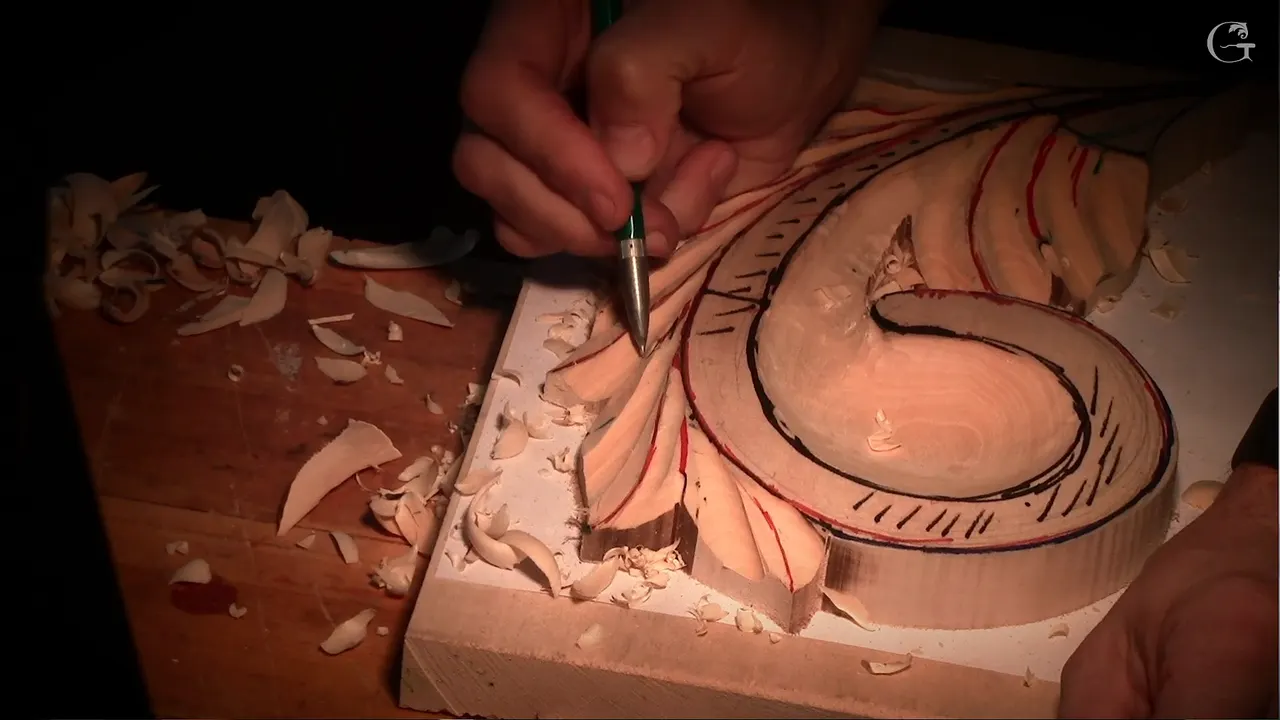
No line in a carved leaf may die square against another one. Draw one that does and you have made what I call a T stop, which stops the eye dead in a place nothing else on the panel is stopping. Every line here runs into the same centre, and every line arrives at an angle.
Today is the second roughing pass and almost nothing gets removed. What happens instead is marking, in two colours, and by the end the board carries a complete map of where it rises and where it falls.

Blue means down. Orange is the sunshine colour, so orange means up, and once those two are on the wood nobody has to hold the plan in their head any more.
Key takeaways
- Nothing ends in a T.
- Every movement on the panel runs toward one centre line, so a leaf tip that heads somewhere else is wrong even when the shape of it is lovely.
- Orange marks the high spots and those are always convex.
- An eye is the little teardrop where two leaves come together, no wider than five millimetres, and a pipe is the raised run joining a pair of them.
- Concave cuts go straight and nearly parallel.
- What makes this leaf Byzantine rather than Greek or Roman is the raised middle, and the reason for it is gold.
What are the two roughing stages?
The first bosting pass took the mass off and halted ten millimetres above the ground, which was the whole of that day's work. Today decides where every surface rises and falls. Very little comes off.
By tonight this layer looks nearly finished. The second layer then goes on top, and the panel starts behaving like the drawing rather than like a board with lines on it.
Almost all of today is marking. A couple of permanent markers and half an hour of looking does more for the finished carving than an afternoon of cutting would at this point.
What is a T stop?
A line running into another and ending there, in the shape of the letter itself. Draw one and the eye walks along your leaf, arrives at that junction and finds nowhere further to travel.

Watching the fault get made on purpose does more for a student than any rule I could state, so I draw it wrong on camera. An hour later they find one in their own board. Nobody has to tell them.
Carving has to flow. Everything runs toward the same centre line, arriving at an angle rather than head on, and that single habit separates ornament that moves from ornament that sits.


Where does the centre line go?
Off centre, at forty against sixty. That division has lived in my hand so long that a centred line now reads to me as a mistake.
It flips on the inner side of the two leaves. Sixty becomes the other part and forty moves across, which keeps the pair from reading as a mirror of itself.

Even there it is not critical. Somewhere around that split is enough, because this is a proportion the eye recognises rather than a measurement anybody checks.
Where is the eye, and how big?
Where a pair of leaves come together, shaped like a falling teardrop. Its width stops at five millimetres, and almost everybody draws it larger on a first attempt.


Get that size wrong and the whole leaf changes character. An oversized eye turns a Byzantine leaf into something coarse, and it cannot be recovered once the surrounding wood is gone.
And the pipe?
That raised run stretching across from one eye as far as its neighbour. Pipe is the name because it behaves like one, standing round and proud for its whole length.

Every orange line on this board is going to become the highest spot of a raised shape, and that holds everywhere on the panel without a single exception. Mark it orange and move on.

Where does a convex actually come from?
From the hollow beside it, and from nothing else at all. Nothing raised on this panel gets carved directly. What you are looking at is whatever survived the two cuts that went down on either side of it.

Those hollows go straight and almost parallel. Fanning them out is the common error, and a fanned set reads as a mess from any distance at all.

Start with almost no weight at the black line and add pressure as the cut travels. By the outer edge the tool is working hard, and the hollow deepens exactly where it should.


| Colour | What it means | What your tool does about it |
|---|---|---|
| Blue | Down | Hollow it, straight and nearly parallel to its neighbours, starting light and ending heavy |
| Orange | Up, and convex without exception | Leave it alone and let the hollows either side do the work |
| Black | Outline | Cut up to it and never onto it, because that line is the one thing on the board you cannot redraw |
| Red | Off limits | Nothing at all |
Does any of this get cut today?
A little, at the very end, once the whole map is on the board and has been looked at twice. The hollows go in first because they are what create every raised shape on the panel, and they are the only cuts of the day that genuinely matter. Everything else can wait until tomorrow without costing anybody anything.
Resist starting early. A carver who begins cutting before the marking is finished ends up drawing round his own mistakes, which is a slow and demoralising way to spend an afternoon.
The wood is not going anywhere. Neither is the drawing, and neither is the fact that a badly planned panel stays badly planned however beautifully the detail on it is eventually cut.
Which lines may your tool touch?
One of the four, and only one. You carve on the blue, you come up to the black, you never cross either the black or the red.
Saying it as three separate instructions is deliberate. Students hear one rule and remember roughly half of it, so the sentence gets broken into pieces small enough to survive the next twenty minutes.
The black line is the outline of the whole piece. Cross it and there is no recovering the shape, because nothing on this panel can be added back once the fibres are off the bench.
Which tool cuts all of it?
One gouge does nearly everything today. A number nine at ten millimetres, which is close enough to three eighths of an inch, and it goes all the way round without being put down.


A three millimetre eleven comes out for the eyes. Its section reads as a shallow U, and that is the only other tool this lesson genuinely needs.


Why does the flute point at two o clock?
To throw one leaf in front of its neighbour. Set the veiner on the mark, roll it toward two on a clock face, and an overlap appears where a pencil line used to be.


Never as far as three. Two is the position, and that small difference shows in the finished relief even though it sounds like hair splitting.
A mirrored junction reads ten o clock instead, an identical cut with an identical tool, the clock face simply read the other way round.


How long does this marking take?
Longer than the cutting that follows it, and that ratio bothers people. Half an hour of drawing decides what an afternoon of gouge work is even allowed to attempt.
Photograph the board once it is marked. Students in the room are welcome to come and take a picture on a phone and keep it beside the bench, and I recommend that over trying to memorise anything.
Then look again before cutting. A mark that seemed right while you were drawing it often announces itself as wrong the moment you stand up and take two paces back.
What makes this leaf Byzantine?
The middle stands up. A acanthus in the Greek manner carries a sharp vee cut inside it, the Roman one carries a hollow, and the Byzantine has a raised convex where both of those go down.
This ornament was never once left as bare wood, and too many lines and channels give a surface that gold leaf cannot sit on properly. Gold is the whole reason.

Softness serves the finish. Every decision about this leaf was made by people who knew what was going over it, which is worth remembering before adding a detail because it looks clever.
Blending a transition, with which tool?
A number two held upside down takes the transition out, and if that grip feels wrong in your hand then the ordinary way works perfectly well. Turn the tool over and try it once. Most carvers end up preferring it inside a minute, whatever they thought at the start.


Then take the ridge off. Slightly, and make it smooth, because a hard edge left at a junction catches light in a way nothing else on the piece does.

What goes wrong here?
Your raised part climbs the wrong way. I found it in my own work on camera: the raised part climbing away from where it should climb, which kills the whole movement.

Excavating the neighbouring hollow harder turns the raised part uphill again, since the shape you want is only ever the shape you left behind. You fix it next door. Never where the fault is.


One more warning, and it is the same one from last time. Ten millimetres is what most of you have left and some have only six, so the black line stays untouched and the piece survives.
What happens when there is a stone in the wood?
It breaks something, and you shrug. Something hard was buried in this board and it took a piece out of a cut in front of a room full of students.
That is fine. A carver who has never hit an inclusion has not carved much, and a panel is not ruined by one defect that turns up in the middle of a rough stage.
Reach for a bigger tool and carry on. The repair happens later, during cleaning, and worrying about it now only slows down the work that actually matters today.
Why did the Byzantines take it to extreme?
They put the curvature into three dimensions. Earlier styles curved a leaf in the plane of the board, and Byzantine workshops turned it out of the surface as well, which was a very large improvement.
Being authentic to that matters. Give this leaf a Roman twist instead and it will not look as good, and I say that after carving a great many of both.
The proportions behind it are simple enough. Something like Fibonacci at the easy end, not twenty steps of it, and the sequence of styles runs through the Corinthian before any of this arrives.
Are you copying nature?
Somebody asked an old master exactly that. His answer was no: the job is to heighten nature and to be more than it, which is a different ambition altogether.
Exaggeration is the process. A carved leaf that merely resembles a real one is botany, and nobody has ever crossed a room to look at botany on a wall.
Ask me while I am cutting. If a thing has not landed, stop me there and then, because a question asked at the bench is worth ten asked afterwards over an email.
Come and stand round me too. There are moments in a session where the camera simply cannot show what a pair of eyes at eighteen inches will, and this gilded tradition was taught that way for a thousand years before anybody filmed it.
Third of ten workshops. Workshop one draws the design and glues the blank to paper, two roughs it to ten millimetres, then four and five model the surfaces and start undercutting. Detail runs through six, seven and eight, with nine and ten finishing, all inside the course. The same leaf in other centuries fills the Greek acanthus, the Roman, the Corinthian and a modern reading, and it bends round a curve in acanthus over moldings. Why forty and sixty beats a centred line is argued in the design course, gouges get picked in the tools course, and no veiner rolls cleanly without sharpening. Starting from nothing? First cuts uses one knife.
Two markers, one gouge, and a rule about the letter T. Access to the school opens the other nine workshops.
How it's done
- Mark the whole panel in two colours. Blue where it drops, orange where it climbs. Write nothing down and hold nothing in your head, because the wood can carry the plan for you.
- Send every movement to one centre. Coming in on the slant, never square on. A junction shaped like that letter halts the eye at exactly the place you wanted it travelling.
- Split the division off centre. Forty against sixty, flipped on the inner faces of a pair. Dead centre reads as manufactured from right across a room.
- Draw the teardrops small. Their width stops at five millimetres. Anything larger coarsens a leaf, and there is no taking it back once the surrounding wood has gone.
- Hollow straight, nearly parallel. Light beside the outline, heavier as the cut travels out. Fanned hollows are the commonest fault of all and they show from any distance.
- Roll the veiner toward two. Which throws one leaf in front of another. A mirrored junction reads ten instead, the same movement seen from the opposite side.
Frequently asked questions
What does a carver mean by a T stop?
A line that runs into another and stops there in the shape of that letter. It halts the eye at a junction, and flowing foliage has no room for one anywhere on a panel.
How big should an acanthus eye be?
Five millimetres is the ceiling, shaped like a falling teardrop. Nearly everybody makes one larger on a first attempt, and a coarse one changes the character of an entire leaf.
Which part of a leaf is the pipe?
That raised run joining two junctions. Round and proud for its whole length, which is where the name came from, and it always gets marked as a high spot before anything is cut.