
Alexander Grabovetskiy, woodcarver, School of Woodcarving · Published 2021
What does a wood carver mean by "change it"?
Quick answer: In part 2 of 109 I plan a separation cut, then say "I'll do absolutely different" and "that is not right." In other lessons the same words come beside a chunk I do not like, a blade, a direction against the grain, and a drawing.
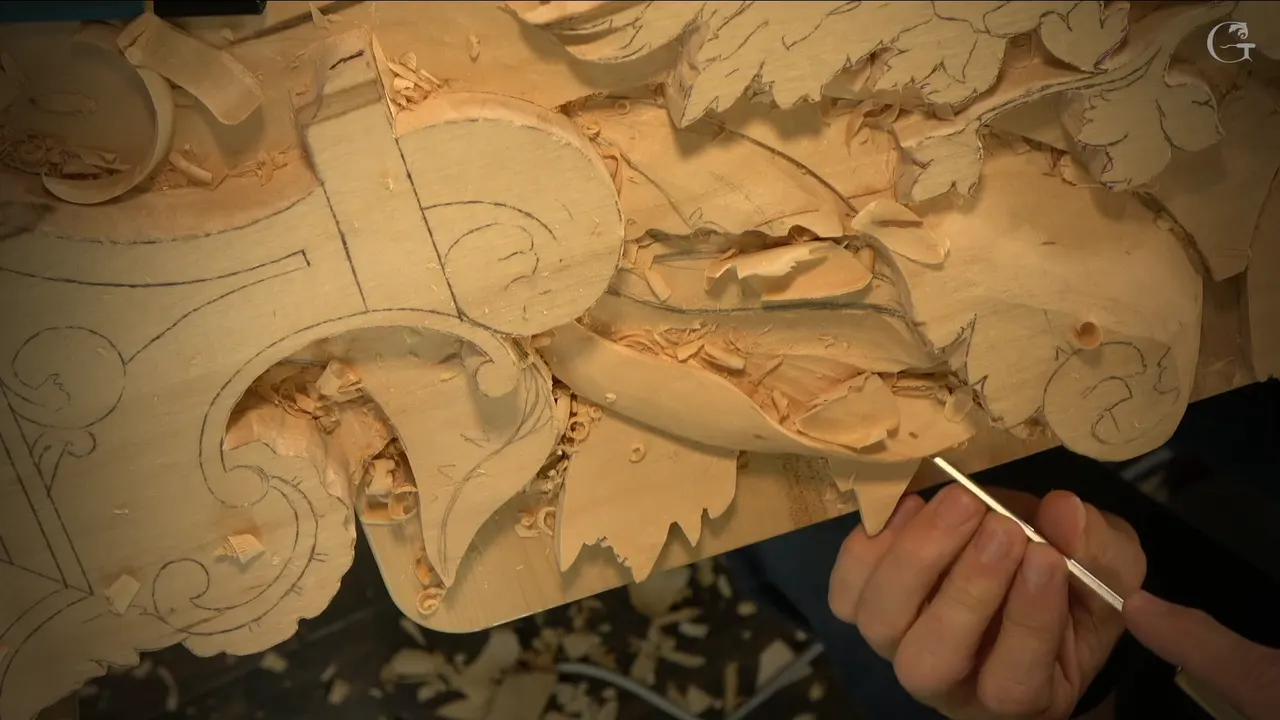

In the second part of workshop 109 I say "Let me change what I just explained to you." Other lessons of mine put the same words, "change it", beside a side of the wood, a gouge, a blade and a drawing.
Ever started a part, looked at it, and said no, not like that? Ever had the grain tell you to come from the other side? The second part of 109 has the first. My other lessons of woodworking have both. After the part come my own lines from other lessons, each one named and linked, so you can go and watch the spot yourself. Every size is in millimeters and inches, my figure first and the other one in parentheses.
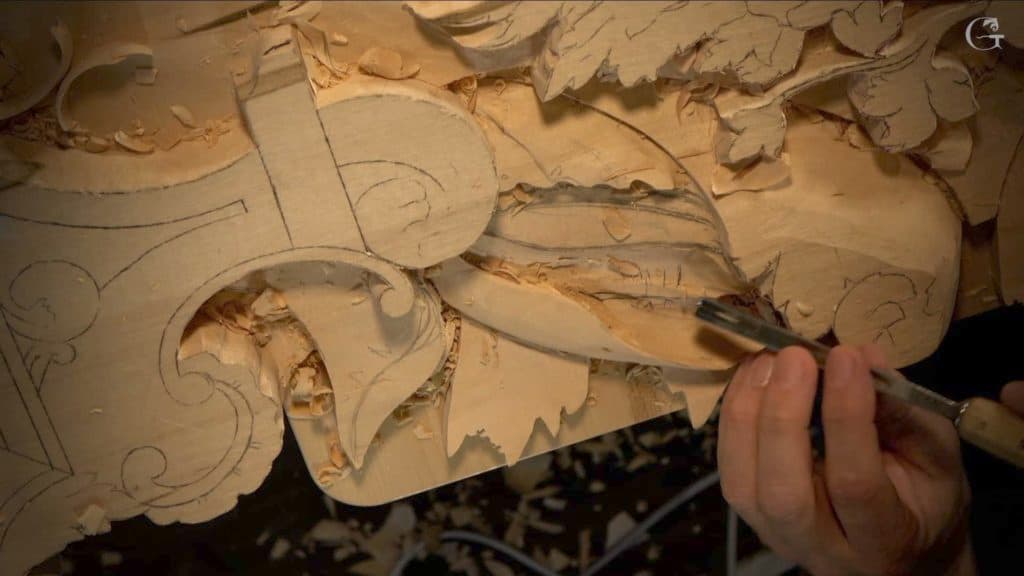
What did I change in workshop 109, part 2?
It opens with "laying almost on the left-hand side." Then: "But see, it already gives me that shadow that I am after." I say "I actually have to start my undercutting right here" and I need to "continue this undercut and connect those two undercuts on both sides." One section: "it's going to be gone." Then "I have to just excavate that completely out" and "I apologize if you can't catch it." It "should feel like this part laying on those raised."
After that, "let me continue digging slightly deeper." I could take 1 mm (about 0.04 in) now, and "of course it would be number 11." Then: "Number 11 laying on the left-hand side, and I'll excavate it even deeper." Does it matter? "Not really," I say, though "I could live with two-millimeter cut" (2 mm is about 0.08 in). Next: "maybe I just invented a new word, better pop, better shadow, okay." Then: "pretty much just a better shadow."

Number seven comes next: "I'll take number seven and roll." And my words for the roll: "not chamfer it, but feel it. And roll it underneath." I want to "make sure it feels like it does rolling from underneath" and then: "looks like I was able to do that." Of one little section: "I can actually go downhill and almost lay, well, actually not almost, but lay right at my future background." With number seven, "I can just lower that down."
But "I also need to take care of this side." For a deeper shadow I say "I need some kind of gouge, and gouge that make like a boat-looking one." Then: "Okay, so gouge this part out." Which gouge? "Let me think which gouge I can use. I can probably take big number seven, maybe about one-inch number seven" (25.4 mm). And "I can probably do number nine and get a little deeper excavation on this area."

What stopped my plan in that part?
Then, about how it looks: "it looks good even from above. So you can see it just rolls." Even if it is not "the main part," I say, "I think it looks really good." The part I name is "the main detail" and "the big idea." Of it: "the big hero of this part is this." I won't create divisions and stuff like this, "and not as much on the outside."
A plan follows. "Now what I can do, I can actually create that separation cut." It will "look awesome," because "this part going to go underneath of that line." That gives me "another shadow." I add "maybe I should" then "let me think" then "why don't I?" After that: "Let me change what I just explained to you. I'll do absolutely different."
Next: "This part going to go underneath of this line. So that is not right. Okay? So let me do that." For it I name "seven millimeters" (0.28 in), "number 11, and a little bigger than a quarter inch" (6.35 mm). And: "start little by little" and then "without creating lots of pressure."

The third part, 109-3, starts with "I think I should attack that from this position" and in it I name 2 mm (about 0.08 in), a number 11, and 1 mm after it (about 0.04 in). Both parts are on the 109 lesson page.

Where else do I say "change it" over a chunk I don't like?
The Venice Room panel has plenty of these, so here are the workshops where I can point at the spot. The gouge changes from one to the next, and so does the wood around it.
Venice Room 56, part 8, has "I don't like this chunk, this movement right here." Right after: "I have to change it because it, like I said, does not make too much sense." For the chunk I plan to "get rid of this chunk" and "open this section to the shell." I think it will make a lot more sense that way.

Another one sits in Venice Room 75, part 10, with one acanthus part over another: "So originally, I had this one, this part of Acanthus overlapping that part." I want a change, and "now this one" goes "right underneath." Of the first order: "I don't like it. It just breaks overall look, I would say." About the eyes: "I excavated kind of deep eyes, but it should be okay."
Workshop 9, part 1, asks "what else I don't like" and answers "I think I should change the idea right here." The plan after it: "get rid of whatever I cut" and "cut from opposite side." Then: "let me remove that completely."

How long can I still change it?
Part 6 of Venice Room 93 has "Let me make that change." And why: "If you would ask me why I'm changing, because I'm looking from different points of view, and if I don't like some stuff, and it's not too late for me to change it, I would change it until I like it."

Workshop 69 puts it at part 12: "sometimes it looks good from one point of view, from one angle, but it doesn't look from another one." The fix I give: "just step away for a couple seconds and look at it, and if it makes sense, it's good. If it doesn't, change." Next: "I'm using number three, by the way."
Over at Venice Room 90, part 7: "This side, I'm not sure yet. Maybe it's not the right position yet of this line. Maybe I'm going to change it." Next: "But this section right here, it's pretty much where it's going to be. So I can go ahead and clean it."
Real life comes in at Venice Room 85, part 3. "In real life, I have to make a lot of different choices and decisions. For example, if I don't like something, how it looks, I would rather change it pretty much right on the fly." Right after: "It has to move. It has to have a movement the right way."

Does "change it" ever name a tool?
One more line comes from Venice Room 56, part 2. The tool is "still the same number nine quarter-inch" (about 6.4 mm). If it turns out "a little too big of a tool," I say, "so I have to change it." Then: "But I really need deep shadow on this end."
Furniture Panel 16, part 6, opens with "let me get inside" and then "I'm not sure if I'll be able to get inside with this blade. Maybe I should change it to a smaller one" and "I think I'll get one 3/16 of an inch" (about 4.8 mm). Part 7, with the router plane, brings "Maybe I need to change the blade again to a little bigger." Then "one-eighth of an inch, three millimeters."
Chamomile and Bow Rosette, lesson 4, part 2, offers "looks like this one doesn't give me enough concave." Then "number five or number six." The scroll saw lesson of the Lily Box course, part 3, has "I still probably would prefer a thinner blade, like number five." Then: "I just don't like that blade. It just doesn't make my cut quicker."

Greek Acroterion, lesson 5, part 4, brings a short one: "much easier to control my movement when I'm doing cuts like this." Then: "lay it really low angle" and "create my channel."
What does "change it" mean when the grain is against me?
The Lily Box course, lesson 2, part 13, has me say "You can see the grain goes this direction" and "I have to approach from this side, not from that side." And then I say I'll go around, "and I will just work from this side."

In Venice Room 59, part 4, comes "let me chop a little bit this direction, too, though I need to change the direction because it is against the grain" and "work with the grain."
In part 3 of 109 the position has to change "because I see what grain direction. I started wrong. But anyway, not started wrong, but sometimes I can get away from starting from any position, but sometimes it just doesn't work because the grain against me, so it doesn't want to do a good job for me."
Grape Onlay 9, part 1, puts the words beside a motion. "If I'm gonna flip it, maybe it's not gonna look good," I say, and "I still kinda like" the overall motion. Then: "point that inward like that" and "create this lift little deeper." And: "So still gonna keep that motion."

Grinling Gibbons, Maine class 12, part 1: "probably gonna change the style of that flower and that is what I like about a wood carving in general. You can change stuff and nobody's gonna know it's still gonna look nice." My plan: "I'll create the different type of flower." And: "Gotta be careful."

Do I change it before I even carve?
At the drawing, yes. In Furniture Panel 7, part 1: "This type of carving, you draw something and you change something, which is a normal process. If, for example, if it doesn't feel right, I'll change it." Lesson 14, part 6, has "I believe I am ready to carve it." The next line is "if I want to change something, I'll change it on the way."
Floral and Molding, lesson 2, part 2, has "it's not really important to follow all of those curves with this flower. I'm still going to change it." And Venice Room 3, part 2, has a detail I won't go inside yet, because I might change it.

About the acanthus in Venice Room 81, part 7, I say I'll change the idea a little bit from the original design, and not the main movements. Venice Room 38, part 4, has "I also look at this movement, this part of this movement, and I kind of don't like what I see." Then "it's not too appealing to me."

When do I say I will not change it?
The barrel gets its own line in Venice Room 45, part 9: "I like the slope this way of this barrel. I do not want to change it." Part 4 of Venice Room 47 leaves it as it is: "Going to leave it like that."
A line with its own reason sits in Workshop 85, part 2. The middle line goes right there, so "obviously" it stays, and then: "I'm going to create the letter S movement like this."
In Furniture Panel 14, part 5, I say I can probably take charcoal now and fill my background, and I do not think I will change it. A straight down cut at 90 degrees comes from Venice Room 121, and in its first part I say "for the sake of keeping line, that's the only reason. Otherwise, I could change it."

One more sits in Floral and Molding, lesson 10, part 1: "it doesn't have to be really clean cut. Really, it's unnecessary at this point because I do have flowers" and the change is "just to remove some of that mess."

Lesson by lesson, what I changed
| Lesson | What I changed |
|---|---|
| 109, second part | A plan for a separation cut, then a new plan |
| Venice 56 | A chunk that does not make much sense |
| Room 75 | An acanthus part going right underneath |
| Room 93 | Look again, then change a spot |
| Panel 16 | Maybe a smaller blade, maybe a bigger one |
| Chamomile 4 | Maybe number five or six for more concave |
| Lily 2 | Go around, and work from there |
| Grape Onlay 9 | Point it inward and keep the motion |
| Gibbons 12 | A different type of flower |
| Panel 14 | Ready to carve, with changes on the way |
| Venice 45 | Keep the slope of the barrel |
Is there a spot on your carving that does not feel right, and are you the one who gets to change it? Everything in these lessons sits inside one tuition plan. The Part 9 course page holds workshops 98 to 109, and the room goes on in Part 10 for more wood carving.
How it's done
- The shadow it gives. It already gives me the shadow that I am after, I said.
- A roll underneath. The seven for the roll, to feel it and roll it underneath.
- The plan stops. After a separation cut was planned, I said the plan was not right.
- The new tool. A number 11 for the new plan.
Frequently asked questions
Which tool did I name for the new plan in workshop 109?
I named "seven millimeters" (0.28 in), a number 11 of "a little bigger than a quarter inch" (6.35 mm). That came after I called the first plan wrong.
Which detail did I call the main one in this part?
I called one detail "the main detail" and "the big idea," and added "the big hero". I also said I won't create divisions and stuff like that.
Which gouge did I think about for a deeper shadow?
I said I could probably take a big number seven, maybe about one-inch (25.4 mm), plus a nine for a little deeper excavation on that area.
What to carve next