

Alexander Grabovetskiy, woodcarver, School of Woodcarving · Published 2021
Should you separate carved petals with a V tool or a veiner?
Quick answer: Separating carved petals is the same first step with either tool, and I have said so in my lessons. A 1 mm number 11 does it, and so does a V tool. What differs is the bottom of the groove. The V leaves a sharp line, and the veiner leaves a round transition.
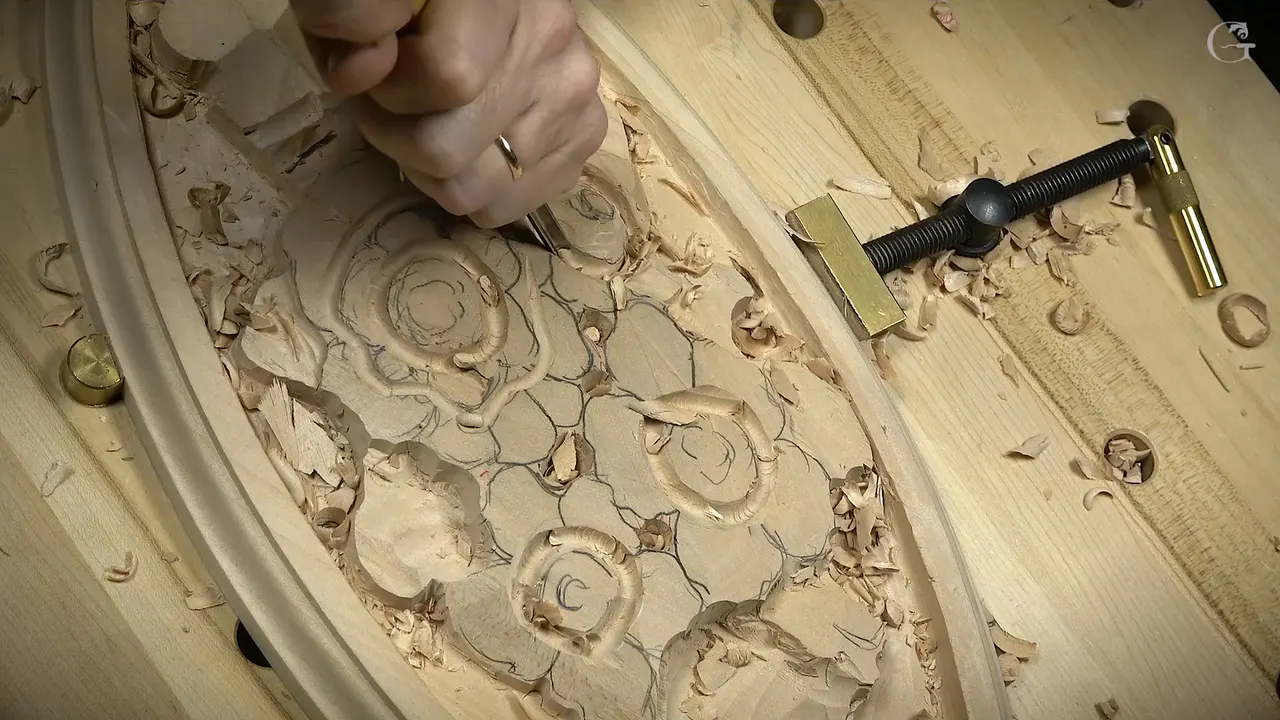
Separating carved petals with a veiner or a V tool is one job done two ways, and I have done it both ways on camera. Veiner vs V tool comes down to the bottom of that groove. A V tool leaves a really sharp line. The number 11 gives a round transition on the inside, and where people will look at it from above, I like the round one.
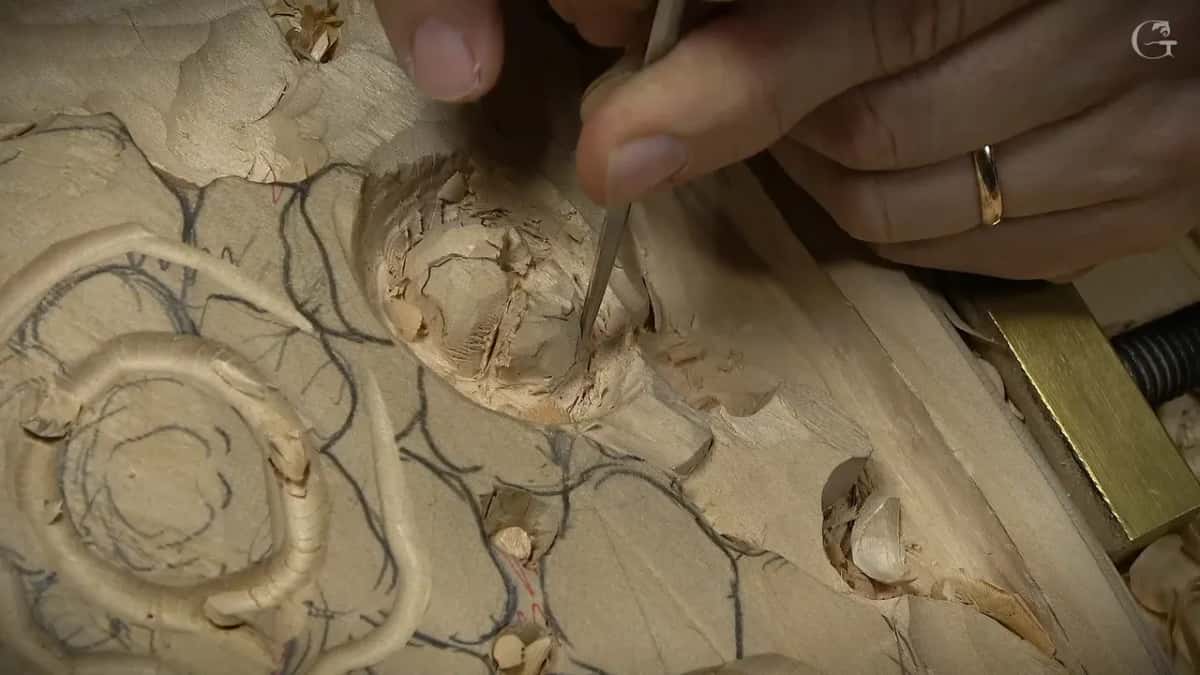
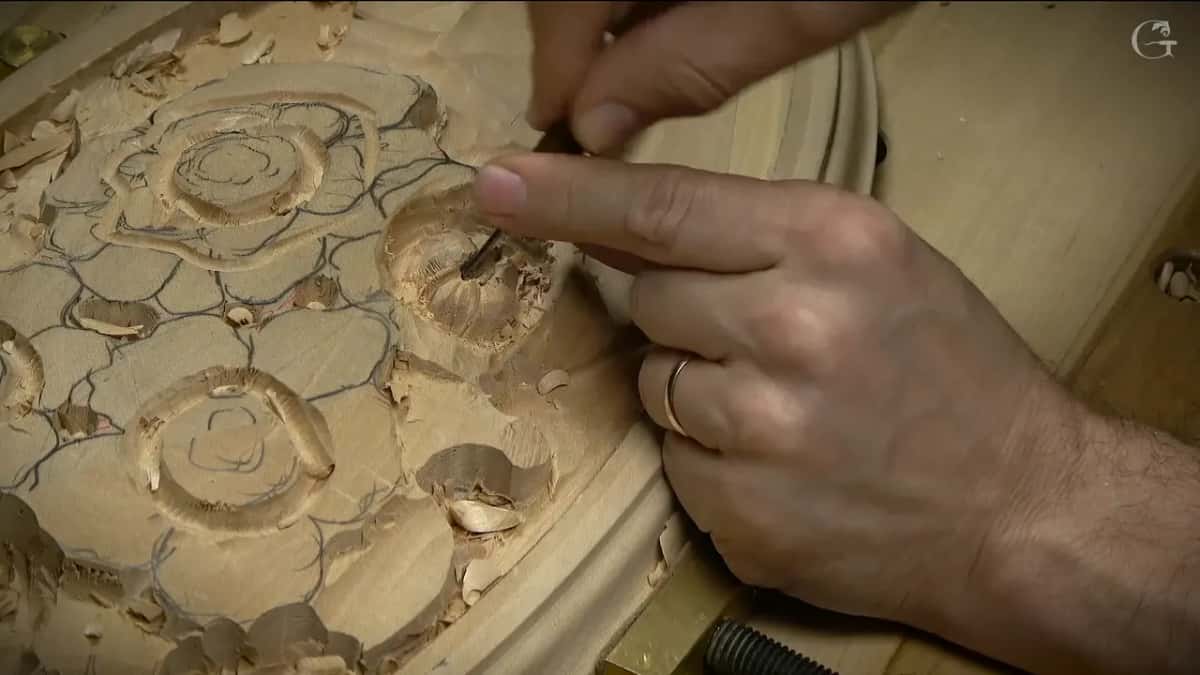
This page started in the middle of one flower on my rosette, in lesson 2 of Venetian Flowers Rosette. Five small inner parts sat there, petals or not petals, whatever you call them. I said out loud that on this project I was trying to avoid the V tool, then took one for the first marks anyway.
Is there a pencil line where two of your petals meet? Do you have a V tool on your bench, or a little eleven? Then you can start that separation today, with whichever one you have, because in Hashemi Flowers, lesson 47, I called it the same idea.
Below is what each tool did on my flowers, course by course, with the sizes I named.

What the two tools left on my petals
- Sharp at the bottom from a V tool, round from an 11.
- Many Hashemi separations began from my number 16 V tool.
- On the Venetian flowers I tried to keep the V tool away, saying out loud that a small 11 would be more authentic there.
- Maine students asked why the veiner.
- Where the V tool no longer fits, an eleven of 1 mm goes deeper.
- A 0.5 mm eleven made the last pass on the lily piece.
What did I do on the Venetian rosette?
I started with the V tool, and then I talked myself toward the 11. First the five parts went on in pencil. I hope I have pencil, I said, and drew them right inside the hollow. Inside those petals I needed concaves and convexes, so they had to be divided first.
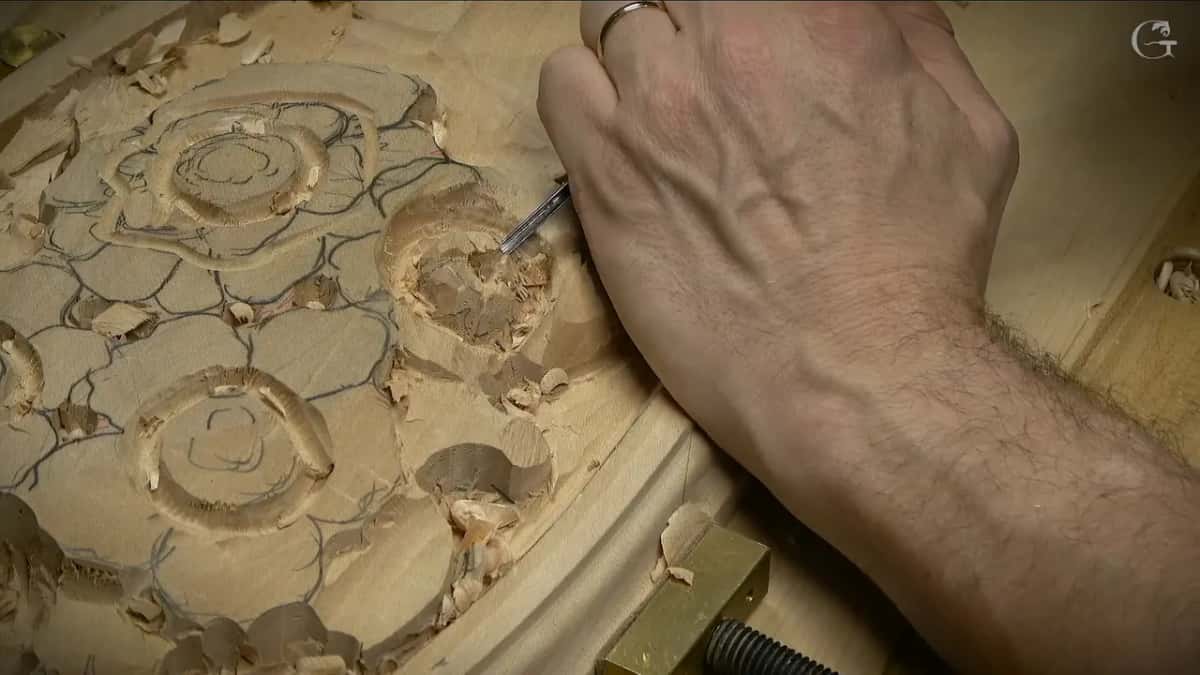
Even a V tool could do it, I told you. Not sure if I should, I said, because on this project I was trying to avoid that. On the other hand, you can use just a V tool to make divisions. So I used it for now, just for the initial marks.

Then I changed course out loud. The 11 I used before would still work, I said, and I probably should use it, because that way it is more authentic. So the next marks would be like these, with a small number 11.
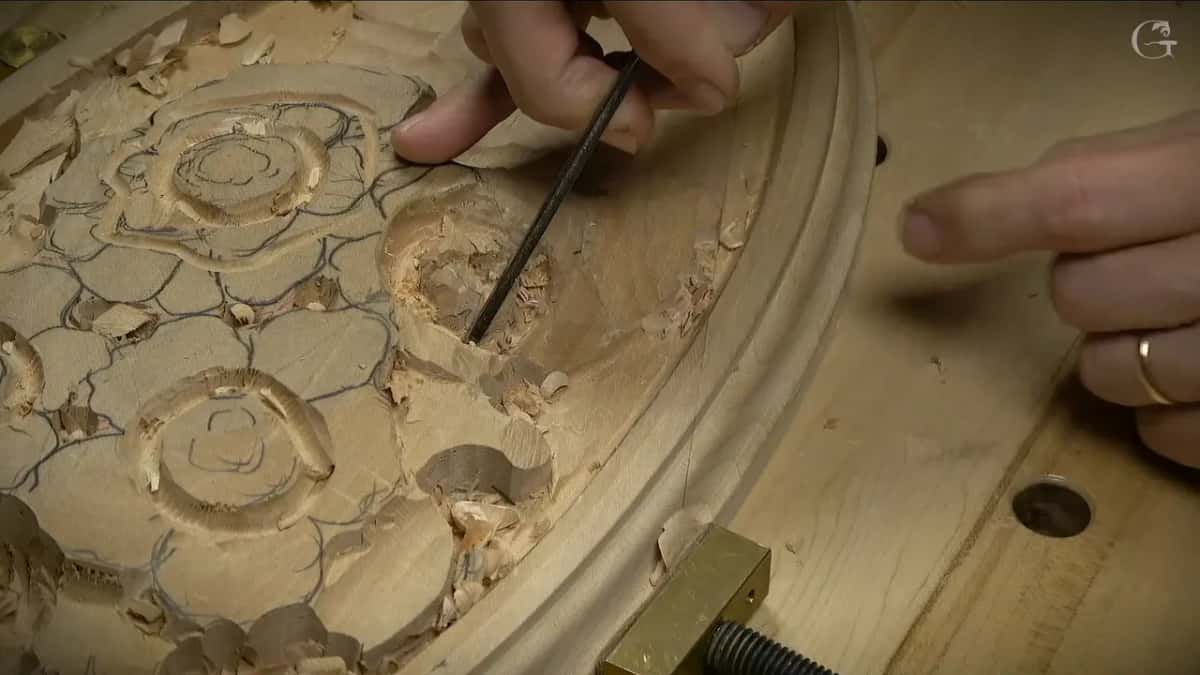
Why not stop at a clean divided line? On this flower some petals go underneath another one, I said, so it is not going to be just the divisions. There will be some interesting movements. A flat tool came next, like a number 3 or so, small, to tuck one part under its neighbor.
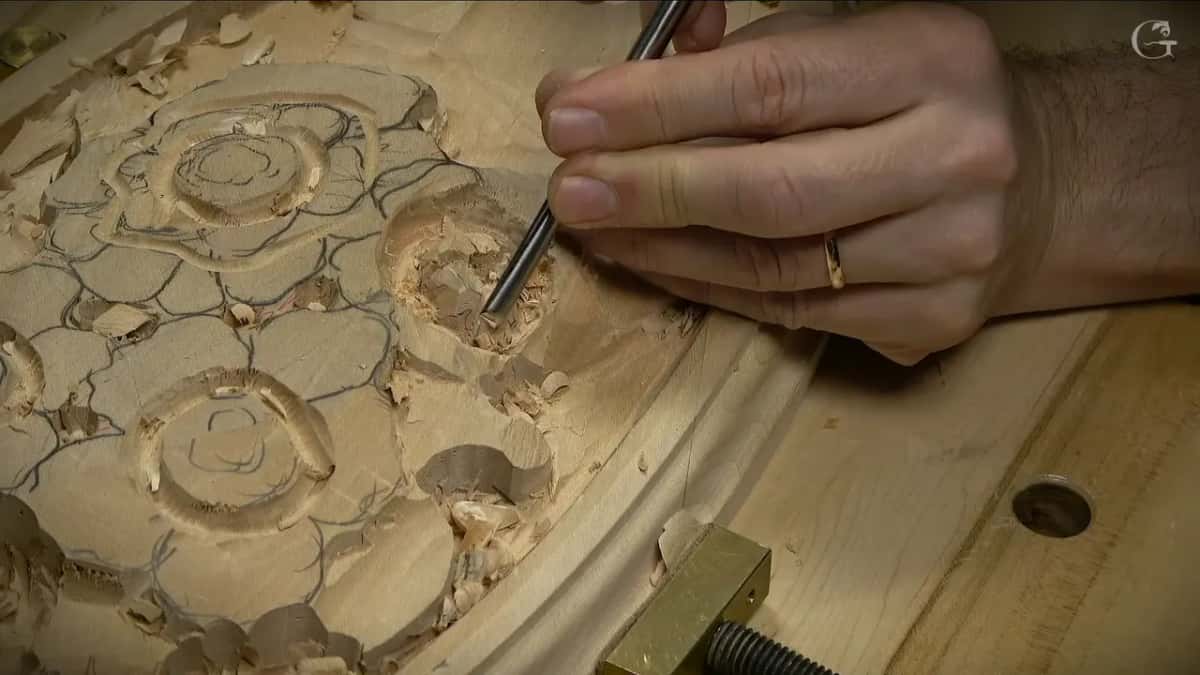
In lesson 3 of the same rosette I came back to it while I worked beneath a petal. My tools there were number 11s, I said, but you could use V tools, parting tools, and feel free to use whatever you feel is best. I really didn't need one there. With an 11 of about half a millimeter (1/50 in), the result would be exactly the same, I said.
Veiner vs V tool, what does each one leave at the bottom?
A sharp line, or a round one. On my lily box, in lesson 7 of that course, I said why it mattered there. There are some limitations, I said. This pass matters, because people are going to look from above, and they will see any roughness left on the inside.
So that is why I really like to use a number 11, I said, and give a round transition on the inside rather than a V tool and a really sharp line. Then I went down to a 1 mm one (1/32 in), escaping gradually to almost nothing. Half a millimeter was my last pass. I know on the camera it is hard to see, I told you, but it is a nice and smooth transition.
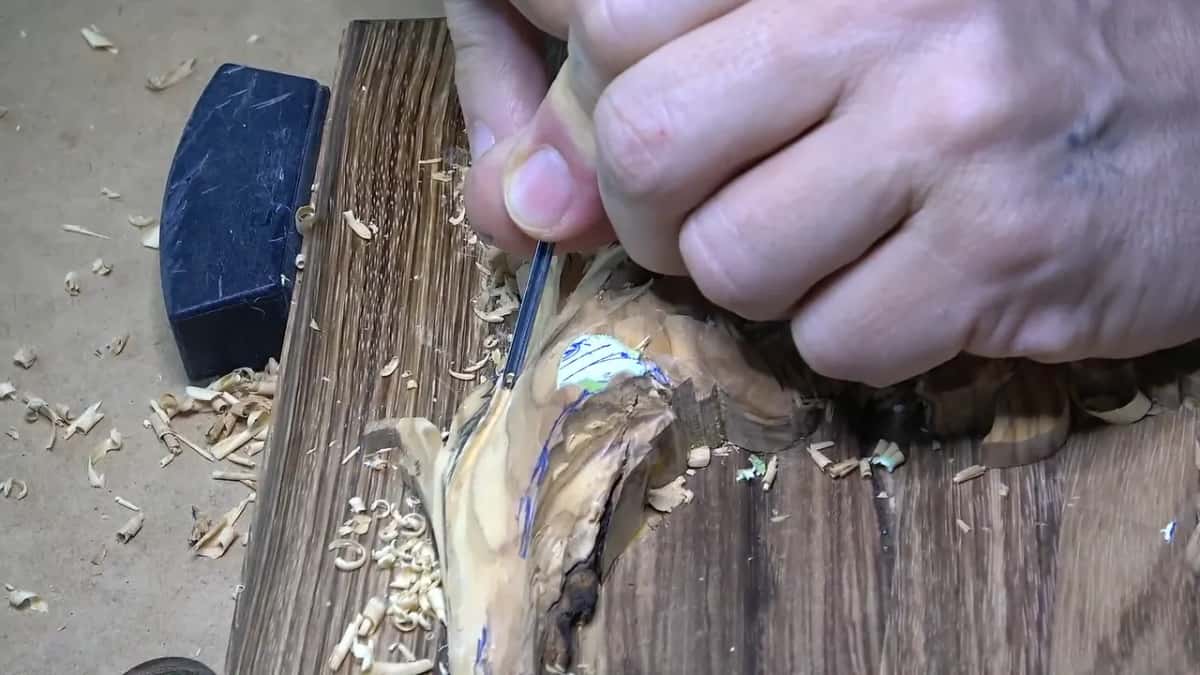
The ridge beside that groove needed some roundness too, filleted, as I put it. My number 7, the half inch (13 mm) one from before, gave it the overall shape.

So what is a veiner, exactly? For the Corinthian acanthus leaf in lesson 6 I put it this way. It is sort of a gouge, round too, but it has extensive wings, more like a U shape, and it is used for making veins. The one I particularly like is a number 16 at 35 degrees, not 45, and in lesson 19 of Hashemi Flowers I said it is really sharp, a really low angle, so I can go deeper without hitting the sides. A 45 or even a 60 degree one will still work.

Why did students in Maine ask about my veiner?
I was outlining with a veiner, and they wanted to know why. At my Grinling Gibbons class in Maine, in class 4, I showed a couple of approaches to the flowers. For the first one you can grab a 3 mm (1/8 in) number 11, I said, and outline your highest flower, attacking from different points.
A really sharp point can wait, I told them, because you will have a chance later. Stay shallow there, too. About 2 mm, a little more than 1/16 inch, is okay, and an eighth of an inch would be too much.

Then the question came from the students. Why a veiner and not a V tool? Excellent question, I said. The V tool is an excellent tool, but it was not invented for that purpose, and not all carvers use it all the time. You don't need that sharp line there, I said. It will be hard to clean, and the veiner will give you a nice one.
That outline is not a necessary step, I said, but I like it, because it gives you the cleaner result. The next flower was supposed to go right underneath. So a number 7 of 14 mm (9/16 in) blended it in, and a number 9 of 10 mm, 3/8 inch, dropped the whole area down to 1/4 inch (6 mm).
When does the V tool go first?
Often. Through the Hashemi course I took a number 16 V tool for separation after separation, and in lesson 35 I said I can undercut slightly with it, as a preliminary.

On one flower in lesson 30 I needed the V tool to make a couple of passes, so I could see exactly where those petals divide. Just straight down. One little part was supposed to grow from underneath, so with that same tool I did a semi undercut, carefully, because the piece I left there is small and kind of fragile. They are not really separated in real life, I said there, and usually one leaf goes on top of another.
Separating whole flowers in lesson 29, I said a V tool could begin it, or even a gouge, and it will be the same result. That day it was a number 9 of about 5/8 inch (16 mm), with a smaller mallet of 12 ounces (340 g).
On a flower rosette the first lines went straight down with a number 6 of a quarter inch (6 mm) and a small brass mallet. Hit it too hard and a weak part could snap out. If you feel safer, I said, take the V tool first, take a little away from that main line, and then make a clean pass. It was not that deep there, so I had to make it look like the original, and the same gouge cleaned it.

And on a furniture panel, in lesson 33, I told you I am absolutely okay with a V tool there. I would prefer a number 11. Any V tool will work very much, and I like the number 16, which has like 35 degrees.
What happens when the V tool stops fitting?
A smaller number 11 takes over. On one Hashemi flower, in lesson 44, I said I would make the concave even deeper on the inside, then take the V tool in as far as I can. Once it would not fit, the plan went on to a number 11 veiner, only 1 mm, even deeper, but carefully.

My card on the screen named it, a Pfeil veiner number 11 at 1/32 of an inch. I could use a 2 mm tool, definitely, but my goal there was to take that line all the way deep, as deep as possible, until it disappears.

Why that deep? You would have a feel that every petal is glued together, I said, but it is not, and looking at the grain you will see the piece is solid. Some of those petals grow from underneath, so the V tool came back for that line, started from the inside. By the sound you could hear I was working against the grain there, and the line was still really clean. Attacking from the other side would be cleaner, I said. In this case I was able to, but not always.
Lesson 47 brought a petal that had to go inward, underneath the one next to it. I could use a V tool, definitely, I said, but a small number 11 was easier for me for that first pass. Even a number one chisel would do it, and a knife will work also. Then a 0.5 mm one went in to dig even deeper, because more shadow helps me there.

Later in that lesson I said it the plain way. Step number one, I said, a V tool will do, and so will a 1 mm eleven if you have one. Same idea, just start the separation. Then a number 4 made a curl going from the outside inward, and a half millimeter 11 took away some of the wood between those two petals.
Can a V tool reach under a petal?
It can, carefully. On a furniture panel, in lesson 27, I said it for anyone without a half millimeter number 11. Lay the V tool, the parting tool, almost flat on its left wing, and you can make that undercut, carefully, carefully. It is also legit, I said.
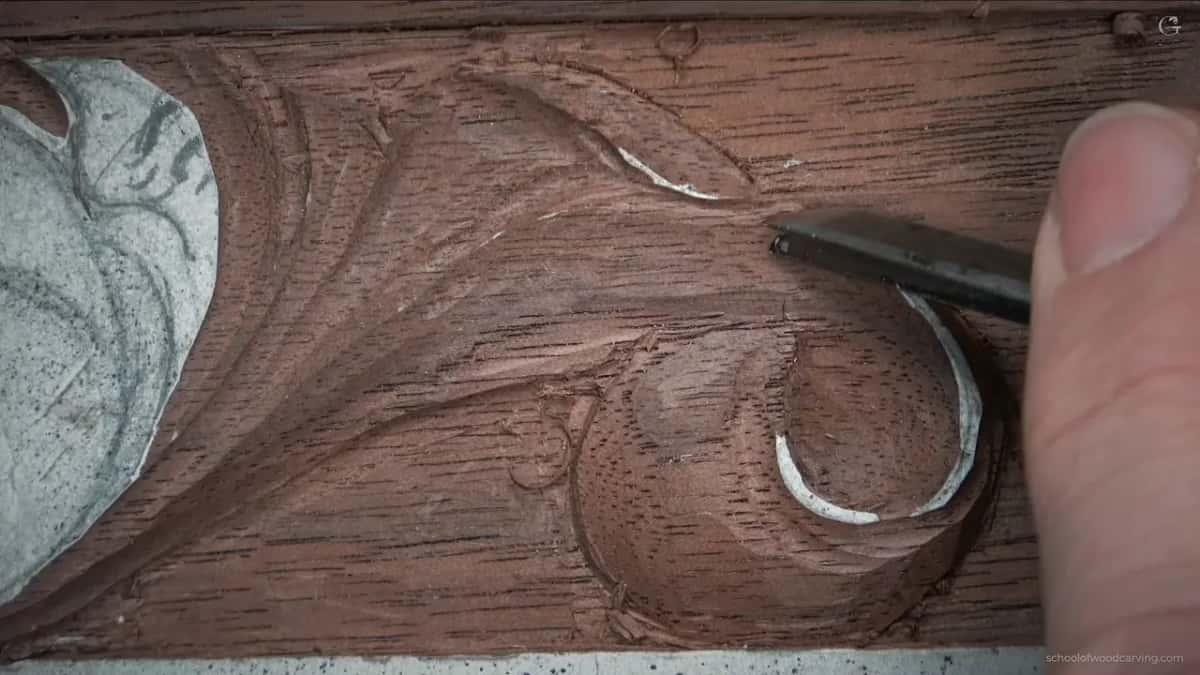
I still love the tiny half millimeter eleven for that job. I think it is much better with the flute to the right, in my case, and I can go as deep as I want, only not so deep that I lose the background depth.
Do these small tools have to be sharp?
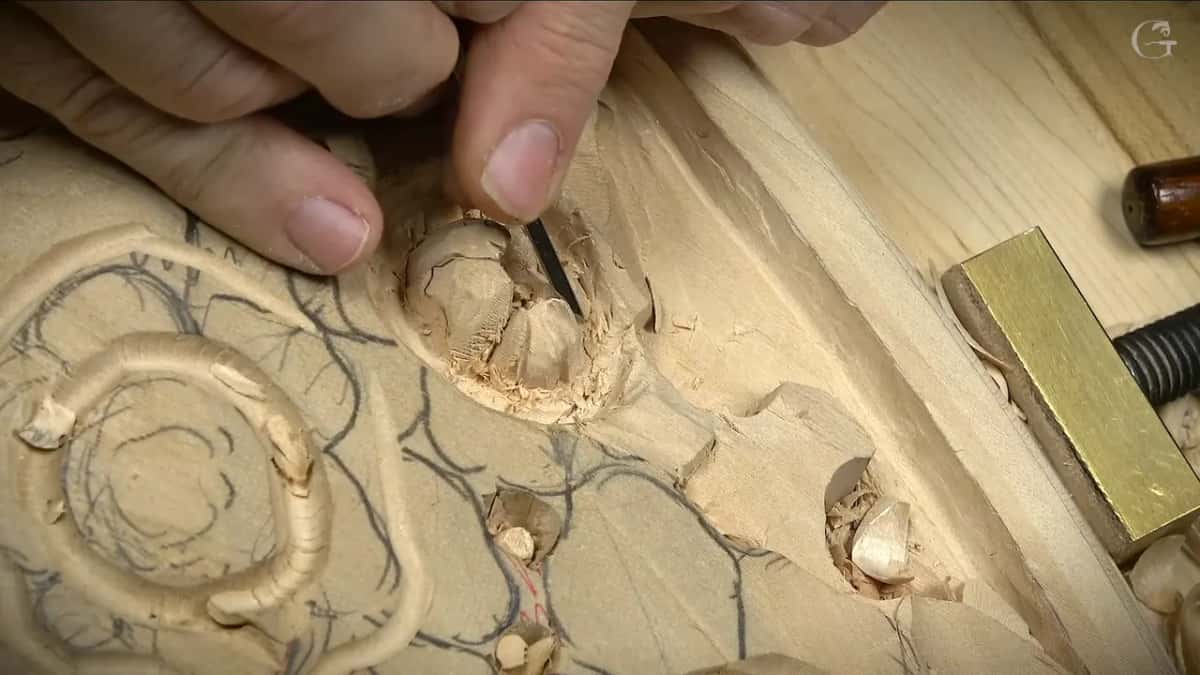
Really sharp. Back on the rosette, once the five parts were set, one area felt a little bit mushy, so I needed my tools really sharp. The ones I named next were tiny, a number 9, or elevens of 2 mm and 1 mm, whatever you have. They must be sharp, I said, absolutely must be sharp.
My V tool needed it too. In Hashemi Flowers mine needed a strop partway through, and I stropped it just from the inside, on leather with green paste. How I bring an edge back, tool by tool, is in my sharpening course.
Which sizes did I name for these separations?
Here they are, tool by tool, with the course each one came from.
| Tool | Job | Course | Words |
|---|---|---|---|
| Number 16 V-tool | Ground at 35 degrees, carves deeper lines | Hashemi Flowers | Any V-tool will work, I said |
| Eleven at 3mm | About 1/8 inch, outlining my highest flower | Maine class | Veiner will give a nice one |
| One millimeter eleven | 1/32 inch, where the V won't fit | Hashemi lesson | And go even deeper, but carefully |
| Half millimeter eleven | My last pass there, about 1/50 inch | Lily box | Nice and smooth transition on inside |
| Flat number 3 | Tucked one inner part under the next | Venetian rosette | A flat one, like number 3 |
Reviewing one set in my tools course, I named what I'd add, a smaller number 11, maybe 1 mm, to get underneath for undercutting. Its 60 degree V tool I would change to maybe 45, maybe even 35. That is only my opinion, I said, because I use a 35 degree V tool a lot for undercutting and so on.
So which one goes on your petals?
Whichever you have, to start. On camera I have said same idea, and the same result, in more than one course. Where the bottom of the line will show, or where people look down into it, the 11 gives the round one I like.
Do you have a flower drawn on a board already? Is one line between two petals still waiting? Then come and carve the Venetian Flowers Rosette with me, where both tools come out on camera, and every lesson opens with an access plan.
How it's done
- Mark the parts in pencil. Draw where each petal divides before any steel goes in. I drew five inner parts right inside the hollow.
- Open the line with either tool. Start the separation with the tool you own. A V tool works, and so does a 1 mm eleven.
- Stay shallow on the outline. About 2 mm (1/16 in) is okay for the first outline. Going to 1/8 inch is too much.
- Choose the petal that goes under. Decide which part tucks beneath its neighbor, then a small flat tool, like a number 3, tucks it under.
- Step down once the V is too big. Go even deeper, carefully, with a 1 mm veiner once the V tool no longer fits in the line.
- Finish with the smallest veiner. Step to 1 mm, escaping gradually to almost nothing, then make the last pass with a half millimeter 11.
Frequently asked questions
Is a V tool the same thing as a parting tool?
Yes. In the UK, as I said on a live stream, you don't call it a V tool, you call it a parting tool, and it's still the shape of the letter V. When I worked on the Venetian rosette I named the two together as fine to use.
What angle should a V tool have for petals?
Mine is a number 16, ground to 35 degrees. Really sharp, really low angle, so the line goes deeper without hitting its sides. A 45, or a 60 degree one, will still work, as I told you in Hashemi Flowers.
Which veiner size suits small petals?
Small ones. An eleven of 1 mm (1/32 in) went deeper on a Hashemi flower once my V tool stopped fitting, and the half millimeter one finished that lily groove. For an outline in Maine I took a 3 mm (1/8 in) eleven and kept it near 2 mm deep.
What to carve next