

Alexander Grabovetskiy, woodcarver, School of Woodcarving · Published 2021
What does a wood carver mean by "moment of truth"?
Quick answer: In Venice Room 143, video 1, I said it after my 30 mm number 11 (about 1 3/16 in) worked fine, and I named a smaller tool next. Other courses have me say it before a flower fit or a spoon.
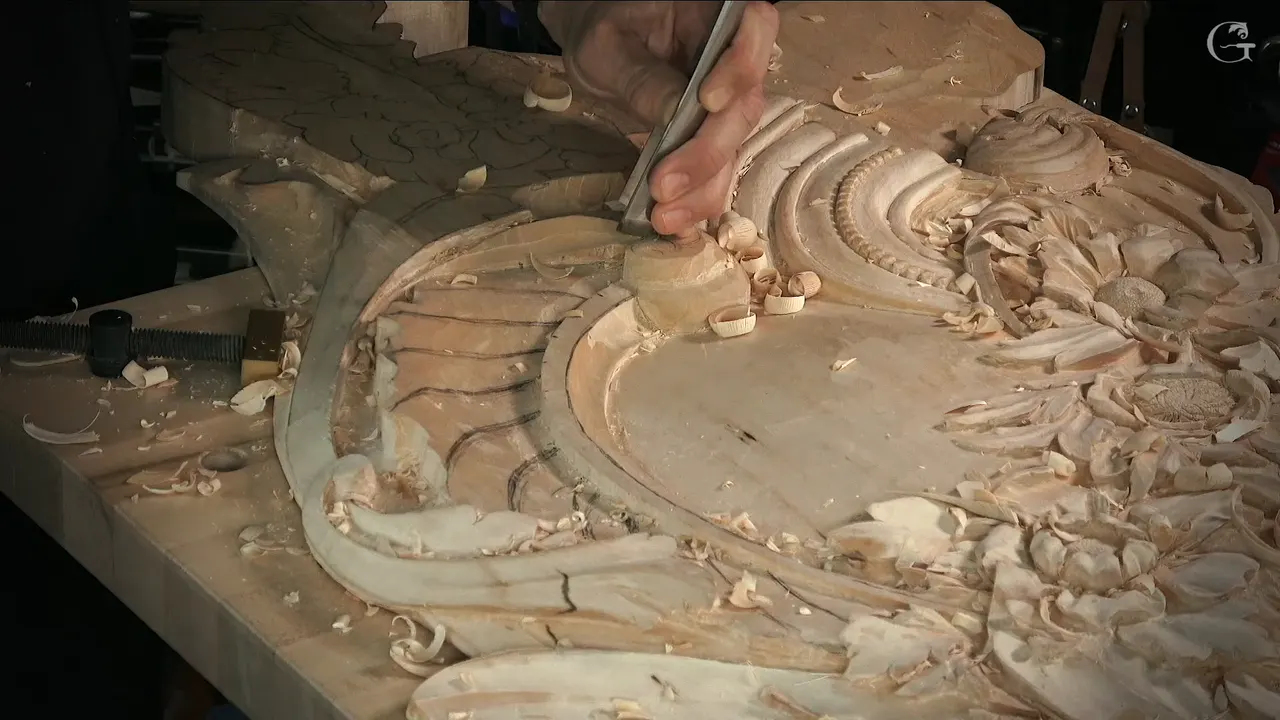

I said those three words in the videos below as I was about to try the next thing: a smaller tool in my hand, or a flower in its seat. I said them in the first video of Venice Room 143, and again in my Hashemi Flowers course and my panel molding course. Here the three uses sit side by side. Then the plain word truth runs through eleven more videos.
Ever worked a hollow with one gouge until it had nothing left to give? Ever set a part into its place for the first time? Then you know the second I mean. Below is where I called it that, and where I stopped to give you the truth straight.
What did the first gouge give me before those words?

The first video opens on a number. Approximately 3 mm (about 1/8 in) had to stay in one space, because I needed to undercut there. Without it, the carving would not look as nice. "I can go even lower than three millimeters, but at least three millimeters," I said. "That is what I need."
Next, "Let me also get from this side" and "carefully remove what I don't need." Under that line the shadow "has to be a lot deeper shadow," so it "really needs to be deep shadowed."

With the 30 millimeters I could probably try to excavate a little more, "but at some point, I will have to switch to another tool." So far my 30 mm number 11 (about 1 3/16 in) worked fine. It gave me "plenty of control."
Right after those words, what did I do?
At 2:24 of that video I said, "And that is probably the moment of truth." Half a minute before, I had said a switch was coming. Now it was "I need to switch to another tool." My plan was "maybe 25 first" and then to "just gradually move to a smaller tool."

The tool in my hand needed sharpening. "So let me take care of it, and I'll catch you." The next caption reads, "Yeah, it's much better now." After that, "It's already too big. Let me turn to my 20 millimeters" (0.8 in). Later, "I really want to make it smooth. Smooth and nice."
Some "concave underneath" was in already, but "it's not enough, so I want to create even deeper." Next I named 18 mm (0.7 in), "Number 11, of course" and caught myself. "And maybe not even 18. Maybe I could just switch to smaller right away. Maybe 5/8 of an inch, like 15 millimeters or so."
What did the smaller tools leave?

"And yes, that is probably enough," I said, and "it's already going to cast some shadow." "And that already gave me that much lighter look." I thought out loud about 12 mm (about 0.5 in): "I could excavate with a smaller one in this section." I weighed it, "Let me think if I should do that or not" and floated "the 10 millimeters" (about 0.4 in) for a deeper shadow right there.
"And that's enough, I guess. That is enough." The mess was next, and I began to say I would take care of it, then stopped. "Well, actually, you know what? I can get some of it with the same tool. Just attack it from the opposite side. And blend those two cuts together."

A spoon came up after that, with a plan to excavate deeper. "I could actually go with some kind of spoon, with the spoon veiner. Same, like, 10 millimeters, let's say. And excavate deeper." Later, "Maybe I can just go with a smaller spoon, like maybe seven millimeters" (roughly 0.28 in), "and just go deeper even more. Number 11, of course."

"Attack from two sides. That's going to give me really awesome shadow." The captions of that video close on "And scoop it out." So the words came with a tool change. A switch was coming, I had said, and soon after them I named 25 first.
Do the same words show up for a flower that has to fit?

Lesson 49 of Hashemi Flowers, video 9, has me at the point of doing no more refinement on one piece. It looked pretty good, I said, and "you could take it to extreme, and it can be even more beautiful, but I think it's going to be enough for this particular project."
I planned to clean it, blow it off with the air compressor, and "let's try it on." The second layer was glued already, with dowels to come. Then, "So let's try this flower and how it fits," followed by the same three words.
A little later I went to take out two screws, a really big one and a smaller one, and then tried to fit the flower in. "Looks like it fits perfectly from everywhere." Then, "Although maybe it's too big comparing to the next ones." I would not fasten it until the other three flowers were in, and "if I need to make it lower, I can always do that."
What came after the words in the panel course?

Video 3 of lesson 2 in Floral and Molding for the Panel opens on them. Then, "Let me put it back, and I'm going to grab probably a spoon," a spoon number 11 at 2 mm (about 5/64 in). "With the spoon, I'm able to get in a lot more tight spaces where with a straight tool, I don't have that ability sometimes."
One line there was "really important for me not to lose." For it I planned a flatter tool, "maybe number two, and mallet," set right on the line for a straight down cut. Then a warning about force: "You can easily, easily just go through, because I've got only five millimeters" (about 0.2 in) on the opposite side. "So don't do that mistake."
Where does the truth about a tool come in?

In Furniture Panel 15, video 5, I tried a knife from tools I got for free. I did not strop or sharpen it first; I "just took out of the box pretty much." My verdict came slowly. "It's too early for me to tell you the truth, and I don't want to be biased." Getting them free, I said, does not mean "I have to give a really good or bad or whatever review." I wanted to "honestly judge it if I'll be using it or not a lot."
The knife, I said, was "not made for the operation what I'm using it right now" with metal "a little thicker" that was "not meant to just dig in."

The April 2020 livestream on sharpening a spoon gouge included three questions, and the first was whether a bevel has to be really, really long. Here I had to be straight. Some of my spoon gouges do carry a long one, "approximately 10 millimeters, I would say, long, about three-eighths of an inch." A number 6 I use "a lot of times just to clean up." Most of the time, "you really don't need that long bevel."
Later in that livestream a line about sanding disks lasting longer was read out, and I gave the truth in my own words. The same disks had gone with me to schools for about five years, and "some of the paper I did not change at all for over five years" with people at school using it too. It was "absolutely truth."
When do I use the word after a slip or a surprise?

In the third video of lesson 143, I tried a number 7 and was not eager to lose that part. "So oops. My bad." And then, "I'm not going to tell nobody except you that I made my mistake. I think I just rushed that."
Lily Box 5, video 6, has a smaller surprise. A void sat inside the wood, and I could justify it by the grain change right there. "So that was a void inside. I did not create that. I hope I didn't create, and I'm telling you the truth." Then work went on. "But we have plenty of meat, and I'm not afraid." I wanted a bigger gouge, and I would try a number 7 "and an inch" (about 25 mm).
The livestream on clay modeling, also from April 2020, has the hard version. A lot of my work, I said, had been done without any modeling. "And did I make mistakes? Yes, absolutely, I did." The problem with wood carving, I said, is deduction. You are really taking out, and if you bang a little harder on your gouge with the mallet, "you took a little too much." And then, "You screwed up." The line I follow here is "So that is truth." Which is why I started using clay.
When is the truth just a fact that sounds strange?
In my V tool sharpening lesson, I called the V tool the most difficult tool, "because it's the hardest to sharp." About a year before that video, one guy had brought a brand new set to a class, and his V tool needed to be resharpened. "He tried that for a couple hours and ended up really frustrated because it's really, really hard to sharpen. It's the truth." Many people who try wood carving, I said, quit just because of the V tool.

In Furniture Panel 19, video 3, I said I love the V tool, "one of my favorite tools." Then came a turn. "If we really want to be authentic to the original wood carvers in 18th century, okay, I have to tell you the truth. Not in all countries where they made furniture, they had V tools." Parting tools came later, I said, and not all wood carvers in the world even know the V tool exists. "I know it sounds strange."
The questions-and-answers livestream of April 2020 has me talking about two vehicles. A Western brain, I said, reads one going downhill and the other uphill, and a brain born in the east reads them the other way round. "I know it's just strange, but it's the truth." Next, "you can check yourself."
When am I not claiming the whole truth?

In Hashemi Flowers 35, video 3, I was talking about how many parts to split a flower into. "I like to be really close to nature," I said, and I brought up the Fibonacci numbers and the petals on a flower. "I'm not saying that's the absolute truth, but as far as I know, it's always close to the Fibonacci number." The way out came next. "If you don't like the idea of Fibonacci numbers, just feel free, create whatever you feel is going to look better."
In Roman Acanthus 10, video 4, I was checking my edge for a wire edge. I re-strop, rebuff or resharpen "multiple times daily." Some people say the best wood is a soft wood and your tools shouldn't get dull. "That's not necessarily truth," I said. "It is soft wood, but your tools, for some reason, still get dull, and really quickly sometimes."

In Carving Corinthian Acanthus Leaf 1, video 2, I said the Corinthian form is probably the most ancient form of the acanthus leaf. I hedged. "It might not be necessarily absolutely 100% truth. Okay? Because acanthus leaves were common in different cultures also." Some ancient drawings were found in Egypt before the Corinthian leaf, I said, and it "was also decoration in Egypt."
Where else does lesson 143 hold an honest doubt?
In the second video I could open one spot all the way through. "I really don't think I need it. We'll see. But at this point, I think I really don't." Near the end of that video, "I think I made the right decision to make it lighter." Early in the third video, "It's not clean yet, but I am happy. So I've got initial idea." None of those lines is a verdict, because each one only says where I was at that minute.
Where do the passages sit?
The table lists the videos in the order this page took them, with what each one held and what I did next.
| Video | Context | Move |
|---|---|---|
| Venice workshop 143, video 1 | A 30 mm gouge still worked fine for me | Switched tools |
| Hashemi Flowers 49 | I planned to clean the flower, then test it | Fitted it |
| Floral Molding 2 | Let me put it back, then grab a spoon | Spoon number 11 |
| Furniture Panel 15 | I tried a knife straight out of the box | Held back |
| Spoon gouge livestream | I gave some tools a really long bevel | Not all |
| Same livestream later | Some sanding paper stayed unchanged for over five years | Absolutely truth |
| Venice workshop 143, video 3 | Oops, my bad, and I owned the mistake | Rushed it |
| Lily Box 5 | I found a void inside the wood | Try number 7 |
| Clay modeling livestream | A hit a little too hard takes too much | Started clay |
| V Tool Sharpening 1 | A brand new V tool needed resharpening | Many quit |
| Furniture Panel 19 | Not every country had V tools back then | Sounds strange |
| Questions and answers livestream | A vehicle reads uphill or downhill by birthplace | Check yourself |
| Hashemi Flowers 35 | Petal counts sit close to Fibonacci numbers | Not absolute |
| Roman Acanthus 10 | Soft wood does not keep a tool sharp | Not necessarily |
| Corinthian Acanthus 1 | Corinthian is probably the most ancient form | Not 100% |
Which tool on your bench is about to run out of room? Every lesson named here opens with access to the school, paid monthly or yearly and renewed automatically until you stop it. The Part 12 course page holds lesson 143, with lesson 142 just before it and lesson 144 after. Wikipedia has plain pages on wood carving and glue.
How it's done
- Leave room for the undercut. About 3 mm had to stay in one space, I said, because I needed to undercut there.
- Keep the tool that works. So far, I said, the 30 mm tool worked fine.
- Name the switch out loud. A change of tool would come, I said, and later I said I needed it.
- Step down in size. Maybe 25 first, I said, and then gradually a smaller tool.
- Sharpen when the tool needs it. The tool needed to be sharpened, I said, and then it was much better.
- Attack from the opposite side. Part of the mess could go using the same tool from the other side, and the two passes would blend together.
Frequently asked questions
How much wood did I plan to leave for the undercut in video 1?
Approximately three millimeters (about 1/8 in). Going even lower was possible, I said, but at least 3 mm was what I needed. Without that space, the carving would not look as nice.
Which sizes did I name after the 30 mm gouge?
I named 25 first, then 20 and 18, and I wondered about 15, 12 and 10. They were plans said out loud as I went. My word at 18 mm and again at 7 mm was number 11.
How did I plan to clear the mess at the end of video 1?
Part of it could go using the same tool, I said, attacking from the other side, and the two passes would blend together. After that I floated a spoon veiner at about 10 mm, then maybe 7 mm.
What to carve next