
Alexander Grabovetskiy, woodcarver, School of Woodcarving · Published 2021
What does "too fast" mean when a wood carver says it?
Quick answer: In lesson 143, video 3, I called number seven too fast, and I said I rushed that. I weighed gluing a part back and said it was too preliminary. I use the same words in other lessons too, each time with a tool and a spot named beside them.
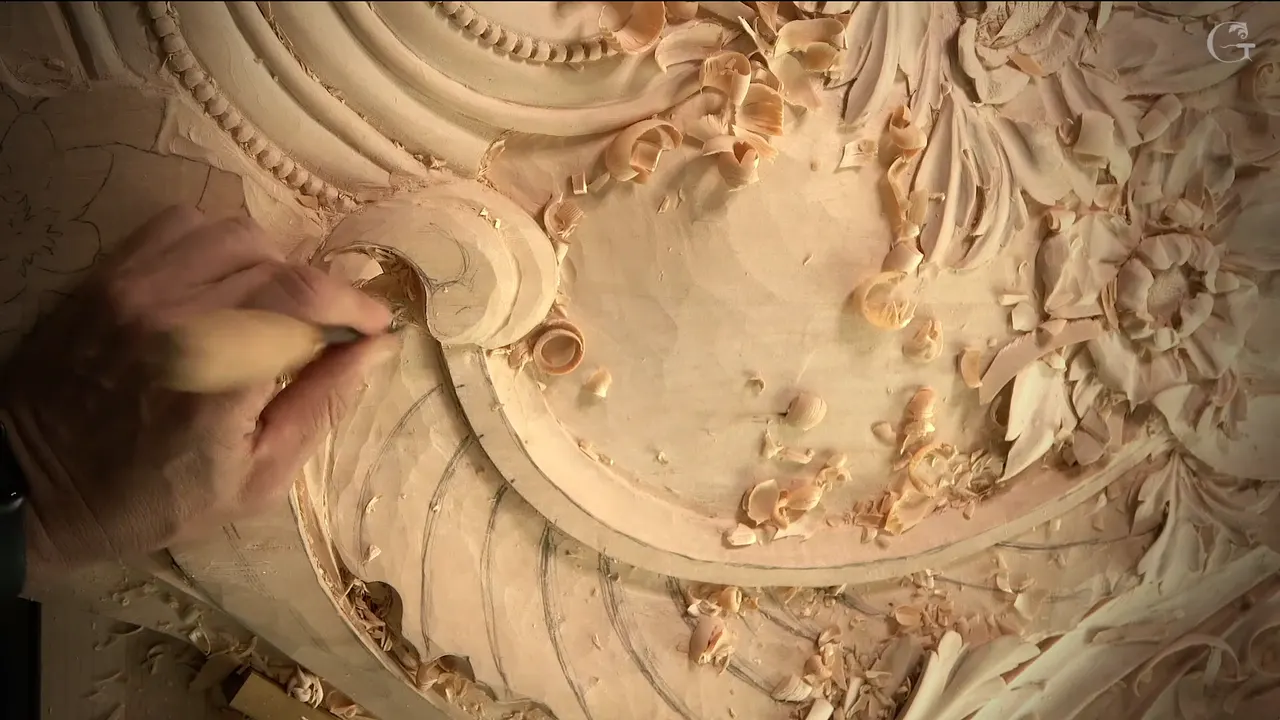

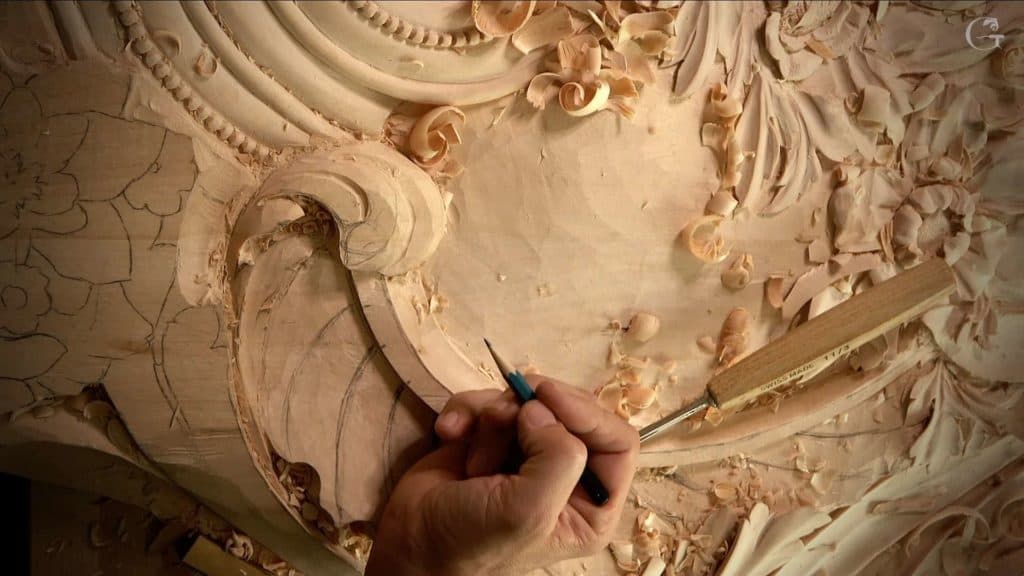
In Venice Room 143, video 3, I told you number seven was the tool I tried, and then I said two words about it, "too fast." Those two words sit in lessons of other courses too, and each time a tool and a spot stand right beside them. First comes this video, one line after another. The other lessons where I found the same words follow, each one linked.
Ever had a gouge take more wood than you asked for? Then you know the seconds after. I said out loud what I thought while you watched, and glue was one of the things I named.
What did I say before number seven went in?
The video opens on a plan. "And yes, I'm going to create that letter S curvature a little later," I say. Then: "But I am somewhat happy. It's not clean yet, but I am happy. So I've got initial idea."
Then a smaller tool. "So let me get the smaller spoon. So I'll get two millimeters there" (5/64 in, about 0.08 in), and "right away, actually take care of this inside." I tell you "I don't need to go all the way yet to this part, but at least just indicate my movement." Then: "And let me relieve it here, too, right away. Here and right there." Of the cuts I say only "Just a couple relief cuts."
Two more spots come up in the next lines. "From above, I'm using number three," I say, and then "couple spots like I said," of which I say "they're going to lay on top of the shell."

What happened when number seven went in?
Right before it, I say "I'm not too happy about this separation because it's not done yet, and that just kind of bugs my eye." I add that I want "to make sure I like it."
Then the slip. "Number seven, that's what I tried to use, but looks like it was too fast." The next line is "I don't really want to lose that part." I weigh it out loud: "I don't know. Maybe I could lose it. That's okay. It's going to be just lighter."
Gluing is one way out, and I name it: "I could glue it back, but it's too preliminary." Out comes "So oops. My bad."
"But on the other hand, it gave me a chance to open up a little more and my separation going to move this direction." A moment later I say there are still "plenty of separations."
Next comes a line about my mistake. "And I'm not going to tell nobody except you that I made my mistake." After it: "Looks like I rushed that too much, but it's okay. I'll just take it out." Then "Here you go," I say.

Here is what I say about what is left: "Not bad. I'm not that worried about it, okay?" And my last words on it: "it's actually made it a little lighter."
What did I do right after the slip?
"Okay, so let me attack right now this part." I name two ways. "I could go that part higher than this part, or I could make this part higher than that part." Raising this part of a leaf "a little higher," I say, will look "a little lighter" and "much better."
My plan is "number 11 and three millimeters in my hands" (0.12 in). I plan to "start excavating this way." I ask "How do I want to see it" and I add that I don't want it to "look stupid." One road has my point "somewhat downhill." The other has "a little more twisting this way, and my point going to be right there." I lean to the twist, and I say "probably."

"So I am safe to cut that away," I say, with "the same 3 millimeters" (a little under 1/8 in). Then: "That's still deep enough," I say, and "I'll take number three and blend that ridge in." Then comes "number 11 and 2 millimeters again" (0.08 in), to "take this out, all that mess" and that will give me "that really, really, really deep shadow." Then: "Beautiful shadow. Okay? Okay. So now I'm happy."
The head of that part gets a question of its own. "And do I want to make it point high, or I could actually go downhill?" Downhill would make it "more three-dimensional, let's say," but it shows from "the point of view" and a low head means "that point" is "lost." My ending on it is "Just keep it high, just for that sake."
The video ends on a new plan. "I need to get 3 millimeters again and create couple relief cuts" (a little over 0.1 in). "I also have a question," I say, about the separation on that side, and my first answer is "Maybe not." What I could do instead is "take this middle line and move it this way, move it that way, and make undercut going underneath of here, so it would look like it's rolling from underneath." "That way, I have to do only one bigger separation. I think it's going to look lighter." It ends on "undercut."

Did I plan to go slow in the videos before this one?
A line about it sits in video 2. "I'm not going to rush anything, so later on, I'm going to undercut and then use this here," I say. In video 1 comes a measure for that undercut. "I have to leave approximately three millimeters in this space because I need to undercut," I tell you, and "I can go even lower than three millimeters, but at least three millimeters" (0.12 in). The lesson page is the lesson 143 page, and lesson 142 comes right before it.
Which other Venice Room videos have me saying it was too fast?
Here they are, each with a link.
The same number comes back in Venice Room 45, video 6. A cut goes a way I did not plan: "That is not what I was planning, okay?" Then I say I was "just probably too fast." And: "See, I just used number seven." I explain that this is "not always the best idea to get really close to detail like that." "It just hits with the corner and breaks away. So that's why it is better to use proper tools." After that I say it is "okay," "not like the end of the world" and "actually created a beautiful movement and insight."

The same words are in video 4 of Venice Room 72. First "And that is no bueno" and then "See? I was little too fast." A rule of mine follows: "One of the rules what I like to use if something broke, I just change the design and don't tell nobody." I name the slip too: "I did not create a good enough relief cut."

It shows in video 3 of Venice Room 61 as well. "One side is always cleaner, which is in my case, it's the right-hand side of a cut." Also: "I can always go back and clean opposite side, but now all I need is just preliminary, just remove most of that stuff." Then: "Let's see, I got too quick again, but it's okay." My next plan is "kind of really low cut," which will be "wavy, really wavy, and curly. Beautiful movement."

Video 7 of Venice Room 32 has me say "I have to keep an eye" on "the grain of the wood, not my grain, but the grain of the wood." Then: "attack it from this side" and then "I just messed up. Got a little closer than what I need to. Got too quick." Afterward I say "that is better for me to take time not to rush it."

In Venice Room 35 the words land right at the start of video 6. "Oh, that is no bueno, what I just done. I just rushed too much." And then: "It's still fixable." My fix is "going to do cut like that" and "bring this little bit under." And a shrug: "I don't like when it happens, but it happens, so what can you do?"

Short and plain, video 9 of Venice Room 93 says it. "I just made mistake." And then, "I rushed a little bit, but I'll clean it."

"Not at this stage" and "in general" both sit in video 10 of Venice Room 4. "That's not really a mistake right now, but in general. Okay? In general, that would be a big mistake when I would work on details." Then: "So the mistake is that I rushed, and I didn't take care of the triangle."

The words sit in a decision in video 9 of Venice Room 73. "Let me think first before making too quick decisions, how much I should take out. So how much I should keep." I take "number 11 veiner" at "seven millimeters or so" (0.28 in), "a little bigger than a quarter inch" (6 mm). And: "start little by little. I have to be also mindful. Okay. Really mindful."

A slip shows up in video 2 of Venice Room 14. "That's not supposed to happen. That's what happens when you're trying to run ahead." Then: "I wanted to keep that high, but now because I made a too quick cut," I will not keep it. Then "We use maybe number eight" and "fix what I just messed up." It is "still not a big mess I created, but still it's not so good."

Do those words show up in my other courses?
They do. The Hashemi flowers course has them in lesson 11, third video. I start with "Maybe a little smaller this time than the original 1/8" and then "just a 3/32 of an inch" (2.4 mm, against 3.2 mm). Next: "Oh, that is not so good. I don't like what happened. That's okay. I think I just rushed too much a little bit. That is always a mistake, to rush it." My next tool is "number 11" with "1 millimeter" (0.04 in) "to make the shadow line." And: "now I have to fix this."

Carving Roman Acanthus 13, video 4, splits two kinds of work. "Definitely when I'm doing a production work, I have to be much quicker, because I can't waste time." And: "I am more on the side of being more careful than rush it." I'm using "number three, just a small, tiny tool. It's an eighth of an inch" (3 mm). I add "when I rush, I have a tendency to make a lot more mistakes, and I break, and then I have to glue back, and that's not nice."

Greek acanthus gets its turn in lesson 11 of that course, video 1. "Just try not to take too much at once, because you can make a big mistake if you'll do that." The next part: "I know it's tempting. I'm guilty also. When you're trying to do too fast, too quick, but that's a big mistake."

On the furniture panel, lesson 16, video 2, I say "Make sure my line is perfect and smooth." Then: "not too fast, because I've got to control it and pull it." I say "that's harder, a little bit, than basswood."

Another panel lesson, number 22, warns in video 8 that "you can't just push it. The grain goes like that. If you're going to push it, you can break that grain." Then the line turns around: "It's better to be a little too slow than too fast, okay?" And: "not just the pushing, but slicing little bit."
In the lily box course, lesson 11, video 8, the words come as well. "Like everybody else, I am trying to do sometimes some stuff too quickly. And that would be a big mistake. Or dig too deeply." Next: "rush it and make it too quick, I have to start all over again."
In Greek Acroterion 2, video 4, I say "the main idea, not to rush anything because I can make a mistake." Then: "You already know woodcarving is an art of deduction. So which means if you made a mistake, in some cases, it's fixable, but sometimes you can't fix it."
Which video said what, side by side?
The table keeps one row for each of these videos, with what I said and what I named near it.
| Tool or spot | Lesson and video, in Venice Room unless named | Next |
|---|---|---|
| A number seven gouge | 143, third video | Said the part comes out, then weighed two ways to raise the next one |
| A number seven again, near a corner | 45, sixth video | Called it a beautiful movement, and not the end of the world |
| Relief cut | 72, fourth video | Gave a rule: change the design when something broke |
| Preliminary | 61, third video | Planned a really low cut, wavy and curly |
| Grain | 32, seventh video | Said it is better to take time |
| The triangle | 4, tenth video | Called it a big mistake when I work on details |
| Number 11 veiner at seven millimeters or so | 73, ninth video | Said let me think first, planned to start little by little, and to be mindful |
| Number 11 | Hashemi Flowers 11, third video | Said now I have to fix this, then named number seven and number five |
| Number three | Roman Acanthus 13, fourth video | Said rushing brings more mistakes, and breaks to glue back |
| Slicing | Furniture Panel 22, eighth video | Said it is better to be a little too slow than too fast |
Which cut of yours ran ahead of you last week? Every lesson named here opens with access to the school, paid monthly or yearly and renewed automatically until you stop it. Video 3 belongs to the Part 12 course page, in lesson 143, with lesson 142 just before. Here is what I mean by the work on these benches: wood carving, relief carving, chisel work, acanthus leaves, wood grain, gouge sweeps, hazelnuts, a shadow line, apprenticeship and Venice ornament.
How it's done
- Name the tool. I named number seven, and I called it too fast.
- Say what you lost. "I don't really want to lose that part" is how I put it.
- Weigh the choices. Losing the part would be "just lighter," I said, but gluing it back was "too preliminary."
- Look for what it gave. The slip let me open things up, and my separation would move.
- Own it. I rushed that, I said, and it's okay.
- Carry on. I would just take it out, I said, and then I named two ways to approach the next part.
Frequently asked questions
Which tool did I call too fast in lesson 143?
Number seven was the tool, and "too fast" is what I said about it.
Could the piece go back on with glue?
In my words, "I could glue it back, but it's too preliminary."
What came of the slip?
It let me open up more, and my separation was going to move in that direction.
How did I feel about it?
What to carve next