

Alexander Grabovetskiy, woodcarver, School of Woodcarving · Published 2020
What is the difference between a main division and a subdivision in wood carving?
Quick answer: A main division is a large movement of a carved leaf, and a subdivision is a smaller one inside it. I explained that word in part 4 of workshop 28. The grape leaves lesson gave each main division three subdivisions of its own.
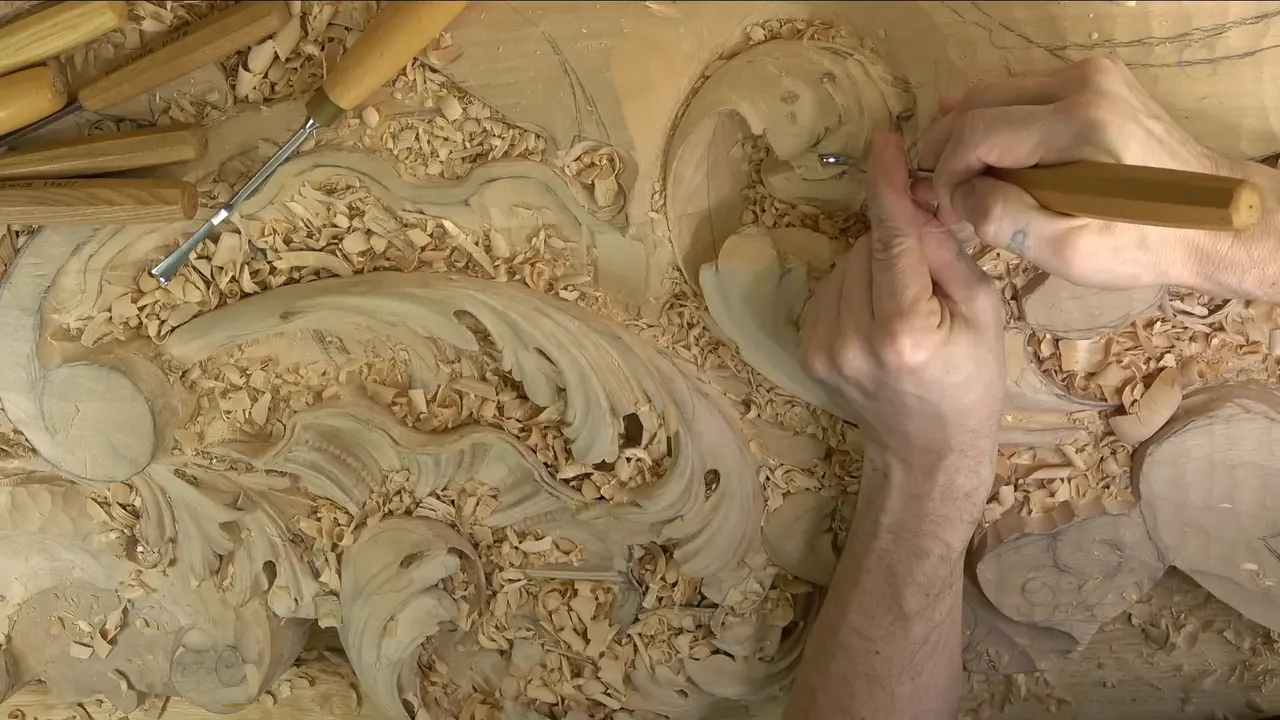
A main division is one of the big movements of a carved leaf, and a subdivision is a smaller movement inside it. I explained the difference in workshop 28, part 4, while I worked on an acanthus leaf with the ceiling piece really close by. "Why I'm calling them subdivisions," I said, I start by working out the main division.

Where does the first line go on a leaf? Did one early cut make the rest of the wood carving feel crowded? I use one rule for that, and I said it out loud in more than one course, so I pulled in my words from the other videos too. Every lesson I use sits on a public page that I link.
What did I mean by subdivisions in part 4?
I meant the second level of a leaf. The part opens on a back bend, and it "would be really nice," I said. It would give me "a much nicer result." I also needed to blend the ridge of the pipe. "I just don't like how sharp it looks, and it should not be sharp." I wanted to "see that convex in the middle."
My hands got in the way of the camera. "I'm sorry that I'm covering with my hands," I said, "but that's the only way I can attack because I've got the ceiling really close by."

The details were tiny. "Those concaves and convexes, it's almost none," I said. "That's number five. That's what I'm using in 10 millimeters" (about 3/8 in). Sometimes you do not notice them at the beginning, I said, especially if you have never done acanthus leaf work in different styles. "But the more you do those acanthus leaves, the more you see them, the more you see those movements."
So I held myself back. "I think I should not go deeper because I already created a too tiny spot right there." I would subdivide it and clean it, "but I shouldn't go more than that." The pipe could go a little deeper on one side "to give a little more movement, but not much."
Next came the word itself. I was "ready to do a lot more subdivisions." I called one spot the main and another one the subdivision. More of them were coming on the side. "Let me do those, and I'll decide later on if I should do more or not."

My reason for the word comes next. "I try to logically figure out what is going to be the main division, which is I divide the main movements of the leaf in certain spots." The count is "usually three or five main divisions, and then subdivisions, which is inside of those divisions." That last part came out twice.
How many main divisions does a leaf get?
Most of the time a leaf gets three or five, and sometimes eight. Part 4 says so, and so does workshop 52, part 8. Every acanthus is supposed to have main divisions, I said, and I tied the count to the Fibonacci sequence. "Three, five, eight, and so on."

Workshop 49, part 7 gives the same answer with a drawing. I marked the main three divisions of the head, and then said, "Most of the time, actually, acanthus has five divisions." That applies to most acanthus leaves, I said. Each one was to be divided again, in three, "all of them." "And that way I can develop any movement."
Here is the whole ladder, in my words from that part. "Just based on the main divisions, then the subdivisions, and even smaller divisions or smaller subdivisions, if you can say that."
In my Dynamic Symmetry course, the same count shows up from another side. "Even inside of the acanthus, we do have three main divisions," I said, and inside those three you usually see three other divisions. Where they land falls "on one of the golden sections." The golden ratio is behind that.

Oak got the count too in workshop 96, part 11. For acanthus, I said, the count is three, sometimes five, sometimes eight. Leaves in life split in three like that, and the people who carved that oak "divided each leaf in three main parts."
What goes inside a main division?
More divisions, one level down. The Grape Leaves Vase course shows it with markers. In lesson 2, part 12 I said, "We do have five divisions, one, two, three, four, and five." Then, "But inside of each division, we're going to create three divisions."

I gave the rule a place on the leaf. From the middle point I took "six parts out of 10" for the golden ratio idea and drew a line there, "like a vein, if you wish." It works as "a center line of subdivision." Next came the plain rule. "If that is the main division, so that is going to be a subdivision." I added that every main division gets three subdivisions.
A notch went in each one next. Relief cut is my name for it, and a number 11 at 4 or 3 millimeters (about 5/32 or 1/8 in) opened it, and I would follow "the outline we just created." I corrected myself on camera too. "Just create those main divisions or subdivisions, I'm sorry, because the main divisions we already done."

I counted them out loud. "There's five main divisions, three secondary subdivisions, and we're going to do even more subdivisions. Okay? Sub-sub. You could call it sub-sub. I don't know if there is such a thing as a sub-sub."
Workshop 74, part 9 has it too. "Inside of those three main divisions, we also divide by three," I said. Each of those would be divided again "just like that."
The Roman Acanthus course has the same count on an old leaf. Lesson 1, part 2 has the line, "The main leaf divisions, they divided in three and the small sections, subdivided even more in threes." Then came "more pipes, more eyes." My line on that was, "You just can't go wrong with those pipes on acanthus leaf."

Workshop 77, part 9 gives my reason for the extra level. Each leaf, I said, would be split in three on the inside. "Then it's going to look really interesting. Otherwise, it's just not too interesting at all."
Where do the eyes, pipes and convexes sit between the divisions?
Between and along the divisions. Back in part 9 of workshop 74 I counted them. "If there is three divisions, one, two, and three, it should be two eyes. Okay? If you have an eye, you always have a convex. It's like the main vein, if you wish."
Two eyes gave two main convexes, I said, and the smaller ones came next. "If it's Venetian style, you will have also convex, convex, and a convex. Five total convexes. Two main ones out of the eyes and three secondary and inside of each division."

My updated version showed "two big pipes, really thick and pronounced," and a convex "a lot less pronounced" on the side of the divisions. I excavated with a number 11 of 5 millimeters, 3/16 of an inch. It became "little too big of a tool," so I switched to 3 millimeters, one-eighth of an inch.
Part 3 of workshop 28 has the pipe. "That is my pipe, and it beautifully flows downhill." Next I thought about raising it slightly with a deeper concave on one side, to "give more roundness right here," using a number 11, 7 millimeters (about 9/32 in). That left two ridges, "and I can just blend them in. That's it."

Part 5 covers the angle of attack. "It's always better to attack that from the side of the eye," I said, "because you can press on a back wall with no problem." My ceiling piece was close, so I had little space. Further in I said I would "create nicer subdivision, or I should say division. Doesn't matter. It still divides and subdivides."
Where did I say it, and what did I count?
This table lines up six places. The last column holds my own words from each video.
| Where | Plan | Next | Words |
|---|---|---|---|
| This part, 28.4 | Main divisions first, with subdivisions inside them | Smaller movements | I try to logically figure out |
| Grape Leaves 2.12 | Five big divisions, three subdivisions in each | Even more | If that is the main division |
| Workshop 74.9 video | Three big parts, each split three ways | Five convexes | So two eyes, two main convexes |
| Lesson 52.8 clip | Each leaf carries three, five or eight | Fibonacci numbers | Three, five, eight, and so on |
| Roman Acanthus 1.2 | Divided in three, small sections in threes | More pipes | Can't go wrong with those pipes |
| Oak leaf 96.11 | Each oak leaf got three main parts | Eye between | going to follow what they've done |
How do I mark the divisions before the gouge goes in?
The outside gets drawn first. In lesson 1, part 2 of the Greek Acanthus course I said, "Before I make my main divisions, what I do, I actually draw the main movement outside borders of acanthus leaf." It looks "like a boat somewhat, or a big leaf." Only then do I subdivide it, and I do not want to go farther than my boundary line.

Every line goes somewhere. "Every flow line or every center line goes to the center flow," I said. One of mine was not flowing nicely, so I fixed it. "So those are my main flow lines."
The Corinthian Acanthus course says it the same way. I needed to "reestablish my main movements, main divisions of this leaf," and I redrew them in lesson 3, part 3. "Every one of those, they have to go to the center line."

A circle works too. Workshop 59, part 1 has me drawing one to expose more area. "A division, main division," I said of it. Each one gets a middle line that runs underneath to the leaf's middle line. That is "my main boundary." I added that I usually do not draw the circle, "because I honestly know already what I'm doing."
Color helps the camera. In the grape lesson a red marker exaggerated one spot, and later a black marker showed the notch points. Center lines got a pencil. "I'll use a pencil because that is a center line."
Does the same count work on an oak leaf or a flower?
It did, on the pieces I filmed. The oak was the clearest. I outlined one, two, and three parts with a marker, then moved to the next leaf and did the same. "And I should call it Venetian style oak," I said.

On the Furniture Panel, lesson 23, part 9, I faced a leaf and said, "I don't want to see just a leaf. I want to see some divisions on that." I went with three. I decided my middle line should go one way, so one side would get "a lot less division" and the other "a little bigger division." Relief cuts went into the triangles from a number 11, 3 millimeters (about 1/8 in). "And those relief cuts, they do matter."
The claw in the Hashemi Flowers course, lesson 16, part 1 had its own count. I said the main divisions were "those three divisions." I thought about an eye and a pipe there, and I said I would need the V tool, a number 16, 6 millimeters, a quarter inch.

Long leaves need more. In workshop 66, part 1 I said I needed "the main divisions and the main subdivisions." The leaf was long, so it would be multiple. I also thought about one big division and said it would make more sense to get the area a little wider.
Sometimes space says no. Workshop 89, part 7 has one spot I called the main division. "Some secondary divisions" were still coming, I said. There was "absolutely no space for the eyes," I said, and I did not need them.

What do I do when a subdivision looks wrong?
I go back to the pipe. Back in that part I said, "I need to fix the movement of my pipe because the pipe doesn't look too good, and I'm almost losing the detail right here." I thought of "a little deeper concave." I was not sure, I said, but I would try number nine.
A limit followed. Another concave would go "all the way like that" because it is "supposed to be connected all together." Next, a warning to myself. "I don't want to create too many concaves and distract the main movement."

A back bend came next, to "fix that pipe and blend it." Somehow I needed to attack it from the opposite side, I said, but I would do it a little later. Last came the eye. "Let me clean inside of the eye." That meant I could safely excavate a little deeper on its sides. A way I could do it was a number seven at four millimeters or so (about 5/32 in).
Part 3 of the same workshop has me saying "separation or division, I should say" while I outlined. Part 5 swapped them again. The carving went on either way.

Which leaf of yours has a line you cannot place yet? Where do its big movements start? And what sits inside each of them? My order is the big movements first, then a smaller one inside each. The full workshop 28 has twelve parts, and the Venice Room Part 3 course holds eleven more workshops.
How it's done
- Find the main divisions. The main division came first. After that the main movements of the leaf got divided in certain spots.
- Draw the outside border. My Greek acanthus lesson began with the main movement and outside borders drawn first, so I could see how the leaf would look all together.
- Send each line to the center. The Corinthian lesson sent each one to the center line, with my main divisions redrawn first.
- Divide each one again. Grape leaves got a line at six parts out of 10, and three subdivisions went inside each one.
- Open the lines with a relief cut. I cut a notch with a number 11 at 3 millimeters and followed the outline I had just drawn. Undercutting came later.
- Shape the pipe with concaves. I used a number five and a back bend on the pipe and blended the ridge, without too many concaves.
Frequently asked questions
What is a main division on an acanthus leaf?
Main divisions are the leaf's big movements, and the subdivisions sit inside them. In part 4 of Venice Room 28 I divide the main movements in certain spots, and the smaller ones go inside those divisions. Workshop 52 gave me a count that follows Fibonacci.
How many subdivisions go inside a main division on a leaf?
Three, in the videos on this page. On the grape leaves vase, each main division got three subdivisions, and I said we would do even more and maybe call it sub-sub. Workshop 74 split each of its three big parts in three too.
Do I carve the main divisions or the subdivisions first?
The main ones come first. Venice Room 28.4 has me working out the main division, and the subdivisions sit inside it. In the grape lesson I said the main divisions were already done before I started on the secondary ones.
What to carve next