

Alexander Grabovetskiy, woodcarver, School of Woodcarving · Published 2020
What does aggressive mean in wood carving?
Quick answer: Aggressive, as I use the word, is how much a tool or a pass takes off at once. In Venice Room 28.6 my new rasps were the aggressive ones, and I kind of liked them. Other lessons of mine use it for sandpaper grit, strop paste, the outside of a wheel and the cuts themselves.
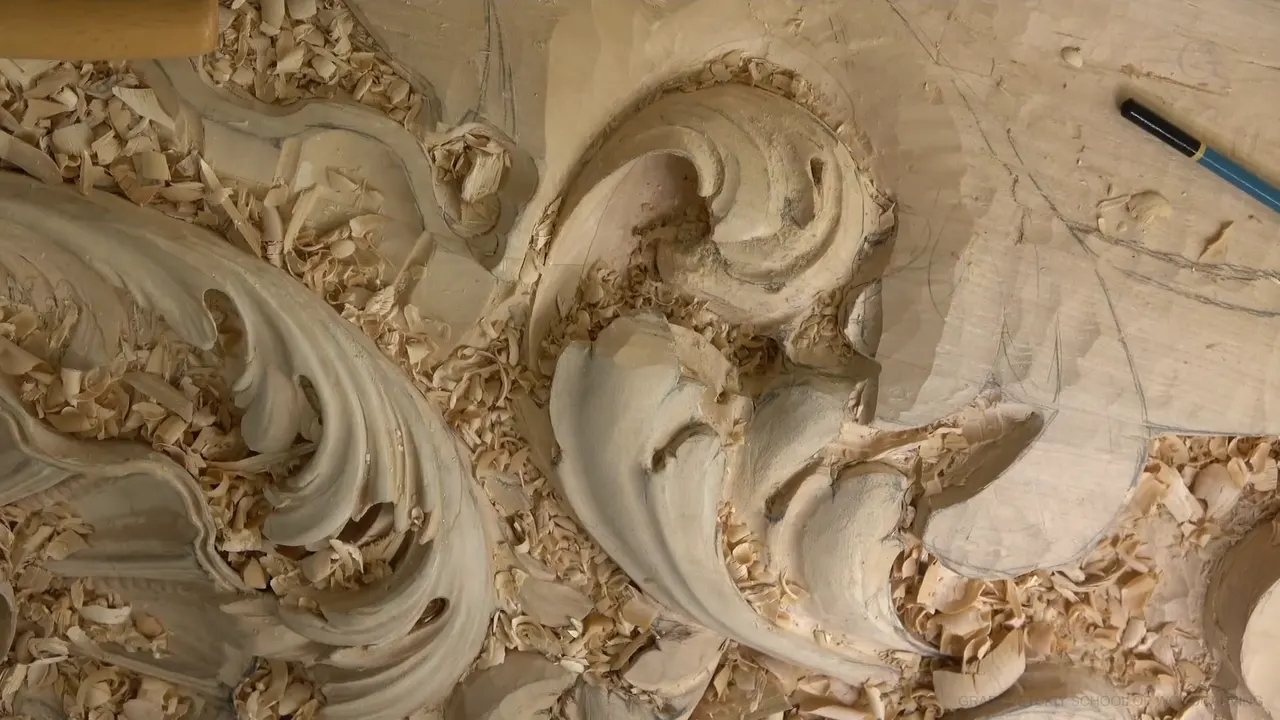
Aggressive is my word for how much a tool or a pass takes off. A coarse rasp is aggressive, and so is a low grit of sandpaper, the outer part of a sharpening wheel, or a cut that takes more wood at once. I said it about my new rasps in Venice Room 28.6. "And those ones are aggressive ones."
Ever held a coarse sheet of sandpaper next to a fine one? Could you tell, just by touch, which one would eat the wood faster? Then you already know what I mean by the word. Part 6 of workshop 28 comes first here, minute by minute, and after it the other lessons where I said aggressive while I worked on paper, strop paste, a wheel and a saw blade.

What the word aggressive covers on my bench
- Part 6 gave the word to the new rasps, and I kind of liked them that way.
- On sandpaper a lower number bites harder, and on the vase I thought of 180 and tried 240.
- On a strop, dark green paste is more aggressive than light green.
- A sharpening wheel is more aggressive at its outside than near its center.
- In workshop 5 one side let me be more aggressive if I had to, while on the side where I caught the grain I was almost just shaving.
- If you feel a pass is too aggressive, take less.
What did I call aggressive in part 6 of workshop 28?
The rasps, near the end. But the part opens inside the leaf, where my letter S goes, and at 0:20 I still didn't like one pipe, how it looked. It's just not really nice, I said.

One side almost asked me for a slight concave. I didn't have to, and I went back and forth on it. So I left it alone like that for now, at 0:59. "Otherwise, it's going to be too stripy."

Instead I gave it a little deeper eye, right there. A tiny one, not a big one, I said at 1:35, and I thought it would give me something more interesting. That meant a little deeper cut on that side too. "Number 11 and 1 millimeter. That's what I'm using," at 2:00, and 1 millimeter is about 1/25 of an inch.


By 2:21 I was kind of happy with the overall movement. Usually I take it to the perfection with just the gouges and blend everything, working my way in. This time I had new tools, rasps, and I could probably use a shortcut and create the semi-final shape with them. "And I like it. I like it a lot," I said at 3:05.


Then the guilt came, like every time I grab those rasps or sandpaper, a feeling of not using the true woodcarver's approach. The course page already tells that story, the furniture makers who used techniques like that in the past and the normal razor blade from Home Depot. I'll stay with the word.
Four minutes and 51 seconds in, I took a different rasp, inside the concaves, and at 6:21 another one, to shape the pipe a little bit. The next 40 seconds have no words, just my hands and the rasp on that pipe.


"And those ones are aggressive ones," came at 7:10. Maybe I should buy some less aggressive, I added. "But it's okay." I kind of like even those ones being aggressive.

The last minute is a number I didn't have. I didn't know the TPI on those rasps, the teeth per inch, and I said I had to check. "If I'm going to say something and I'm not sure, I'm going to lie. Okay? I got to check." I had been reading about those rasps and knew it once, but I forgot how many there are.
Is an aggressive rasp a bad rasp?
For me, not on that leaf. A rasp is a coarse form of file, with distinct teeth cut one by one. In Venice workshop 91, part 9, on another Venice Room board, I planned to use somewhat aggressive rasps I had just bought. "They really are aggressive," I said at 2:20, and with them I could make a lot nicer, smoother transitions. It was a paint job, so I didn't worry about creating too many details.

What does aggressive mean for sandpaper?
A lower grit number. Every sheet of sandpaper is an abrasive grit glued to paper or cloth, and coarser grit makes sanding easier but also makes it easier to damage fine details. The grape leaves vase, lesson 4, part 4, had me wanting sandpaper again, and I wasn't sure 400 would do. "Maybe little more aggressive, maybe 180," I said at 5:41. Then I found 240 and tried it.
Some spots were still darker, not dry yet, but most of the leaves were. I rode on top of those ridges to expose bare wood, not everywhere, and carefully, because I didn't want to destroy what I worked on. Once the oil went on, it would give a really good luster, and that bare area the feel that it is real wood, not just some other material.

The lily box went finer, in lesson 11, part 13. "And I'm not using really aggressive paper. This one is 320," I said at 10:55. Pretty close to the final form there, I let the 320 take off some of the extra edges I didn't need and kept the crispness of the detail. I usually don't like to use sandpaper. We had already used it on that project, though, so I probably could. Not much, just a little.

Which strop paste is the aggressive one?
The dark green one, of the pastes I showed in the stropping and buffing lesson of the sharpening course. In part 3 I showed pieces charged with different pastes for honing on a strop. Dark green is more aggressive, light green less, I said at 2:25. Blue is a really, really super fine paste. The paste I like best comes in two kinds, a green one, slightly more aggressive, plus a fine diamond paste. They're not cheap, but they last forever.
Where on the wheel is sharpening more aggressive?
At the outside. Sharpening a skew bent gouge, part 1, I asked you to understand the rotation. Closer to the center you hold your tool, the less aggressive it is, and more outside of the wheel it is much more aggressive, I said at 5:52. I told an in-person class in Maine the same thing right as we started, and added one line. "It's a dynamic of movement."
A live stream in April 2020 on the spoon gouge put a number on it. Grit 80 was on, really aggressive, and since I wanted to get really aggressive and quickly, I stayed on the outside and kept checking where I was. For less, you bring your tool in near the center.
What is an aggressive cut?
A pass that takes more wood at once, and the grain decides how much I can risk. The first Venice Room course has it in workshop 5, part 12, where I felt like I was catching the grain on one side, so there I was almost just shaving, with absolutely no pressure. The other side ran with the grain. The line came at 7:27. "So I can be more aggressive if I have to." "With my cut, I mean, not with my behavior."

The hazelnuts show the other half. Lesson 3, part 3, is where I said my carving would become less aggressive with the more details, a few seconds past 7:30. Later, with a 14 millimeter number seven (about 9/16 in), my cuts were not as aggressive, because I was working into the grain and didn't want to catch the grain and split the thing. Tools must be sharp, especially when you work into the grain.

Sharpness changes the answer too. The Tray of Blessing, lesson 7, part 1, has me holding a 14 millimeter number seven (about 9/16 in) at 45 degrees, and I said I could probably take a more aggressive cut that way. "But it's also depends on the sharpness of your tool." If the tool is not too sharp, it's better to attack the way I did the first time and clean it. The main idea, I said a little later, is not to push too hard, just small tiny cuts, really shallow.
What do you do when a pass gets too aggressive?
Take less. Cleaning the background of the furniture panel, lesson 15, part 4, I worked to the same depth with a router plane, one side as my reference. I wondered at 8:35 if I was going a bit too aggressive, and the next line was for you. "If you feel it's too aggressive, just raise it up and start with removing little less material."

Lesson 21 of the same panel came later. Part 9 let me attack one area a little more aggressively. "Aggressively, but not too aggressively. Okay?" I still had to keep an eye on overall depth, so please don't get too excited, I said, and a smaller tool came next, a number three of only five millimeters (about 3/16 in).

Venice workshop 77, part 8, shows the other side of it. "And I almost broke it," at 1:01. "Little too aggressive, I guess, today." I fixed that part with a really thin CA glue, just like water, almost, and the piece was paint grade, so I didn't worry about it. At 2:45 I said I don't have to be too aggressive with my cuts. It is not a good idea.

The grape onlay has it at a small scale. In lesson 8, part 1, I had a number seven at 4 millimeters (about 5/32 in) to excavate, and at 7:13 I said an aggressive cut at that spot and I'd break it. Five lessons on, in lesson 13, part 2, a number two of 2 millimeters (about 5/64 in) went in for some down cuts, and I wasn't taking aggressive cuts there, "just little by little attacking from both sides."

Can going too aggressive be okay?
Sometimes it's okay. The furniture panel background, lesson 16, part 3, had a spot I called maybe a little too aggressive. I was fine with it, because it's not the clean cut yet, not the final cut anyway. "Just make sure you see exactly what's going on with the grain of the wood," so you're not digging too much and creating a split inside. Earlier in that part I used a smaller blade to be a little less aggressive, and I thought it was a lot easier to control.
Workshop 62, part 10, had me go more aggressive on one side on purpose. I took a number 11 of 18 millimeters (about 11/16 in) and excavated much deeper there, because I really needed that movement and had to expose a barrel. "Maybe I got too aggressive, but it's okay," at 4:39. The background of workshop 105, part 1, was three-eighths of an inch deep, about 10 millimeters, and I touched an edge. "I was too aggressive and touched that." Not a big deal, since that part would end up lower.
Is a thicker scroll saw blade more aggressive?
Thicker went more aggressive in that lesson, and sometimes less accurate. Sawing out the lily box on the scroll saw, lesson 1, part 3, I showed that you can use pretty much the smallest blade and still do a really nice job on thicker wood, limewood, or basswood. Sometimes a smaller one is even better, because you can control it much better. "It's not as aggressive, I should say," at 9:15. A little slower process, true, but the cut is much, much nicer.

At about 50% of the speed, at 14:32, my cut was much thicker than the previous one, and I didn't smell any smoke, so it wasn't burning. A little more aggressive cut also. At 33:47, with a thicker blade, much more aggressive, and the line much thicker. A thicker blade sometimes is not as accurate as a thinner one.
Where the word came up, lesson by lesson
The last column keeps close to what I said on camera, right next to the work.
| Lesson and part | What I called aggressive, or less so | Time cue | What I said right after it |
|---|---|---|---|
| This part, 28.6 | The new rasps shaping the leaf's pipe | At 7:10 | I kind of like even those |
| Grape vase 4.4 | Sandpaper at 180 against 400, then 240 | Cue 5:43 | Ride on top of the ridges |
| Lily box 11.13 | Paper of 320 grit, not really aggressive | Mark 10:55 | Pretty close to the final form |
| Stropping lesson 3 | Strop paste, dark green the more aggressive | Time 2:25 | Blue one, really super fine paste |
| Skew gouge sharpening | The outside of a wheel, more aggressive | Clip 5:56 | Let me check, closer to outside |
| Venice workshop 5.12 | A pass along the grain, more aggressive | Spot 7:27 | With my cut, not my behavior |
| Furniture Panel 15.4 | Router plane on the background, too aggressive | Point 8:35 | Start with removing little less material |
Where can you watch part 6?
Open the workshop 28 lesson and play part 6 with the sound on. The word comes in the final minute, right after the rasp goes quiet on the pipe. The Venice Room Part 3 course holds the rest of that ceiling board, acanthus leaves in relief, across twelve workshops.
Which tool on your bench is the aggressive one?
How it's done
- Leave the slight concave for now. One side almost asked me for a slight concave. I left it alone like that for now, since otherwise it was going to be too stripy.
- Give a tiny, deeper eye. A number 11 at 1 millimeter, about 1/25 inch, made a little deeper eye, and a tiny one.
- Deepen the cut beside it. A deeper eye meant a little deeper cut on that side too, with the same number 11.
- Take the semi-final shape with a rasp. Usually the gouges take it to the perfection. Here a rasp gave me a shortcut to the semi-final shape, and I liked it a lot.
- Switch rasps for the concaves and the pipe. A different rasp went inside the concaves, then another one shaped the pipe a little. Those were the ones I called aggressive.
Frequently asked questions
Do I mind that my rasps are aggressive?
Not much. I said in part 6 that maybe I should buy some less aggressive, and right after that, it's okay. Workshop 91 had me planning somewhat aggressive rasps I had just bought, for nicer, smoother transitions on a board that would be painted.
Which sandpaper grit did I call aggressive?
400 might not do on the grape leaves vase, so I thought of a coarser one, maybe 180. 240 was on hand, and I tried that. The lily box got 320, which I said was not really aggressive paper, and that flower was already close to its final form.
How many teeth per inch do my rasps have?
I had to check, I said in part 6. I'd read about those rasps and knew the TPI once, but I forgot, and if I say something when I'm not sure, I'd be lying to you, so I got to check before I give a number.
What to carve next
- Advanced carving venice room part 3 workshops 26 37
- Advanced carving venice room 91
- Carving vase with grape leaves 4
- Wood carving workshop lily box carving lily flower 11
- Stropping honing buffing
- How to sharpen skew bent gouge
- Sharpening in person class maine coast workshop
- Livestream april 2020
- Advanced carving venice room 5
- Carving hazelnuts 3
- The tray of blessing cabernet sauvignon 7
- Woodcarving course carving process furniture panel 15
- Carving furniture panel 21 upper part acanthus movements
- Advanced carving venice room 77
- Carving grape onlay 8
- Carving grape onlay 13