

Alexander Grabovetskiy, woodcarver, School of Woodcarving · Published 2020
What does a challenging area mean in wood carving?
Quick answer: A challenging area, as I said it in the second part of workshop 28, is a spot on the leaf that is harder to carve than the spots around it. There I named a number nine for it. In other lessons it did not mean impossible.
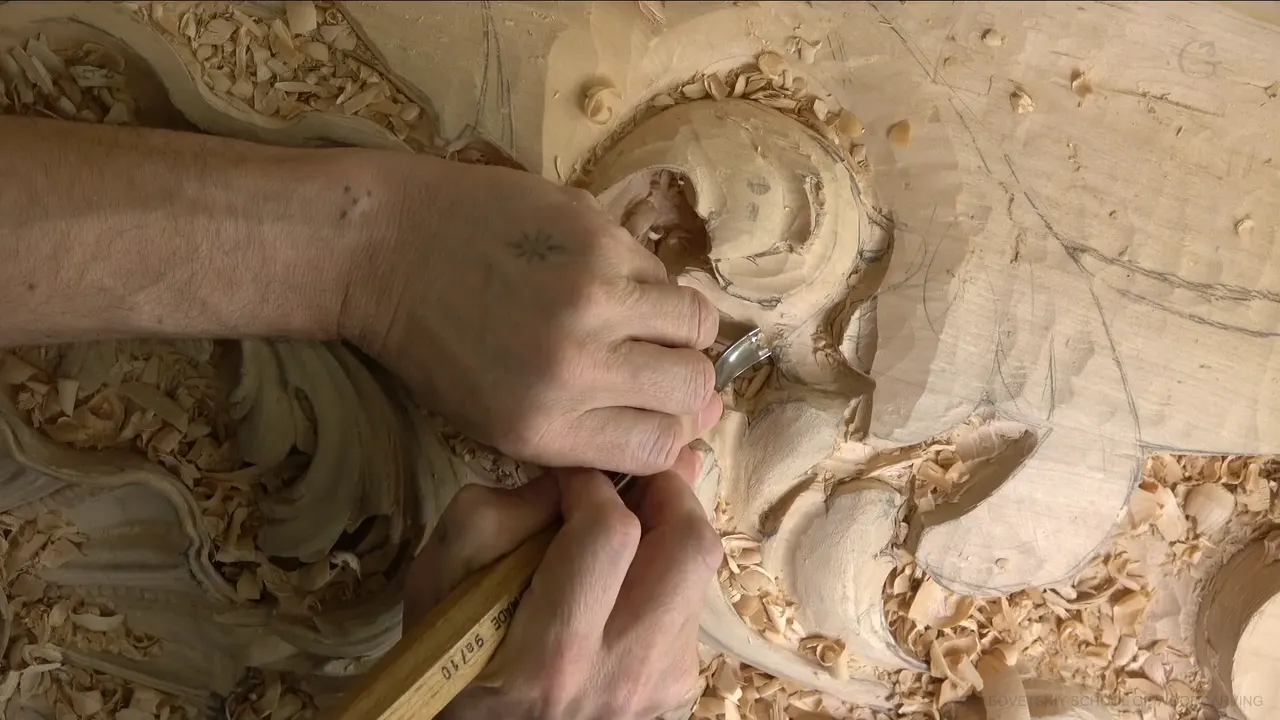
A challenging area, in my words from Venice Room workshop 28, part 2, is a spot on the leaf that is harder to carve than the spots around it. The leaf was acanthus, in the Venice room. Then I reached for a tool, a number nine gouge.

Maybe you have reached a spot in a carving where your hands slowed down. Or you wondered if a teacher feels the same thing. The same two words came out of me in more than thirty of my videos, so I pulled the best of those moments into this page. The lessons I use sit on public pages that I link, and the lines are what I said there.
What did I say in part 2 about a challenging area?
Part 2 starts with a plan for the leaf. I wanted to see the concave on one side, and a number six came first. "It's only number six sweep, but it's still going to give me the concave." Later I took one concave all the way to the point, and whatever looked a little too rough would get fixed.

A little after the four-minute mark, the words came. The plan was to subdivide one spot to make small notches, because I really wanted to see some curliness. Another side needed its own movement and concave. "But it's a little challenging area," I said, "and I think I should use number nine, maybe about 10 millimeters will work. Let's see." That size is about 3/8 in.
A doubt followed, out loud. "And yes, I am going against the grain. Maybe I shouldn't." The plan changed to a smaller number nine, "like quarter inch" (about 6 mm), going in this direction, and then I said, "Change the position and go that direction."

Next comes the wish behind it. That concave ran all the way along, because I wanted to keep how the leaf moves. "Okay. So, that is good," I said. Another concave went on the other side of the pipe, and it needed blending.
For the blending I listed a few tools: maybe a number three or a number two, "or even I could use just a double bevel number one, just chisel and kind of blend." Then the inside got hard to read. I could not see what was going on in there, and one section did not look too good, so it got a little chopping.

A short line followed. "All right. Now it looks much better." After that I went into the eye. Excavating inside it would show me the right movement, and I took small micro tools, like a dockyard number eight. "I don't really have to go that deep," I said, "but a little bit."
So the part gives one picture of the phrase: I named the hard spot, worried about the grain, tried a tool, and weighed a smaller one. Other courses have them too.
Does a challenging area mean it cannot be done?
My lessons say it more than once. Workshop 5, part 5 (Venice Room 5) had me working with a number eight, one inch (25 mm), and a heavier mallet. The spot was a challenge, and I said, "that doesn't mean it's impossible to do."

Seconds later, the reason. The grain of the wood in that spot was going to be a little challenging, "but it's still doable." A part of a cant came next.
Workshop 16, part 8 (Venice Room 16) has the same shape. Approach it with care, take my time, and do not force it, I said. "It is possible, and I just want to make it look really nice," I said.
Part 12 of Venice Room 22 opens with the same worry. "It's not undoable, okay? It is doable." Cleaning the movements of that small detail took a number seven, and I wanted the main idea to stay.
The Hazelnuts course, lesson 3, part 3 puts the hazelnut under a number seven. We were "working into the grain," I said, which made it a challenge. "But still, not impossible. Still possible." After that came the curl, turned the right direction.

Viewers brought it up too. Part 4 of Venice Room 60 has me calling an area somewhat challenging, and then "actually a really challenging area." Some of you, I said, find it almost impossible, and I was not saying that to put you down. Some of you had written me emails: watching how I develop an area, it looks so complicated that you would never be able to do it.

My answer in that video was short. "Well, not true. Okay? If you watch carefully what I'm doing, it's still possible." What I was working on was one long pipe, getting deeper and deeper, and the goal was to exaggerate it.
When does the grain make an area challenging?
Grain shows up in several lessons. Hashemi Flowers 41, part 3 (lesson 41): "And if you think that is easy, not really, because like I said, the grain is running this direction. And once you're going to try, you'll see that is actually a challenging area to do that." Then: "But we like those challenges."
The second one, I said, would sit almost underneath of the flower, where you cannot see it. Smaller tools seemed like a good idea, and the one in my hand was a number five. "Let's make it round," I said, and "just attack that from different angles."

Workshop 53, part 12 (Venice Room 53) pairs the grain with a second problem. Grain direction did not worry me there, since it was not the cleanest cut and I still had concaves to establish. "I think it looks really good," I said. Then an undercut was next, a challenge for me, because "not every tool going to fit right there."
That undercut had a reason too. At least in that area I wanted a really good shadow spot, and some junk I was not going to need had to go.
Does a ceiling make an area challenging?
Ceilings come up in several lessons. Part 2 of Venice Room 59 is the clearest: a number 11 at 12 millimeters (about 1/2 in) made the outline, "so it's a half an inch." And then: "Again, that is a challenging area because it is actually right in the transition to the ceiling."

A challenge to you followed. "If you don't think it's challenging, try it once, because really, I'm limited from both sides." Eight quarter material in that ceiling made me glad. It was almost two inches (about 50 mm), "like one and 15/16" (about 49 mm).
Part 3 of that lesson has the other half. I had to be careful, because I had lots of limitations and everything was on my way. "It's all about solving that challenge." Then: "Challenging area, but it's not that challenging." A plug cut came next, a number nine, even 20 millimeters (about 3/4 in), excavating in.
The tool could not turn in Venice Room 51, part 11. I called it a tough spot for me. Rotating that way too much was out, and so was going in, "because of the ceiling." Then: "Wood carving itself, challenging." The mallet could take me deeper.
Venice Room 37, part 10 has the phrase about six seconds in. "A little challenging area, to be honest with you." The previous shell had just lost a small piece, and I said, "Got to be more careful." Lowering it and fixing it was possible, but I did not like to see it. With the ceiling in my way, a three-inch (about 76 mm) spoon would help, "but I don't think anybody makes it."

This workshop has the ceiling too. Part 3 of this workshop has me outlining one division, and the ceiling part was in the way. "So I have to use a spoon gouge, I guess," I said, and I cleaned it toward myself.
What do I do when no tool fits?
A good case sits in Venice Room 10, part 3. I wanted a little deeper excavation on the side of a separation, and I said, "I have a challenging area." The answer was a kind of indication of that separation, cut with a one millimeter (about 1/25 in) number 11, because "there is absolutely no tool I can fit in."

Part 6 of Venice Room 66 called for a spoon, maybe a number nine at 15 millimeters (about 0.6 in). "It's not easy because this is a high spot, and I don't want to break it," I said, after calling it a challenge. Nothing was undercut yet, so it was still solid, "one of the tougher spots." The shadow needed full depth.

Reach was the trouble in Venice Room 84. "So this is a kind of challenging area for me to reach." I could take a number nine and use a mallet from a back side. I said I was kneeling down. Then the way the piece was fastened changed, because the system I use lets me move it as many times as I need to find the right position.
A curve came up in Venice Room 70, part 4. I called it a little bit of a challenge: "it's, again, right on a curve." I really needed to see that pipe. Otherwise, I said, there would be no reason for it. For the side, I took a back bend, about a number three, and wanted it really smooth and nice.
The Roman Acanthus course, lesson 16, part 5 has a small chamfer to cut, and I called the spot a challenge. "I probably should use a smaller tool or even smaller knife." Number three came to mind, an eighth of an inch or 3/16 of an inch (about 3 mm or 5 mm). A really small, tiny knife could also be an excellent tool here.

The Butterflies plate, lesson 6, part 2 has me asking why the spot was challenging, and answering: "Because I have that part of my butterfly right on the way." That meant care in removing the wood and time to take, and a small spoon like a number three could help.

A last one from Grape Onlay 7, part 1: "that is a challenging area," I said, and the biggest challenge was how much material sat in that section. A stabbing cut is not what I am the biggest fan of, and I prefer a number 11.

Where do these lines sit, and what did I carve?
This table lines up eight places, with my own words cut short.
| Where | What made the spot hard | Tool | Quote |
|---|---|---|---|
| This part, 28.2 | Concave on a side beside another eye | Number nine | I am going against the grain |
| Workshop 5.5 video | Grain of the wood on a cant | Number eight | But that doesn't mean it's impossible |
| Venice 10.3 clip | No tool fits beside the separation cut | Number 11 | Absolutely no tool I can fit |
| Lesson 59.2 video | Outline right in the transition to ceiling | Number 11 | Really, I'm limited from both sides |
| Venice 66.6 clip | High spot I don't want to break | Spoon gouge | It's one of the tougher spots |
| Workshop 84.1 video | A spot that was hard to reach | Gouge, mallet | I'm kneeling down, by the way |
| Hashemi Flowers 41.3 | And the grain is running this direction | Number five | That is actually a challenging area |
| Venice Room 70.4 | Right on a curve in the carving | Back bend | Make it really smooth and nice |
Do I look for challenges?
There is a limit, and part 8 of workshop 37 says where. What I was doing could potentially create a problematic area for myself, "or I should say challenging area for myself." Then: "But we like solving challenges, right?"
A moment later came the other half. The number eight, one inch (25 mm), had gone really deep. I said, "I do not want to create the problem what I don't have to create." And: "I like solving challenges, but I don't like to solve what I don't have to solve, okay?"
The Grinling Gibbons class in Maine sounds close. In lesson 13, part 2, one bulged spot needed a concave on this side and another on the opposite side. "We like challenges," I said, and a moment later: "sometimes, not really, okay. I like challenges to the certain degree." Number 11 at 5 millimeters (roughly 3/16 in) went in, and "that's a winner."
The material was the cause in Venice Room 91, part 5. "Challenging area because of the material. But it's okay. I'm not complaining." An undercut underneath that section would make it feel like it rolls from underneath, and a smaller number 11, I said, has to be really sharp and small.

How do these lessons fit together?
Side by side, the lessons give a short list of reasons: grain, ceilings, high spots, neighbors in the way, tools that did not fit, reach, and material. Answers varied. I picked a different tool or a smaller one, tried a new direction or a new position, or took my time.
Look at the words around the phrase: not impossible, still possible, not undoable, it is doable. In these lessons the two words came with a plan, and with words like doable.
The full Venice Room 28 workshop has twelve parts. This one is only one of them. The Venice Room Part 3 course holds eleven more workshops. Which spot on your board makes you slow down right now? What tool would you try first?
How it's done
- Say what makes the spot hard. Part 2 had the worry about grain, said out loud.
- Pick a tool and say so. I named a number nine, then thought of a smaller one.
- Change position or direction. Part 2 has me saying to change the position. In Venice Room 84 the way I fasten the piece changed.
- Use a smaller tool if none fits. A one millimeter number 11 gave an indication of the separation in Venice Room 10.
- Say that it is doable. Workshops 5, 16 and 22 give one line: not impossible.
Frequently asked questions
Is a challenging area too hard to finish?
In my lessons it did not. Part 5 of workshop 5 says it does not mean impossible, and part 12 of workshop 22 says it is doable.
What tool did I pick in part 2 of workshop 28?
Number nine first. Then I thought a smaller one might work better, like a quarter inch (about 6 mm).
Why was the area in part 2 challenging?
The grain, and I worried about it out loud. That part also had a concave I wanted to keep going along one side.
What else made an area hard for me?
What to carve next