

Alexander Grabovetskiy, woodcarver, School of Woodcarving · Published 2020
Should you walk away from a carving when you are not sure how it looks?
Quick answer: Putting aside a spot you cannot judge is, in my words from workshop 28, part 8, sometimes the better move. My time there was about a day. Other lessons gave me seconds, a few days, or a switch to another area while the spot waited.
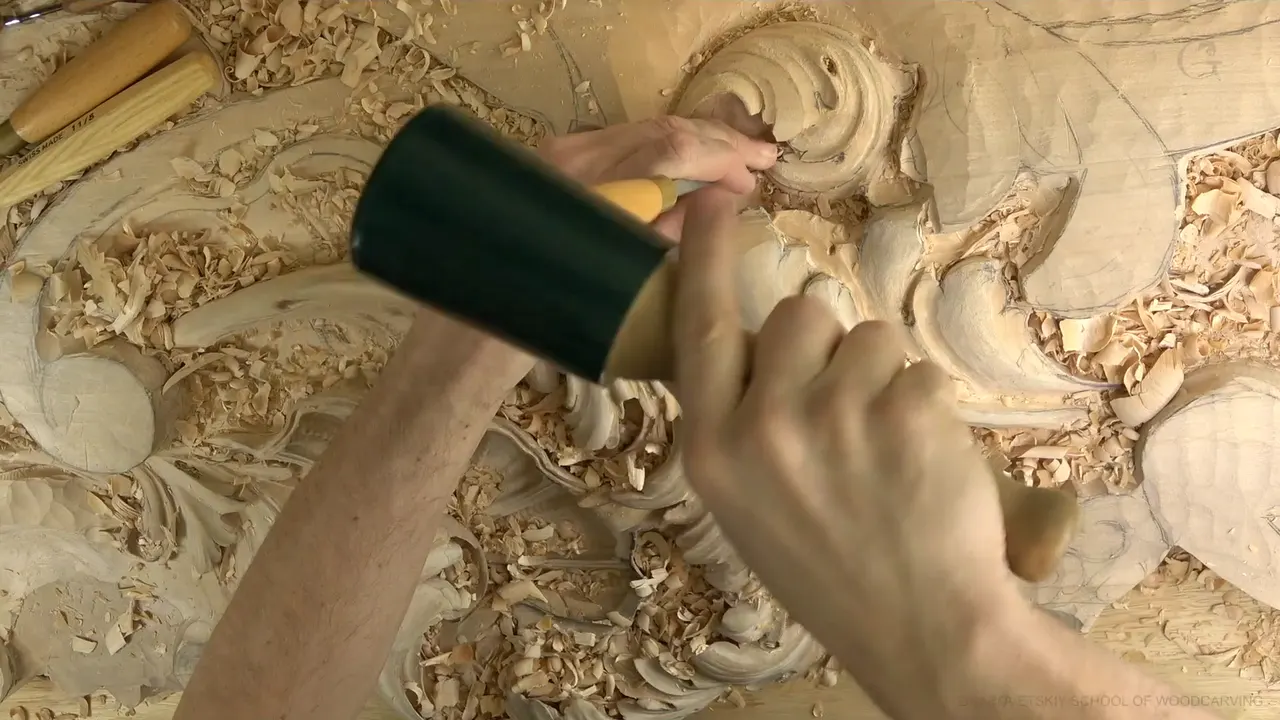
Stepping back from a spot you are unsure about is, in my words from workshop 28, part 8, sometimes the better move. Carving a leaf of acanthus in the Venice room, I put a time on it.

Have you ever looked at one curve until it stopped looking like anything? Did a cut feel wrong? My answer changed with the course, and the time ranged between a few seconds and a few days, so I went through my other videos and put those lines here. The lessons I use sit on public pages that I link.
What did I say in part 8 about a spot I could not judge?
Just over a minute into the part, I said that sometimes it is better to walk away from a certain area, when you are not sure if it looks good or not and nothing else comes to mind. "So come back in a day or so," I said, "and you usually have a solution or an idea."
A moment earlier I had been looking at the side of one spot. I still wanted to check what to do right there, and I was not sure. "I have to take a look a little later." Here is the whole setup: a spot I could not judge, a look later, and then the wait.

My next words were about another job. "Right now, what I want to do, just undercut a little bit, create a beautiful shadow on inside." And then, "I already can see what else I can do." So the wood carving went on in the same minute.
A separation caught my eye. "It is beautiful on its own," I said, "but I can actually excavate a slight concave on the side like this and give an extra shadow." That shadow would be "almost invisible," yet "it's still going to cast some shadow." Maybe even further, I said, twice.

A number five, a quarter inch (6 mm), could take that small concave, I said, and "blend it nicer right underneath." Later in the part I was using a back bend, a number five sweep at 10 millimeters (about 3/8 in), and I said I could use maybe a number seven or eight back bend next. Then came a short line. "I don't want to force it." The part ended on why I wanted an undercut there: it is "a deep excavation," and "you're going to be able to see underneath."
Does stepping back for a few seconds change what you see?
Workshop 69, part 12 gave me the reason. A spot there felt wrong ("it doesn't feel good right here"), so I paused. "When I'm stopping and taking a moment, it helps me to visualize better what's going on."

I stepped back and studied the piece "from different points of view, just like stepping and looking from different positions." It sometimes looks good from one angle and not from another, I said, and then "I need to reestablish." That, I said, is "actually good practice."
The time was small. "Just step away for a couple seconds and look at it," I said. If the look failed, "Just change it." A number three set a point next, and I said again that I was looking from a different point of view.
The Furniture Panel 6 lesson gives the same idea at the design stage. "It is a good practice once in a while just to step away and look at your composition from just a little distance," I said, "and see how overall development develops." That lesson sits in the design half of the furniture course.

What do I do with a spot that still bothers me?
In the Furniture Panel course, lesson 19, part 8, I was still unhappy with what I saw. "It just doesn't add up." A little more time went there, and not too much as of now.
The line I wanted came next. At times, I said, a good practice is leaving the area which bugs you. That area bugged me "a lot." I really did not like what I saw. But I took out a convex and made a concave with a number seven. The number seven was marked six millimeters, a quarter inch, I said, yet it was "a little smaller."
A softer transition was the aim, because I just really do not like really sharp edges. A little later: "That's already actually looking much better."

Workshop 64, part 5 explains why a cut is sometimes not clean at first. I knew I would change some stuff, I said, especially with an outcome I was not happy with. "I know I could do much better and I didn't. So I'll just leave it," I said, with a plan to "return to that area later."
Next I said I needed to lower one side a little to create an uphill movement. I would use maybe about a number three, a small micro tool, and I apologized to the camera for covering the spot with my hand.

Workshop 89, part 5 has the longest version. "It's better just to leave it alone for now," I said, "because at this point that is the part I don't really like it and it bugs me." The reason was short. "The more I take the material out, the more chance I'm going to make the mistake."
My plan that time was longer. I needed a couple of days or so away from that area, and then I would come back to see what I was able to do. Two minutes later I said it again: stepping away is a good idea at times. A first cut followed.
The Furniture Panel 10 lesson, part 4 has a shorter doubt. "I'm not sure. I still have a doubt about this section." Then, "But let me sleep on it." Some movement would go right there later, I said, "because right now it just looks too empty."

Why do I jump to another area instead of stopping?
Tired is one reason. In workshop 124, part 1 it was, "I'm kind of tired of this side, and I want to see overall picture." After that I added that it is sometimes a good idea to leave one area and jump on another.
The other side got the overall movement. The majority of the material would come off, I said, and I asked the viewer not to judge it yet. "Don't look how it looks right now, because you don't see the levels."

The Venice Room 4 workshop is plainer, in part 11. "You get tired when you're working on big details all the time." My answer was that it is a good idea to leave and start doing something else. I had the overall main idea by then, and almost the last part of it, and I could see another part to work on.
Workshop 45, part 6 gives a reason. When you work in a detail, "you don't really see the final picture." I fixed myself right there. "Well, you do see the final picture, but not 100%." That was one of the reasons I was jumping around the piece.

The saying came next. "It's like, we call it, there is a saying, actually, in the Russian language, it's calling soaping the eye." After a while in one detail your eye is used to it, and "you don't really see if you're making something wrong." A reader who wants the science word can look up habituation.
That part also calls redoing a detail "a normal routine." No time was named. The move was simple: carve another detail.
How do I know when it is time for a break?
The Floral and Molding course gives a sign of being tired, in lesson 5, part 1. "If I look at my bench and there's more than two or three tools, that means I am tired." Tools piling up on my bench meant a break. "At least that applies to me," I said. A few minutes away from the bench, and "you should be fine."

The Grinling Gibbons class in Maine, lesson 13, part 2 has a break for tools. The sharpness mattered a lot, because I was working against the grain. This is where you are losing your tools, I said, so you take a break and reorganize. About fifteen seconds later I found a number nine gouge, six millimeters (about 1/4 in), and the work went on.

How long should a spot wait before you look again?
Four lengths came up. Workshop 69 took a couple of seconds, and the Floral and Molding course asked for a few minutes. Venice 28.8 said a day or so. Workshop 89 stretched it to a couple of days. Seven answers sit in the table below, next to my own words.
In lesson 6 of Acanthus over Moldings, part 1, I really like to look again after a few days, I said. "When you're working all day long on the same piece," you have a tendency not to see the mistakes. Then, "when you coming back next day and you look at that piece," you miss that thing, "that movement is not right."

I added a thought about time. If you spend too much of it at the start and decide to make it perfect from step number one, then see the mistake, "that's just like a depression." That was not what I would like to experience.
Lesson 6 of the Tray of Blessing course has a short night in it. "When you look all day long at the piece, it makes sense." I did that late, like 11 o'clock yesterday, I said, then looked at this part of the leaf, and "it doesn't really show that curl well." So I wanted to chop a section and "expose that curl a little more."
Number nine was my pick, I said, and probably eleven could do it too. "Just the small chunks, just a small bites." Starting with a number two would damage the leaf, I said, and "just a relief first."

Where did I say it, and how long did I wait?
This table lines up seven places. The last column holds my own words from each video, cut to six.
| Where | Plan | Wait | Words |
|---|---|---|---|
| This part, 28.8 | Leave a spot you are unsure about | A day | And you usually have a solution |
| Workshop 89.5 clip | Leave the spot that really bugged me | Couple days | better just to leave it alone |
| Moldings lesson 6.1 | Look at the whole piece again later | Few days | I really like to look again |
| Tray lesson 6.1 | Looked at that part of the leaf | 11 o'clock | it doesn't really show that curl |
| Furniture Panel 19.8 | Sometimes leave the area which bugs you | Not said | in this case, this area bugging |
| Lily Box 6.10 | Come back and look with fresh eyes | Few times | really good practice to go back |
| Workshop 124.1 clip | Move to the other side when tired | Right then | kind of tired of this side |
What does fresh eyes mean in my lessons?
In my Lily Box lessons I used it for a return visit to a spot. In Lily Box lesson 6, part 10, I liked the overall development of one side. A few more looks were planned. "It's actually a really good practice to go back and look with fresh eyes." From there I moved to another area.

The Lily Box 5 has the same in part 11. "Let me not do anything right here. I'm going to leave it for now, at least for now. I can always look back with the fresh eyes and work on it." After that I wanted a small concave in a separation. A "smaller one" was the need, and the size I named was 1/16 of an inch (1.6 mm).
Lily Box 8, part 5 follows a finished cut that looked "exactly like I wanted." I cleaned the marks and called myself ready for the next section. Of course, I said, a look with the fresh eyes would show if anything else could be done. The upper part came next.
The Curly Kitchen Cutting Board lesson 15 has a smaller case. A bubble did not fit the main flow line. A recut was next, and "you'll see yourself it looks much better." Then, "It takes fresh eyes. Fresh look." Now I was happy, although a small ridge was left.

What did a second look lead to?
In these lessons it led to a softer concave at the Furniture Panel, a curl I meant to expose a little more on the Tray, and one bubble recut on the cutting board. The Moldings lesson gave the other side of it, a movement that was not right, which you miss until the next day.
The full Venice Room 28 workshop has twelve parts, and part 8 is only one of them. The Venice Room Part 3 course holds eleven more workshops. Which spot on your bench is waiting for you right now? What will you carve in the meantime, and when will you check it again?
How it's done
- Say what you cannot judge. In part 8 I wanted to check one side of a spot. Unsure, I said I would take a look later.
- Look from other places. Workshop 69 gave me a couple of seconds to study the leaf from different points of view.
- Carve another area. The line in part 8 was followed by an undercut and a shadow, and workshop 124 moved to the other side.
- Give it time. One day went to Venice 28.8, days to workshop 89, and a few days to the Moldings lesson.
- Return and look again. The Lily Box lessons call it fresh eyes, then give a spot a few more looks.
Frequently asked questions
How long should I leave a carving I am unsure about?
My times changed with the lesson. Venice room 28.8 gave a day. Workshop 89 gave days, and workshop 69 gave only seconds. Those are my numbers.
What can I carve while a spot is waiting?
Another area. Workshop 124, part 1 had me tired of one side, so I jumped on the other for the overall movement. In part 8 of workshop 28, an undercut came next.
Why does leaving a detail help my eye?
Your eye gets used to one detail and stops seeing what goes wrong in it, I said in workshop 45, part 6. My name for that was a Russian saying, soaping the eye.
What to carve next