
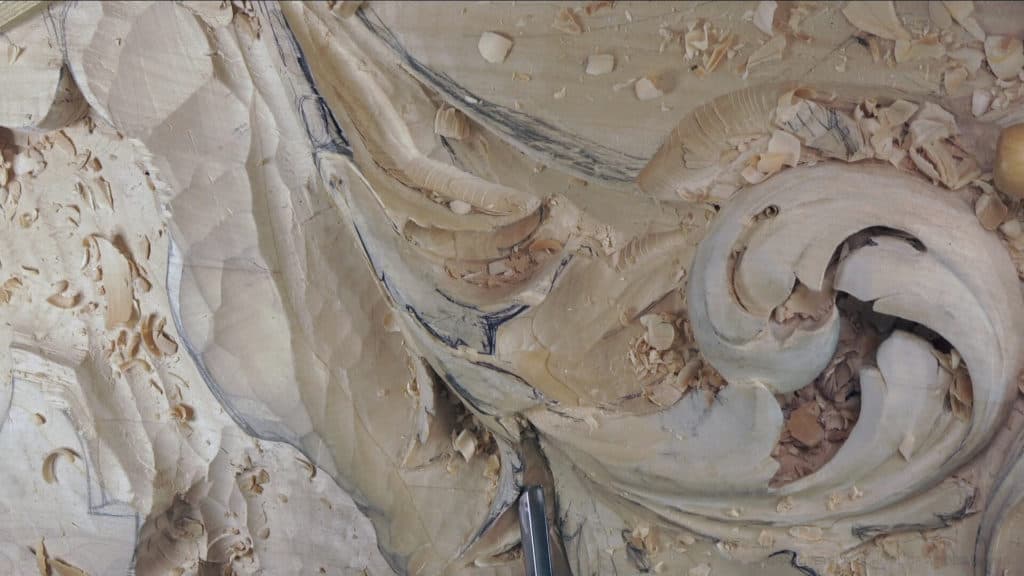
Alexander Grabovetskiy, woodcarver, School of Woodcarving · Published 2020
What does "hope it makes sense" mean when a wood carver says it?
Quick answer: That line is what I said in Venice Room workshop 42, part 8, right after I planned to clean one spot with number seven. In other lessons I say it after a tool, a slope or a shape, and in one lesson I add that it is hard to explain.
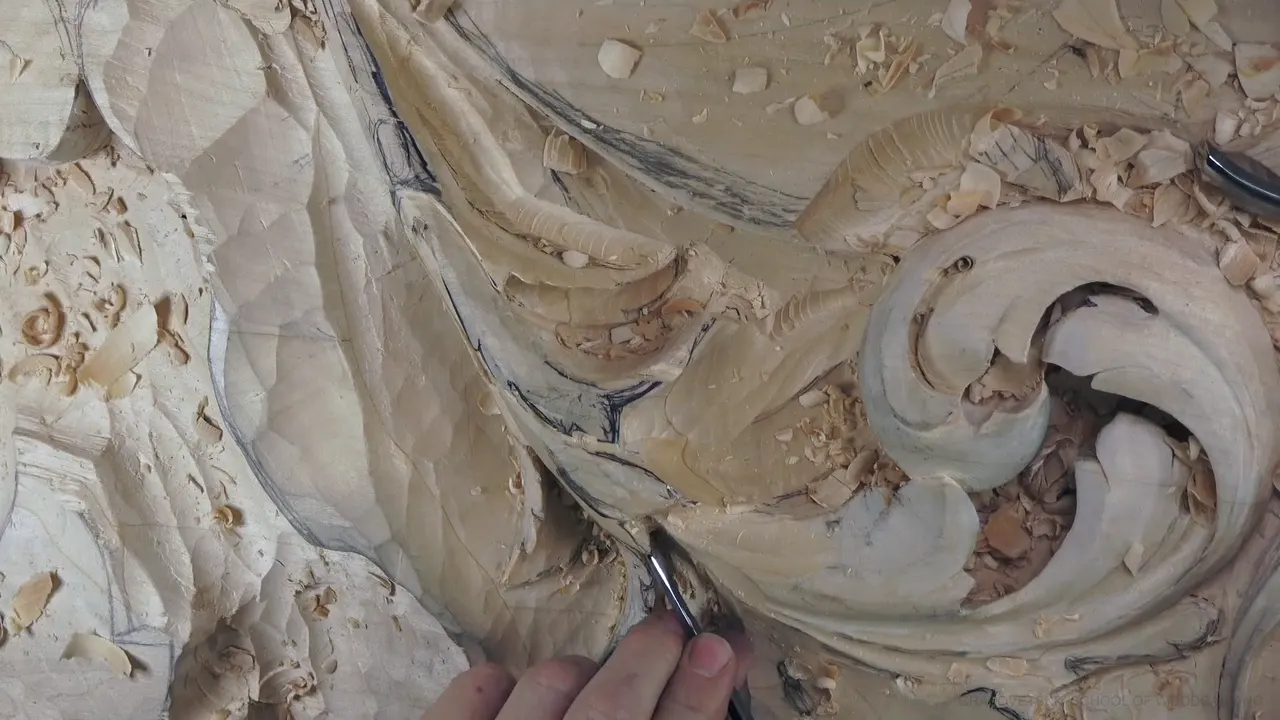

The line is one I say out loud while I carve, and in Venice Room workshop 42, part 8, it came right after my plan to use number seven on one spot. This part is a short one, 563 words in all, so this page sets it beside other lessons of mine where the same words come up.
Ever tried to explain a shape while your hands were busy with a gouge? Have you caught yourself stopping mid-sentence to ask whether the words came out right? That is part 8.
What did I say in part 8 before the line?
Part 8 opens on a tool that will not turn, and I say so at once. "I cannot rotate the veiner because it's a U shape. Veiner is always U shape." Then I said I had to be more careful about how I do it.

Strength came up next. "I did not completely break it. It's strong." Yet I could feel it move with the tool, and see it move too, and that I called not so good.
Depth came after that. "I think it's deep enough," I said, and then, "How really deep should I go?" The plan was just a little bit of cleaning, since that spot is going to be visible from the bottom. Overall movement, I said, was fine, and in my words, "It's actually really nice."

Out loud came the next thought. "Now let me think." Maybe I had to do something like that, because "I don't want to lose overall feel from this point." Another idea was to do exactly what I had done on that side, and maybe it would be better.
One doubt was whether a movement running inside would make sense at all. "It's going down, down, down, and it could be on inside. Yes, it does make sense, actually." I needed to clean that, and then undercut underneath of it.
I loved the idea of curliness right there, "but I also have to be more logical how it's going to work." Some separations were still possible, I said, and they would give me enough curls. I would use number seven to clean that area. Then the line itself: "Hope it makes sense what I just said."

What came after the line in part 8?
Next I said, "I'm going to make that movement go in like that." It would become part of the movement, and there would be my line to undercut underneath. "I have to be really careful how I do it," I said. Number 11 was the plan, "not big, maybe 3 millimeters" (0.12 in), and "just the side of it."
A question followed, "Am I doing the right thing," and then "I hope so." Probably only I would know if it was right, I said, "because I'm the one who's designing it and making the decision how is that going to look."

Smaller and deeper was the wish next, "2 millimeters, I'd say" (0.08 in), but "deep, but not too deep." I still loved that movement, I said, though I needed a better concave in that area. For that, I would use 10 millimeters (0.39 in), number 11, starting gradually.
"That's little too big of a tool," I said. "It's not too big right here," but farther in, "It becomes too big." Still, "I like how clean it gives me," I said. "The look, it's a beautiful concave." Of tools for a job like this, I called it probably the best.

The part ends on a switch. "At certain point, I have to switch to a smaller tool, which is the point is now." Last words: "And I got to take seven."
Do parts 7 and 9 carry it as well?
Not in these captions, but part 7 has a close cousin of it, and I will show you where it sits. At 01:01 I said something didn't make sense, then: "Yeah, it does make sense." I even apologized for saying "let me think," and told you, "Yes, I am thinking, actually. That's why I'm taking time."

The captions of part 9 lack it too. What they hold is a clear look at the work, and a plan to clean it with the 5-millimeter spoon (0.2 in) and "take out all the junk I don't need." After that I could give a final or semi-final form, with a separation on this side repeating on that side.
Which tools sit in front of the line?
Tools do, more than once. Hashemi Flowers lesson 16, in its second video, has me explaining why a tiny handle helps me. It lets a tool go "as low as possible," and "that's why I like those tiny, small handles." I ended that line with "for you what I mean," and went on to the flexibility in the angle I can attack.

Size is the subject in the Roman Acanthus course, lesson 16, part 2. Bigger tools let me use "just a side of it, just a corner of it," and when I need the full property of the tool, I use that. It gave me "a lot quicker result," like "flying versus driving or even walking." A family saying came after the words. My father said repetition is a mother of knowledge, and knowledge is a mother of wisdom.

Part 8 had me using just the side of a number 11. The same move comes in Furniture Panel lesson 26, part 1, with a picture in words: that tool is like a letter U, I said. Use it the normal way with the flute up, to 12 o'clock, or lay it on the side and it becomes a flat tool. "Just cleaning up with the flat side." I followed with, "Well, it should make sense, of course."

Numbers sit in front of those words in the sharpening course. In my video on micro tools, part 2, I said I want a bevel of about 10 millimeters, 14 millimeters on some tools, and some at 25 millimeters (0.39, 0.55 and 0.98 in). Those were my three-eighths of an inch, about half an inch, and approximately one inch. Once I had given the bevel sizes I said it, and added: "If it doesn't make sense, please ask me, and I'm checking my chat all the time."

Where does it follow a plan for a shape?
Many times a plan comes first. In Venice Room 45, part 10, I went around a volute. "There is going to be some excavation, but I need to make it really beautiful." I told you I would show how it develops from this side. "It will make sense," I said, and "I know it will." Then came the plan for number 11, probably 5 millimeters (0.197 in), to start excavating.

Drawing was the work in Furniture Panel 14, part 4. It might flip downhill with a concave, and another concave beside it, and a convex. I said them again right after. The overall size of that volute still did not make me happy, and I thought I should make it bigger. "I think it's looking much better."

Acanthus over Moldings lesson 1, part 2, is about where the tool falls. Each step, I said, the tool falls "right in the middle," and that sets up the next one, and the next. There, too, came the four words. A lot less stress on the tool, I said, and a lot less work for you.

In the Hazelnuts course, lesson 3, part 3, some edges would go up and some would go down. One I could curl slightly up. "I'm not going to put the final detail until I'm really happy with the roll." Past those four words, I thought I could probably drop another one a little more.

For Floral and Molding for the Panel, lesson 10, I said the first step on that side is to establish the main 3D form, the main movement, without the details. All my shapes, movements and curves come first, and then I jump on flowers. The same words closed that plan, with "So I" in front.
The overall shape was the topic in Furniture Panel 33, part 3: just a single division, but a soft one, not like a triangle, more like a number 11 division. Once I had said my line, I added that obviously multiple tools could be used, and that number 11 would be probably choice number one.
And in Roman Acanthus 10, part 1, I named two regions of the leaf that were supposed to go underneath. My four words came right there. Probably just a number five would do for that, a quarter inch (6.35 mm), the same number five as before, working upside down.
From my phone, in Chamomile and Bow Rosette lesson 2, part 1, I showed what I had excavated on the inside and said I wanted to create a twist. "If you look from above, of course," followed the four words, and a little later came "Hope it helped." Number three was the gouge I named.
When did I doubt that the line had landed at all?
Right after saying it, I doubted it. In Furniture Panel 19, part 2, I was describing a second piece set in perpendicular, with the grain running "like this," and said you really need the thicker area, up to 3/32 of an inch (2.4 mm) from the backside. My line followed, then: "Maybe it does, maybe it doesn't." Next I would get a piece of paper and try to explain it a little better, in 3D.

The Greek Acanthus course, lesson 7, part 1, shows a shadow on one side, a V tool, and a leaf leaning one way. I wanted the shadow to fall where I meant it when the light hits. My words ended with "why I do that." My next words were, "I try to make sense of it, but sometimes it's just hard to explain."
Grape Onlay lesson 13, part 2, has a smaller case. I planned the number two, 2 millimeters, a little bigger than a sixteenth of an inch (0.08 in), and talking about how real grapes have a connecting point. It ended in "at least some of the sense."
In Butterflies lesson 2, part 3, the words came, and came again. I wanted much deeper shadow, and I had plenty of material to get it. Near the line you would not reach the quarter inch (6.35 mm), I said, but it would be somewhere right in the center. A little later I told you, "be really careful, be mindful. See what the grain does."

My Grinling Gibbons class in Maine, lesson 11, part 1, has me saying it after I told you the part would drop down and I needed to excavate much deeper, making sure it was just the rolls. I added that at least I could see what needed to be done, because right then it did not look too good.
The scroll saw gave me one in the Lily Box course. Lesson 1, part 3, is me explaining how the blade behaves. When you hold one piece in place, I said, the blade becomes straight and comes to the point. I added, "I'm just trying to explain what I mean."

The odd one comes in Acanthus over Moldings lesson 4, part 2. Time was the subject, and how going back to change a spot you invested so much time in turns the investment into spending. My line came next, and then: "I'm not trying to be a philosophical, but you know, I think it makes sense at least for me."
How do the places line up side by side?
Here are nine of the places, with the plain thing I explained and what came next.
| Where | Explained | Next |
|---|---|---|
| Venice 42.8 | One area to clean, with number seven | Four words |
| Panel 14.4 | A flip downhill with a convex between | A bigger volute |
| Venice 45.10 | Excavation, and a volute that goes around | Sure of it |
| Hashemi 16.2 | A tool with a tiny handle on it | More flexibility |
| Roman 16.2 | A big tool used by its corner | My father's words |
| Furniture 26.1 | A U shaped tool laid on its side | Of course |
| Greek 7.1 | A shadow on one side of a leaf | I try to |
| Panel 19.2 | A second piece, up to 3/32 in (2.4 mm) | A sheet of paper |
| Sharpening | Bevels of 10, 14 and 25 millimeters | Ask me |
In all nine rows, I had explained something plain first. After my line, things went different ways, with a bigger volute in one row and a sheet of paper in another.
What do these parts leave you with?
It is a short line. Here it followed a plan for number seven and an area to clean, and once it was out the plan moved on to that movement going in, and then number 11.
Look at your own workbench now. Is there a spot you could explain with one hand and a pencil? You can find part 8 on the lesson 42 page, and the Venice Room course for workshops 38 to 49 holds the rest of this acanthus work. Every figure in millimeters and inches here is mine, with the conversion beside it. All my courses are in one place: start here.
How it's done
- Name the tool and the area. In part 8 I named number seven for that spot.
- Say the line. At 03:19 I ended that plan with the line about making sense.
- Return to the wood. Next my plan was to make that movement go in, and undercut underneath of my line.
- Ask if the move is right. At 04:34 I questioned my own move, and said I hope so.
- Switch when the tool is too big. At 06:17 I called it a little too big, and at 07:19 I said I had to switch to a smaller tool.
Frequently asked questions
At what point in part 8 did I say it?
At 03:19. Just before, I had said I loved the idea of curliness but also had to be more logical, that some separations would still give me enough curls, and that number seven would clean that area.
What came after I wondered if the move was right?
My answer was that I hoped so. Only I would probably know whether it was right, because I was the one designing it and making the decision how it would look.
Which lessons have me doubting my own explanation?
In my Greek lesson 7, I said I try, but sometimes explaining is just hard. Furniture Panel 19 had maybe it does and maybe it doesn't, and a piece of paper was my next plan.
What to carve next