
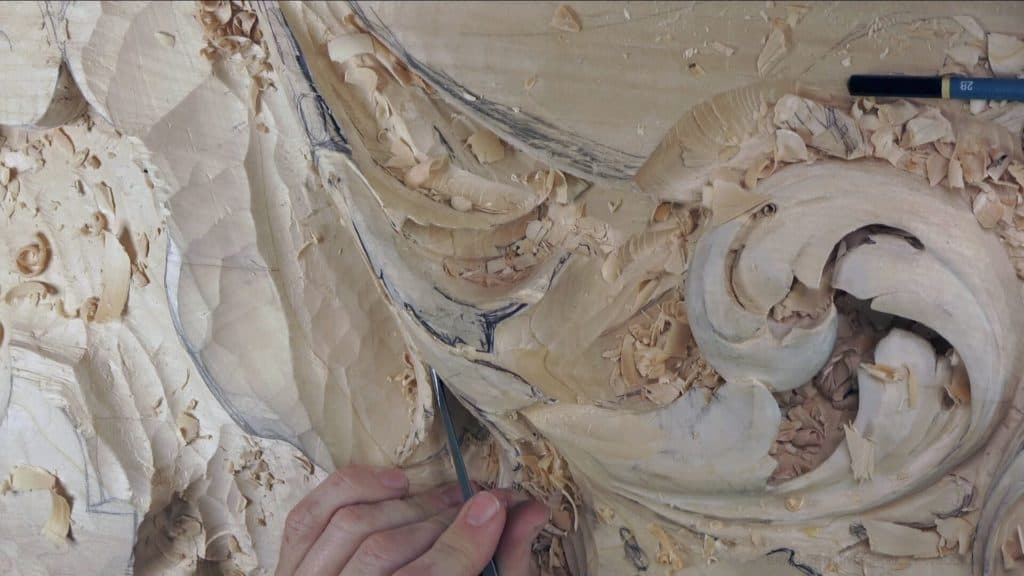
Alexander Grabovetskiy, woodcarver, School of Woodcarving · Published 2020
Is thicker wood better for wood carving?
Quick answer: In workshop 42, part 4, I said depth was a beautiful thing to have. It let me be creative and change stuff, and a board not as deep, I said, would have been a big problem, because I could not have done much.
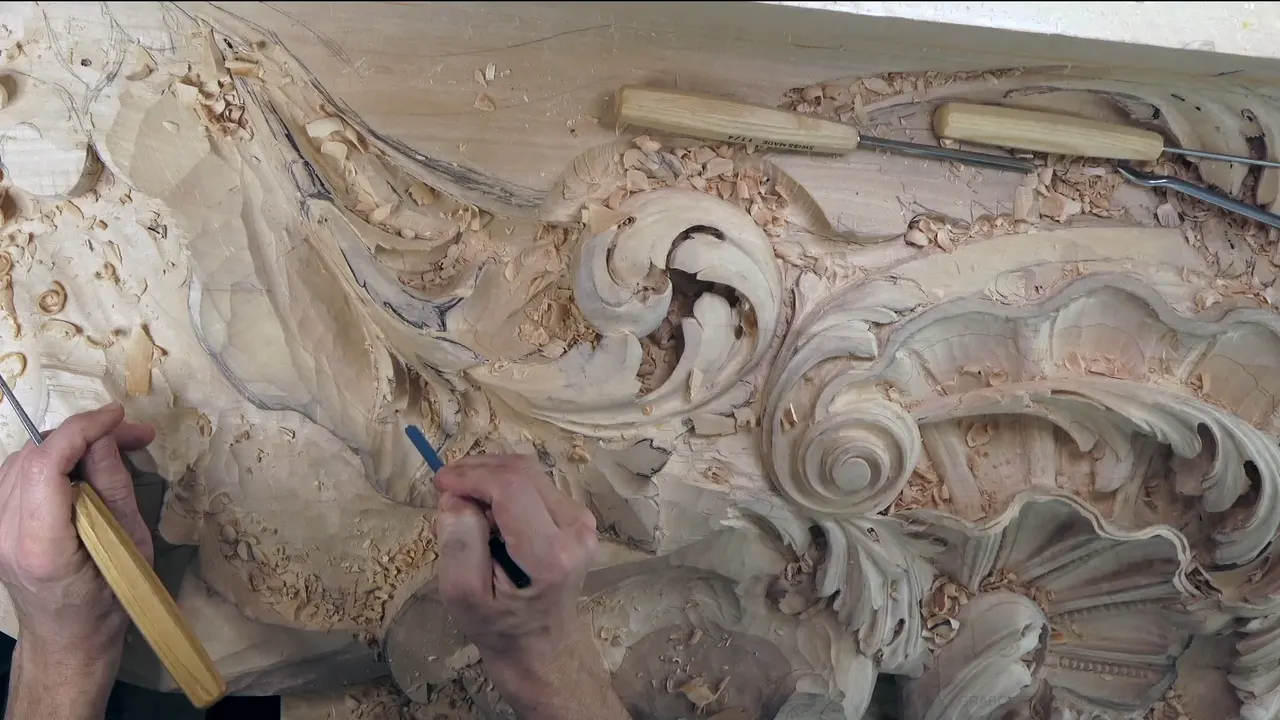
Thicker wood gave me room for a new idea in Venice Room 42.4, and I called that a beautiful thing. I reshaped a part of the carving that was already there.
Ever carved a shape and wished you had one more inch of wood under it? Or looked at a part and wanted to change it, only to find nothing left to change it with? Then you know what this part is about. Below I walk through 42.4, then through other lessons where I talked about the depth of my board.

Why did I call a thick board a beautiful thing?
It came after a new idea. At the start of the part I thought I might make the carving even more beautiful from the side. This side looked a little too bulky to me, so I would take that, make this part a little more tinier, and bring it on inside.
My picture was a main body that lays on top of a folded leaf. For that, one part probably had to come down, another even more down, and a third had to get wider. "Have to undercut much deeper," I told you. The shape just goes on inside. "So let me try to do that," I told you. "I think it's going to look better."

The remark about the wood came while I took that ridge down. A ridge had to come out and go more down, and a number seven was my first choice. And I told you this: "It's actually beautiful thing that I have a really thick piece of wood, and I can be more creative and change stuff."
The next lines were about the opposite case. "If it would be not as deep, that would be a big problem for me because I would not be able to do too much. But now I am." After that I planned to take the edge, so the part would look like it's laying on top of this movement.
How did I use that extra room?
Undercutting came first, with care. The plan was to start undercutting all the way up and approach the division carefully. Kind of hard not to break it, I said, but not impossible. "Just have to be careful. That's it." And then, "More careful."

After that came number 11 again, and I apologized for covering the carving with my hands, since that was probably the only way I could reach it. "If I going to push it, I going to break my edge," I told you. Right after, I wanted to outline those separations at once, because I did not want to lose them, and I thought what I had just done was really nice. "And yes, I do like, actually, what I'm doing," I said, and I liked the idea of how it would look. I also know not too many people who are doing that degree of acanthus anymore.
Another feel I wanted was "even on inside, it goes little bit like that." That was why I used a number seven. It was a straight number seven, I said, so I would use a spoon, and then I needed number 11 again to clean all that mess out.

What I was after was "a big, deep tube, almost like excavated on inside." For that I named a number nine, a quarter inch (6.35 mm), and said I would drill or plug cut. Be careful there, I added, because it is not like working from above, and the grain of the wood makes it a little different.
Smaller was possible, but I really like big, deep shadow in this area. The part closes on the same wish, for a big shadow.

Which Venice Room lessons mention a thick piece?
"See?" That is how the line starts in Venice Room 19, part 5, while I worked around a shape and checked it from the bottom. I went on about having a really thick piece of wood, "so you can do anything with that," and I repeated it: "You can do anything with it." My next tool would be a skew, to knock down a little bit of that side. I thought I could see what it would look like, and you should see too, I told you.

The next part shows the same board from the other side. In 19.6 the more I looked at the section, the more I wanted to change it, "because I have a really thick spot right here." A couple inches (about 51 mm) still went through, and somehow that space had to be filled. Probably my middle point would go all the way down, and I planned to start with a big skew chisel, to knock down a little bit of the main shape. That spot would be visible from the bottom.
In Venice Room 45, part 7, I had the end of a shape to develop. I told you there were a few different possibilities of development. "Because I have a thick piece," I said, and the end was not going to be visible only from a far point. One way was to leave it as it was. Another was a flip that gets a concave, and a third ran around the side to the end. "There is always possibility of overthinking," I said, "which I do not want to do."

A safe clamp comes up in Venice Room 77, part 1. My position had to change to carve a channel in another direction. "Since I do have a thick piece," I said, I could probably clamp it like that, and it was still safe.

How thick was the board in my other lessons?
Roman Acanthus 2 gives the first number. I had really thick wood there, so it was an inch and 7/8 (about 48 mm). My design ran almost to the edge, which made the work kind of dangerous, and I had to go from inside out. Sometimes the wood splits, I told you, but I was not that concerned.

In Corinthian Acanthus 2 I put a figure on the depth I would leave. The piece was somewhat deep relief carving, with about an inch and one-eighth (about 29 mm) of block, and I planned to go down about half an inch (12.7 mm). That much deepness is plenty, I told you. To mark that depth I could place a finger against the board and draw my line, and a marking gauge was the second method I named. With three-quarter inch (19 mm) wood, or 20 millimeters (0.8 in), or 19 millimeters (0.75 in), you would leave just about a quarter inch (6.35 mm) at the back.
Corinthian Acanthus 1, part 2, shows the block itself. It was a really thick block of wood, a solid piece, and it was not glued on. The idea matched my grape carving, a really deep relief, and I named only gouges and a chisel as the tools.

That grape carving is Grape Onlay 1. I called the piece quite big, about 24 inches (610 mm), and really thick. A brand new block of wood was possible, I said, but I did not think there was a reason, because we had not finished the first one.

Hazelnuts 2 starts with a reminder of why the piece was so thick. All three blocks were glued and dry, a full two inches (about 50 mm) in one place, and 75 millimeters (about 3 in) altogether, "or something like that." I planned a full 3D shape, and creating full 3D shapes, I said, was really important. The plan was to block out the big chunks first, to get the right movement and settle how the shape would face.

| Lesson | Thickness | Next |
|---|---|---|
| Roman Acanthus 2.1 | An inch and 7/8 (about 48 mm), which I called really thick wood | Not concerned |
| Corinthian Acanthus 2.1 | An inch and one-eighth (about 29 mm) of block, in a piece of somewhat deep relief | Plenty of deepness |
| Grape Onlay 1.1 | About two inches (51 mm), on a piece of about 24 inches (610 mm) | Same piece |
| Carving Hazelnuts 2.1 | A full two inches (about 50 mm) in one place, and 75 mm (about 3 in) altogether | Full 3D |
| Chamomile Rosette 1.1 | About 7/8 of an inch (22 mm) for the high spot of the rosette | Not required |
| Cutting Board 3.1 | 20 millimeters (about 0.79 in) if you have it, on a board I called really thick | Sufficient |
On Chamomile and Bow Rosette, the piece was about 7/8 of an inch (22 mm). It does not have to be 7/8, I said, though I like the high spot of the rosette at about that. The Curly Kitchen Cutting Board did not need a two-inch board either, and 20 millimeters (about 0.79 in) would be sufficient.

What did extra depth let me do?
In Roman Acanthus 3, part 2, I asked you not to worry if the work was not too accurate right away. You still have lots of wood, lots of material, and the wood is really thick, I told you, so you should not have any problem.
In Furniture Panel 20, part 2, I had the heel side of a knife in mind for the center of a flower. Even deeper was possible right there, I said, because I had plenty of material, plenty of wood. My next thought was a small concave, for some curliness.

On Lily Box 7, part 5, I told you I just made a mistake, and that maybe I should go deeper first, but it was fine. I still had plenty of wood. A little deeper first was still open to me.

When did I say a thick block was too much?
Hashemi Flowers 42 has the plainest case. A thick board, like four inches (about 102 mm) or 16 quarters, could carry all the flowers carved from the solid. But this flower would be kind of high. A two-inch (51 mm) thickness was already there, and three and a half inches (about 89 mm) more would go above it. That makes a six-and-a-half-inch (165 mm) block, I said, and there is no reason. Reaching the areas inside would be really hard, and so would the undercut.

The lumber costs money, too. In my April 2020 livestream I showed a piece glued together in layers of boards two inches thick (about 51 mm), and I was building up. You save money buying thinner pieces than 16 quarter, I said, like four inches (102 mm). Four inches thick was possible for that piece, but I would spend a lot of money, and that would not be wise, because they charge a lot for the thicker piece.
The cutting board gets a gentler line. In workshop 13 the board was thick because I kind of like it, I said, but it need not be that thick. Earlier, in workshop 3, I used basswood, and the thicker piece you have, I said, the more stable it is, so it is not going to warp as much. In the livestream the words went the other way: the thicker piece is a lot more movement. Both lines are mine. Each belongs to its own video.

Where do I turn when the board has no depth to spare?
In Maine class 12, part 1, I looked at a place for a flower. "I don't have enough thickness. That is the problem." I have to work with what I have, I said, and be mindful how much material I have, and I really did not have too much.

Venice Room 62, part 5, has the same trouble. Some pipes were really exaggerated because I did not have a lot of depth to give. I still needed about the same amount of shadows, I said, and that was one of the ways: exaggerate those pipes, and they cast some shadows.
Then comes Venice Room 142, part 1. "The only problem I have, I don't have enough depth," I said, and from the side there was not enough depth to work around. So let me think what I can do, I said. Maybe the movements would be more shallower, and I wanted to round that side and create a dome.
Where does that leave the question?
The board in 42.4 let me reshape a part I had already carved. A spot of a couple inches called for filling in 19.6, and 77.1 let me clamp the work. Hashemi 42.1 called a block that thick no reason, and the livestream said it costs a lot. I give you no single number and no single rule.
What you do on a deep board is your call. The other parts of Venice Room workshop 42 follow this one, and the whole course is Venice Room, workshops 38 to 49. The lessons linked here are wood carving with a gouge in my hand, and the Access page opens every part.
How it's done
- Look at the side. This side was a little too bulky, I thought.
- Reshape the part. Make it a little more tinier, and bring it on inside.
- Undercut deeper. Start undercutting, and approach the division carefully.
- Bring the ridge down. Take out the ridge and take it more down, with a bigger tool and a number seven first.
- Dig the inside. Make it a big, deep tube with a number nine.
Frequently asked questions
Why did I call a really thick board a beautiful thing in 42.4?
A number seven took a ridge down, and then I said a thick board lets me change stuff. Less depth meant doing less, which I called a problem.
Does every carving need a two-inch board?
For the kitchen cutting board a two-inch board was not required, and 20 mm (about 0.8 in) would be sufficient. The chamomile rosette piece did not need to be 7/8 in (22 mm) either, I said, though I like the high spot at about that.
What did I do when a board had no depth to spare?
In Venice Room 142 there was not enough depth to work around, and I thought of shallower movements and a dome. Venice Room 62 got some exaggerated pipes, since I had little depth to give and still needed shadows.
What to carve next