

Alexander Grabovetskiy, woodcarver, School of Woodcarving · Published 2020
What does "it doesn't give me" mean when a wood carver says it?
Quick answer: In Venice Room 42, part 12, I said it right after speaking of turning my tool: it does not give me a clean cut. Next came a question about a back bent, then a plan for a smaller skew on a hump. Other lessons tie the same words to grain, tools, shapes and depth.
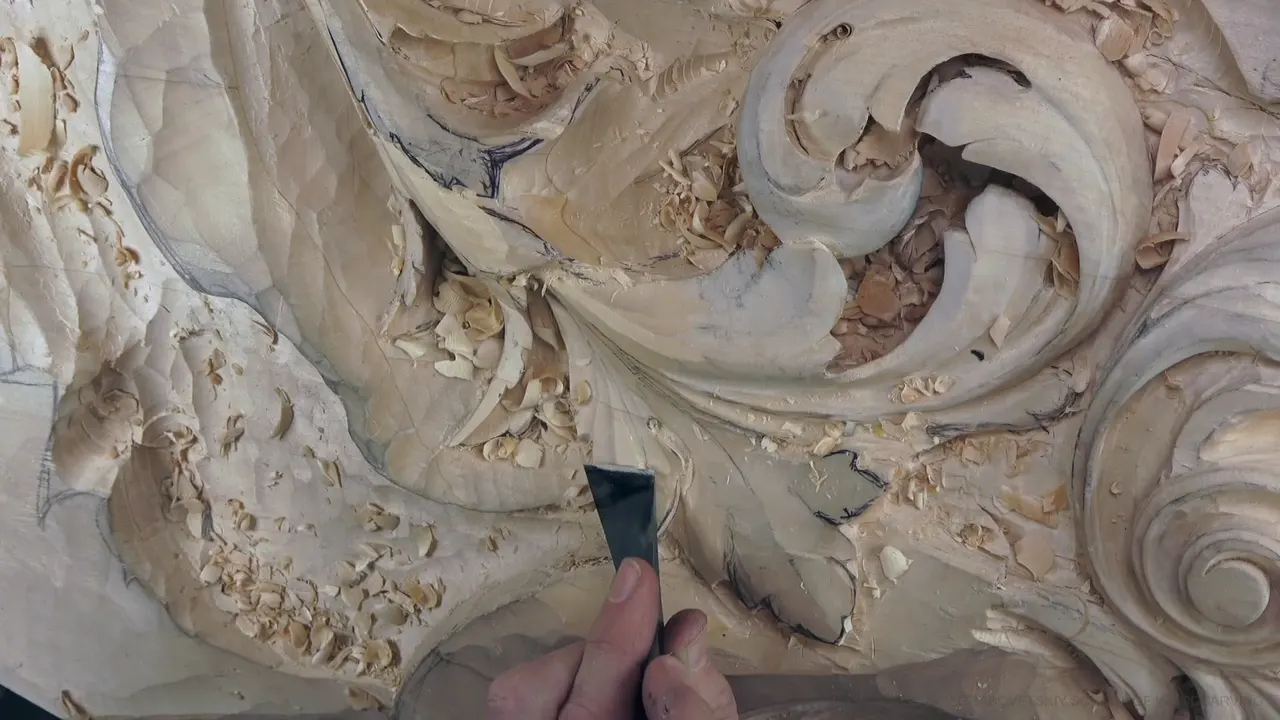

Part 12 of Venice Room workshop 42 has the line at 02:29: "It doesn't give me a clean cut. Now look." I say it when a cut, a tool or a shape has not handed me what I want yet. This part is a short one, 571 words, so I set it beside other lessons where I say something close to it, with what I did next in each.
Ever made a pass, looked at it, and known it was not what you wanted? Did you stop there, or reach for another gouge? Both answers are in part 12, and the lessons after it add more.
What was I carving when the cut came out wrong?
The part opens on a middle line. "Okay, not too deep because this can go right underneath," I said, and then: "So now it looks like the middle line in the right position." Here is the catch. If I cleaned the spot, you would not be able to see that middle line, so I needed to make the movement run from it downhill. That would be gradually, little by little.

A loss came into it. "I know I hate to lose that convex, but it's not going to look right if I'm not doing it." Then: "But let me think." Maybe a smaller tool could get to the middle ridge. If I was going to guess the shadow, I said, I thought I could see that ridge.
At 02:24 I said I could go in the opposite direction and turn my tool. Out came the sentence above. A question followed: "Is that back bent?" I added that maybe I could use a back bent right there, because I really wanted to see that convex. "Not big, but still convex."

A hump came into view. "I've got too big of a hump right inside," I said, and then: "Let me use a smaller skew." A thought about a more pronounced concave followed, for a little nicer movement. Probably number seven, I said, with the deeper concave right there.
Good, I said, but now I needed to blend the ridge: "This ridge is not what I want to see." I needed something smaller, maybe number three, and I would blend it little by little. By 04:56 it looked good to me, though I told you not to pay attention: that was not the final form yet. Close to final, but not final yet, I said; I could always take care of it.

Next I turned to an eye. Maybe I should bring it a little closer, I said, and take the leaf and go a little bit underneath. The best tool for that would be number 11. I could not do big there, I had to do really small. Maybe a little bigger, I said, but not much. I put the size at two millimeters (0.08 in): "That's what I'm using." My aim was to make this piece look as if it went a little bit underneath, and I was not sure I should. It might be a more interesting look, I said, and "I think it is." The part ends on "Let me get this cleaned up."

Where else did a clean cut go missing?
Grain comes first. Venice Room 14, part 3, is where I said to take number nine, go all the way and clean it that way, and I still wanted the concave in view. "Yes, I am cutting against the grain, which is okay." The pass left no crisp cut, not the way I would like to see. To cut from that side I would have to switch to a spoon gouge or so, but I did not need to, since it was going to be paint grade anyway.

Wiggling shows up in that part too. The 2 millimeters (0.08 in) came next, I said, to excavate underneath, carefully. "And yes, I am wiggling slightly." The pass made no really clean cut, but that was okay, I said. The next cut could make it much cleaner. Then I was already experiencing a problem right there, and maybe I had to switch to 1 millimeter (0.04 in). "Actually, you know what, I could use just a straight tool," I said. I named a number 11 of that size.
Control is what the wiggle bought in Venice Room 23, part 11. My plan, I said, was 5 millimeters (0.2 in), number 11, which I called 3/16 of an inch (4.8 mm), to remove whatever I had just made. "It gives me much better control without creating lots of stress on the wood." Same for the hands, I said. Then came the other side: "It doesn't give you a clean cut, though." After it, I said, I have to go back and make a slicing cut. As a preliminary cut, it works miracles, I think.

The same trade shows up in Furniture Panel 21, part 14. Not all wood carvers would approve the wiggling technique, I said, "but it works." I called it a jewelry-making technique. Control was the gain, with not too much pressure, even if no clean pass came of it, since I could always come back and clean it. "I let the tool do the work."

Grain trouble came back in Venice Room 72, part 10. I was carving against it, and the result was not a really good cut. Going from that side was almost impossible for me. The skew was my way out. It could still create a clean cut. "I like it. I like the movement."

Upward, with the grain not in my favor, is the setup in my Maine class of Grinling Gibbons, lesson 13, part 3. That did not bring a really nice result either, and I said so. "But that is just preliminary." My aim was to remove a lot of material, hopefully without breaking it, with a slight wiggle right underneath.
Where did a tool miss the shape or the depth?
Size is the next miss. Number seven, 25 millimeters (0.98 in), about one inch by my words, is the tool in Venice Room 25, part 3, held upside down. "Have to be careful." A slip poked inside of the element, which I did not want to do. The shape was not right, I thought. Maybe number six, I said, and a little later, maybe number five. I called that preliminary.
Depth is the word in Venice Room 34, part 8. One tool I called one inch (25.4 mm) did not feel sharp enough, although I had sharpened it yesterday. A smaller one was my plan, because the first did not reach the right depth, and I would excavate deeper. With the side of the tool I could cut clean on the right-hand side, and I got closer and closer to the edge.

Reach went missing in Furniture Panel 19, part 8. First I said I should create a little deeper concave. "So it looks like number five is not giving me the reach I want." Attacking from the opposite side was possible now, I said, and number six was next. "Looks like number five is not enough." Later: "I kind of like concave by number six from this point down," but not enough on the part right there.

Concave fell short in Chamomile and Bow Rosette 4, part 2. One tool did not hand me enough of it, so I would change it to maybe number five or six. A number 11 would do the blending, maybe slightly bigger, maybe one-eighth of an inch (3.2 mm). "That is what I'm after." A really smooth transition to a deeper concave, I said. On a bigger petal I would create a double concave, but not an exaggerated one.

Tool shape is the point in Venice Room 38, part 12. Careful with number 11, I said, because it is not half a round. It is a U-shaped tool. To go in, I said, it is better always to use number 9 or number 8. You can rotate those, but this one does not hand you that, because it is a U shape.

How do you tell a shape from a feel?
Feel is the word in Venice Room 29, part 12, where a subdivision was in place and I said it was not enough. So an extra movement went on the list, because the spot did not feel too light yet. Extra subdivision, I said, and an extra eye, for a much better movement. The detail was not right either.

By feel I mean this. Sometimes I have to go by whatever feels better, "not just what's supposed to be by the design." And if it does not feel right for me, I said, probably for somebody else it will be the same.
Same level is what I saw in Venice Room 34, part 1: everything looked like it sat on the same level, and the feel I was after was not there. A much deeper concave was my idea, with one part still a convex. "So usually I like to do a concave," I said, but this time I would like to try a convex.

Overall movement went unanswered in Venice Room 48, part 6. A line of movement came first, and then I said it was not what I'm after, I mean the overall movement. Not good, I thought. It would be better to do it slightly differently. Thinking out loud was how I put it, because I wanted to tie everything together.
Finish was the missing piece in Venice Room 50, part 11. It has to be a gradual movement, I said, beautifully moving in three dimensions. "And maybe, well, that is the wrong way." That way left me without a really nice finish, and the other way brought a much better one.

Chunky was the trouble on one side in Venice Room 101, part 12. It did not look too good, I said, because it was too chunky, and it did not have really nice movement. Some kind of roundness on that side was my plan. What I had done right there did not please me either, so that bit would get chopped out.

Airy is what I missed in Venice Room 8, part 3. Something just bugged me there, and I called it not organic, at least for me. There were not enough shadows, so the spot lacked the airy feel I really like to see. Extra cut and extra shadow with the number 11 was my idea. "Maybe it's going to give me much better feel." A little later: "Which I think now it does, but I need to go with the smaller." Maybe 2 millimeters (5/64 in), I said.

Flow was the word in Furniture Panel 20, part 3. The overall feel of the movement still did not make me too happy, and as far as I could see it left me without a really nice flow line. The line was a little too straight, I said, and repeating the movement right there was the aim. A little deeper clean and a recut was one way, and an outline was another. Making it a little lower was an idea too.

My livestream of April 2020 is about shadow. I cleaned with number five, got a little closer, and called a good shadow probably possible. "I don't like that it's just blending too much." Not a lot of shadow was coming, and I really wanted a shadow there. So I would create a deep one, as part of an eye, with a small tool, number 11, only a sixteenth of an inch (1.6 mm), which I called one and a half millimeters (0.06 in).
Motion comes up in The Tray of Blessing, lesson 3, part 2. One lobe looked kind of dull, and a really good motion was missing. The idea was to send it right underneath the next lobe, with number seven, and make a shape like a water drop. One lobe already had really good shadow, I said. The other one did not, but it would if I dropped it even more.
When does it count in the tool's favor?
Tools can win favor for what they leave out. In Roman Acanthus 16, part 2, I said what I like about number 17 is that it does not give a really sharp point. Undercut with a V tool, and the point looks kind of sharp, I said. With number 17 it is a little round on the inside, for a softer look. "That's why I like this tool, probably." Number 16, I said, is also my favorite.
The knife works that way in Furniture Panel 17, part 8. My favorite, even in that application, I said, because I can hold it really low to the surface, and then it is not digging as deep. There is less resistance. "So it's all about maneuverability."
Yet Furniture Panel 22, part 10, shows its limit. The knife made a really nice edge, and for a quick result it is probably a really good idea. I get fast results, I said, and as deep as I wish. That feel of a true three-dimensional feel was missing, I said. There is a place for it, and a better approach for that operation, I think, in furniture style at least.
The shortest case closes the run, in Venice Room 14, part 9, where I carved uphill with number seven, the grain against me, and so far it was okay. No problem there, I said.
How do the places line up side by side?
Here are nine of the places, with what I said was missing and what came next.
| Where | What it was missing | Next |
|---|---|---|
| Part 12 | No clean cut, the line above | Back bent, maybe |
| Venice 14.3 | A crisp cut, against the grain | A paint grade |
| Venice 23.11 | Clean cut, while wiggling a little | A slicing cut |
| Workshop 25.3 | The right shape, from a number seven | Maybe six |
| Workshop 34.8 | The right depth, from a one inch tool | Something smaller |
| Panel 19.8 | The reach I wanted, from number five | Number six |
| Roman 16.2 | A sharp point, from number 17 | A softer look |
| Panel 22.10 | A true three-dimensional feel, from a knife | A better approach |
| Tray 3.2 | A good motion, on one dull lobe | Right underneath |
Each row names a gap. After it I switched, carried on, or changed the plan.
What does part 12 leave you with?
A short sentence that names a gap. The gap in part 12 was a clean cut, and I named a back bent first, then a smaller skew. After those came a deeper concave and a small number 11.
Look at your own workbench now. Is there a pass that came out not the way you wanted? You can find part 12 on the lesson 42 page, and the Venice Room course for workshops 38 to 49 holds the rest of this acanthus work. Every figure in millimeters and inches here is mine, with the conversion beside it. All my courses are in one place: start here.
How it's done
- Turn the tool. My idea in part 12 was going the other way with my tool turned around.
- Say what is missing. At 02:29 I said the pass left no clean cut.
- Try a different tool. I asked if it was a back bent, and then said I would use a smaller skew for the hump.
- Make the concave deeper. I said I might need a more pronounced concave, and number seven was my probable pick.
- Go smaller to blend. To blend the ridge I said maybe number three, and for the eye I named a small number 11.
Frequently asked questions
What was missing in part 12?
A clean cut. My idea was to try the other direction with my tool turned. My next question was whether it was a back bent, and maybe I could use one right there, to see that convex.
Does a rough pass have to stop me?
In lesson 14, part 3, the pass was not a clean cut, but I called it okay. The next cut could make it much cleaner. Part 9 of that lesson brought no problem so far while carving uphill.
What did wiggling bring, and what did it leave out?
Wiggling brought much better control in Venice Room 23, part 11, without lots of stress on the wood, and on my hands. A clean cut stayed out of reach, so a slicing cut had to follow.
What to carve next