

Alexander Grabovetskiy, woodcarver, School of Woodcarving · Published 2020
What does "the right tool" mean when a wood carver says it?
Quick answer: Part 3 of workshop 42 has me saying I needed the right tools for the job. A spoon or long bent was my first thought, with maybe number four, since I did not need to do too much to it. Later I named a back bent, with number five as a maybe.
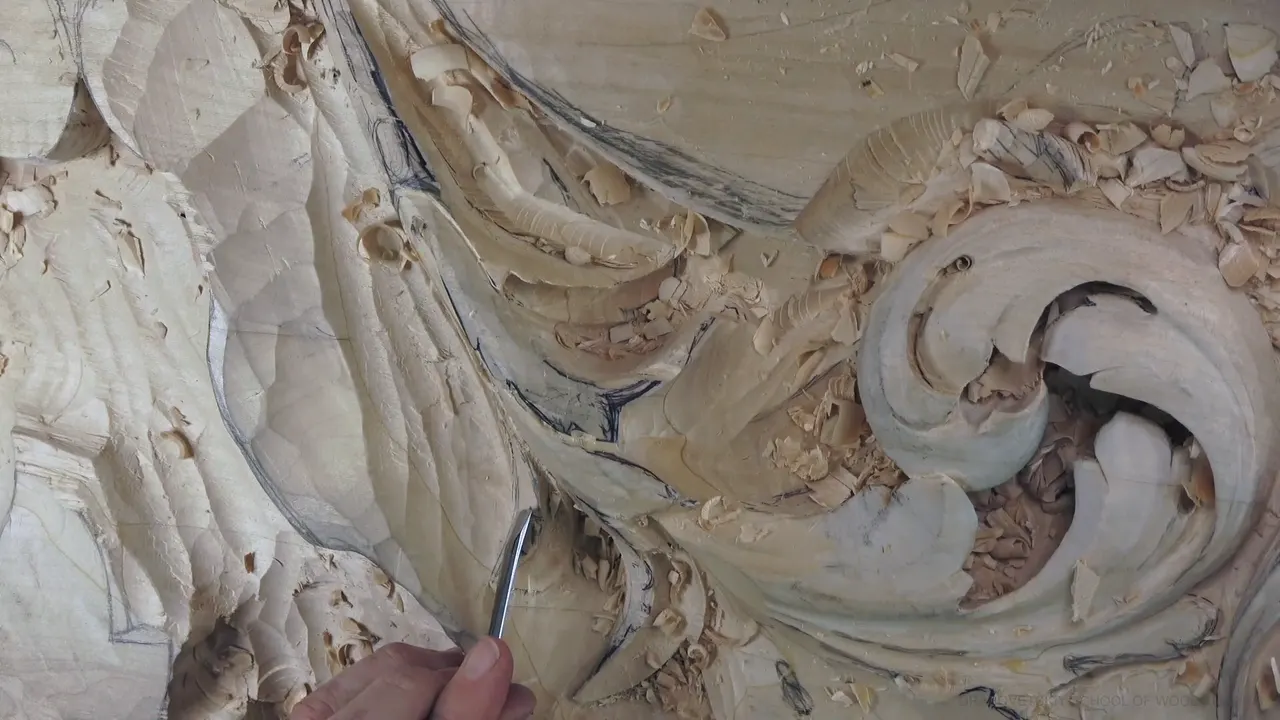

The right tool, in my parts, is the one I name for the cut in front of me: a spoon, long bent, back bent or number. Part 3 of Venice Room workshop 42 is where I named the need for the right tools. Later in that part, a back bent came up.
Ever stood at the workbench with a gouge in your hand and wondered if it was the wrong one? This part has just 362 words. Twenty-nine more of my video parts sit beside it on this page, each with me weighing a tool.
What did I say in part 3?
It starts mid-job. "I need to curl it in." Otherwise, "it's not going to look what I'm after." A doubt followed at 00:26. Maybe I was doing it too quick, and maybe I just needed to relieve it first and get the undercut. That, I called the proper way.

Then, at 01:12, the need got words: "need to get the right tools for the job." In this case, "I got to use a spoon or long bent." Long bent would probably be even better. And I did not have to use a long bent like number 11. I could use just a long bent.
Size came next: "Let me see, maybe number four, no more than that. Because really, I don't need to do too much to it."

After that, number 11. It was "just number 11, and get all that" out at 02:26, and maybe a bigger one at 02:49, "and use the side." By 03:05 I had "a really nice movement downhill, and plenty of movement for the shell."
A slight clean-up with number four was the plan at 03:21. Then, twenty seconds on, came "I could use, actually, a little bigger tool," though it was not final, because this shell would be developed later on. "But a little bit."

Once more, at 04:07, number 11, until all that was gone. At 04:33 came the line this page is built on: "You know what? I should use a back bent. Back bent would be the right tool for the job." After it, "let me think, maybe number five."

Five minutes in, I said I needed a smaller number 11 to get a little more "this way." Then, at 05:44: "And that's the right movement. That's exactly what I'm after." More or less a finalized look could probably develop from there.
A straight number 11 had its limit. It worked only to a certain degree, I said at 06:23, "because that is in my way, and that's almost impossible for me to work around." Then: "let me try from this side." The last cue reads "Number 11, 4 millimeters" (0.16 in), ten seconds after I said the final divisions were next, and one division was going to the point.

How did part 2 and part 4 handle tool size?
The sizes in part 2 step down. Probably 5 millimeters (0.20 in) came first, I said, and then: "Even five now, too big." Gradually down to 4 millimeters (0.16 in) came next, and that was "too big also." So it was, "let me go with the 2 millimeters" (0.08 in) "right away," and soon after, "that is probably enough for now." Of course, a smaller tool was possible. "But that is enough."

Doubt showed up there too. Later in part 2, I said I'd use number seven to get that movement "this way," and seconds after came "Maybe number seven is not going to work in this case."
Turned around, the same phrase sits in part 4. On the inside I wanted a feel that goes a little bit like that, and that is why I was using a number seven. On camera I put it this way: "this is a straight number seven, and that is not the right tool." I said a spoon was what I had to use. A long bend would work too, but I would just use a spoon.

The inside had to be a big, deep tube, almost excavated. My plan was a number nine of a quarter inch (6.35 mm), to drill or plug cut. "I could use smaller, but I really like big, deep shadow in this area."
Where do I say it before I pick up the tool?
In several parts the words come first. Floral and Molding for the Panel, lesson 12, part 1: "All right, so let me get the right tool." The one I had in mind comes in two versions, and I said I could use the bigger one.

Add a size in lesson 9, part 1: a small gouge, three millimeters (0.12 in) or so, like number eight, to attack right underneath. The move was like a drill, without forcing too much, and it "actually got me really wonderful curl."
Space decided it in Panel lesson 5, in the third video. Two pipes were coming, each needing concave cuts on the side, and I had to think about the right tool, "because we don't have too much space right there." Grabbing probably 3 mm (0.118 in) and starting to excavate just on the sides was the plan.

Asking myself came in lesson 14, part 1. Maybe four millimeters (0.157 in) had to come out, or maybe three millimeters (0.1181 in), which I called one-eighth of an inch. I asked myself out loud what the right tool was. A smaller version of the one I had was my plan, with real care, since the spot was shaky and weak with the grain running that direction.

In Venice Room 43, part 3, the shape was right already, and I planned to see whether that tool suited the cut. To give that convex feel I needed the one millimeter (0.04 in), if I could find it. Number 11, of course, and go underneath.

What if two tools could do the job?
Both get named in lesson 13 of the Panel course, part 2. A slope had to run inward, and I paused to get the tool. For the first way I planned on number five, set on the line for a straight-down cut. The other way was number 11: attack first with its side, "like a left wing," and go with the grain until I hit the line.
That second way was also legit. It was "actually safer somewhat," because you don't push anything.
One pick stands alone in Furniture Panel 22, part 12: probably a number five of a quarter inch (6.35 mm), used upside down. I added, "I would say," that it was the right one. Bigger tools, a bigger number five, six or seven, would help a lot "just to give a quick result." We were only establishing the main shape, and the undercut was coming a little later.
Profile is the point in Furniture Panel 21, part 2. Relieved enough, I said, so I could probably hit straight down using the right tools, which could be number 5. And then: "I'm just again trying different profiles, and I'm trying to find the profile which fits." No full fit? Then a small number 3, one-eighth of an inch (3.2 mm).
Furniture Panel 16, part 9, was closer to the final line. Tools for it were next. A number 2 of 12 millimeters (0.47 in), my half an inch, was the one to get, and I would start going down with the gouge right on the line. Then the doubt: maybe number seven in that area, 14 millimeters (0.55 in). "It's going to feel much better."
Both moves sit in Venice Room 36, part 5. Right there, number five "would be the right tool." Then 40 seconds later, the tool had to change to a smaller one, number five also, about five-eighths of an inch (15.9 mm). The same number three could have gone all the way, but changing profiles to fit the line gave me a lot more accuracy.

How do I say a tool is wrong?
Part 10 of Venice Room 26 finds me with that movement still to work on and no wish to damage my future piece. "I don't think it's the right tool I'm using." Next came "use just the flat number nine and 14 millimeters" (0.55 in), which I called half an inch. From the side, number five came right after, as a plan.
A tiny separation in Venice Room 21, part 9, got a verdict that the tool was not for it, though that did not mean it was impossible with that one. Part 11 of Venice Room 16 has me saying the tool or the direction was wrong, and twenty-seven seconds later: "Now I'm happy."
Mid-thought, in Venice Room 30, part 11, I was talking about getting the separations more pronounced when I stopped myself: "That is not the right tool." Next I said I should use a number 11 of 2 millimeters (0.079 in), maybe 3 (0.12 in), "maybe even 1.5 millimeter" (0.059 in). We'll see. "Try 2 millimeters first."
In Venice Room 47, part 2, I spoke of a concave that was not really pronounced but slight, and I said that tool was not the one for the job: "I have to use probably number six or so and move that direction." I had to be careful, too, not to lose a really beautiful detail right there. Earlier in that part I said I needed to chop the point "with the right tool," something like number five.

Sweep can be the fault, as in Venice Room 18, part 9. Number seven and 10 millimeters (0.39 in), trying to create an even deeper cut because I really wanted to see that shadow. "This would be probably the wrong tool because it has too big of a sweep."
Is the right tool easier to find with practice?
The Hashemi Flowers course, lesson 33, part 2, says it comes naturally. "More I carve, more I catching myself just grabbing the right tool." In that carving I was using number five a lot, and some of you may think it is my favorite tool, "but it's not necessarily."

With that carving it can become a favorite, and the next project will bring a different one that I am going to use a lot more. Number 16, a V tool, was the other one I named. Favorites for this project, then, and not necessarily for the next.
Where a tool sleeps matters as well. Leave tools out on a bench in Venice Room 25, part 4, and there is a moment when I can't even find the right tool, because they all get mixed up, "and that slows me down." So the tools were going back right away, pretty much, into the tool chest, and I can always go back and grab the right profile, size and sweep.
Venice Room 18, part 9, goes further. A workbench crowded with tools is something I really don't like, so I try to keep no more than a couple out, two, three, maybe five. Next I caught myself: "I try. I shouldn't say I do that." Sometimes, when I work too long, mess builds up, and then I'm losing my tools.
Marks do not decide it for me. Use a tool every day, I said in the Dining Table Apron course, workshop 16, and you really don't look at the marking or go back and forth, "Oh, is it three millimeters, or is it four millimeters?" "You just kind of keep going and grab the right tool." The old masters made the tools for themselves and did not mark them.
Why does the right tool matter before you cut?
Don't undercut too deep, I said in the Modern Acanthus course, in the third part of lesson 5, "because it's gonna be really hard to reach later on if you don't have the right tool."

Hashemi lesson 7, part 2, carries a promise. I promised to prove that this type of wood carving can be done: "with the right tools and the right approach, you are able to do it." Next came "Work upside down against the grain," and "And I'll clean it."
Two lines come from Acanthus over Moldings. In lesson 5, part 1, I said a back bend would probably be the best, and "I want to be safe." Lesson 8, part 1, is about blending. For blending, I said I'd get the number three, a small, tiny spoon.
What I want to see steers the pick in Venice Room 8, part 3. "Let me choose the right tool," I said, maybe number six, "Because I don't want to create really deep concaves, but I really want to see those ridges, which also cast some shadows."

Blending those cuts together, in Venice Room 41, part 10, I stopped to think which tool to use. With 10 millimeters (0.39 in), number 11 worked just fine. One little region still needed the smaller seven, 7 millimeters (0.28 in), "little bigger than a quarter inch."

A deep concave cut was ahead in the first Hashemi lesson, part 4: "I need to make sure I'm going to use the right tool." Maybe even number nine, I said, and it was number nine, about an inch and one-eighth (28.6 mm).

Not everyone owns every tool, and Panel lesson 1, part 3, says so. It is a good idea to have proper tools, but "I also understand not all of you do have the right tools." Any skew would work to refine an outline, and so would any straight tool, like number three. Number two, I said, was the one I'd grab, placed right on the line for a cut straight down.
How do the places fit side by side?
Here are nine of the places, with the tool I had in mind and what I said or picked.
| Lesson | The tool in question | What I said or picked |
|---|---|---|
| Venice 42.3 | Back bent, the one I named at 04:33 | Maybe number five |
| Venice 42.4 | My straight seven, wrong for the job in my words | The spoon |
| Venice 36.5 | Five, the right one in my words | A smaller one of the same number, about five-eighths of an inch (15.9 mm) |
| Panel 13.2 | On the line with five, or with the side of 11 | Two ways, and the second was safer |
| Lesson 26.10 | The tool I was using, which I doubted | The flat nine, 14 mm (0.551 in) |
| Venice 30.11 | Another tool, called wrong | A 2 mm number 11 (0.079 in) first, and we would see |
| Venice 47.2 | A tool that I said did not suit the job | Probably six or so |
| Panel 5.3 | What fits a small space beside two pipes | Probably 3 mm (0.118 in) |
| Hashemi 33.2 | The five I used a lot in that carving | Not necessarily my favorite for the next project |
In six of the nine, a named tool was then called wrong, swapped, or joined by a second way.
What do I take from all of this?
Picks changed in these parts. Across part 3, my thinking moved from the first idea to a back bent, and on to a smaller number 11. In part 2 the sizes dropped from 5 to 4 to 2 mm (0.197, 0.157 and 0.0787 in). And Venice Room 36 swapped a number five for a smaller number five.

Look at your own workbench now. Which tool is in your hand, and what does the cut in front of you need? My choices are on camera in part 3, and the lesson 42 page covers the whole workshop. For all my lessons in one place, start here.
The Venice Room course for workshops 38 to 49 holds the rest of this acanthus carving. These videos come from my Venice room carving and other courses of mine, and every figure in millimeters and inches on this page is mine, with the conversion beside it.
How it's done
- Name the job first. Part 3 starts with a need. I wanted a spoon or a long bent, in a small size.
- Give the reason for a small pick. My reason was that the job did not need much.
- Change the tool when the cut changes. At 03:41 I said I could use a little bigger tool, and later I named a back bent.
- Step the size down. Part 2 stepped down, and I called 2 mm (0.08 in) probably enough for now.
- Say so when a tool is wrong. Part 4 has the opposite case: a straight seven that was the wrong choice, and then a spoon.
Frequently asked questions
In part 3, which tools did I name when I talked about the job?
First a spoon or a long bent, then a back bent. After it came number five, as a maybe. I also said a long bent like number 11 was not required, because I could use just a long bent.
Why did I call a straight seven wrong in part 4?
I was after a feel on the inside that goes a little bit like that. A straight seven was not right for it, I said, so a spoon was what I had to use.
How did I choose a size in part 2?
Probably 5 millimeters (0.197 in), I said, and I found even five too big. Four (0.1575 in) was too big also, so 2 (0.0787 in) was next, right away.
What to carve next