

Alexander Grabovetskiy, woodcarver, School of Woodcarving · Published 2020
What does "awesome" mean when a wood carver says it?
Quick answer: "Awesome" is the word I use for a look I like. In Venice Room 42, part 11, it went to the overall shape of one movement, once its concave, convex and concave were in. Blending was the next thing I named, and later in the part the middle line still needed a twist.
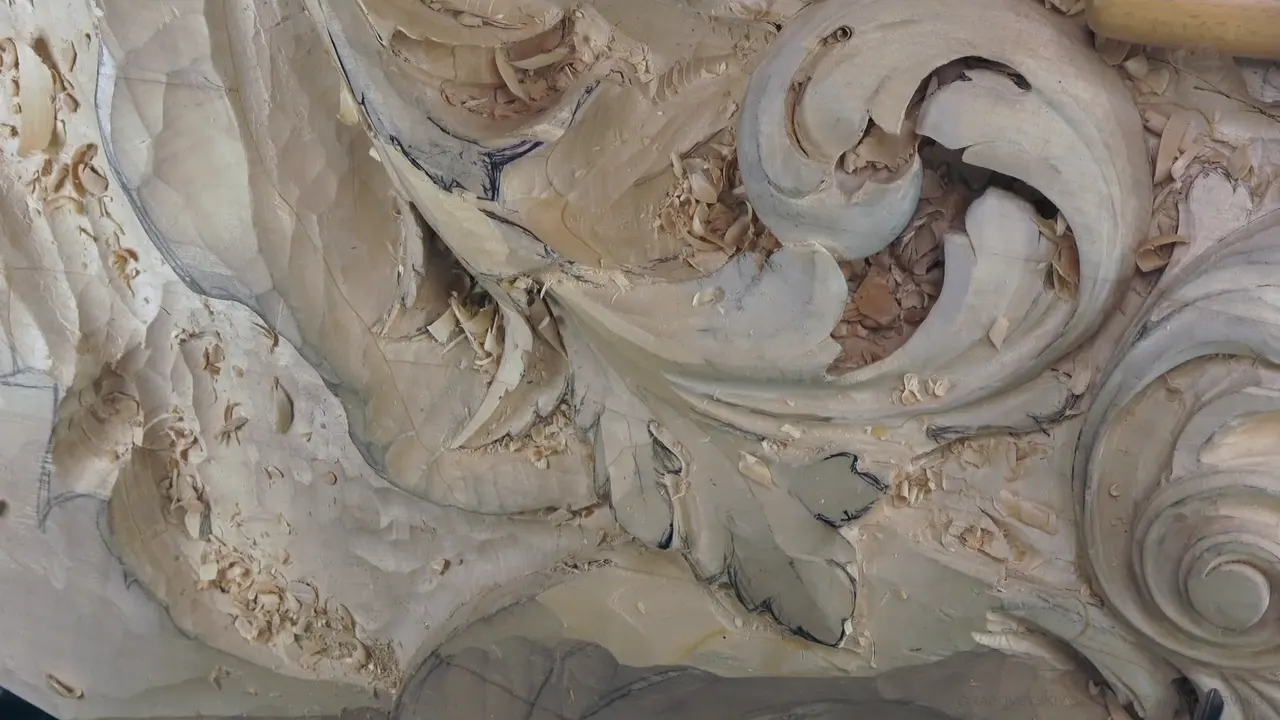

"Awesome" is my word for a look I like, and in part 11 of Venice Room 42 I said it about the overall shape of one movement, not about one small spot. It came once a concave, a convex and another concave sat side by side. The next thing I named was a little blending.
Have you ever stood back from your own wood carving and liked the whole of it? Did one line still bother you a little later? Then you already know how I use this word. Below is part 11 from start to end, and next to it some of the other places in my courses where I said awesome, with what I did or planned right after it.
What the word covers, in six lines
- In part 11 it named the whole movement, not a single spot.
- Blending and the middle line were still ahead of me.
- Several times it came with "going to", before the work was done, on a Byzantine leaf among others.
- Once I heard myself and called it a kind of encouragement.
- I call it my opinion, and I told you that you don't have to agree.
- A router plane and an even depth earned it too.
What did awesome mean in this part?
The overall look of one movement on my Venice relief panel. Just before the word, one spot I had raised came out a little too big of a raise up. I need to probably just give a better shape to it, I said.

Then came a but. But I like the overall concave, convex, concave. So overall, it looks awesome.
The word came with a flaw named out loud and a fix still owed. What I liked was the whole shape.
Which smaller calls led up to the word?
Plainer words came first. Part 11 opens on a spot where a shell is going to go inside, and early on I said that is good.
Then, that is actually really good. I don't think I want to do anything else, I said, and a few words later I was weighing whether to give a shape this way or that way, with knock down anyway a little bit this way as the call.

I'm going to use number 11 at three millimeters (about 1/8 in), I said, to clean a little more on the inside. After that, let's give an overall shape. One part was a bit too pointy, so I need to make a transition.
The points got a plan. One really pointy, the next less pointy, and the last absolutely no pointy, with no sharp point at all.

Now I can start developing details, I said. Three millimeters again, though I could use bigger, maybe four millimeters (about 5/32 in), number 11, to get underneath.
Let me think how I want to see this one, I said. Then a well, actually. It does look good. It goes up, it repeats that part, and this is going up a little bit, too, so maybe it makes sense.

My plan right there was a concave, with this ridge raised up a little, for a little better movement. I could get a bigger concave if I wanted to, I added.
A number seven left one concave a little too small. I think I should give a little bigger than that, I said, and I named a number eight. Then I said go around the pipe. Now this one is a little raised, and that is a good thing.

A convex was possible there, but a concave would probably look better, and I said do this concave also.
Count the words with me. Good came first, then really good, then it does look good, then a good thing. Awesome came after them, and it was the one for the overall.
Here is part 11 again, five moments in a table, with my words and the job that came next.
| Moment in part 11 | My words about the wood right then | The next job |
|---|---|---|
| Near the start | Actually really good, and I didn't think I'd do more | Knock it down a little anyway |
| Developing the details | It goes up, it repeats that part, maybe it makes sense | Concave, and raise the ridge |
| Around the pipe | A little raised now, and that is a good thing | Concave, probably better looking |
| The overall shape | I like the overall, and it looks awesome | Blending together a little bit |
| The middle line | Really nice, though the middle line needs a twist | Chop with number five, one inch |
Does awesome mean the carving is finished?
Far from it. In part 11, a little later, I said that is really nice, but I don't see the middle line.

I see the middle line, but it's not how I want to see it. So that is the middle of the movement, and everything is supposed to go to the middle. Somehow I need to probably go out like that and just twist my middle line this way. Otherwise, it just doesn't look too good visually altogether.
So that is going to be my middle line, and I need to chop out this section. I'm going to use number five. Number five, that's one inch (25 mm). The part ends right there, on that plan, and the next part picks it up.

Part 12, right after it, opens with the answer. Now it looks like the middle line in the right position, I said there. I moved that to the right position.
Even then the middle line had more to ask of me. If I shaved it or cleaned it, I said, you would not be able to see that middle line, so I need to create somehow the movement from the middle line downhill.
The flower bouquet on my furniture panel was plainly unfinished when the word came. On the side I can create some more shadows, I said, and next time I will attack the rest of the flower. Yes, I know it doesn't look finished yet, because it's not finished, of course. But in overall, it looks really awesome.
It looks like this tool needs to be sharpened, I said in workshop 40 of this same room. Oh, I don't think, I know it has to be sharpened. I feel it. Then, okay, and that is looking awesome, and the next words were let me also just break this ridge, the pipe.

Why say awesome about wood that isn't carved yet?
Workshop 62 of the Venice Room is where I caught myself at it. The plan was a slight slope over one area, and then I was going to develop an inner part. It's going to look awesome, actually, I said, and I said it twice more right after.

Am I trying to say that to myself? Just kind of encouraging words to myself. I know I can do it, because I've done it, and more than a couple times I've done it.
On my Byzantine acanthus, I wanted the bulk of one part closer to the golden ratio, and a pencil went around it, because a texture was going all the way to those marks. I said it would look awesome. Well, at least I hope.

The lily box had me trying to stay as shallow as possible. I was really close to the edge, next to a flat area, and too deep there would make it much harder to blend the flat area to the leaf. Believe me, I said, it's still going to look awesome.
And on my Venetian flowers rosette, I said I could go even with a half millimeter number 11 (about 0.02 in) for a really beautiful shadow, although nobody's going to see that. Maybe someone will. From above, it looks actually awesome, and once undercut it would look even better. I know that for a fact.
At the end of a day on lesson 32 of the furniture panel, my words were so that's how it looks in overall, I do like it. Do not judge yet. It is not done. Once it's done, it's gonna look really awesome. Well, it should look awesome, but let me just show you how it looks.
On the floral and molding panel, I'd get a 3 mm number 11 (about 1/8 in), I said, and go a little deeper, and as of now it did look good, though not too good on the camera. Awesome was my forecast there too. I'm just not spending my time on details yet, I said.

Is awesome just one carver's opinion?
Coming from me it is, and I say so on camera. On my furniture panel background, a small detail sat inside another detail, level with the one next to it. In my opinion, it looks awesome. I think it looks awesome, I should say. You don't have to agree with me, but I think so.
All it takes right now, I added, just to clean up.
One part before that bouquet moment I got a beautiful shadow and said so. Then I explained myself. When I say I've got a beautiful shadow, it's just what I think about it, and it will look really awesome once it's done, I told you, two times.

I even asked about my own words once, in workshop 67 of the Venice Room. My plug was out, made with a quarter-inch number nine (about 6 mm). Beautiful, right? How many times did I say beautiful? I don't know. But I think it's a good word.
Beautiful, great, wonderful, awesome, gorgeous. Everyone's supposed to use those words if you're an artist, I said, and then I was going to do exactly the same again.

Does it matter where you look from?
In the Venice Room it did. Back in workshop 24, I described you standing on the floor and looking up from this position. From there it would look really good, really awesome, because gradually you will see the secondary edge from the bottom even.
One detail in workshop 67 goes on the ceiling, and that's why I called it an awesome detail. It's going to be visible really nicely, I said, with a lot of shadows.

Can a tool or a depth be awesome too?
A tool can. During the seventeenth lesson of that panel, probably I could do most of it with just the gouges, I said, but for some reason I was really having fun. It just feels really good to use this router plane. It feels awesome, I should say.
A depth can too. In an earlier lesson on that background, the router plane was on a spot only an eighth of an inch (about 3 mm) deep, along the grain. If I press too hard, I can make a big mistake, and that would be probably my stopping point.
Then the result is awesome. Absolutely awesome. Same depth, exactly what I wanted to see, an eighth of an inch.

Over in workshop 61 of the Venice Room I talked about a line of tools I love, because the tool is super light, with really thin walls. It's a really good tool for a softer wood, like lime or basswood, and in harder wood a thin tool can break easily. But for this operation, it's just super awesome. Can I say super awesome? Is that even a word?
My hazelnuts course has the word too, for a half millimeter tool (about 0.02 in) that in my opinion is a must-have. With it, on the hazelnuts, I can clean around and get really deep, super deep, and it would look awesome, I said.
Two knives with some curvature got it on my plate with butterflies. Just so awesome, I said, because when you look at the board, it has a border, and that border is on the way sometimes. With them I can attack a detail and it's not on my way.
When did awesome describe something already finished?
Back in Russia, in a Russian jail, I had to make some furniture and some marquetry. Sometimes I didn't have any veneers to do real marquetry. So I used simple birch plywood and cooked a stain. We didn't have any walnut. We used pine bark.
I would draw a picture, take a really tiny gouge, one millimeter (about 0.04 in), and make my separations right on the picture. It would look like I used different veneers. It looked awesome. People didn't even know it's not true marquetry.
I told that story in my beginner course on the curly kitchen cutting board, with the color on that board in front of me. I really like the color, I said, how it's developed right there.
Where can you watch part 11?
You'll find part 11 among the twelve parts of Venice Room workshop 42, which comes right after workshop 41. Workshops 38 to 49 are all in Part 4 of the Venice Room. If you'd like to see the overall look come together and the middle line move, every course of mine is one click away when you start here.
How it's done
- Look at the whole movement. Before the word, I looked at the overall, all three curves together.
- Name the flaw out loud. A little too big of a raise up, I said, so it needed a better shape.
- Go up a size when a concave comes out small. A number seven made one a little too small, and I said I should give a number eight.
- Call the overall. Then the word came, for the whole shape, and a little blending was the next job I named.
- Check the middle line. Everything on that movement is supposed to go to the middle. Mine needed a twist.
- Plan the fix. Twisting the middle line and chopping out a section with a number five, one inch (25 mm), was my plan.
Frequently asked questions
Is awesome the same as done on your carvings?
Done was still a way off in part 11. Right after the word I named a little blending, and later I didn't like how the middle line looked. The plan then was to twist that line and chop out a section with a one inch number five.
Why would a carver call wood awesome before carving it?
I wondered about that myself in workshop 62, after saying it three times in a row. Kind of encouraging words, I said. I knew I could do it because I had done it, more than a couple of times.
Which other words sit next to awesome for you?
Beautiful, great, wonderful and gorgeous, in the list I gave in workshop 67 while a plug from a quarter-inch number nine sat in front of me. Everyone's supposed to use those words if you're an artist, I said. Just before, I couldn't tell you how many times I'd said beautiful.
What to carve next