

Alexander Grabovetskiy, woodcarver, School of Woodcarving · Published 2020
What does "too early" mean when a wood carver says it?
Quick answer: "Too early" is my way to hold back a step. In part 2 of workshop 42 the final undercut waits for the shell, and number seven may not work in this case. In other lessons the words sit beside other reasons.
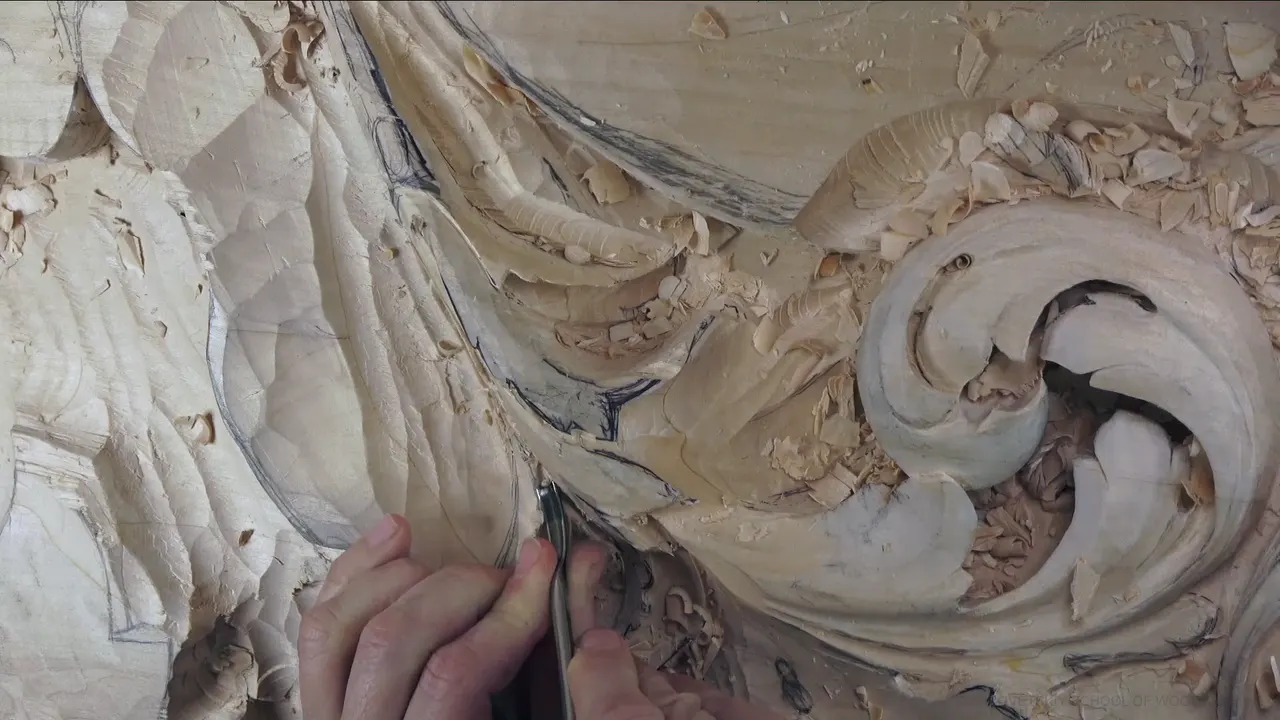

"Too early" is what I say about a step I am putting off. In Venice Room 42, part 2, the step is the final undercut, and I say it waits for the shell. In other videos of mine the same two words sit beside other reasons.
Ever stood at your workbench with a gouge in your hand and the next step sitting right there, ready to go? Ever wondered if the wood is ready for it? This part is short, 383 words, so I put beside it what I say about "too early" in other lessons and other courses of mine.
What does "too early" mean in this part?
The words come at 04:39, near the end of the part. As far as the final undercut goes, I say, I'll do it later, when I work on the shell. Right now, that would be a little too early. Then a short line to you: "But you should be able to get the idea."
Most of the part before that is about size. Part 1 ends with a spoon gouge of 7 millimeters (0.28 in) that is too big, and I say I need a smaller one. The next part opens with a plan: probably 5 millimeters (0.20 in). Even five is now too big, so I move gradually to 4 millimeters (0.16 in).
Four is too big also, and I go with the 2 millimeters (0.08 in) right away. By 01:04 I call it probably enough for now. A smaller tool is possible, no problem, I say. "But that is enough."

Next I turn to another spot. At 01:21 I want to figure out how that one will develop. It must not get too narrow, and maybe I have to start moving this direction a little farther. So: let me get the skew chisel and see if I'm going to chop that down, and if it's going to look good or not.

The skew test gets a verdict at 02:55. Careful, I say, but it looks like that gives me the idea I'm after. Then comes a waste, in my words, and I can probably take care of it with just the number 11. A short line follows: "And that will be undercut."
I also need to get smaller, number 11, and get inside of there. Number seven comes in to clean a little better inside, at 05:20. Then, at 05:35: "Beautiful movement. Really nice movement." A smaller tool could get even more inside, but I don't have to do that right now. Not at this point, anyway.

The part ends on a maybe. Number seven comes up at 07:06 to get that movement this way, and the doubt arrives at 07:20: "Maybe number seven is not going to work in this case."
Why does the final undercut wait for the shell?
The reason comes in part 5, at 07:47. I leave final undercuts until I develop the whole thing, shell and all. First of all, I might change something. "And why spend time right now and then redo some?" Semi-finish is okay. But finish finish, I say, is too early.

The shell shows up again in part 3. At 03:41 a little bigger tool is possible, although it's not the final, of course, because this shell will be developed later on. Back in part 1, at 04:51, I want to shape one side a little bit, but "that would be too early to give a finish." I'm just creating a twisting effect there, and the side will curl down later.
A worry about feel sits near the start of part 1. I will undercut, I say, but not too close to the line, because once I undercut and round that, I could face the danger of losing how it feels. The undercut stays a plan there.
A small version sits in part 10, where a hump needs my attention and just a skew chisel removes it. Next I hold back: not too much, since that part still needs developing. "I don't want to make mistake and remove too much too early. All I need is just little bit."
Can you clean a spot too early?
A spot in Venice Room 2, part 1, is not at its final destination yet at 00:09, so maybe cleaning is early. Six seconds later I say it again: "I think it's too early to clean." Number five comes next, three-eighths of an inch, which I call 10 millimeters (0.39 in).

A different lesson, Venice Room 14, part 7, has me saying I can go underneath a little bit if I need to, though I don't really have to, and then go in and clean. Probably early, since that side needs developing first. Next comes: I really don't need to run ahead of my horses.

Over in Venice Room 55, part 12, you could clean pretty much right away, I say, although it's not developed yet. Maybe early for cleaning. Furniture Panel 31, part 2, has the same call with a number five: no cleaning yet on the inside. I can actually jump on this leaf instead.

The Lily Box course shows me cleaning a little anyway. In lesson 7, part 9, the mass on that side doesn't worry me yet, and a smaller tool could remove all that waste. Cleaning everything is too early yet, I say, since undercutting is still ahead. Then the smaller tool comes out. It just bugs me, I say, that I've got too much waste right here.

My own reason sits at 15:14 in the Grape Onlay course, lesson 11, part 3. Cleaning that little is, for me, early. Suppose I change something or break something after so much time cleaning everything. That would not make me happy.

What about going deep?
Workshop 97, part 4, outlines with a number 11 of 5 millimeters (0.2 in). A deep outline is not the plan right now. Going deeper would be early, I say, because the main form is not established yet. Just a little bit, maybe about 1/16 of an inch (1.6 mm) deep as of now, and then: "It's not the end yet."

In Venice Room 21, part 4, a deep one I made before catches my eye. Probably better not to do those deep ones this soon, I say. Fine, though. Once we use a gouge in this movement, it will be gone.
The Furniture Panel course, lesson 16, part 4, has a straight down line at the outline. Not final, final, I say, but the initial outline, with the final one still ahead. I leave it just slightly above the finished surface and don't really need to go all the way yet.

In the same course, lesson 18 starts with a one millimeter (0.04 in) to clean up. Undercutting waits. Later I will, but it's a little too early for that. Then comes my line about the router plane: let me use it now to reach the final depth, still a 16th of an inch (1.6 mm) blade. Getting all the way is impossible, but a small pass shows what the final depth is going to be.

In lesson 23, part 9, the talk is about shadow. A half a millimeter (0.02 in) number 11 could get inside a little deeper and give even more. Not yet, I say, twice: too early yet. The surface is too flat and doesn't look too good, I say, so we still have to create some kind of movements.
Can a part get too weak too early?
Strength is the worry in these Venice Room workshops. A tool is a little too big now in Venice Room 44, part 3, and 2 millimeters (about 5/64 in), number 11, takes over. This edge must not get too weak too early either.

Leaning on pieces that I may weaken is the worry in Venice Room 47, part 12. I'm doing this before I finalize the forms, I say, and some concaves and convexes are still ahead. Leveraging against some of the pieces could make them too weak. A chance to work my final details comes a little later, but now I need to excavate to the right depth.
A lesson that comes after the fact sits in Venice Room 54, part 8. You know why it happened, I say: I went inward too early with my skew chisel and took too much material out before I created those separations. "So that's another lesson for myself." The area behind the ears gets left alone until I'm finished with the face, I say.

What waits when a design is still moving?
A question to you comes up in Venice Room 37, part 6: see why I didn't do all those concaves and convexes yet? I knew it's not done. Attacking that early would be a big mistake. Blending the shape comes right before.

I turn it on myself in Venice Room 41, part 3, at 00:43. Maybe I put those divisions in too early, because a lot more excavating is still to come. A little later comes number seven, approximately half an inch, 14 millimeters to be exact (0.55 in).
The middle line is the subject in Venice Room 33, part 3. "There is going to be my middle line. But that is probably too early because it's not as clean yet." More undercut underneath is needed first, I say.

A pause like that turns up in Venice Room 90, part 2. I can do exactly the same right here, but it is early. Going right away to the final stage isn't needed, since those surfaces need to be established first and I want to be happy with the overall design. Meanwhile, small separations are possible.

When do I go ahead anyway?
A correction sits in Venice Room 36, part 4, one that I voice myself. Double-check and clean nicer, I say, but undercutting it can wait. Early, I say. Then: I will, but not yet. Maybe I will. "I shouldn't say I will because there's a few different ways of development of this." Maybe no undercut at all, and maybe something different.
Lesson 19 of the Furniture Panel course, part 5, goes ahead anyway. Number five, I believe, will work, at 12 millimeters (0.47 in). I will place it right on the outline at the beginning, lean a little inward, and initially just undercut right there. "I'm not sure, maybe it's too early, but it's okay. So that is another way of doing it."
Part 11 of lesson 20 in that course has a switch of tools. Number three is the plan, then a turn: "Well, actually, no." That comes too early. Undercutting comes first, with a one millimeter (0.04 in) number 11. Next, half a millimeter (0.02 in), number 11, to continue my undercutting even deeper. A mallet is in my hand right then, and I can go extremely underneath. Care is still needed.

The same lesson holds an undercut back in part 7. Later we will continue undercutting on this side. Right now the petals are in my way, which makes it almost impossible. It's possible, but there is a better time for it.

No undercut yet in Venice Room 59, part 7, since the section must develop into the smaller divisions first. "I don't want to rush it too early." A deep one could come first, and I want to see if a quarter of an inch (6 mm) fits, a plug cut. It's going to give me a really good shadow, and an idea how deep to go. The undercut still comes later on.

The pattern repeats in Venice Room 51, part 9, and Venice Room 62, part 8. In 51, the undercut with number 11 comes later, since I am still working out what I want to see with this development. The eyes of 62 get a plan: excavate on the inside with number nine and create a plug cut. All of it waits until I clean everything.

In Roman Acanthus lesson 8, part 2, I'll take the same gouge and start digging in inside on an angle, and you can see how the shadow comes from inside. I say it is too early now, because the symmetry still has to be set. This side is already a little higher than that one, and undercuts like that have to wait.

How do the places fit side by side?
Here are ten of the moments, with what had to wait and the reason I gave in each.
| Lesson source | What had to wait for a later step | The reason I gave for holding it back |
|---|---|---|
| Venice 42.2 | The final undercut, which I do later on | The shell comes first |
| Venice 42.5 | Final undercuts on the whole carving, shell included | I might change something |
| Venice 2.1 | Cleaning it up, which I called early | Not the final destination |
| Venice 14.7 | Going underneath a little bit to clean | That side needs developing |
| Venice 33.3 | The middle line that is going to come | Not clean enough yet |
| Venice 97.4 | A deeper outline than just a little bit | No main form yet |
| Panel 20.7 | Continuing the undercut on this side, later | Petals in the way |
| Panel 23.9 | A half millimeter (1/50 in) number 11 for more shadow | The surface is too flat |
| Acanthus 8.2 | Undercuts, as I just explained them | No symmetry yet |
| Onlay 11.3 | Spending so much time cleaning everything | Something may change |
Four rows name work still to do first: developing a side, cleaning a line, setting the main form, and setting the symmetry.
What do I take from all of this?
Plain reasons follow the words. In workshop 42 it is a change I may make. A middle line in workshop 33 needs more undercut underneath first, and in the panel course the petals are in my way.
Now look at your own workbench and find one step you are about to take. My lines sit on camera in part 2, and the lesson 42 page covers the whole workshop. For all my lessons in one place, start here.
The Venice Room course for workshops 38 to 49 holds the rest of this acanthus carving. These videos come from my Venice room carving and other courses of mine, and every figure in millimeters and inches on this page is mine, with the conversion beside it when I did not give one.
How it's done
- Name the step that waits. The step in part 2 is the final undercut, and I leave it for the shell.
- Step the tool down. Part 1 ends with a spoon gouge that is too big. Part 2 steps down through three sizes until it reaches 2 mm (0.08 in).
- Say the reason out loud. My reason in part 5 is that a change may come, and I ask why spend time and then redo some.
- Take only a little. Part 10 has me saying I'm not going to take too much, because I still want to develop that part. All I need is a little bit.
- Leave the finish for later. Part 5 says semi-finish is okay for now, but finish finish, I say, is too early.
Frequently asked questions
What did I hold back in the second part of workshop 42?
The final undercut. I said I would do it later, once the shell is my job, and that for now it was early. The part closes with a doubt about number seven.
How small did my tool get across parts 1 and 2?
A spoon gouge of 7 mm (about 9/32 in) was too big at the end of part 1. The second part tried 5 mm (0.20 in), then 4 mm (0.16 in), both too big, and then 2 mm (5/64 in) right away. I called that enough for now, and said a smaller tool would be no problem.
Why did I skip final undercuts in part 5?
The whole carving had to develop first, shell included. A change might come, I said, and I asked why spend the time now just to redo some. Semi-finish was fine.
What to carve next