
Alexander Grabovetskiy, woodcarver, School of Woodcarving · Published 2020
What does "let's see" mean when a wood carver says it at the bench?
Quick answer: In Venice Room 42.5 I said "let's see" at 00:39 and again at 05:31, each time before a look at the shadow in the hollow I had dug. Other videos of mine put the same two words before a tool size, a camera move or a light.
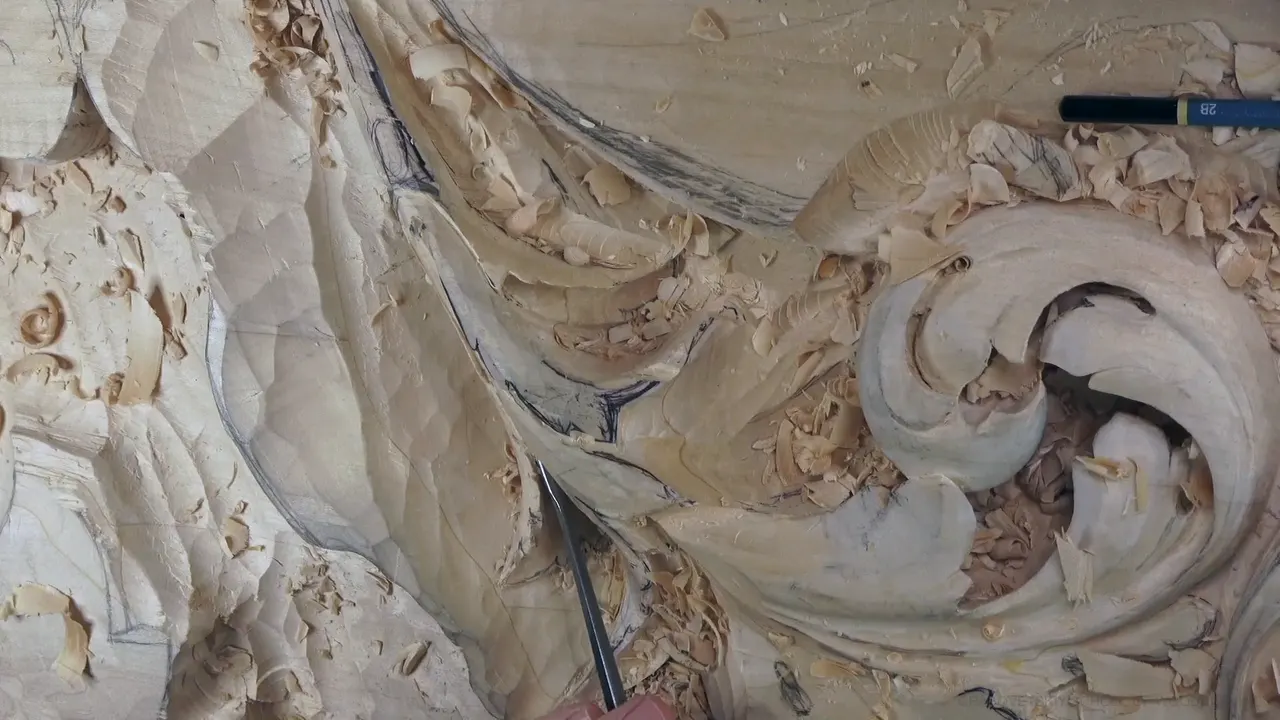
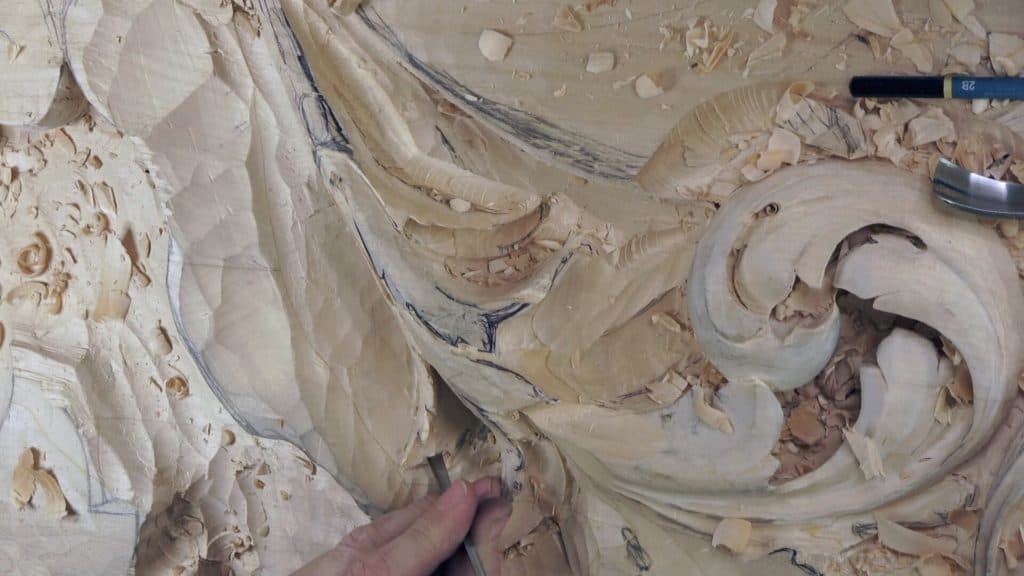
My two words "let's see" came before a look at a hollow in Venice Room 42.5, and the next thing I told you was that the tool needed sharpening. Near the end of the part they came again, and my verdict was short.
Ever pushed a gouge into a deep hollow and had no idea what you got until you looked? Then you know why those two words sit in my videos. Below you get this part in order, then twenty-one other parts where I said them, with what came right after.

What came before my first look in this part?
Plan first. "Somehow I need to make sure it rotates completely around," I said at 00:05. In 42.4 I named a number nine at a quarter inch, with "a big, deep tube, almost like excavated on inside" as the aim and a "drill or plug cut" as the method.
The captions go quiet until 00:39, when I said, "Let's see how deep shadow it creates." Right after came this: "It looks like my number nine needs to be sharpened." Sharpen it first, I said. Close to 00:57 came my promise to continue after that.

How did the hollow go once the nine was sharp?
Once the tool was sharp, at 01:03, I went back to "just my excavation on inside." Then, "Create really, really deep excavation. Create beautiful shadow." I corrected myself at 01:28: "Still not able to do-- Well, actually I am. I'm able to do the full rotation now."
The plug came out at 01:41, and cleaning was what remained. Then two plain words. "Get deeper."

A bit smaller tool would go inside later, I said. Next I told you, "you look from below, from this point, and that's visible. You can see that. So that has to be kind of clean."
On depth, I hoped to get the excavation "a little deeper," until there was "complete shadow, and you can't see, no matter how you look at it." At 03:04 I asked you to see that plug, about a quarter inch. My reason for the big tool is back in 42.4, where I said smaller was possible, "but I really like big, deep shadow in this area."

Which tools came after the straight gouge?
"Tricky area," I said around 03:35, and again, "Tricky area for the straight tool, okay?" My next words were that I should probably switch to a spoon or long bend, and I named a long bend number 12. The plan was a start at 1/4 in (6.35 mm), then a smaller size.
Not too small, though. The area, I said, is not going to be visible too much below that, with "too much stuff going on inside." The call at 04:34 was "maybe eighth of an inch. Like three millimeters and get in." An eighth of an inch is 0.125 in, about 3.2 millimeters.

Then a verdict, "that is actually really good." Next a number seven, to "give that shape I'm after," and around 05:24 a short line: "And clean again."
What did I say after the second look?
At 05:31 they came back. "Let's see how deep a shadow I just created." And then, "personally, I love it."
A bigger tool followed, a number 11, to "excavate a little bit inside, which I know you don't see. But it's okay." "You actually see what the client is going to see no matter what," I said, and on the inside, "Nobody's going to stick head in, which is almost impossible anyway." My verdict on the hollow was plain. "Deep and beautiful."

Another deep excavation was planned for the other side, one that would "give me the idea I'm after." The separation came next. One spot got its verdict near 06:53: "that is not really nice movement, so I need to chop it." "And this side also," I added at 07:07.
"Can you see how nicely it develops?" I asked you at 07:23, and then I answered, "I think it's really nice."

Why did I stop short of final undercuts?
Cleaning could wait. "Of course, there is always room for cleaning, which I'm going to do later anyway." About the undercuts, I said I do not want to create final ones until I develop the whole thing, "all the shell and stuff like this." One reason was that I might change something. And I asked why spend time right now and then redo some.
The part closes on one line. "Semi-finish is okay, but finish finish, it's too early." That is where 42.5 stops.

Do other videos use the same words before a depth check?
Five of them do. First, Furniture Panel 24, part 6, near 00:32. I had said, "let me try to remove it, and it doesn't go. Now it goes." The two words came next, then "how deep shadow I just created." The petal felt like it curls "from this point all the way underneath," I said, "exactly what I want to see." Later in the part I said I was happy with the result.

Second comes Venice Room 46, part 4, near 01:12. Just before, I had said it is better to take time and excavate little by little than to press too hard and lose the efforts. After my phrase came "how deep that excavation is, how nice shadow I'm getting." A limit was coming, I said, a stopping point where I would not be able to reach in.

For the third, open Venice Room 51, part 3, 05:31 in. I had "about the 3 millimeters down, about 1/8 of an inch," and lower was possible. Next I named my question, the depth I could reach, and I answered, "I can get really deep." Someone may ask about a drill. There was "no way you can place a drill that low," I said. My hand barely fit.
With the gouge I could go through if I wished. The plug came out, and the hole was, in my words, impossible to see by naked eye on the inside.

Fourth is Venice Room 43, part 3, near 03:18. Inside those eyes I could excavate with a small number eight. Whether it was a little too big was the question, and I gave "two millimeters approximately," about 5/64 in. Depth stayed open too, "as deep as I wish with those areas," for "extra shadow." Then I added, "I don't have to do it everywhere, but sometimes I could."
A fifth is Hashemi Flowers 37, part 2. The overall shape was established, I said near 01:06, and "Let's work on details." Those words came with "how much down I can go." The V-tool was my pick to "just undercut," and I added, "Or maybe I can use mallet on this."

Which tool sizes did I test with those words?
Over in Hashemi Flowers 10, part 1, I said bigger tools are always better, as long as they fit. My first try was "3/4 of an inch or 20 millimeters," a number nine. Then, at 01:18, "And let's see if it's going to fit in." The answer came at 01:36. "Maybe this tool is a little too big, I would say. Just slightly too big. That's okay." The pass still worked, and a number seven, about one inch, was what I would need next.
The smallest start was in Furniture Panel 18, part 10, near 12:13. I planned "one millimeter, number 11," then said I could start with three millimeters (1/8 in). Out came the phrase, then "how deep I can get with that one." After that I fixed my own wording. "Or I should say how far I can get with this one."
A sweep was the question in Hashemi Flowers 23, part 3, at 00:46. I needed "the right sweep to make it more rounded." After my words came "if I can use number eight," and then "Yep, that looks really good." Another option was leaning the gouge inside to undercut, but the piece was "already too fragile" and I did not want to risk it.
Sometimes the question was whether to try at all. In Hashemi Flowers 46, part 2, at 01:17, I said I would start undercutting first. Next came "what I can create with that one." Then I asked, "Should I do something crazy with this one or not?"

A number seven came first in Venice Room 67, part 4, at 01:30, "maybe 14 millimeters" (0.55 in). "Let's see if it's going to fit perfectly." Then, "And yes, it does." I also planned to angle it slightly, and the pass "just created an extra separation." Then "maybe smaller number three, three millimeters, one-eighth of an inch."

Smaller still, in Venice Room 64, part 3, I said, "Two millimeters, four millimeters, maybe." Then, around 03:05, "Maybe four millimeters" (0.16 in). The words arrived at 03:10, followed by the question of whether it would work out. I called the waste "junk," to be "dug out like a shovel, almost."
In Furniture Panel 19, part 8, around 09:30, a number five was "not enough," so I tried a number six, and the two words sat before the question of whether it would give a much better result. I kind of liked its concave from one point down, but not on "this part right here." Maybe "even number eight," I said, and "let me use a micro tool."
Then Venice Room 76, part 3, at 03:44. I would probably use "six millimeters, number nine to clean on the inside of that" (0.24 in). Then my words, and the hope of "a little better, cleaner transition." I liked the result and said I did not lose the overall feel.
And Hazelnuts 5, part 1, at 06:01. "Probably number 11." Right before "which one is going to be better," I said my words. I took a number 11 at about one-eighth of an inch, "about three millimeters," to indicate where the nuts and the husk go.

What about a view or a light?
Look first at Hashemi Flowers 44, part 3, around 03:17. "I'll take it all the way to the edge," I said, and the words came next, with "how it looks from above" behind them. My reaction: "And I do like it, actually." On to the next one.
In Venice Room 57, part 4, around 06:14, the view was the camera. I changed its position and asked whether it made any difference. "Yeah, it is," I said. You looked more or less like me, but you still saw some space, and I did not.

Light came next in Furniture Panel 19, part 10, at 25:21. "Let me turn the other light off," I said, to see the opposite side. The reply: "Just gives a beautiful shadows. Really nice from this side and from above." Then "I'm happy."

Then a router plane, in Furniture Panel 21, part 7. Later I could get really close with it and go right underneath, I said. The test, near 01:43, was how crisp the result came out. Next, "really crisp and nice," and then "One more cut." The router plane was the tool.

In Modern Acanthus 5, part 3, I planned an undercut with a number 11 of 3 millimeters (about 0.12 in). The movement right there was the thing to watch. Force it, I said, and I would break that thing, so I had to take it "from the opposite side."
Different again was Venice Room 58, part 9. Maybe I had to switch position and attack from another side, I said, and then see what happens. I was cutting along the grain, which was okay as of now, but later it would be a "big mistake" to continue like that. Better to attack "multiple times" than a single time.
Last is Venice Room 55, part 10, at 01:03. I thought I could create a big eye, almost a huge one. Then the phrase, and a check on the look. "If it's not, I still have material."
What do all those hub passages show side by side?
| Where | What I was trying to check for | Next move or words |
|---|---|---|
| First look, 42.5 | How deep the shadow had gone | Sharpening came next, because the nine needed it |
| Second look, 42.5 | The depth of the new shadow | Bigger number 11, for the inside |
| Panel 24.6 | That petal's shadow | A petal curling underneath, which was exactly what I wanted to see |
| Hashemi 10.1 | Whether a 20 mm (0.79 in) nine would fit | Slightly too big, and I still made my pass |
| Hashemi 44.3 | The look from above | I liked it, and I moved to the next one |
| Panel 19.10 | The opposite side in other light | Beautiful shadows, and I was happy with them |
| Hazelnuts 5.1 | Which tool would be better | A number 11 at 1/8 in (3 mm) |
| Acanthus 5.3 | The movement right there | Force would break it, so I took the opposite side |
Each row is a different video. The middle column is what I was checking straight after the two words, and the right column is what came next. A dictionary would not tell you more than these rows do, and they only show where I put my words.
What would I take to the bench?
In the parts above the look went to depth, size, camera position or light. In 42.5 the first look led to sharpening the nine, and the second to a number 11 and a short verdict.
This part is one hollow. I dug it with a number nine, said how deep I hoped to go for a shadow, and changed tools as the excavation got smaller. At the end I told you, "finish finish, it's too early."
The other parts of Venice Room workshop 42 sit in the same lesson as this one, and wood carving with a chisel or a gouge, both hand tools, fills the rest of it. The whole course is Venice Room, workshops 38 to 49, and the Access page opens every part of it.
How it's done
- Say the plan. In 42.5 I said I needed to make sure it rotates completely around.
- Check what the tool made. I looked at the depth of the shadow, and my next words were about sharpening the nine.
- Change tools as the spot shrinks. A long bend came first, then a smaller size.
- Look again. A second check of the shadow came near 05:31, and a bigger 11 took the inside.
- Hold the final undercuts. Those waited until the whole thing, the shell included, was developed.
Frequently asked questions
What came right after the first look in 42.5?
At 00:46 I said the number nine needed to be sharpened. I told you I needed to sharpen it, and that I would continue after that. By 01:03 the tool was sharp, and the excavation on the inside went on.
How did I answer my second look in that part?
A short verdict came first. A bigger tool followed, a number 11 for the inside, which I said you don't see, and I added that it was okay. Another deep excavation on the other side was my next plan.
Which tools did I name for the spot I called tricky?
For the straight tool I said I should probably switch to a spoon or long bend, and I named a number 12 long bend. I planned a start at a quarter inch. Smaller came after, with a size near three millimeters by 04:34.
What to carve next