
Alexander Grabovetskiy, woodcarver, School of Woodcarving · Published 2020
Why is wood carving so satisfying?
Quick answer: Satisfying wood carving, for me, is choosing the different detail over a plain one that would still pass. In Venice Room part 42.9 I said a simple acanthus probably would fly, without that feel. In other videos the same word came from hand tools that sound so nice, and from fixing a part when I didn't have to.
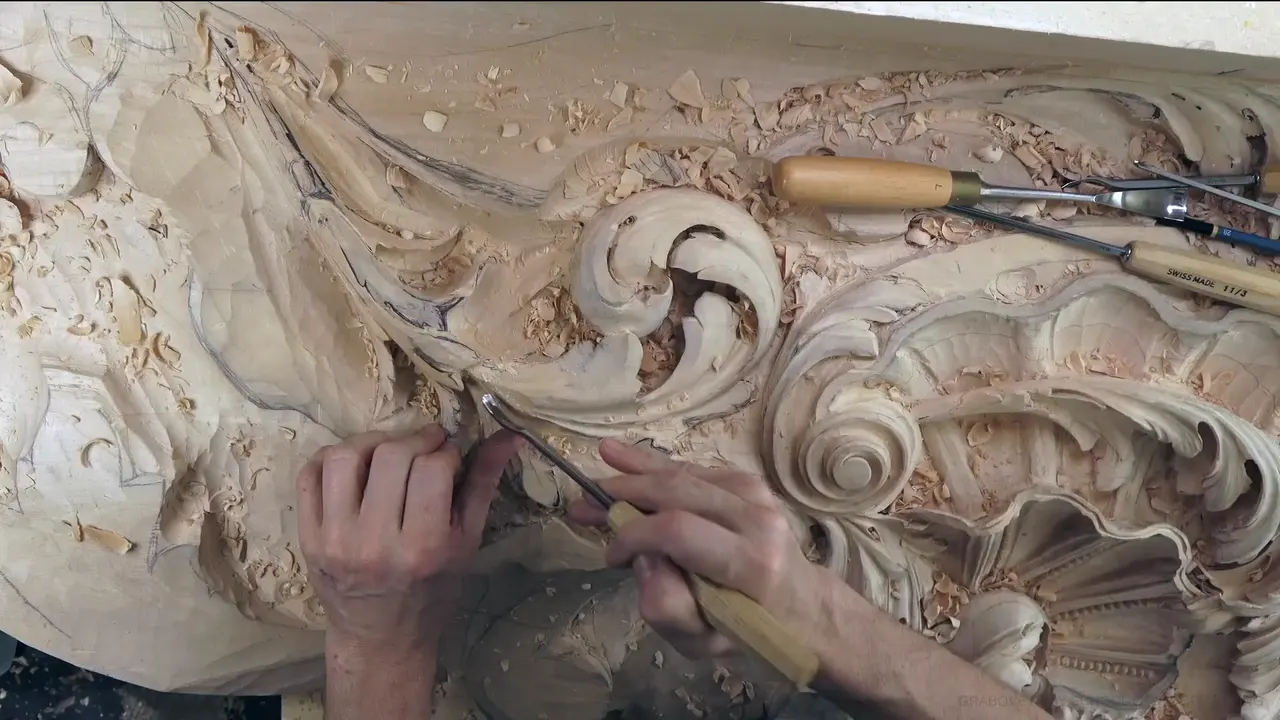

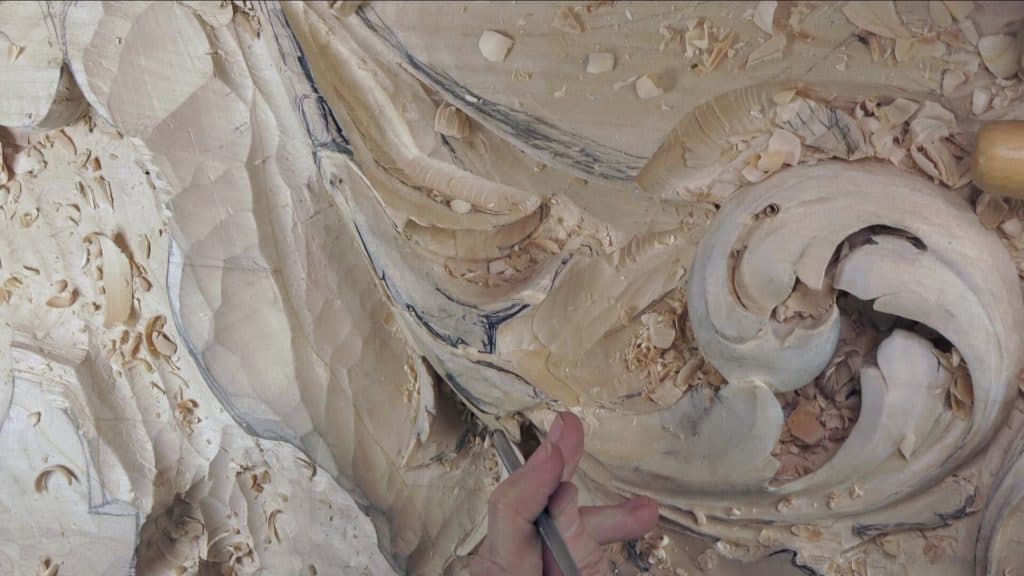
Satisfaction in wood carving, for me, is the feel I get from a detail I picked because it was something different, when a plainer one would have passed. Part 9 of workshop 42 in the Venice Room is where I said it straight out. I could do a simple acanthus, and it probably would fly, "but it wouldn't give me the feel of satisfaction."
Have you ever made something with your hands and liked one small part of it best? Do you still think about that part now? Then you already know the feel I mean. This part runs a little over seven minutes, so I went through my other wood carving lessons and streams for the times I say satisfied, satisfying or satisfaction, and I kept the ones that show something at the bench. Each one carries the place it comes from.
Where the feel came from
- Something different, where a plain acanthus would fly.
- One section I changed after it already looked good on the print.
- Fixing a small pipe.
- Digging a little deeper, for the height of the upper part.
- The router plane, which makes no dust and sounds so nice to me while I work the background.
- Two diagonals in one design.

What happened in part 9 before I said it?
The video opens on a 7 millimeter (about 9/32 in) tool, a little bigger than a quarter inch, as I put it. I said I'd keep going, although it felt like it needed to be sharpened a little. By 00:28 it's much better. And yes, I don't film my sharpening, I said, because of the camera position, and I don't want to spend my time moving everything around. Please forgive me for that.
At 00:54 that tool was probably too big at that point. Now maybe even just 3 millimeters (about 1/8 in) right away, pretty much, I said. "Get in." After that came the plan for a really deep excavation, a deep shadow. I caught myself there. "Oh, I shouldn't say we." So I said I would create a deep shadow myself, and a few seconds later I fixed that once more. "Well, me and a tool."

A 5 millimeter (about 3/16 in) spoon cleans it out, and I go in and take out all the junk I don't need. Then comes a short line. "And I think I love what I see."

Now I can give a final form, I said, or a semi-final form. If I've got a separation right here, it's going to repeat on that side, somewhere right about there. Another one was going to go to a point, and I wasn't sure if I should make that point or not. "But I kind of love it. I'm going to leave it like that."

Why wasn't a simple acanthus leaf enough for me on that spot?
I wanted something different. I'm glad I went with this detail, I said at 03:08. I really like it, I really love it. Right after, I corrected my own words: I should say I love it because it's something different. A simple acanthus would probably fly, I said, and it still wouldn't give me that feel.

Then came a brake. I'm not going to do the "final, final" pass again, I said, because I still have to work on a future shell around that semi-final form, so I'm not losing it. The tool was a number three, by the way, a quarter inch, "about 6 millimeters" as I said a little later. And that looks good, I said at 04:49.

Does a dirty spot spoil the feel of a carving you love?
A little. At 05:21 I said it's a little dirty, but that's okay. I can probably clean that with the back bend a little bit. I don't have to, I said, but I think I could, just to give a little cleaner look. Pencil marks and marker, it just doesn't help.

A small move came at 06:17. Maybe move a little bit this way, I said, and give it an even more interesting feel. "Just like that." There is going to be a micro eye underneath, and this part is going to flip slightly above. Both are still plans at this point in the video. The tool I'm using is a number three sweep, but this is a back bend.

The part ends on a turn. "Now nothing stops me from developing this cut," I said, "creating that separation." Then: "Although, see, that is not what I want to see. I need to glue it." The next part, 42.10, opens on gluing a piece back. I could leave it like that and just work my way in, I said, and it would still be looking good, but with this part it's going to look more three-dimensional. So I'm just going to glue it back, and I use the Titebond 2.

Why change a part that already looks good?
On the Venice Room again, in workshop 150, part 2, I looked again at a section that had looked really good before, on a computer and even on the print. And I thought, hey, I can make it much better. I didn't have to do it, by the way. Nobody would know it. But it will give me more satisfaction to do it that way, I said.
I was happy I'd left extra material there. Leaving some extra is sometimes a smart thing to do, I said, if you're not 100% sure what you want, because later you look at the design and see exactly what you want to change. That is exactly what happened right there. See? Really good idea to have extra material. The next step I named was a number 11, 5 millimeters (0.2 in), to take out all that mess, and the same 5 millimeters around the volute, carefully.

Workshop 64 of the Venice Room has the same thought about something small. The shape of one pipe just didn't look nice to me. Around the eye I'd have to excavate a concave, which is kind of tricky for me. I know it's a small detail, not that visible, I said, but it's still going to give me satisfaction. "I'm going to be happy."
That, I said, is why I'm sometimes not 100% clean at first. I know I'll change some stuff, especially if I'm not too happy with the outcome. And if I know I could do much better and I didn't, I just leave it, walk away, and return to that area later.

The Venice Room again, workshop 5, says who that care is for. Nobody's going to touch it, I said in part 12. It's not like every day somebody's going to come and place a finger on it just to check everything. It's just for me. I really want this project to turn out really nice, and I really want to be satisfied myself. Light matters too. When the light hits that, a slight variation gives a different shadow, I said, and I want to see really good consistency.

How deep do I dig before I'm satisfied?
Earlier in that same workshop, in part 8, I didn't think the convex right there was deep enough, so I needed to dig a little deeper. That is not the final step, I said. I have to dig until I'm really satisfied with the height of this upper part. This side was not too deep either, in my opinion, so it needed a much deeper pass too, and the plan was the same number 11, 3 millimeters, about an eighth of an inch.

Satisfied can also mean stop. The Greek acroterion shows it. Once I had the right profile all the way, on all three sides, I said I wasn't going to do anything else. Maybe a touch of a back bend for the high ridges. Otherwise I'm satisfied how it looks. No overdoing it, I said. That part was end grain, so the plan there was sandpaper later on.
In workshop 28 of the furniture panel, an edge that had to roll got the same test. My plan was the same number three spoon gouge, 3 millimeters (0.12 in), and several chamfer cuts until I'm happy with the overall look. I also said I needed an undercut right under that line, or it won't feel like it's rolling.

Why are wood carving videos so satisfying for people to watch?
I have people signed up for my classes who pretty much don't carve, I said in the Furniture Panel course, workshop 15. They just love watching it. They like being inside my shop, talking to me and watching what I'm doing, and it's okay, especially for those of you who are limited with tools and space. At least you can watch.
I don't know how to explain it, I said, but when you're watching and hear those sounds by the tool, it gives you satisfaction. Almost feels like you're doing it, not me. "And that's true." Next I tried the router plane at 1/16 of an inch (about 1.6 mm), not sure I could get all the way. Just a little cleaning gave me a perfect background, the same as I have right there. You don't have to use it, I said. I just like it because the result is a lot more perfect.

In an April 2020 livestream I talked about a video I'd posted the night before, carving without any music and without any talking. Just the sound of a gouge and the wood. Steel and wood. There are a lot of gaps when I'm working on my piece, I said. I can't talk all day long, even filming for hours every day for my school. All I can hear then is the sound of my gouge.
And of course I'm checking the analytics, I said, the retention rate and which videos are watched the longest. Without any talking and without any music, I said, retention was absolutely tremendous. People just kept watching and watching. "I think it's just like a hypnosis or something like this." Someone in that stream wrote that carving is their meditation, until they break something. Yeah, absolutely, I answered. You got to have some problems to be solved.
Another one, the October 2020 livestream, had someone write that you know carving is in your blood when watching someone carve is just as satisfying as doing it. "Oh, yeah, absolutely," I said.
Workshop 17 of the panel says why the router plane feels that way to me. If you don't have that patience, I said, you could use a normal power router with small bits, like a sixteenth of an inch (1.59 mm) in diameter, and I've done it also. I'm not going to judge you for that. Go ahead and do that. But for some reason it's just so satisfying to use a router plane. First of all, it does not create dust, and I really don't like dust in my shop, which sometimes gets really dusty. And secondly, the sound of hand tools. Just so nice.

Can a layout be satisfying before it's perfect?
On the Venetian flowers rosette I readjusted the layout a couple of times until I was really satisfied with the overall dimensions. It's not as perfect, I said, but perfect enough. The first one was a little too wide, the second was a little too narrow, and the red line was actually perfect. Of course a computer will do a much nicer job. But in a huge room where you need a really big oval, that technique is probably one of the best, in my opinion. Next, I said, I'd cut the rosette out and use it as a template for a couple of boards.

The furniture panel design course has the same word in its first lesson. It's probably a wise idea to get a few different pencils, I said, and of course you're going to need the eraser. We're going to draw and redraw until we are satisfied, I said, and that was about the final design. What I wanted was more than a practice piece or the next carving piece, a real piece of art, in this case in a furniture style.
Whose satisfaction counts on a commission?
On a commission it can be the client's. In my design course I told a true story about a couple who would read a design in two different ways, one with an eastern mindset and one with a western one. The design had to go a twisted way. "I had to satisfy him," I said, so I did one diagonal for him and another diagonal for her, and intermixed them all together. I showed them the piece, and they were so happy.
Then the builder installed it. When I walked inside the house, I found that piece installed upside down. I did not say anything. I didn't want to take time to redo that, I said. They still don't know. The only ones who do are me and you.
Each place I used the word, and what came right after
Each row is one video from this page, with my words and the step that followed.
| Place | What I said about the feel | What came next, or what stayed as it was |
|---|---|---|
| Venice Room 42.9 | A simple acanthus would fly, without that feel. | Kept the detail I love. |
| Venice Room 150-2 | Nobody would know it, but more satisfaction that way. | A number 11, 5 mm, planned for the mess and the volute. |
| Venice workshop 64.5 | Small detail, still going to give me satisfaction. | A concave planned around the eye. |
| Venice workshop 5.8 | Not the final step, so dig until I'm satisfied. | Number 11 and 3 mm planned, for a much deeper pass on this side too. |
| Greek Acroterion 1.5 | Satisfied how it looks, so no more. | Sandpaper later, end grain. |
| Furniture Panel 17.10 | So satisfying to use a router plane. | No dust, and the sound of hand tools, just so nice. |
| Venetian Rosette 1-1 | Readjusted a couple of times, perfect enough. | Template next. |
| Law of Movement | I had to satisfy him, I said. | One diagonal for him, another for her, and they were so happy with it. |
Where can you watch all of part 9?
Part 9 is one of the twelve parts of workshop 42, in the Part 4 course with workshops 38 through 49 of the Venice Room. The tools go from 7 millimeters to 3, then the spoon, the number three and the back bend, all on one piece. If you'd like to watch the whole run at the bench, the tuition opens every workshop in the room.
And about that we in the middle of the part, it's me and a tool.
How it's done
- Step down when the tool gets too big. At 00:54 the 7 mm (about 9/32 in) tool was probably too big for that spot, so I said maybe even just 3 mm (about 1/8 in) right away.
- Clean the hollow with a spoon. A 5 mm (about 3/16 in) spoon took out all the junk I didn't need.
- Hold the form at semi-final. No final, final pass yet, because a future shell still had to go around that form, so I wouldn't lose it.
- Keep the detail you love. A plain acanthus would have passed there. I kept the different one, the one that gives me that feel.
- Leave extra material. Extra material gave me room to change one section in workshop 150 after it already looked good.
Frequently asked questions
Why do people like watching wood carving videos?
Part of it is the sound, I think. In my Furniture Panel course I said that watching and hearing the sounds of the tool gives you satisfaction, almost like you are doing it and not me. My own videos with no talking and no music were the ones people kept watching.
Is a router plane worth using when a power router can clear the background?
For me it is. A power router with a small bit, about 1/16 inch (1.6 mm), gets close almost everywhere, and I've used one, so I won't judge you. But a router plane makes no dust in my shop, and I like how hand tools sound.
Do pencil marks get in the way of the carving?
On part 42.9 they did. The spot looked a little dirty, but that's okay, I said, and I could clean it with the back bend, if I wanted. Pencil marks and marker just don't help when I want a little cleaner look.
What to carve next