

Alexander Grabovetskiy, woodcarver, School of Woodcarving · Published 2020
What does a wood carver mean by "busier"?
Quick answer: In part 7 of workshop 70 my plan for a carved movement was extra detail, and the word I used was "busier." Part 8 gives the big shell as the reason, and other lessons use the word the other way, as "too busy," each with its own reason.
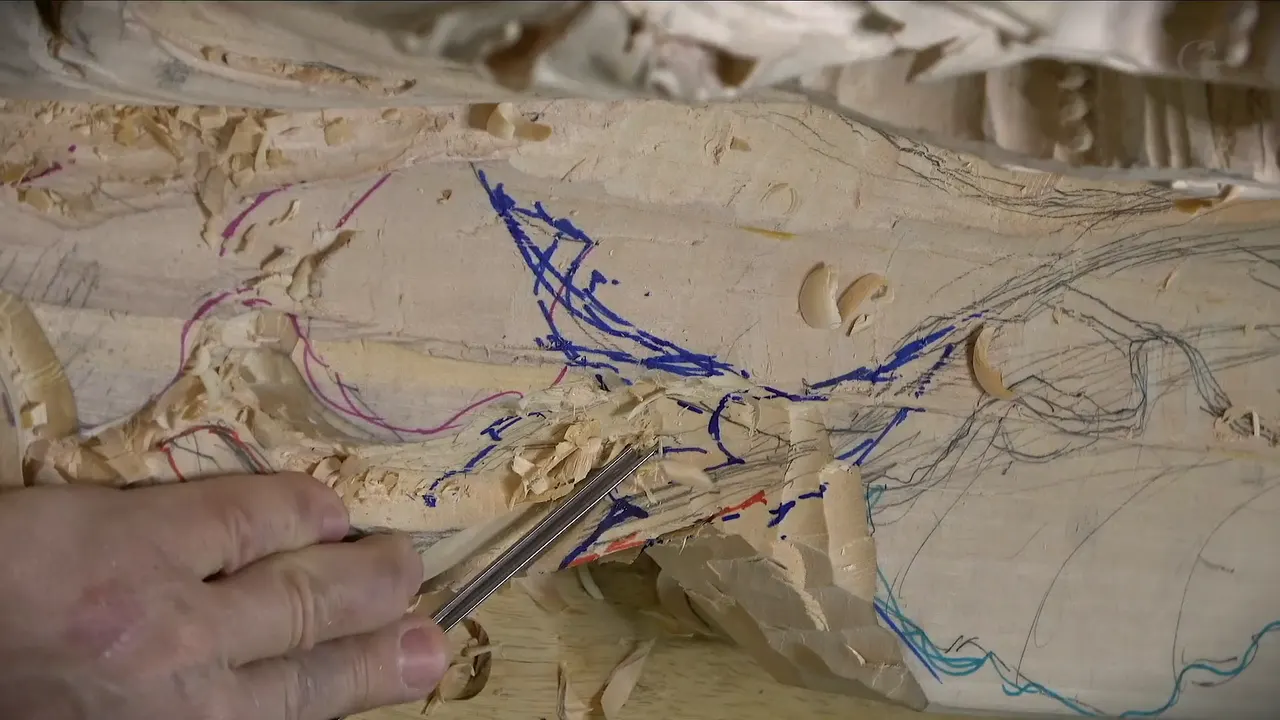

Workshop 70, part 7, is where I said "busier," about extra detail on the inside of a movement. Under that part, a shell was still to go. Other lessons of mine use the word too, and some say it with a warning.
Ever looked at a carving and felt it needed one more line? Ever added a line too many? Then follow me through the places in my lessons where I say the word, lesson by lesson, and listen to what I say right after it.
What was I carving when I said "busier"?
I told you at the start that the grain was against me. "Yes, I am carving against the grain." And the reason I gave: "That's why I'm kind of really carefully approaching this area."
A chunk had to go: "I need to get rid of this chunk," and "This is stuff what I don't need." With a "probably" in front, the tool was "20 millimeters, like three-quarter of an inch number nine" (20 mm is 0.79 in). The bevel was my reason: "I do have a long bevel on this one, and that's going to be giving me much quicker, cleaner cut."

"I think it's good," I said, and I named the step after it: "So the next step would be outline." A shell would come later, I said, and "you will see." I planned to take "number 11 and five-eighths of an inch, about 15 millimeters" (5/8 in is 15.9 mm) for the outline.

"Okay, wonderful. So, I can get a little deeper in this area," I said, and again, "A little deeper." Then a question to myself, "Maybe should I do extra movement this way or not?" and my answer: "Maybe yes, maybe no. I don't think so, but I can actually make this part little wider." Wider is what I said I would do.

Why was this spot hard to carve?
"I've got my main carving in my way, so not really convenient area," I said. Video came into it too: "it looks really easy on a camera sometimes, but in real life, that is actually I'm working on a slope, and that's not too convenient."
Next I named the challenges. "First of all, I don't want to show my head in the camera, and I have to position a little farther away from myself, the carving itself. Plus, it is a slope area."

The next words set a limit: "Okay, that's enough." I would not go too deep "right here" because "it's supposed to just wrap." A deep spot was coming in that section: "It's going to be much deeper, but not right here." Another line waited for an outline: "I need to outline this line right here. Exactly the same idea."
The shell, I said, "gives me ability to get actually much deeper cut if I wanted to."

My plan took in a big tool. "Okay. That is beautiful. And what I can do right away, I can take a big gouge, like number seven and three inches, like about 80 millimeters, and chop this way." Three inches is 76 mm. The chop would give me a "good starting point." Those words are a plan, and the frame here shows a wide tool in my hand.

What did I say before the word "busier"?
"So wonderful movement, and that shell going to go underneath of this development," I said. For me that meant I could outline it "right away pretty much." A brake followed, "But not too much, okay? Not too much because it still has to make sense in the overall movement. Right?"
The plan itself came next. "I like this one, but what I want to do, I want to actually get extra detail on inside going like this. Just make it little more busier if you wish." And the look: "that's going to give me a lot more curly look, I would say." Near that line, the frame shows a pencil on the wood.

What does "a lot more busier" mean in part 8?
Part 8 says it again, and the part is "absolutely different" from that movement. My reason: "All I'm just doing, because the shell is a big element, I need to make around a lot more busier." It is "a framework," I said, and "a framing around." The part also has "outline this way also," and "a little blending."

The next lines were about depth. "And yes, I need to get much deeper in this section, I need much deeper." My reason: "Otherwise, it's not going to make sense." The deepest spot, I said, would be "a really dark shadow," and then: "But I have to be mindful how much thickness I've got left, which is not that much." "This part of this wrapping has to be much lower, actually," I said, with "Even if I have to chip a little bit this way."
Near the end I said the section "could be used on the top of the mirrors, on the frames." It is "a really beautiful ending, the upper part," and "this part could be used anywhere, pretty much."

Is empty better, or is busier better?
In the Principles of Design course, design lesson 2, part 3, I spoke for two sides of one design. Of an empty spot I said "Space around makes big difference," and about the fight between the two: "that emptiness versus busyness, they also fight for the idea."

One side says "the empty is better. The plain is better," and the other says "no, the busier is better. More is better." Modern design, in my words, says "less is more, which is not true." Down the same part, "More is more."
Where does the busy part go?
Design lesson 3, part 2, takes the word to flowers. "You should not repeat the same size on one canvas." Of the main flower in the picture: "What surrounds cannot be the same size." I said that "Even the eyes on the human body is different. Left is smaller, right is bigger." Flowers put "right here," I said, "it would be off."
On busyness itself: "I acknowledge that it's a busy design, but you have to create that busyness in the right spot." The rule after it: "You have to fill space based on the golden ratio."
My question was, "Again, what's the main idea and how you want to support that main idea?" A sermon was my picture, "there's the one main idea and three points around that idea to support that main idea." Then: "Usually, it's supposed to be four based on a golden ratio because there's a four golden spots."

In part 3 of the same lesson I talked about a movement inside a rectangle and asked what the main part of the design would be. My answer: "Upper part, because that guy supports this." Then "much busier on a canvas," and "Same idea, just on a simpler design."
A sunflower is in that part too. "What's inside? seeds." Of how many there are, I said "Fibonacci sequence. No joke." The shape for those seeds: "Not rectangle," and "diamond!" The movements go in one direction and another, I said, and "closer to the center you get, more Busier you get."
Do chunk and wider appear in other lessons?
In workshop 74, part 6, I said of a chunk, "I really don't need it." A "huge, big tool" would probably do, I said, and the chunk would be in my way, and "restrict."
In the same part: "I want to create right now a 3D movement going downhill a little bit, just like that. Going to the ceiling, I would say." The result looked good to me. "Now it's a little wider, which in this case, it's a really good thing."
When did "too busy" make me stop?
Later in that part I named a fear. "The only fear I have" was how it would "interact with this movement" because it "has a lot of motion," and I said "I'm afraid it's going to just be too busy in this area." And a thought, "Maybe I have just to change a little bit."

Next came "Three divisions, okay? Three main movements." "I'm taking that point and I'm taking this point," I said, and a line placed there puts a point at "60%, 40% out of 100%," or "six parts out of 10," which is "a golden ratio approximately."

In workshop 115, part 3, I said I could see "the middle ridge, the movement," and that "a shadow" would come from it. We can "give some waviness to those leaves, too." On flowers like those, I said, "you can be really creative." A smaller gouge was the plan for "just a few concave cuts," with "just number seven" for the size. It does not have to be "really exaggerated," I said.
The middle line goes at "six parts out of 10," and the cuts beside it should be "not too many." Too many cuts "look too busy," and "Just subtle."

And "too many and too small cuts" are "not going to look nice at all," and "just going to look awful."
The Carving Plate with Butterflies course, lesson 12, part 2, has two plans. A couple of spots were left to fill, with "the same detail like I've done on the inside, like triple movement." And: "I'm going to do exactly the same in opposite direction, filling this part. But in this case, I'm going to do just the two. So those three versus two, again, 60/40." After that, "I don't want to make it too busy."

Looking it over: "I think that is enough," and "Let me check if I want to change something." My verdict was "I don't think I want to change anything. There's plenty of movement, I would say." I did not want to "overwhelm," and not to "take overall idea from inside to outside."
The last lines of that part say you "can just actually dress up some mirror. So the mirror frame or something like that." I said I had done the same style casing "inside of the really high end homes, just the detail on the inside."

In Grinling Gibbons, Maine lesson 10, part 1, I said "Too much going on in this section. It's just too busy." What I had to do, I said, was "create some kind of separations. And make it look much better."
Then: "I do have a hole and I want to take advantage of that hole." I still wanted "some kind of openings because it's just like a block of wood."

"Let me think what I can do this section. I can probably introduce small small leaf." And "Maybe not maybe actually I can just excavate the whole thing."
Where do these lines sit side by side?
Here is each lesson, what I was looking at, and the word I used.
| Lesson | What I was looking at | My word |
|---|---|---|
| Workshop 70, part 7 | the inside of a movement over a shell | more busier |
| Part 8 of workshop 70 | the area around one big shell | more busier |
| Design lesson 2.3 | a spot with nothing in it against busyness | the busier is better |
| Same course, lesson 3.3 | the upper part of a movement in a rectangle | much busier on a canvas |
| Design course 3.2 | putting a bunch of flowers right here | a busy design |
| Over in workshop 74 | one spot and a movement with a lot of motion | a fear of too busy |
| Workshop 115, part 3 | many small cuts down a flower leaf | not too many |
| Butterflies plate 12.2 | three against two on one plate | too busy |
| Gibbons Maine 10.1 | a section with a lot going on | just too busy |

Do I say "busy" about anything but a carving?
I do. Workshop 61, part 7, was about a plan to post tools on my school site and have them in stock. I was "busy enough," I said, and did not want more "busyness than what I have to."
Workshop 63, part 6, has a plan for later. "Maybe in the future," I said, I might do some livestreams "only for members." Then "it has to be logical for me, too," and "without getting myself to be too busy that I can't handle it," and I had to be "really wise about it."
An April 2020 livestream has it too. "I'm not trying to market myself because I am busy, and I'm blessed with that, I guess."

Where can you watch every lesson named on this page?
The word is in Venice Room 70. Workshops 62 to 73 sit together in Venice Room Part 6. Workshop 115 is in a later course, and Principles of Design in Wood Carving, the Butterflies plate and the Maine class have pages of their own.
Want to hear the word in my own voice, with the shell under it? Would you like to see where the extra detail goes? The full part is open to you with school access, and this page starts you.
How it's done
- Remove the chunk. The chunk had to go, and a number nine was probably the tool, for its long bevel.
- Outline the movement. A number 11 of about 15 millimeters was named for the outline, with a shell to come later.
- Go deeper and wider. Going deeper there was possible, and a part could go a little wider.
- Plan the big gouge. Chopping with a big number seven was lined up, a good starting point in my words.
- Add extra detail. Extra detail inside was the plan, a little busier, with the brake that it still had to make sense overall.
Frequently asked questions
What did I want inside the movement in part 7?
More detail there, going a little busier, with a curly look as the result. A brake came with it: the movement still had to make sense. Underneath, a shell was due, and I told you that you would see it later.
Why did the shell matter in part 8?
The shell was a big element, so the area around it needed to be busier, a framework and a framing around in my words. Part 8 also called for going much deeper in one section, and the deepest spot meant a really dark shadow.
Which tools did I name in part 7?
A number nine of 20 millimeters (0.79 in) came first, probably, for its long bevel. Next came a number 11, five-eighths of an inch (15.9 mm), named for the outline. A big number seven of three inches (76 mm) was lined up for a chop, and that was a plan in my words.
What to carve next