

Alexander Grabovetskiy, woodcarver, School of Woodcarving · Published 2020
What does a wood carver mean by "not original"?
Quick answer: In Venice Room workshop 70, part 5, I said "it's not original, what I'm doing right now, not like what I drawn before." Next I said I think I can take this part and get that part on inside of movement. My other lessons say it about a loop, a deep cut, and an older design.
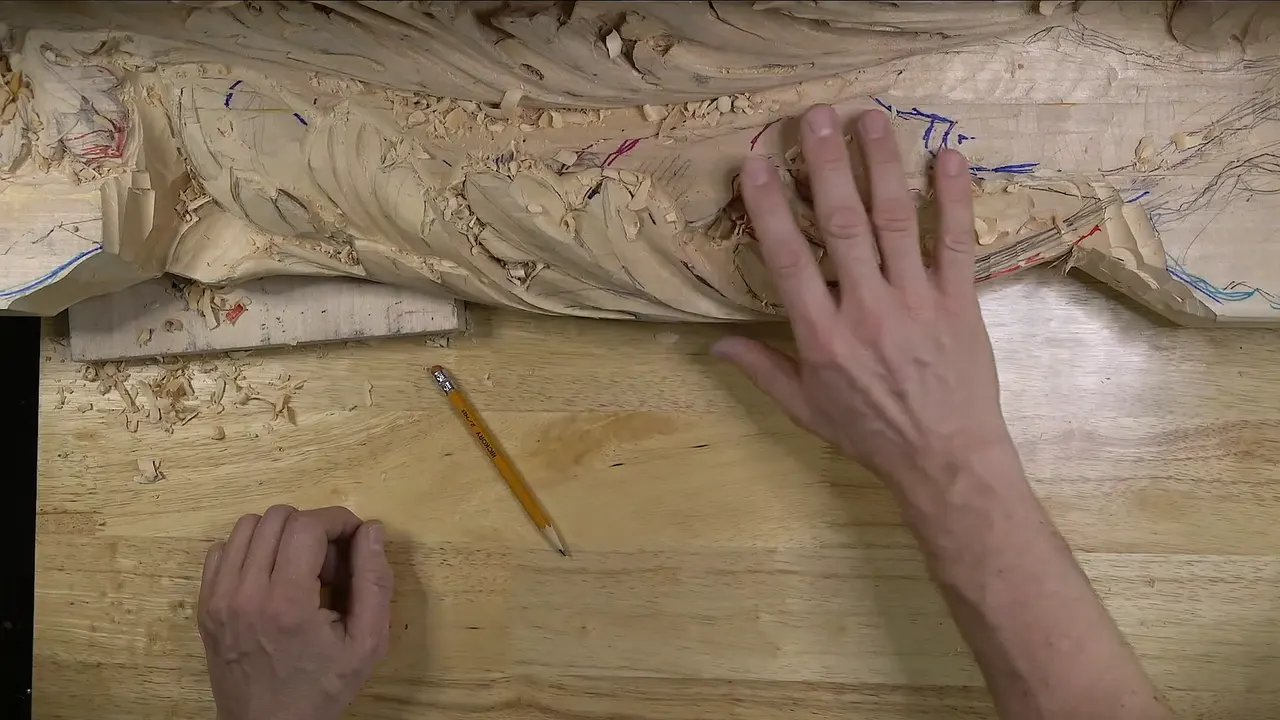

In Venice Room workshop 70, part 5, I said what I was doing right then was not original. Other lessons of mine say it about a small loop and a deep cut, and about a leaf that fills a void and a design that rests on an older piece.
Ever carved a movement on one side of a board and then wanted it on the other? Did you wonder whether a repeat like that is still your own work? Come through this part with me, then through lessons from my other courses. Every lesson is linked.
What did I say about "not original" at the start of part 5?
Early on I said "I lost a lot of videos." Then: "But let me explain what I've done." What you see, I said, "is actually a part which is going on the ceiling." And: "So that is a ceiling part."
About the work: "I developed about the same movement what I have right here at this area." For the earlier parts: "If you watched previous segments, you should be able to understand the development." And: "Later on, you will see the whole picture."

The shell came next: "the same shell what we have in another areas." On this side, I would have a shell "little later." One chunk had to go because it was "a little too bulky," and "that gradual movement" was what I needed.
Then: "Should I work on this one right now and then jump on development of those shells and the details, or I should continue to work on this side?" My answer: "I think it would be really good idea for me to jump in this area and develop it." And: "It's kind of interesting area. It's also moving."
The area sits on "the curvature from straight to the ceiling." My line on that: "Kind of challenging for me to show that on a camera." Of another spot: "Here, it's also going to be acanthus, so we're going to work on that maybe today yet."

What went with "not original" in part 5?
About that area: "I don't want to do just a simple acanthus right here." I wanted "something more interesting like I've done in another areas." One of them: "really interesting movement going from below and wraps around."
Then: "just because there is such a thing as a law of repetition, I am able, actually, to use this area, and develop something like that." Right after it: "develop something beautiful."
And this: "What I even could do, you should understand, it's not original, what I'm doing right now, not like what I drawn before."

Next, a plan. "I think I can actually take this part and get that part on inside of movement." Then: "It would grow from inside of the cavity right there, okay?" And: "I think it would give me beautiful movement." For that, I said, I need "to figure out how I going to end up with this movement."
I had doubts, and I said so out loud to you. "I still have doubts, of course." The goal was "to use this area, I don't want an empty spot." I really do not want "to see empty spot and still able to excavate and create deep shadow." Then, on shadow: "I need some kind of shadow in this area." Also: "I need to create beautiful transition right here."

How did I plan to mark the wrapping?
"I'm probably going to use just a marker to indicate my movements," I said. I planned to start my wrapping "somewhere right there in this area." It would "wrap around, going all the way," and end "on the opposite side like that."
The acanthus part "is going to grow from it." About the movement itself, I said I was going to fix it, and then: "I kind of don't like the movement." The plan for the divisions: "All my division is going to go only in which is toward the main body."

Then: "this would give me really beautiful wrap or wrapping movement, I would say. Hope it makes sense." The tool plan: "the same number 11 I used before." For size: "Ten millimeters, that is probably what I going to start with." That ten millimeters is about 0.39 in.

Did the wrapping come back in part 6?
The next part sits in the same workshop, and the wrapping shows up in it again, in my own words: "Not much material I have left, but I still want to develop the feel like it's really... This part wrapping around that element."
One more plan: "I will need to undercut later on because like I said, I want to make sure it feels like it's actually wrapping." Later in part 6: "I want to make sure it just feels like this part growing from underneath."
In part 6 I also said "Yes, it is against the grain, but the goal is to make that feel like this part growing from right underneath."
Where else do I call something not original?
Lily Box lesson 3, part 3: "I could create a small loop in this area, it loops inward, if I wanted to." Then: "It's not an original design." After it: "Again, it's really an extra step." And: "those small twists, small loops, they make a big difference."
That part also has this: "I've got a really deep cut right here, which wasn't original design or original intention. But it's still possible."

In workshop 15, part 11, I said "I can probably get little smaller cuts inside." Then: "nobody's going to know that is not the original design." Next: "Okay. It is original because I'm still creating it, but sometimes it happens." And: "That's why I really like to use relieving cuts."
Part 11 of workshop 36 has an acanthus that could come "really close to the edge of my shell." That "would also be really nice movement." Next: "it is not original idea of my design, but I think it's going to give me something extra."

The same part has this: "I don't want to go too deep yet." And: "before I go too deep, I have to make the decision if it's even the right movement or not."
Over in the Plate with Butterflies course, lesson 13, part 3, I said "I'm going to just introduce one more element." Then: "it's not the original what I wanted to do." And: "you can see I left approximately six millimeters right there, and the six millimeters left right here. And there's an intersection between." Six millimeters is about 0.24 in.
For that spot, I said "I could use the same gouge, and I just can create the real micro cuts right there."

In Modern Acanthus, lesson 6, the design gets a plain source in part 3. "Like I said before this design is not original design. This is based on a sculpted piece in 1903." I also said "It's called modern." That lesson is linked here.
In the Furniture Panel course, lesson 19, part 4, the words point the other way, back at a plan. "If I don't like it, I'll do something else with that, but for now, I'll just leave to my original idea." Next came "I have no idea why I did what I did. But I did something anyway."
And: "It happens sometimes when you're just designing something and it makes all the world of the sense. But later on, when you just look at it and you think, 'Why did you do that?' And you don't remember." For me: "it's a good idea, because I filmed everything, so I can always look back and find exactly what I've done it."

What do I mean by original idea?
At times the words point back at my first plan. Part 7 of workshop 55 has "maybe I will have to do some changes to the original movement." After that: "I don't really like this development, originally, the overall movement's supposed to go like that, okay?"
A shell comes into workshop 60, part 10: "I really can't forget there is going to be a shell sticking from underneath. At least that was my original idea."
Furniture Panel 22, part 5, has its own line: "Let me restore original movement. That was just like that."
In lesson 24 of the Furniture Panel, part 2, I laid out two choices for one part of the carving. "I could make this part as a part of a big flower." Or: "a continuation of my molding, like this piece, straight piece." Then: "Both would be legit, but I think I would probably just stick with the original idea."
Is a copy still original?
The Questions and Answers course has this question: "it's better to be original or copy others?" I began: "It all depends what you mean. I don't quite understand sometimes what it means to be original."
I went on: "You're still original even if you copy someone else's work." And: "You're still you." Also: "You can't replace your tool marks."
About my own work: "I do not copy, personally, anybody else's work." On my school site, I said, "people actually, it's exactly what they do. They copy my work."

The advice: "I encourage you to start with copying because you will understand much better what they did." Then my reason: "until you understand the wisdom behind, the logic behind what they did and why they did it and the way they did it, then you can start developing your own, I would say."
Last: "I would definitely start with the copying." And: "Nothing wrong with that."
Where do I talk about repeating a detail?
In Furniture Panel lesson 2, I said in part 3 that we would "talk later about the law" and "the rule of repetition or rhythm." Then: "this is five millimeters and I repeat myself about five millimeters right here." That comes to about 0.2 in each.

That course's lesson 3 has "since I've got 5/8 of an inch right here," then a line back to what I told you before, then "I'll mark about 5/8 right here." Five eighths of an inch is about 16 mm.
Then comes lesson 7, part 4: "Again, I've got my perfect 90 degrees, and I kind of repeat." And: "there is a law of repetition." After that: "I have to just to get my five millimeters or 3/16 of an inch. I'll mark here."

Workshop 32, part 9: "if you remember in one of the lessons, not in this project, but in the furniture panel, I was talking about design laws." Then: "one of the rules is a law of, or rule of repetition, when you repeat one detail and it has to reflect somewhere else."
I went on: "I really like this movement." Then, a possibility: "I could do something similar. Okay, something similar." Also: "I think it's going to give me a really interesting look."
Lily Box, lesson 6, part 6: "let's work on a second one, exactly the same idea. We have to repeat." And: "So we have to repeat the same process."

Does a repeat have to look the same?
In Principles of Design, lesson 4, part 4: "Rhythm, what it is, repetition of the detail, but it's not supposed to be the same size." After it: "I could just do it three or five spots with the same idea. But they're going to play with a different size."

The Venetian Flowers Rosette, lesson 2, part 3: "You can see there's no repetition. Okay? Absolutely no repetition. I've got concave, convex, concave, another convex, and another concave." And: "it's exactly the same idea, but it's not repeating it on its own. I've got just different variations."

Where does each lesson say it?
They sit in one table below, each under the course it comes from.
| Lesson | What was not new in each one | My words there |
|---|---|---|
| Workshop 70.5 | The movement I was working on | Not original |
| Lily 3.3 | A small loop I could add | It's not an original design |
| Lily, later | A really deep cut right here | Wasn't original design |
| Room 15.11 | What nobody is going to know | Relieving cuts |
| 36.11 in Venice Room | An acanthus that fills a void by my shell | Something extra, I think |
| Butterflies 13.3 | One more element on the plate | Micro cuts |
| Modern Acanthus 6.3 | A design that rests on a sculpted piece | Based on 1903 |
| Furniture 19.4 | The idea I would leave for now | Original idea |
| Room 60.10 | A shell that was my first plan | At least that |
| Venice Room 55, part 7 | The overall movement, supposed to go one way | Original movement |
Where can you watch the full videos?
Every lesson above sits inside one of my wood carving courses, so a full video stands behind each quote. This workshop holds all twelve parts of workshop 70, and workshops 62 to 73 are in Venice Room Part 6. To watch the full videos, start here.
How it's done
- Point at what you already carved. In that part I pointed at a movement going from below that wraps around, one I had in another area.
- Say what is not new. I said out loud to you that the work in front of me was not original.
- Plan the wrap. My plan: a marker for the lines, with a wrapping that starts in one area and goes around to the opposite side.
- Think about shadow. I did not want an empty spot there. In that area I said I need some kind of shadow.
- Name the first tool. My start was the number 11 I used before.
Frequently asked questions
Where in part 5 does the line fall?
It comes in the stretch where I talked about developing something more interesting than a simple acanthus. I called the work not original, and then said it would grow from inside of the cavity.
Which tool did I plan to mark the movement with?
A marker, probably, to show my movements. I planned to start my wrapping somewhere in that area and send it around to the opposite side. For the carving itself, I named a number 11, ten millimeters (about 0.39 in), as the start.
Did I say copying is wrong?
No. In my Questions and Answers course I said you're still original even if you copy someone else's work. I also said I encourage you to start with copying, and nothing is wrong with that.
What to carve next