

Alexander Grabovetskiy, woodcarver, School of Woodcarving · Published 2020
How does a wood carver decide which tool to use?
Quick answer: In part 1 of Venice Room workshop 70 I named number seven and number six, then asked myself which tool I should use and leaned toward "maybe number six." Other lessons of mine carry that pause with a gouge and a size right after it. Each one is below with its lesson.
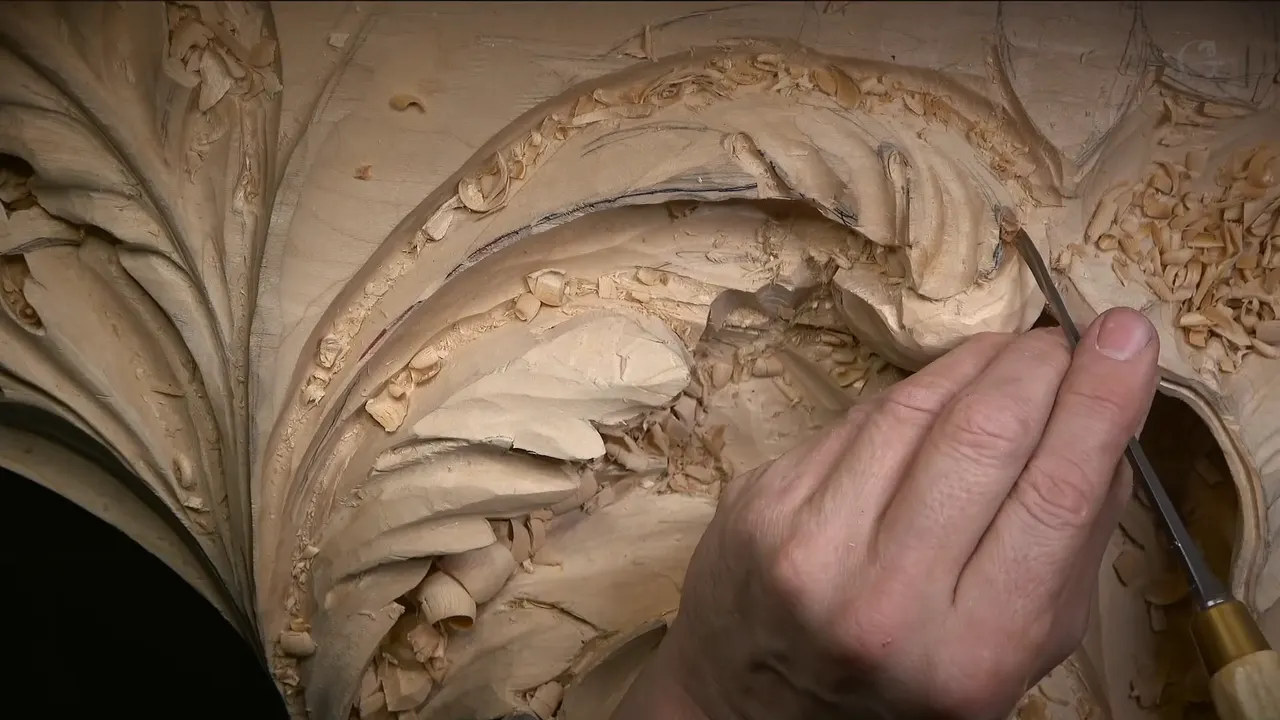

In Venice Room workshop 70, part 1, I weighed number seven against number six before I named a gouge and a size. My other lessons carry the same pause, and a number and a size follow it in each lesson below.
Ever stood over a carving with ten gouges in reach and no idea which one to take? Did the first one feel right, or did it fight you? Here is what I said and picked in part 1 and in lessons from several courses, each linked to the full video, from a chisel in a first lesson to hand tools in a last one.
Which tool came first at the start of workshop 70?
The part opens with a choice. "And now I'm going to need a smaller number. Let me think. Seven or number six should I use?" Then: "Maybe number seven. Number seven and a quarter inch" (about 6 mm). Cleaning "a little bit that part" was the plan, and I told you not to pay attention inside yet.

My goal was the shape. All of that would get cleaned a little later, and the overall shape "is the main goal for me to establish." Then the pause came back: "let me think which tool I should use." My answer was "I think maybe number six."
What did I plan to do with number six?
I planned to "create that type of movement," and to "make this part, part of a pipe." A line about the tool itself came in the middle of the first cuts: "Is that-- It needs to be sharpened or something. Feels like it. Yes, it definitely needs to be sharpened." Back to the work: "Again, later on, I will fix overall movement how it feels. But now I need a really good pronounced convex."

In part 2 there is a tool line too: it looks like my tool needs buffing or honing, which is okay, and I would take care of it a little later. Back to part 1 and a small first step: I would do a micro cut on this side. My reason: "Because I can't do beyond that point anything because I still have to establish."
How did a bigger tool come into part 1?
Hitting my shell was something I did not want: "There is going to be a shell, but I still need that feel of a continuous convex." Then: "Even if I have to dig a little deeper inside of the main head, that's okay." A new division was part of my plan too.

For the next pass I changed tools: "Okay, let me use a little bigger tool. In this case, I use 10 millimeters, number 11 of course. It's still number 11 veiner. Three-eighths of an inch." In inches, 10 mm is 0.39 in, and 3/8 in is 9.5 mm. Right after the change came this: "Again, without touching my future shell."
Soon I told you "here I'm safe," and went on, "I can actually dig a little deeper." Could you feel the overall shape, I asked, and I said you could.

The side of the tool got its own line. "See, the beautiful thing about those tools, I can use just the side of it and blend nicely and bring that to the ridge." I added: "See, now I'm really happy. Now it goes the way I think it's supposed to go."
Sharp lines got a word too in part 1. "Of course, no sharp lines whatsoever. Just really, really nice and smooth lines." Then, about one I had on the carving: "And if you do have a sharp line, like I do right here, so just blend it."

Does the first gouge turn out right?
Hashemi Flowers lesson 3 says otherwise. The paper was off, and I wondered which gouge to use. "Let me try number eight," I said. The next words: "It's a little too big."

A second one followed. "Different number eight, and this one is perfect. It's about 3/8 of an inch" (about 10 mm). Next came a plan to go from the sides, and I called that spot my focal point, my highest point.
The same turn shows in Lily Box 9. I called it "too dangerous." My next question was what to take. "I probably could use just a number three or number four. Well, let me use number three" at "14 millimeters" (0.55 in) was my pick, and the result came soon after: "That still gives me resistance. A little too big."

Another way to miss shows up in Venice Room 2, part 5. I tried "a number nine and quarter-inch," and then: "Quarter-inch is a little too small." My fix was three-quarter, 19 mm, "and just go straight down." Lesson 5 of the Lily Box course, part 12, has a small miss too. I took number seven at a quarter inch (6.4 mm), and it was "a little too small." I wanted "a little more defined concave than that."
From the big end, Venice Room 121, part 3, gives a reason for the shadows: "just the sake of those shadows." Then the pick: "Number 11, and I'm going to start with the big 30 millimeters or maybe 20" (1.18 in and 0.79 in). A test came with it: "Let me start with 30, and I'll see if it's too big."

What if the best tool will not fit?
Over in workshop 44, part 9, I said: "the best tool for the job would be number 11." It came with a catch: "the closer I get to this spot, I'm not going to be able to fit this tool." The lesson is workshop 44.

Part 5 of that Lily Box lesson says it with a risk. My words were "let me see which gouge I can fit," and I called one "probably the best." Then: "I can't cut downhill." I thought it "could be a big mistake," and said "I don't want to risk it. I'll just use the number three" and wanted "to give a nice edge."

When it did fit, I said so. Over in the Furniture Panel course, lesson 20, I wanted more definition and had to change my tool. "I am using number eight right now," I said, and it "fits perfectly."
How did I choose between number five and number three?
I put the choice into words in Venice Room 66, part 8. "I need to use probably back bend. But which one should I use?" My thoughts ran "maybe number five or number three," and I wondered which one would be better. My lean was "maybe number five at half an inch" (12.7 mm).

Venice Room 102, part 7, starts with a blend. I needed some kind of spoon and asked which one. My answer was "probably number four," about "13 millimeters or so" (0.51 in). A "number three gouge will work also," I added.
A change of mind sits in part 11 of that Lily Box lesson. "I need to blend, and I don't like to see that ridge," I said, and my next question was which gouge would do. The answer was "Okay. Number three. No, 6 millimeters, but I need to buff it" (6 mm is 0.24 in).
How does a size settle it?
A size can be the answer. In Venice Room 41, part 10, I wanted to blend cuts together and asked which tool would be the right one. My plan was number 11 at 10 millimeters (0.39 in), and I said "looks like it works just fine" soon after.

A smaller one sits in Venice Room 71, part 7. After my question I said "Seven millimeters, of course" (0.28 in), with a number 11. Carefully near an eye was where I would start.

For a shadow, Venice Room 109, part 2, goes big. "Now what?" I asked, and then which gouge I could use. "I can probably take big number seven, maybe about one-inch number seven" (25.4 mm), with the hope to "see if I'll be able to create beautiful shadow."

Hashemi lesson 23, part 4, begins with the grain. It "runs this direction," I said, and I asked about a gouge. My pick was "just a bigger number nine" at "about 5/8 of an inch" (15.9 mm), and I planned to start carefully by establishing my cut.
Hashemi lesson 10, part 5, opens on a tool question. "I can use probably number five, about three-eighths of an inch" (about 10 mm). Next I called it "a little bigger" and "not quite half an inch," and I put a figure on it too. My estimate was "about, I would say, seven-sixteenths" (11.1 mm), and "it's number five."
A guessing line sits in part 3 of lesson 5 in the Lily Box course: "you guess which tool, and of course," one millimeter and number 11 (0.04 in). Later in that part I asked you to guess which tool would clean it, then said "it's number 11 and one millimeter at first." I added that I "could go, actually, with a half a millimeter" (0.02 in).

A short one sits in Lily Box 4, part 4. I was going to recreate my middle section, and number seven at three-quarters of an inch (19 mm) was my try. Part 4 of Lily Box 9 asked about a small one: number eight at 3/32 in (2.4 mm). I thought "it fixes the problem."
Furniture Panel 20 has one at the small end. My words: "maybe just number one, but the small one, like 3/16 of an inch, 5 millimeters" (3/16 in is 4.8 mm). I would go straight down. The Venetian rosette course gave "probably number 11," "about quarter inch" (6.4 mm), and "I have to be careful." Lesson 14 of Hashemi Flowers, part 1, says "this is #9 and 3 millimeters" (0.12 in) after I said I was checking which tool is better for the case.
In the Greek acanthus course, lesson 8, I said I would take "probably just number five, which is 10 millimeters, let's say" (about 0.4 in), after a pause over the choice. And in the Venetian rosette course I said "number six will work," then "I'm kind of debating which tool."
Back in Venice Room 5, part 5, I asked for a tool, answered "maybe number eight," called it a spoon gouge, and then backed off: "Oh, no, I'm not. That would be a big mistake."
Why try different tools at all?
Hashemi Flowers lesson 12, part 7, gives my reason: "I hope you understand why I do that, why I am trying different tools, and I just try to find which tool easier to use in this area." Next I said "now maybe I can use just a slight mallet," and a moment later, "no, it's too fragile."
Do I stop to think every time?
Venice Room 21, part 11, has the other side. It sometimes takes time for me to think about the grab, I said, and then: "I just open the tool chest and grab whatever looks right for me for this operation without even thinking." And: "Don't have to think twice, just grab the tool." The lesson is workshop 21.

The pick was "number five and 8 millimeters" (0.31 in), and I was "creating the letter S shape, goes like that, like a wave."
Which lessons put a tool next to a choice?
The table below holds nine of them, each under the course it comes from.
| Lesson | Task | Words |
|---|---|---|
| Workshop 70.1 | Weighing number seven against number six at first | a quarter inch |
| Hashemi 3.1 | Trying number eight, then a different number eight | and this one is perfect |
| Hashemi 16.3 | Blending an upper part with a number seven | Okay, I'll take number seven |
| Lily 4.11 | A micro pipe between two subdivisions, number seven | could probably use number seven |
| Lily 5.5 | Seeing which gouge fits, then not cutting downhill | don't want to risk it |
| Room 41.10 | Blending the cuts together, using number 11 | looks like it works just fine |
| Room 66.8 | Choosing number five or number three, back bend | That's the question |
| Venice 71.7 | Starting near an eye, using a number 11 | Seven millimeters, of course |
| Venice 121.3 | Starting big for shadows, using a number 11 gouge | start with 30 |
Where can you watch the full videos?
Every line above comes from one of my wood carving courses, a woodworking craft built on tool choices and relief work. Workshop 70 holds all twelve parts, and workshops 62 to 73 are in Venice Room Part 6. Go back to workshop 69 or on to workshop 71. Other lessons live in Hashemi Flowers, the Lily Box lessons, and the tool sharpening course. To watch them, start here.
How it's done
- Name your options. A choice of seven or six opened this lesson, before the first cut.
- Estimate the size. In Hashemi 10 I put a number five, about seven-sixteenths of an inch (11.1 mm).
- Say why you try more than one. In lesson 12 of Hashemi Flowers I test other tools to find the easier one for that area.
- Watch for the fit. A gouge I called probably the best could not cut downhill in the Lily Box lessons, and I took another.
- Reach big for shadows. Workshop 109 had me taking a big one-inch (25.4 mm) number seven, hoping for a beautiful shadow.
Frequently asked questions
Which gouge came first in workshop 70, part 1?
First came number seven, with a quarter inch (about 6 mm) beside it, after I compared it with six. Later in the part I leaned toward number six, still with a maybe, and I meant it for a pipe.
Which gouge did I pick in Hashemi lesson 23?
After I mentioned the grain, I said "maybe just a bigger number nine," at about 5/8 in (15.9 mm). I would start carefully by establishing my cut.
Why try several tools on one carving?
My reason is in Hashemi lesson 12: I try different tools to find the one that is easier to use in that area. Right after, I thought of a slight mallet, then said no, it's too fragile.
What to carve next