
Alexander Grabovetskiy, woodcarver, School of Woodcarving · Published 2020
What is the difference between rough cuts and clean cuts in wood carving?
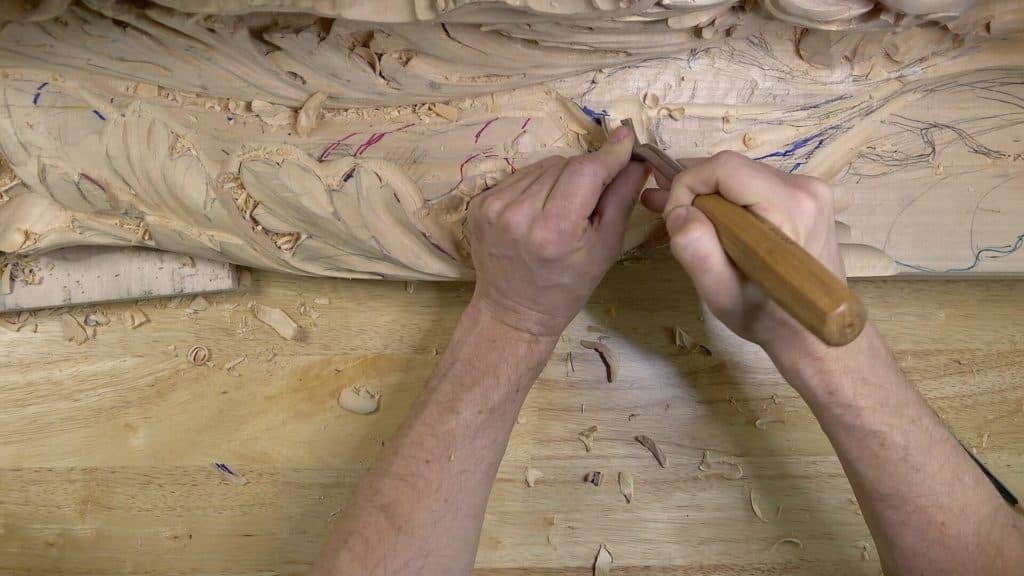
Quick answer: In workshop 70, part 9, the pass I was making in a concave was rough cuts to me, with cleaner ones put off. Other lessons of mine set the words beside wiggling, the height I stayed at, shadow lines, flipped pieces, skews and number 11s, each with what came next.
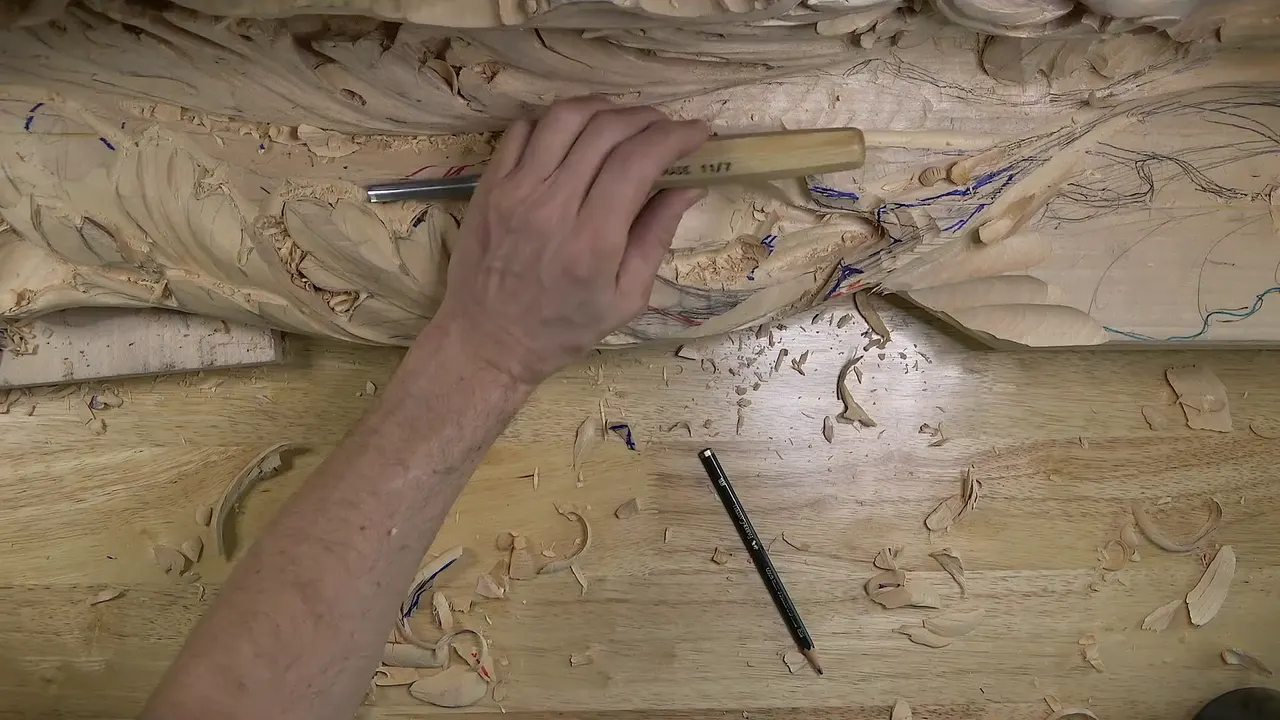

In part 9 of workshop 70 I called what I was doing rough cuts and said cleaner cuts would come later on. My other lessons use the same two words for wiggling a tool, a safe height, sharp shadows, flipped pieces, skew chisels and number 11s.
Ever dug a hollow and looked at the mess it left? Ever wondered whether to clean it right now or later? Come through part 9 with me first, then through the lessons where I use these two words, and see what I did next.
Which cuts did I call rough in part 9 of workshop 70?
The line sits in the middle of a concave. "It is also going to be like a concave movement. It's supposed to feel really gradual concave." And right after it: "And that's rough cuts, that's what I'm doing. But later on, I'll do much cleaner cuts."
Tools came first. My 7 millimeters (0.28 in) were "probably a little too big," by my own words. So I picked "5 millimeters" (0.2 in) of a number 11 as the size I would use. My undercut was next.

One thing stood in the way. In my words, "before I continue my undercut, I need to get rid of this stuff because it's on the way." About the shape: "it has to wrap in, and I'll just move over my undercut."
How deep did the rough cuts go in part 9?
My warning had my history in it. "I have to be really mindful how deep I'm going. Because I've done that mistake too many times when I carved too deep." A bit later: "That's probably it. And I can continue to get my excavation much deeper."

A tool question followed: "Let me see if the straight tool will be sufficient, or I should switch to a spoon." My answer a few seconds on was "I think I need to switch to a spoon."
Next, the hole. "This cut went all the way to the hole," and the hole was "really deep, about 25 millimeters or so" (25 mm is 0.98 in, close to an inch).

The spoon I named was a "Veiner, in this case, and maybe 7 millimeters." I added "Let me try," and a second choice: "I could use a number nine gouge. It would give me about the same result."
Mindful came back a little later, and then, shorter, "Cannot forget."

What did I want clean in part 9?
The place under the movement. "I need clean, really clean transition from underneath, because it's going to be visible." Of that spot: "clean and nice."
The tool, in my words: "And that's why I like those number 11s. It gives me beautiful transition."

Rounding the movement was my next plan. It would be "growing from underneath, just wrapping from underneath and growing this way."
I spoke to you right there, too. "I know exactly what you think. It looks a little complicated, but it will make sense." A little later: "Now it looks like it's showing up exactly what I am imagining."

What was I thinking at the end of part 9?
While I was working on the concave, an idea showed up. "You know what I could do? I'm not sure if I should or not. I could make this part as a concave," and then "give an even nicer movement to it." Its value, as I put it: "a lot nicer transition," and then "Maybe I should do that."
I saw room for it. "There is some empty space, which you don't see that on a camera, but I do." My plan: "I'm going to create a big concave right here. And I'm going to undercut underneath of this line."

The slope made the plan harder, and I said "it's right on the slope" and "not really convenient."
The last words of the part: "Maybe number nine and a spoon," with care "not to hit my detail on the main body. Because it's really close already."

Why do I call a first pass a rough cut?
In Venice Room 16, part 3, I wanted to "go as deep as possible inside right there." I was wiggling and making a rough cut, "which is all right." What I worried about: "All I worry about is just get in." A little later: "I can always cut it again."

The wiggle is back in Venice Room 30, part 8, and a smooth cut follows. "Wherever I wiggled, it creates a really rough cut. But I can go from the right position and create really smooth cut." Of that second cut: "You don't see it, but it's really smooth and nice."

A mess had to go in Venice Room 35, part 9, and my words were "Just take it out and that's it." My name for the pass: "it's a kind of rough cut. It's what I'm doing right now, but I'm always able to clean it with the final cut."

Lily Box 7, part 7, has it too. I knew I was carving against the grain, and said "if you do have a really nice sharp tools, it should not be a problem." The cuts themselves: "I still have to establish the details, and this is more or less rough cuts. Not the finish cuts." The tool I named after it: "number 3 and 14 millimeters" (0.55 in).
A height is the subject in Greek acanthus lesson 11, part 3. The right corner of the tool kept me "approximately 16th of an inch from this rib down" (about 1.6 mm). The height, in my words: "Later on, I can bring it up, but for now, it's a rough cut, and it is safer to stay a little higher."
A reminder rode along with that cut: "The main idea is not to rush." And on mistakes: "it's easy to make a mistake."
When does a rough cut show too much?
In Hashemi lesson 48, part 6, I said what rough cuts do to a shadow. "You can see a lot of rough cuts. I mean, I could leave it like that." Then the reason I would not: "those rough cuts, they create too sharp of a shadow." And: "I don't like that."

My fix in that part was to "blend those cuts and soften a little bit the shadow line." The look I wanted: "Like a soft transition." And on where: "I'll do it everywhere just to make it kind of soft blending cuts."
Size matters in Lily Box 12, part 1. "It's a really small scale. I mean, it's a fairly small box." The eye gets close: "visible really close to the eyes. You can't make too rough cuts, okay? I should say. In a big scale, you could do that, but not on that."

I named a number 8 there, "maybe about one-eighth of an inch" (about 3 mm). For the inside I wanted "some really nice movements," and "I don't want to make it uniformed concave."
Time can make a cut look rough, as in Roman acanthus lesson 16, part 1. About a pushed chisel: "you create actual pressure, and there is fibers, and you're smashing those fibers." And: "it's possible to cut, but a day later" the fibers "will come back, and that's going to look like a really rough cut."
My fix: "to make a relief cut, it's a much better idea," with a number eight and "an eighth of an inch" (about 3 mm).
In Grape Onlay lesson 12, part 2, I said "I'm trying to do a slicing." A wish for the look: "but I still would like to see some clean cuts."
When do the cleaner cuts come?
The wall comes later in Lily Box lesson 10, part 5. "Later on, I have to take care of the wall." Then the plan: "I have to flip it and do it with much cleaner cuts." For now: "let me just give some of the undercutting, okay, wherever I can reach from this side."

Number three and a concave that is "almost no concave" are in Venice Room 49, part 11. About the tool: "this is a little too big of a tool." And the plan: "later on" there would be "clean cuts, really clean cuts. So now it's not, and I don't worry about it."
Venice Room 45, part 6, adds a check. I would "just hit every edge, every point" and "inspect everything." If I don't like something, my words were "redo some stuff, which is a normal routine, I would say."
The camera has a part in Venice Room 31, part 2, too. "Really don't need to do that on the camera because cleaning, there's nothing special, but it takes time." And: "sometimes doesn't make any sense to spend your time."
The plan is the same in Venice Room 101, part 9. "Yes, I could clean it, and spend a lot longer time, just to get areas like this, just to get really, really clean cuts. But I'll do that off camera, so it's not a big deal for me to just spend time for cleaning."

A molding is in Acanthus over Moldings lesson 9, part 1. "So use number four and that would be 1/8 of an inch about three millimeters." I would "somewhat create some clean cuts" in one area, and I said "I don't want to spend too much time right now." The rest: "I'll have a chance to clean that even better."
Which tools gave me cleaner cuts?
In Venice Room 32, part 2, a number 11 worked. "same four millimeters what I used before, number 11" (4 mm is 0.16 in), "just creating much better and cleaner cuts." And: "I'm not excavating deeper. I'm just trying to hit the sides, okay?"
Number seven comes next, in Venice Room 54, part 7. A size of "maybe 5/8 of an inch," "16 millimeters" (0.63 in), was not going to work, and I said "I need to use something else." My next pick was "number seven, 14 millimeters" (0.55 in). It was "much better," I said, and the cuts came out clean, "without rushing anything, without forcing anything."

A skew helped in Venice Room 63, part 5. "Why I like the skew idea, because I'm just pushing and it's already slicing. I don't have to create too much movements with my hand, and it just gives me much cleaner cut pretty much out of the gouge." Also: "I can get pretty clean cuts." A limit came with the tool: at some point I "can't go deeper with this tool because it's number seven."
The skew is back in Venice Room 72, part 9. "Just because it's a skew, it gives me a much better slicing." Also: "sometimes I can just use a point of it, just a corner of it. But even when I'm carving against the grain, it gives me a chance to actually excavate much cleaner."
Training the hand is the last point, in Beginner lesson 2, part 6. "If you'll train your hand from the first time to cut clean in this type of carving, so you're not going to have any limitations what you can do later on."
Where do the two words sit side by side?
Each lesson on this page, my pass, and the words I said for the next one.
| Lesson | Pass I made | What I said I would do after |
|---|---|---|
| Workshop 70, part 9 | rough cuts | the cleaner ones for later on |
| Lesson 16, part 3 | a wiggle to get in, and a rough cut that is all right | cut it again |
| Part 8 of workshop 30 | wherever I wiggled, it creates a rough cut | really smooth cut from the right position, smooth and nice |
| Workshop 35, part 9 | a rough cut | clean it later with the final cut |
| Lily Box 7 | more or less rough cuts, details still to establish | the finish cuts |
| Greek acanthus 11 | a rough cut, staying a 16th of an inch from the rib | bring it up later |
| Hashemi 48 | a too sharp shadow from rough cuts | blend those cuts |
| Small box, lesson 12 of the Lily Box | a really small scale | no rough cuts that heavy on a small box |
| Roman acanthus 16 | a day later, fibers that come back as a rough cut | relief cut instead |
| Lesson 10 of the Lily Box | undercutting wherever I can reach from this side | flip it for cleaner cuts |
| Workshop 49 | almost no concave, with a number three | clean cuts, later |
| Venice Room 101 | areas I could clean for a lot longer | off camera |
Where can you watch part 9 and the other lessons on this page?
You can watch part 9 in Venice Room 70. Workshops 62 to 73 sit together in Venice Room Part 6. The other lessons on this page have pages of their own, linked above, and each one is open to you with school access.
Want to hear both words in my own voice, with the spoon coming out for the deep hole? This page starts you.
How it's done
- Pick a smaller tool. My first size was too big, so I said a number 11 of 5 millimeters (0.2 in) was what I would use.
- Clear what is in the way. Before I continued my undercut, I said I need to get rid of the stuff on the way.
- Name the pass. I called the pass rough cuts, with cleaner ones to follow.
- Watch the depth. Mindful of how deep I was going, since I had carved too deep too many times.
- Plan the clean part. I needed a clean transition from underneath, and I said it would be visible.
Frequently asked questions
Which cuts were rough in part 9?
In a gradual concave, using a number 11, and I said the cleaner ones would come later on.
Which tool did I plan for the deep hole?
A straight tool might do, but I said I needed a spoon, a veiner of maybe 7 millimeters (0.28 in). I could use a number nine gouge for about the same result.
Can you make rough cuts on a small piece?
On a small box, visible really close to the eyes, I said you can't make them too rough. On a big scale, I said you could.
When do the cleaner cuts come?
What to carve next